
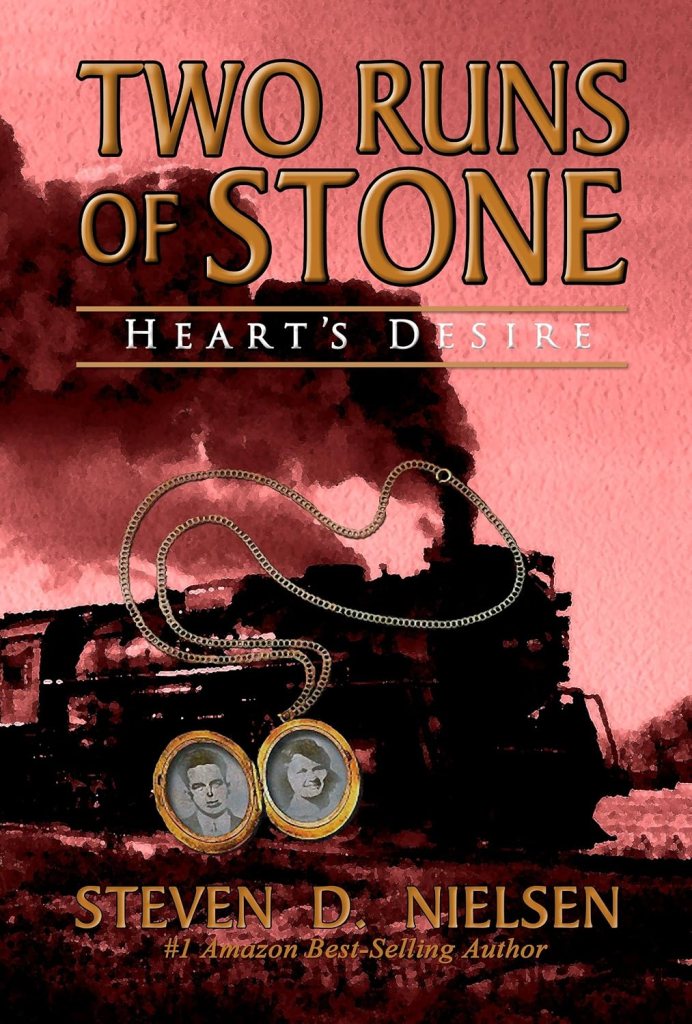
Review of “Two Runs of Stone: Heart’s Desire” by Steven D. Nielsen

A Realistic View of Plural Marriage

As the 3rd book in this saga begins, the main characters are preparing to leave their temporary homes in Wyoming City and head for their final destination in Utah. There are three plot lines that follow the main characters we met in the 1st book, who are on separate journeys in the New World, some of which was covered in the 2nd book.

While they prepare for their long journey via covered wagons and handcarts, the author also provides an intimate look into how members of The Church of Jesus Christ of Latter-Day Saints dealt with the issue of plural marriage. This is probably the main issue that most people have heard about with regard to the Mormon Church, a practice which has since been discontinued.

There were various reasons for instituting this practice, with which most are familiar from the Old Testament. At this time in the mid-19th Century scores of men had died in various ways from attacks and accidents to diseases, leaving a vast number of widows and children who needed protection from the many hazards and brutal life style at that time. The story provides a realistic glimpse into how the people felt about it, which naturally varies with each individual involved in the practice as well as the persecution they endured because of it. As pointed out in the book, immorality is tolerated while a practice that involves commitment and sacrifice on the part of all involved is frowned upon. What’s wrong with this picture?

Their hardships continue as they prepare for this final leg of their journey, again providing fascinating details of life at that time. Readers are immersed in everyday life with the characters that by now feel like their own family.

You can get a copy in the format of your choice here.

A Magnificent Historical Novel

Version 1.0.0

Review of “Two Runs of Stone: A Beckoning Call” by Steven D. Nielsen

I was gifted a copy of this amazing book many years ago and it sat on my shelf until recently when I came across it again. Oddly enough, I’m actually glad that it took me so long to read it. Had I read it when I received it I would not have appreciated it nearly as much as I do now.

Since that time I became an author myself who has written 8 novels and two nonfiction books. Thus, being familiar with the work involved in the creative and publishing process I can admire this magnificent story even more.

The author did an exceptional job crafting living, breathing characters, and placing the reader into 19th Century Denmark. The imagery was astounding and interwoven with the story in such a skillful manner that every scene comes alive. The necklace was a beautiful symbol on so many levels.

The book itself is a work of art. I’m disappointed that there is no mention of who did the gorgeous artwork or designed the cover  on this 2003 hardback, which is a perfect complement to the story within. The notes included for each section enrich the story with historical facts that contribute to the overall context.

This is truly a masterful work. I learned so much about Denmark, its history, people and struggles. Shortly after completing this story I came upon a beautiful flower-studded picture of a windmill. I beheld it for several minutes, having a new appreciation for the structure’s complexity and essential function. I’m also grateful that since I read this book years later that there are now several volumes that continue this gripping saga.

My criteria for an outstanding book is for it to make me laugh, cry, learn something, and see something in a new way. This book checked all the boxes. As an author and editor myself, however, there was one thing I found that kept this novel from absolute perfection. The copy editing was remiss in several areas regarding proper punctuation, especially for dialog, as well as a few minor typos. This spectacular story deserved better.

You can get a copy in any format you prefer on Amazon here.