Writing Tip: Irony

It’s been a while since I posted a writing tip and one came to me the other day that has a bit of history behind it. Many years ago, when I took a “Writing Short Stories” class in college, the professor was giving me A’s but told me repeatedly that they were not, by definition, short stories.

Now that I look back, how negligent was he as the professor for that class not to define what constituted a short story on day one? Duh!

Kind of like how many grammar rules did you actually learn, much less understand, in high school or even college English classes? All I remember is diagramming sentences and making mistakes I didn’t understand. I have no love lost for the English and math teachers I had over the years. Now I’m an award-winning author and a physicist who worked for NASA for 21 years with no thanks to any of them! These were things I eventually figured out myself.

Like “What exactly is irony?” several decades later.

Am I that dense or are teachers seldom capable of teaching a subject? At this point in my life, I’m sure they’ve all passed on so if I were so inclined I’d list their names, but I don’t remember them. Ironic? Maybe. But right there, that tells you how impressed I was. My memories of high school in particular are not complimentary for my teachers, believe me.

So back to the short story class and my point for this “Tip du Jour.” I asked the professor why they weren’t short stories. He said that they were “slices of life” but not short stories because they lacked irony. So, next I asked the $64,000 dollar question: “What is irony?”

He couldn’t define it!

I think he may have referred me to a few classics that had it, but I still didn’t get it. Here I am, many years later when I’ve written 8 novels, accumulated several awards, and I’m just now figuring it out.

Is that more irony?

And I must say, I’ve wondered about it for more years than I care to count until the other day it came to be like a blast out of the blue.

Irony is when something you’ve put a lot of effort into turns out to be very wrong.

More irony that the English professor teaching a short story class couldn’t tell me what irony was. Also ironic is the fact that throughout that class I got an A on every assignment and an A in the class, yet never wrote a short story.

Once I had that epiphany, my memory flooded with examples. The biggest one that came to mind was back in the 70s, when I wanted to buy my aging parents a garage door opener for Christmas. I don’t remember why, but it probably related to them complaining about opening the heavy garage door by hand in freezing Utah winter weather.

We didn’t have much money and had a bunch of kids to buy for, so it was a challenge how to afford it. I saw an ad in the paper that some guy was buying up silver. I had some old sterling silver candlesticks, silverware, and so forth, that no one wanted. Long story short, I cashed it in and got enough for the garage door opener. (Of course, I’d give blood and pay money to have them back at today’s silver spot price which is probably at least ten times more than it was then.)

The irony of the story?

They weren’t happy!

At least my father wasn’t. He didn’t want to go to the trouble of installing it or hiring someone to do it. After all the effort I put into getting it for them and being very excited, thinking they’d love it, that was a real downer I remember to this day.

If I’d understood what irony was, I would have written that up as a short story, which would have actually fit the definition! And if that prof had given me a concise definition I could understand, I probably would have.

So here’s a note to any teachers reading this and probably shaking their head at my ignorance: Not all students can learn by assimilation. A clear definition is essential to understanding! What’s intuitively obvious to you is not to someone learning a subject for the first time! Even Einstein said if you can’t explain something to a kid in kindergarten, then you really don’t understand it yourself!

So now you know what constitutes a “short story.” In many cases, those stories you’re putting together for your memoirs or family history are just “slices of life.”

Does it matter? Absolutely not. Unless you have a professor who isn’t as generous as mine was if your short story doesn’t fit the definition.

P.S. As an astrologer, I’ll add that you’re lining yourself up for some irony if you buy anything electronic or mechanical during Mercury retrograde. Mars retrograde is similar, but in that case, it will probably function properly, but you’ll realize at some point it was a waste of money because you really don’t need it, your regret proportional to how much you paid for it.
A Jolting and Thought-Provoking Finale

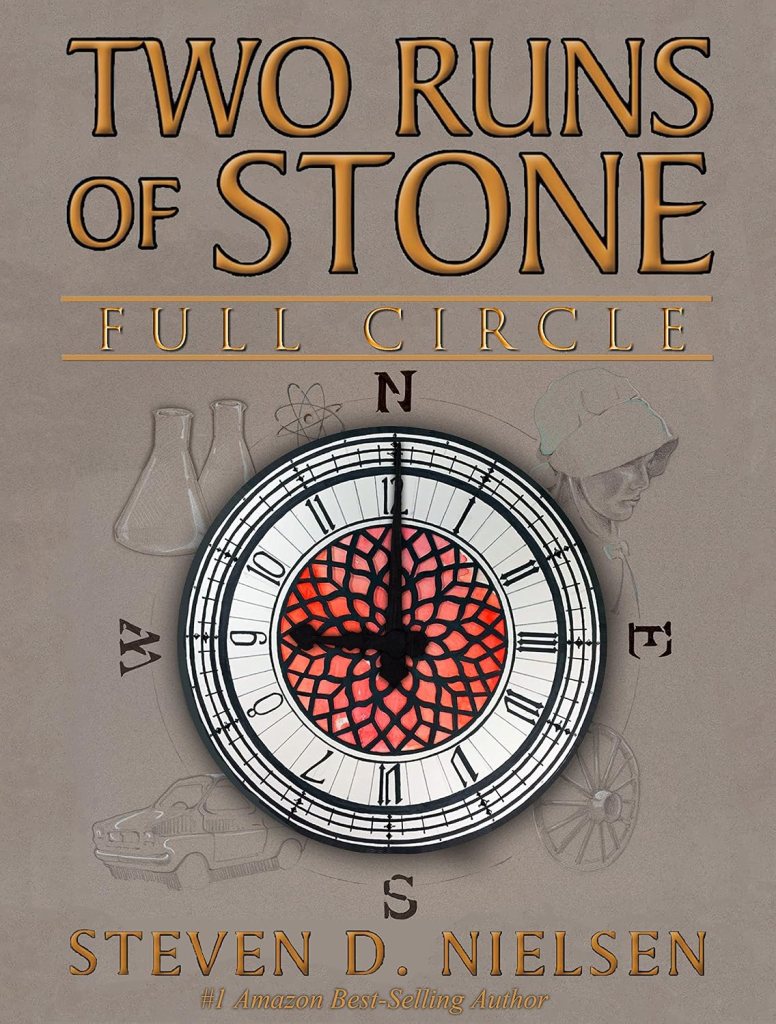
Review of “Two Runs of Stone: Full Circle” (Book 5 of the saga)

By the time I finished the fifth book in this saga I felt as if I’d traveled along with the characters who’d endured a series of remarkable and often traumatic experiences living in the 19th Century. It included history and cultural lessons that had me hooked from the start.

The final chapter of the first section would have been more suitably labeled an epilogue since it summarized several events that followed and segued into the section section. The ending of the 19th Century portion was abrupt as well as shocking. Having read the previous four books, I could see it coming, but I didn’t like it. To explain would constitute spoilers so I’ll leave it at that.

The shift into the 20th Century to descendants of the original characters and the development of Cache Valley, Utah where they settled felt like the culture shock a time-traveler would experience jumping forward in time. Nonetheless, it was an important part to wrap up the saga. Anyone who hasn’t read the previous books would not appreciate it.

It amazed me how familiar I was with story locations, especially Cache Valley, Utah. I lived there from 1973-1988, which included some of the timeline in the story. The fictitious city, Torrent, was undoubtedly Logan. I’ve driven through Sardine Canyon and I remember times it was closed due to snow. Surnames of some of the characters were prominent there, e.g. Bingham and Wangsgaard. I smiled at mention of Strasbourg, France, which is where my grandfather was born and I visited in 2004.

It was almost eerie, how much in these books resonated in one way or another with my own experience.

Our ancestors were real people who are often forgotten. The foundation they built for us is taken for granted, as are the sacrifices they made so our lives would be better. Peter Jensen was the great-grandfather of the modern character. The razing of the house and mill were particularly touching, showing how nothing lasts forever and what constituted the life’s work of someone is easily dismissed generations later.

I am the great-grandmother to 16 children, some of whom I may never meet since they live in other states. Will they have any idea who I am? Know anything about me? Even know my name? Can you name your great-grandparents?  All four sets of them?

The saga left me feeling melancholy towards life and how quickly it passes. It seemed as if the modern-day section dragged a bit. Having read the previous four books, I knew what was likely to happen. Yet it was necessary to explain the descendants’ dire situation in sufficient detail to identify with them and appreciate the dramatic ending.

The author is a gifted storyteller and I loved these books, which had me so engaged that I read all five in under three weeks. I especially enjoyed the “Section Notes” that gave more historical and source information.

That said, I have one overall criticism: They desperately needed a competent editor! There were so many examples of using homonyms incorrectly (example, rein vs. reign; alter vs. altar; whetted vs. wetted, fowl vs. foul, etc. as well as the wrong word, i.e., continence vs. countenance) that I lost count. Dialog was seldom (if ever) punctuated correctly. In a less-gripping story I would have never finished reading a book, much less books, with so many editorial issues.

The typo “blood tasting facilities” vs. “testing” made me laugh out loud. A few characters changed names, which made my head spin. Krista’s daughter was Anna Katrina in the other books and became Anna Sophia while Elizabeth Anne’s son was August Peter Jensen in book 4 and became August Charles in book 5.

I know as an author of a science fiction tetralogy as well as a cross-cultural thriller trilogy that maintaining consistency is a challenge. But such things are often caught by beta readers, proofreaders, and should definitely be corrected by a competent editor.

Since I read the entire series so quickly the 5 books all ran together, which facilitated catching such discrepancies. I understand how such things can happen plus this probably stood out more for me than the average reader. Nonetheless, this wonderful saga deserved better. It’s on a short list of stories that I will remember for a long time and recommend highly, though I feel inclined to apologize for the poor editing.

[NOTE:–Book Four, “Wagons West,” as well as this one had numerous hostile encounters with Indians. I’m acutely aware of the other side of the story having written “The Curse of Dead Horse Canyon” saga with a Northern Cheyenne coauthor. Native Americans had their land stolen and somehow survived an attempt at genocide. Is it any wonder they attacked those taking possession of it?]

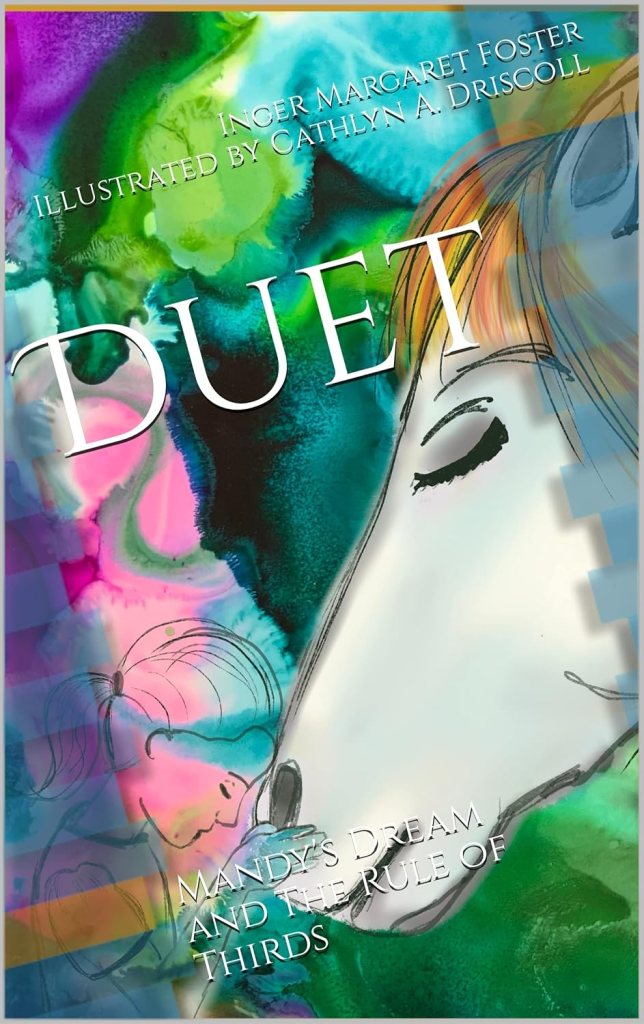
“Duet” by Inger Margaret Foster

Another wonderful story from the lovable characters in Beauville, NY. I love the ongoing characters like Meg and Mary, then folks cross their path and add another touching story to the series.

This book is actually two combined, “Mandy’s Dream,” and “The Rule of Thirds.” Warning, both are tearjerkers and so very touching! “Mandy’s Dream” is the story of Meg and a new character, Jessica, who’s a gifted young artist, helping a young girl named Mandy who has been mute since both her parents died in a horrible accident. Spending time with the girl and introducing her to expressing her feelings through art plus interacting with a special horse helped the girl to heal from her trauma. In the story they write a book for Mandy to express her feelings which is included with beautiful artwork and also sold separately for young children dealing with grief. Beautifully done on both literary and illustration levels.

“The Rule of Thirds” title relates to art design, yet in this story ties in how often a group of three has meaning in our lives. In this story, Jessica’s journey as an artist continues as well as a surprising and exciting development in her life. Saying anything else would be a spoiler so I’ll leave it at that.

I love this series and highly recommend it. While the main characters are high school age living back in the 70s, their situations are apropos regardless of the decade. The author has a gift for creating warm, relatable characters and touching situations most will encounter at some point in their life. I would have loved these books as a teen and do today as a great-grandmother. Highly recommended.

I’m extremely excited that “Elke’s Magic” in this series is a screenplay that is in pre-production! I can’t wait to see it on TV someday!

You can pick up your copy of “Duet” on Amazon here and available thru Kindle Unlimited.

Historical Fiction at its Best

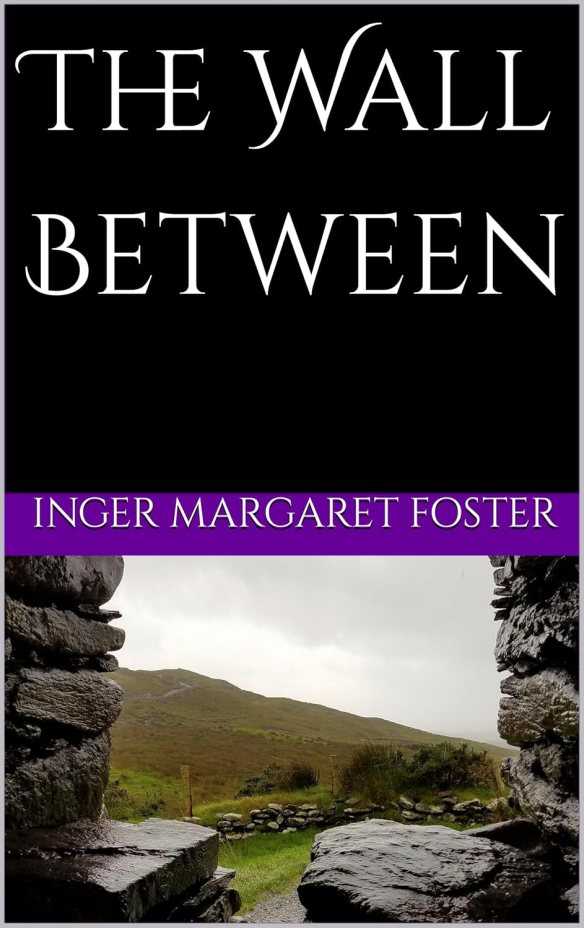
Cover of  the book "The Wall Between"

Review of “The Wall Between” by Inger Margaret Foster

My binge marathon on Inger Margaret Foster’s books continues!

The point of historical fiction is to take you to some time in the past and live it. This story definitely does that and more! I’m old enough to remember much of what went on back in the 70s. I also remember when President Ronald Reagan told Gorbachev to tear down the Berlin wall. But never did it have the impact as it did in this amazing tale of a couple separated by it and the horrible policies that were in place when East and West Berlin were separated.

That was the situation at the end of WWII when Communist Russia got East Germany and the allies got West Germany. What it required to cross from one side to the other was solid identification, then being escorted by an armed guard who kept his eye on his watch to make sure the meeting didn’t go longer than it was supposed to.

I’m glad that I read “Elke’s Magic” first, though it’s not required. Nonetheless, it gives you a glimpse of the situation and you get to know the main character. You can also understand why Elke missed her idyllic little cottage back in the States. When she was washing dishes in her humble apartment in West Berlin and remembering the dried herbs hanging above her sink in her little house I could so totally relate! When I lived in Texas I was able to grow a multitude of fresh herbs that I dried in the house, just like that. I hope to be able to do so again, maybe next year, though some won’t survive where I live now in New York State, where it’s so much colder.

I absolutely loved this story and it touched me deeply. I read it in a single sitting, unable to put it down. Highly recommended to understand what the people in Germany went through during those dark and trying years.

You can get your copy on Amazon here, for free if you subscribe to Kindle Unlimited.

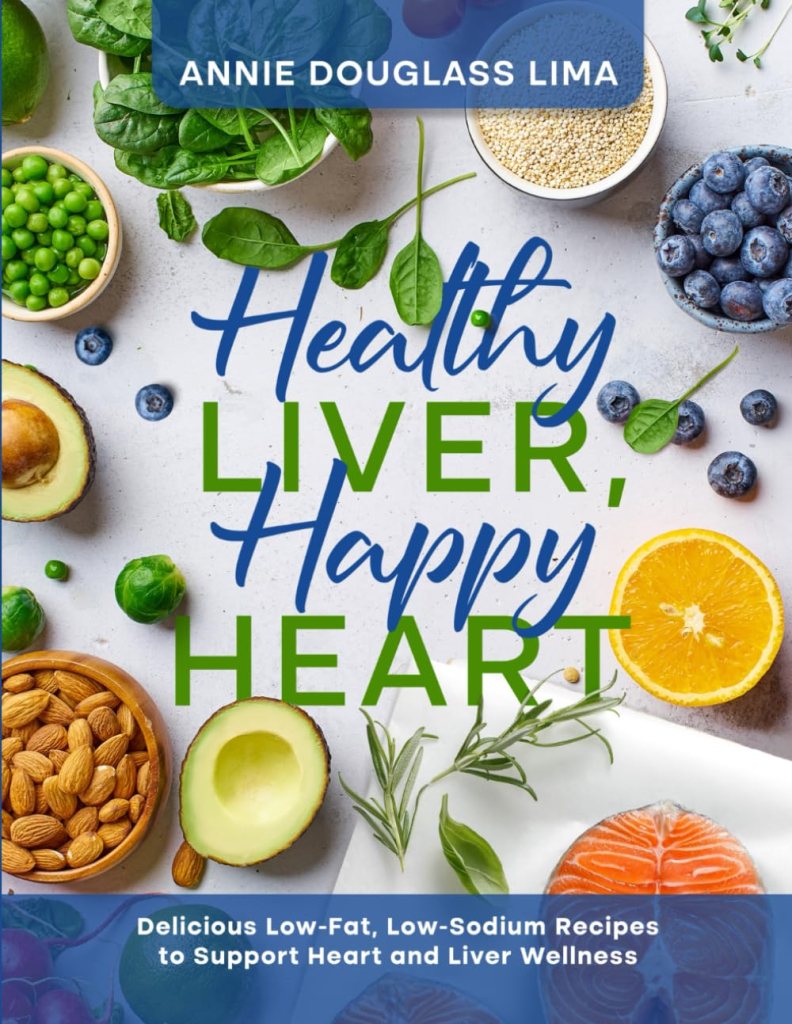
Review of “Healthy Liver, Happy Heart” Cookbook by Annie Douglass Lima

I don’t usually review cookbooks, as you’ve probably noticed, but I was provided a free pdf of this one in return for an honest review.

I found this to be an excellent cookbook loaded with interesting and healthy recipes as well as basic nutritional information. My favorite is the avocado chicken salad. To save time, I sometimes use canned chicken. I’m looking forward to trying several more, but will have to stock up on some things that I don’t normally have on hand in the pantry.

If you’re used to the usual ingredients in most recipes, you’re likely to encounter a few things you’ve never heard of in this book. This is a good thing, since the entire point of the book is to eat healthy. When I first reviewed this book it didn’t include any introductions to these less-common ingredients, but since I pointed out the need for them Annie has added a section to do just that! This will be helpful to anyone who has no clue what some of them are or has not used them before.

For example, you may not have ever heard of or used quinoa (pronounced keen-wah). I loved the use of maple syrup as a sweetener in many of the recipes. Make sure that it’s authentic maple syrup, and not the artificially flavored version typically found in grocery stores. That would be entirely counter-productive as far as health is concerned.

If your grocery store doesn’t carry some of these more unusual items, check online. And it goes without saying that organic is best. It probably would have been helpful to include a list of unhealthy things lurking in your pantry that you should throw away, too. The typical American diet is horribly unhealthy between processed food and all the chemical additives, which is why there are so many chronic diseases these days. Changing your eating habits isn’t easy, but this book can be a tremendous help for finding healthy alternatives.

If you’re already familiar with this type of healthy cooking-from-scratch then you’ll love these creative, delicious, recipes and the wonderful variety along with several mouth-watering illustrations. We can all get stuck in what we eat and you never know if your favorite recipe may be right there, just waiting for you to give it a try. Just be sure to plan ahead and make sure you have everything you need on-hand to avoid last-minute trips to the grocery store in the height of commuter traffic.

You can pick up a copy in ebook, paperback, or hardback formats on Amazon and various other online vendors such as Barnes and Noble, Kobo, BookBub, Google Play, and Apple.

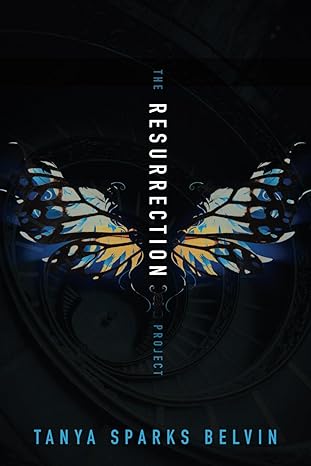
Review of “The Resurrection Project” by Tanya Sparks Belvin

[NOTE:–I tried to post the following review to Amazon and it was rejected. I’m not entirely sure why, but I suspect the first paragraph was verboten, which figures, right? I edited it down significantly and they posted it, but here are my original comments.]

This story stands out as a chilling cautionary tale. While it’s set in 2034, don’t think it’s not already happening. Our reverence for life is seriously compromised as demonstrated by the ongoing abortion issue. At what point does human life begin? Conception? Or with that first breath at birth? What about those laws that have legitimized infanticide? Promote euthanasia? Where is society headed? We are being dehumanized, starting with the most vulnerable members.

It’s difficult to write a review of this story without spoilers. If you’re really paying attention through the first few chapters, it’s possible to figure out what’s going on as people disappear. The story slowly and methodically reveals the horrific truth through the viewpoints of the three main characters.

The premise reminds me of medical thrillers I read years ago by Robin Cook. Suspense author Mary Higgins Clark was another one who worked with such themes. This book lacked that kind of nail-biting suspense. It was written in a very journalistic style that failed to render emotional reactions in the reader. At least that was the case for me. I could tell where it was going, especially after the blatant revelation provided by the android, Daisy, in the middle of the story. If you haven’t figured it out by then, there it is.

This thought-provoking book deserves a lot of attention for its potential to wake people up, if nothing else. Being directed at Christians is somewhat ironic since they aren’t the ones who need to be jolted awake to the evils in the world around them. It would definitely be in the “medical thriller” category if the emotional impact and suspense were ramped up a bit.

Actually, if written to its full emotional potential, this book would be in the horror genre. Since this is the author’s debut novel, I assume she has not yet acquired the writing skills to render an emotional reaction in her readers. (This is normal except for incredibly gifted writers. I didn’t figure it out until around the time I was writing my 6th novel.) This is not a criticism since in this case, it’s a good thing. As it’s written, more people will choose to read it and make it through the book. Rest assured that it does have what can be considered a happy ending, plus incentive to read the sequel.

For what it’s worth, if a book makes me cry and laugh, I’m more impressed. There are a lot of good premises and stories out there that fall short on their emotional impact, which is the element that tends to hook readers and convince me the author knows how to write.

On the editorial side, I think the scriptural quotes were a bit overdone. Not that I don’t agree with them and I understand the underlying Christian message. However, I don’t think their inclusion will convert anyone to Christianity, while conversely, such excessive use could feel “preachy” and be a turnoff for the very people who need to read it. The fellow Christians I’ve been around usually don’t quote the book, chapter and verse, just the content.

The book is beautifully formatted and the cover is great. The editing is well-done regarding misspellings, grammar, typos, etc. Only one thing jumped out that her editor missed: Near the bottom of page 249 of the paperback it says, “There’s no way I’m not going to let that happen.”

Huh?

The way I read it, the double negative conflicted with the statement’s intent. There were a few other things but I may be the only person in a thousand who would notice, so I won’t even mention them all, but if I’d been a beta reader I definitely would have. I guess the biggest one I wondered about as a science fiction author is that I suspect by the year 2034 we won’t be using much paper, but who knows?

I gave this book 4-stars. For a debut novel, she did a pretty good job. It’s worth a read for its very important message of where we might be heading. Heaven help us if it turns out to be prophetic.

You can get a copy on Amazon here.

Cosmic Wisdom–Literally!

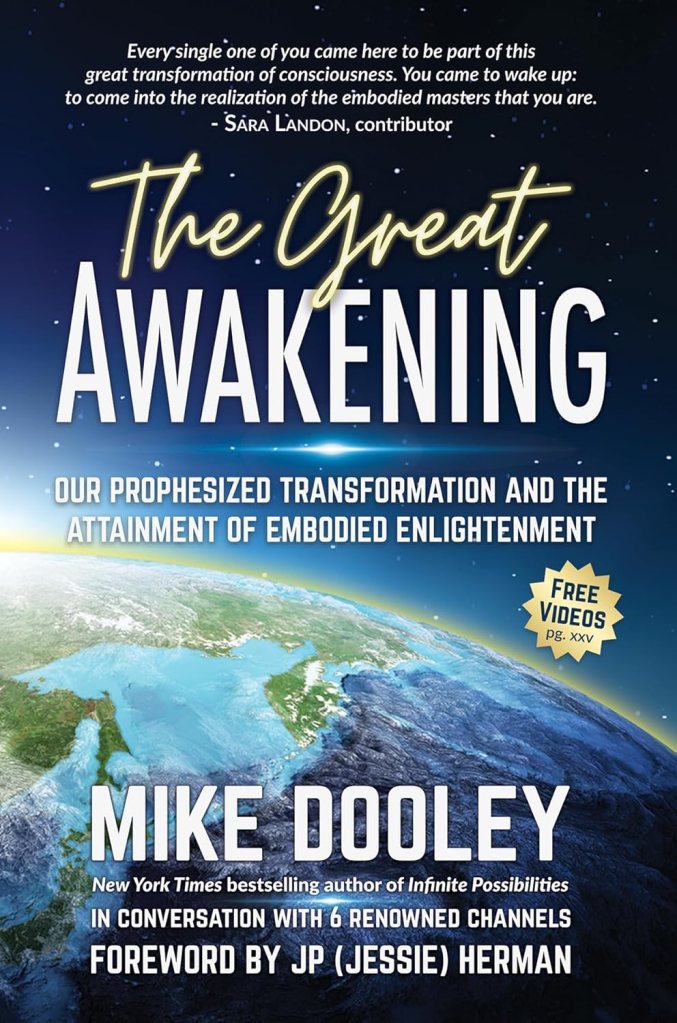
Review of “The Great Awakening: Our prophesized Transformation and the Attainment of Embodied Enlightenment” compiled by Mike Dooley.

This fascinating book comprises six messages received from cosmic sources. These were channeled by individuals who have published similar information in the past, i.e. Darryl Anka, Lyssa Royal Holt, Matt Kahn, Salvatore Rachelle, Sara Landon, and Daniel Scranton.

Not your typical book.

If you’re familiar with Mike Dooley and his “Thoughts become things: Choose the good ones” mantra, then this is what is best described as the “graduate level” course. If you’re new to the concept of manifesting your desires, then this is likely to be over your head. So much so, it will read like fantasy.

One of my favorites comes from the section channeled by Sara Landon: “Reality moves through you, and as you raise your consciousness and vibration your destiny comes to you. That which is in your highest good, that which is your highest purpose, that which is your highest potential, and that which is your highest joy will present itself to  you, because you are no longer imposing an experience of separation on your reality.”

While I’ve read similar material before, this one stood out for its timeliness as the world is clearly undergoing change. How to maintain stability when there appears to be nothing but dissention and chaos is a theme many struggle with.

What struck me in a new way was the concept of different dimensions. We determine which one we’re in by our own thoughts and actions. In spite of appearances, we do not all live in the same world. Think about that for a moment and its implications.

One observation I made years ago was that no matter how bad things appeared to be on this planet, some people were thriving. Some were exploiting the chaos in a despicable way, while others were simply living their life and doing well.

Like they say, “Birds of a Feather Flock Together.” In other words, we attract other people into our lives through our thoughts and actions. This applies to our circumstances, too. In effect, we can be living in a different vibrational frequency than those who have not yet figured out why they are on this planet and what they’re intended to learn and achieve.

Heavy stuff, indeed.

And to clarify, not to be found in your typical organized religion.

You can be “religious” without being spiritual. In astrology, religion resides in the 9th house along with other belief systems, including politics. Somehow, that doesn’t bring spirituality to mind, which lies in the 12th house along with enlightenment, dreams, and visions. A few negative things hang out there as well like hidden enemies, self-defeating behaviors, and delusions. As with every other part of life, opposing possibilities that yield to free will are everywhere.

What amazed me the most as I read, however, was the similarity between diverse belief systems that reflect the messages in this book. Whether New Age, quantum theory, or indigenous practices, there is significant overlap.

Coincidence?

Not likely.

There is no such thing as coincidence, especially when it relates to spirit.

Where are you on the path to enlightenment? It’s no longer confined to Buddhist monks, you know. This planet is changing and you can either keep pace or be lost in the chaos. If this is something new, I suggest you start with something simple, like Dooley,’s “A Beginner’s Guide to the Universe: Uncommon Ideas for Living an Unusually Happy Life.”

That will give you a foundation to build upon. Otherwise it could be like stepping into a graduate level physics class without having the math background to follow the theory.  (Been there, done that.)

Expect me to be comparing those belief systems soon from New Age to what indigenous people have believed for millennia on the blog associated with Dead-Horse-Canyon.com.

Til then, Namaste.

Bluebird Addendum: Message Received!

This morning at 6:08 a.m. the tapping on the window resumed. Mr. Bluebird has still not given up. And perhaps the reason is that it wasn’t until this morning that his true message was received, literally with the dawn.

It takes me awhile to think things through. Yesterday I was taken by his persistence. In applying that to myself, it didn’t really fit. If anything, I tend to be too driven to accomplish my goals. If anything I need to learn to chill once in awhile. Perseverance is not something I lack.

But lo and behold, at some point his message as a spirit animal came through.

He is worried about something that will never happen!

At least from the cats he sees watching from the window. He recognizes them as dangerous predators, which they can be, but the chances of them getting out to harm his family is about as close to zero as they can get.

If I have a superpower, it’s worrying about things that will never happen. While they may loom before me from time to time, truly serious issues that could end badly, somehow they always work out.

I have a few on my mind right now. Quite a few, actually.

Thank you, Mr. Bluebird, for reminding me of the waste of mental and emotional energy that worry represents. Like they say, it’s a poor use of creativity, inventing trouble that will never arrive.

It’s particularly appropriate that he’s a bluebird, which is often equated with happiness. How much of that precious commodity is negated by needless worry? The symbolism goes even deeper with the fact he literally woke me up two mornings in a row!

I can definitely be a little slow putting things together.

I hope that his nestlings remain safe. My indoor cats will definitely not be the cause of their demise. His diligence is commendable, though there are numerous other threats to their well-being, like our dogs, who are always outside, yet he ignores.

Meanwhile, I will do my best to set my current concerns aside and count my blessings. Truly there are messages all around us that we often miss, ignore, or discount.

I just hope their fledglings fly soon. That tapping on the window is starting to get pretty annoying. Especially when, from time to time, the cat lunges for the window. Is he thinking that at some point he’ll succeed in catching that bird?

Which takes me full circle back to beating a dead horse.

Hmmmm…..

One Determined Bluebird

You can learn a lot about a person, including yourself, by looking at your thumb. Yes, that side-mounted digit that enables humans and primates to do things other animals can’t. According to palmistry, the upper joint represents will and the lower joint, logic. Ideally, they’re the same size. If so, you’ll have the will to put forth the effort to see your ideas to completion.

If the top joint (will) is larger (which is the case with me), your will/determination is stronger than your ability to see things logically. What does that mean? You’re likely to be inclined to beat a dead horse.

If the lower joint prevails, you may have a plethora of great ideas but lack the will to make them happen.

Obviously, a bird does not have a thumb. However, if the bluebird attacking my window had one, clearly the top joint would prevail.

Why is he attacking my window?

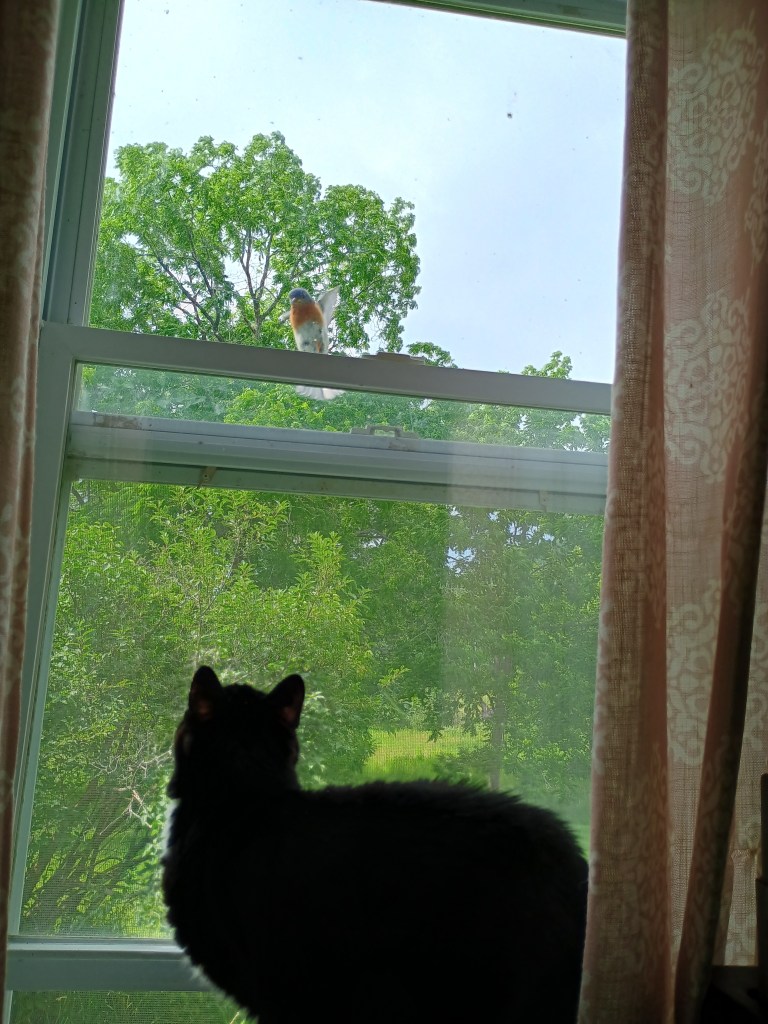
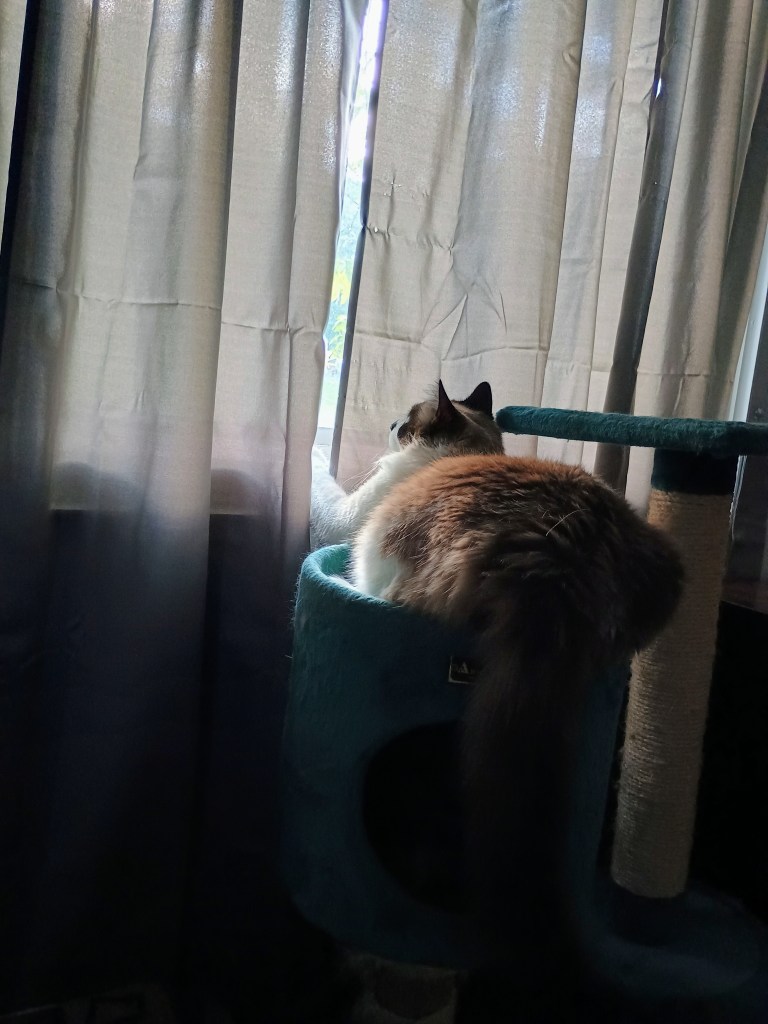
cat  inside looking at a bird outside the window

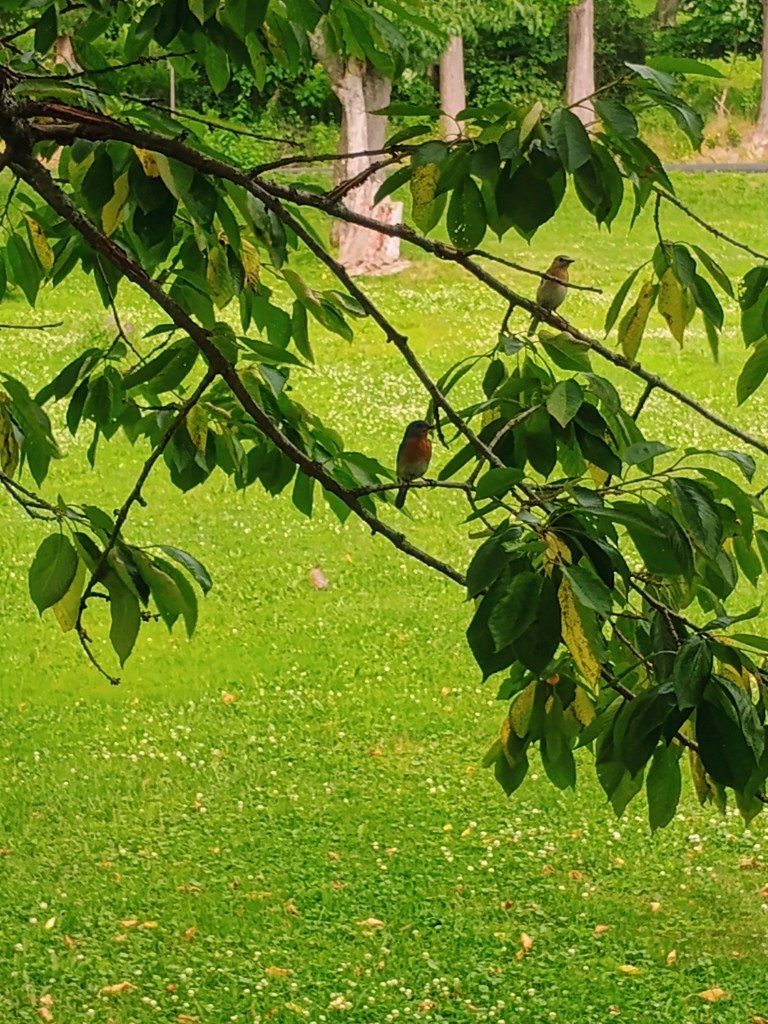
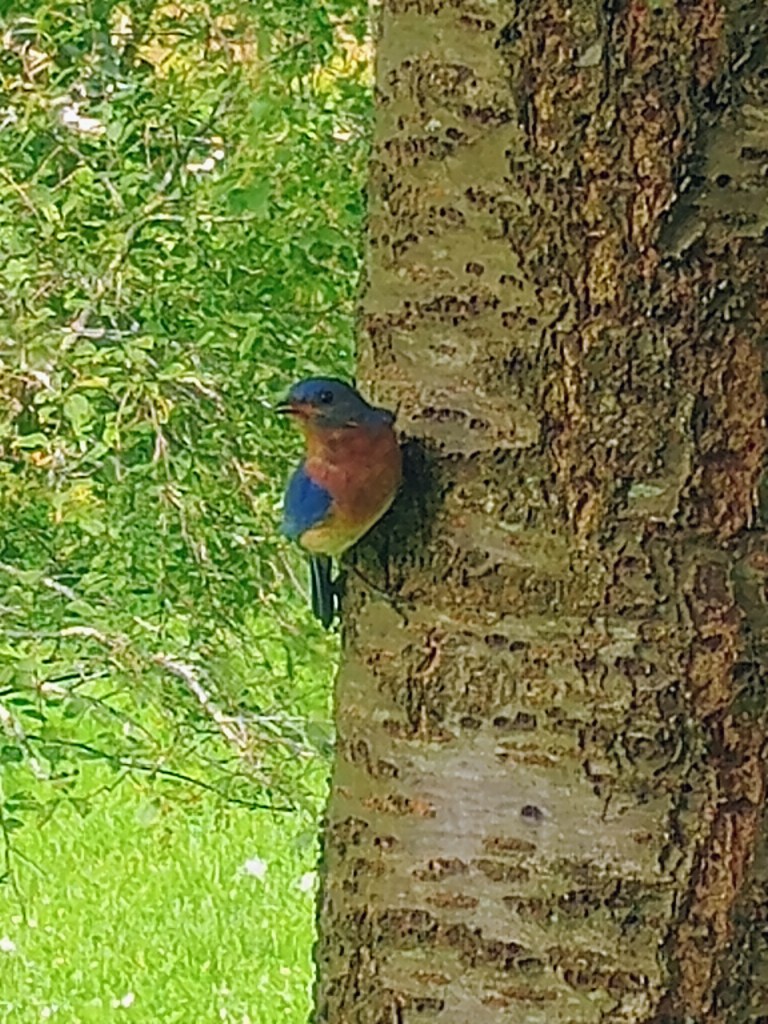
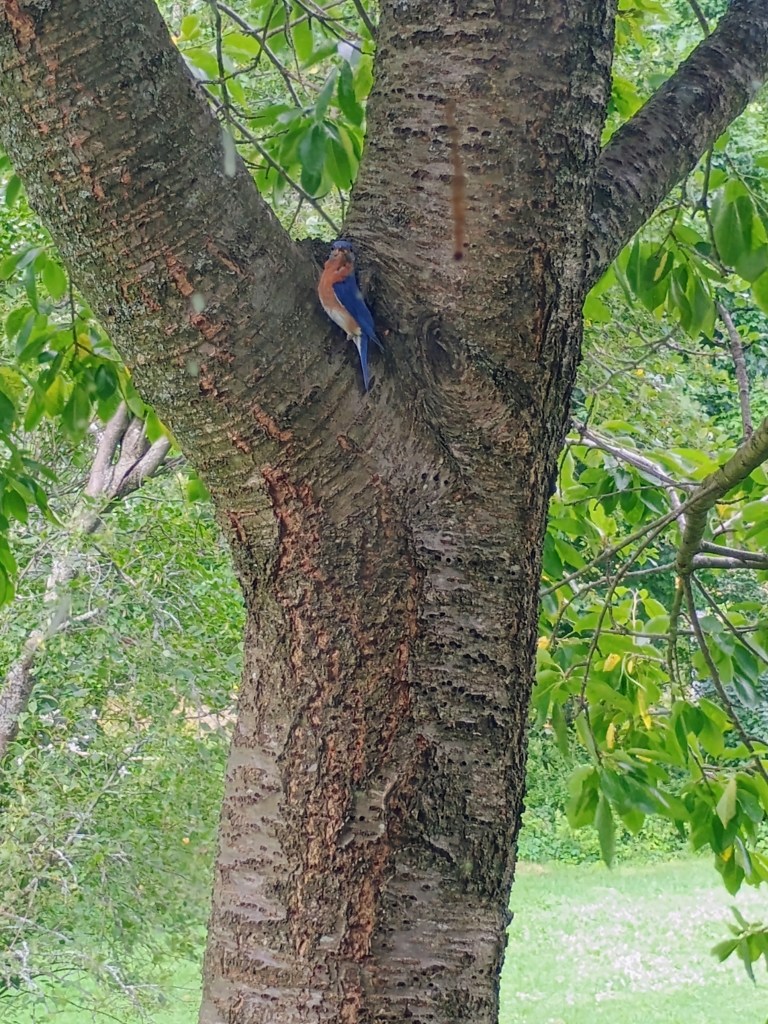
Because I have two indoor cats. Apparently, he and his mate have a nest in the purple martin house in the front yard and he’s concerned.

So let’s think about this.

As I said, the felines in question are “indoor cats.” They do not go outside. Thus, the danger does not exist.

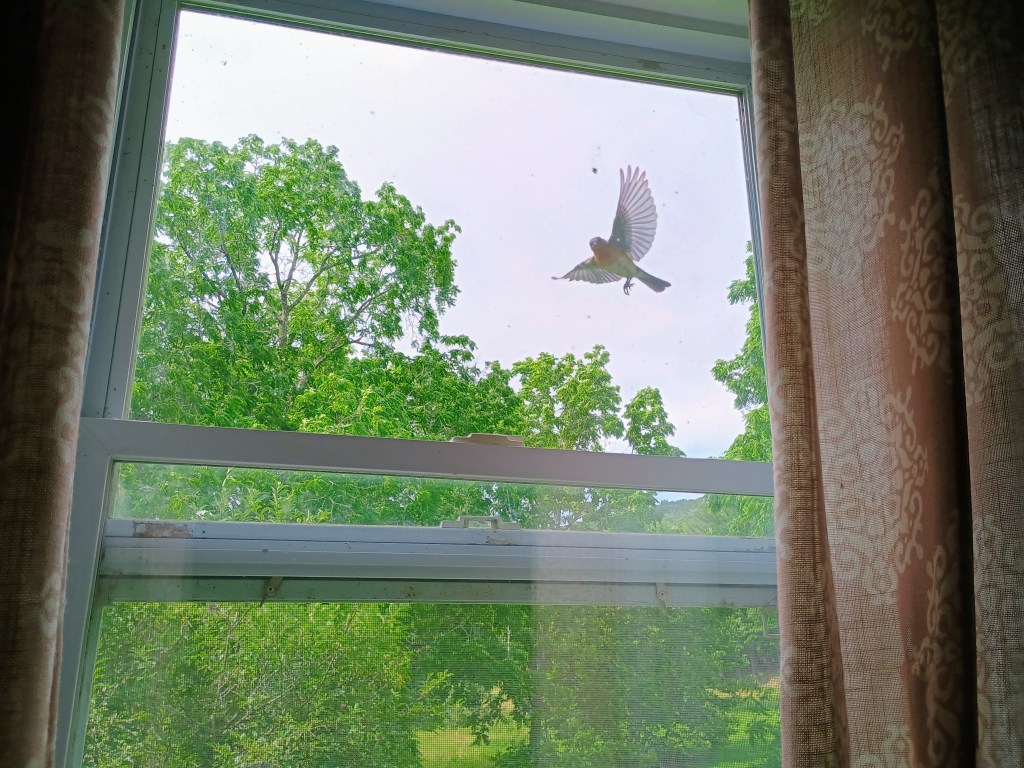
So far, this daddy bird has been attacking my windows since yesterday afternoon. After a few hours of the thumping sound of him hitting the window, I closed the curtains. He still continued until dark. First thing this morning, right around dawn (which comes early this time of year, i.e. 5:30 a.m.) he was at it again.

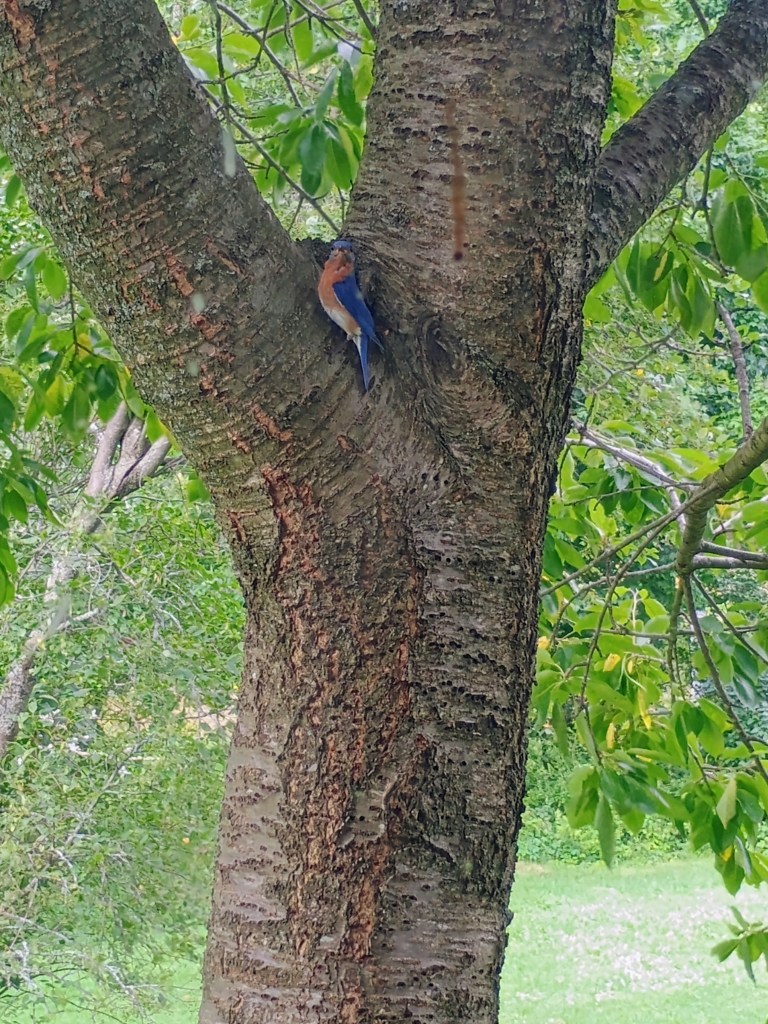
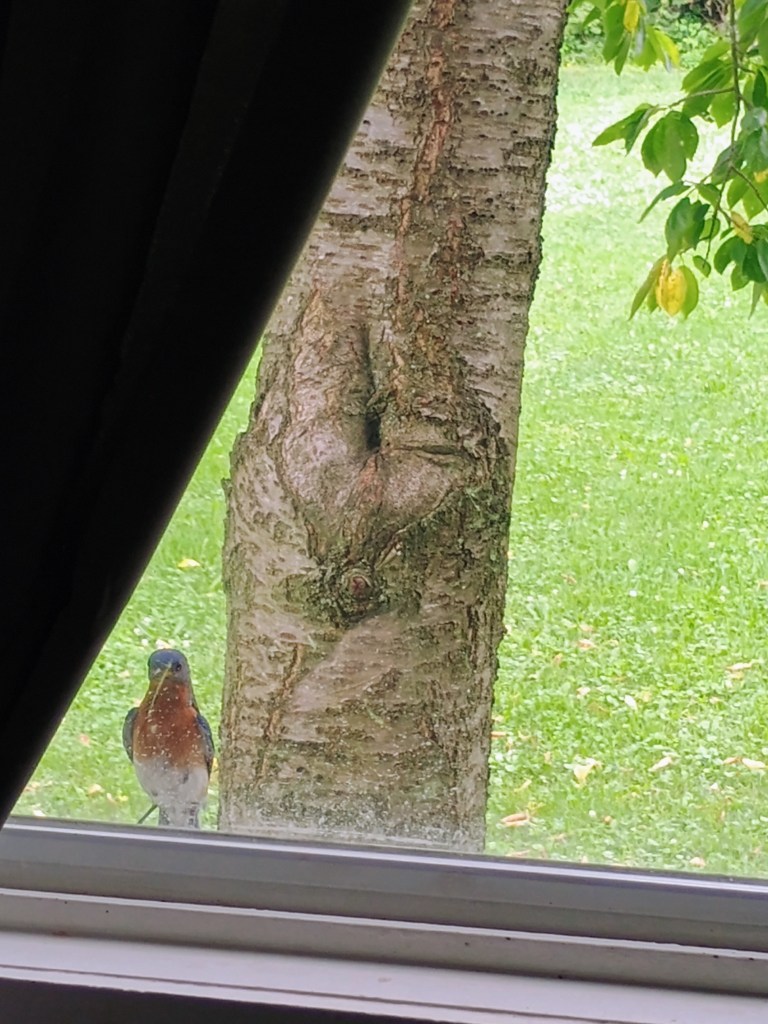
bird perched on the trunk of a tree

Thump, thump, thump.

The odds are (hopefully) very low that the cat or bird will break the window in their ongoing confrontation. If the barrier between them were removed, the cat is the definite favorite. It’s not that far to the ground, so then he’d have a definite opportunity to pursue the bird. Would the bird retreat? Or attempt to fight?

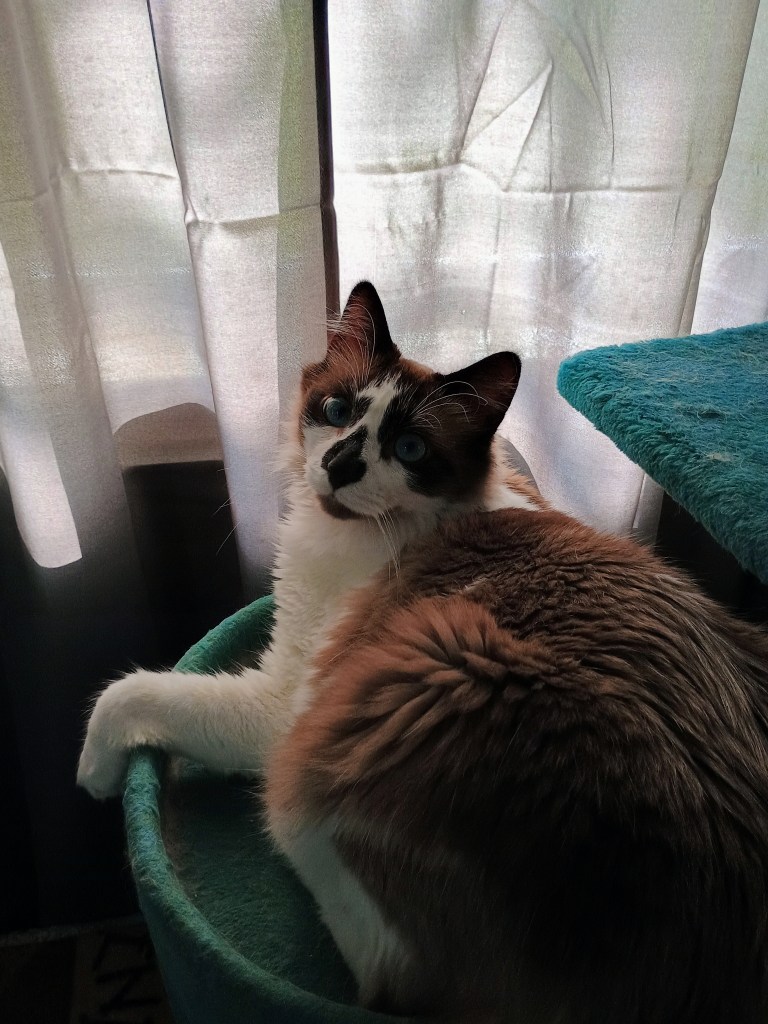
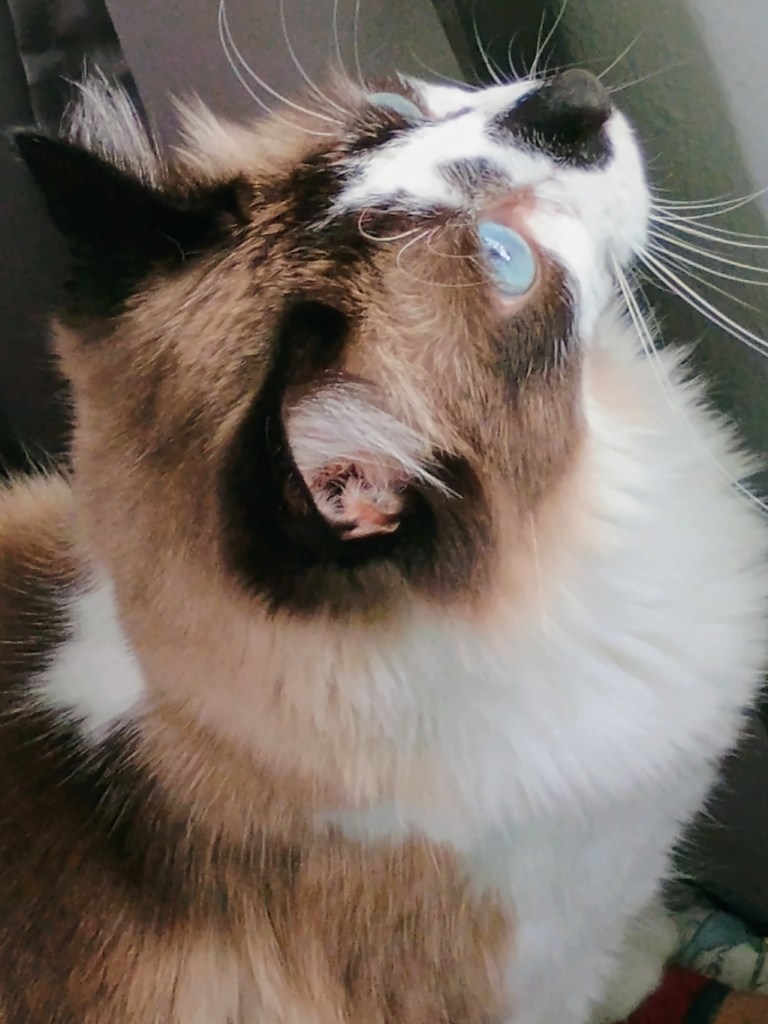
I have two cats who have entirely different views of the situation. My tuxedo cat, who is female and a very good mouser, is also around twelve years old. She found it amusing, but after awhile returned to her napping. However, my ragdoll/Maine coon male, who’s a little over a year old, is thoroughly enjoying the show.

Most the time he just lays there, watching the bird with a bemused expression. Occasionally, he’ll lunge for the window, but no telling what his expectations are.

cat looking out a window

As the assault continues I wondered: Is this bird a spirit animal with a message? While perseverance is usually a virtue, when it becomes an exercise in futility, then what? And at what point do you know it’s a battle you’ll never win? When do you know it’s time to walk away?

There are various quotes and  a couple poems that have encouraged me not to give up. The simplest is, not surprisingly, on my wall: “Never give up! Never surrender!” from the movie Galaxy Quest. Another favorite is: “Aiming for the stars and dragging your feet in the treetops is better than aiming for the treetops and dragging your feet in the mud.” (Anonymous)

Here’s my favorite poem, which has seen me through various challenges:

 Good Timber

by Douglas Malloch.

The tree that never had to fight
     For sun and sky and air and light,
But stood out in the open plain
     And always got its share of rain,
Never became a forest king
     But lived and died a scrubby thing.

The man who never had to toil
     To gain and farm his patch of soil,
Who never had to win his share
     Of sun and sky and light and air,
Never became a manly man
     But lived and died as he began.

Good timber does not grow with ease,
     The stronger wind, the stronger trees,
The further sky, the greater length,
     The more the storm, the more the strength.
By sun and cold, by rain and snow,
     In trees and men good timbers grow.

Where thickest lies the forest growth
     We find the patriarchs of both.
And they hold counsel with the stars
     Whose broken branches show the scars
Of many winds and much of strife.
     This is the common law of life.

Douglas Malloch. “Good Timber.” Family Friend Poems, https://www.familyfriendpoems.com/poem/good-timber-by-douglas-malloch

Here’s another favorite:

Keep Going

By Edgar A. Guest

same bluebird perched in the crotch of a tree

When things go wrong, as they sometimes will,
When the road you’re trudging seems all up hill,
When the funds are low and the debts are high,
And you want to smile, but you have to sigh,
When care is pressing you down a bit,
Rest if you must—but don’t you quit.

Life is queer with its twists and turns,
As every one of us sometimes learns,
And many a failure turns about
When he might have won had he stuck it out;
Don’t give up, though the pace seems slow—
You may succeed with another blow.

Often the goal is nearer than
It seems to a faint and faltering man,
Often the struggler has given up
When he might have captured the victor’s cup,
And he learned too late, when the night slipped down,
How close he was to the golden crown.

Success is failure turned inside out—
The silver tint of the clouds of doubt,
And you never can tell how close you are,
It may be near when it seems afar;
So stick to the fight when you’re hardest hit—
It’s when things seem worst that you mustn’t quit.

Edgar A. Guest. “Keep Going.” Family Friend Poems, https://www.familyfriendpoems.com/poem/keep-going-by-edgar-guest

same bluebird sitting on the windowsill looking inside.

So, given that, when do you give up?

I’m in the midst of a project that may very well be a little too similar to that determined daddy bird valiantly defending his family.

Should I give up?

If so, when? At what point have I done enough?

I have never been able to figure that out.

Let’s just say I feel better about myself beating a dead horse than quitting. I usually land in the treetops, but I’ve never wound up in the mud.

cat parting curtains with his paw to look outside

How about you?

Take a look at your thumb. Do the joints line up with your natural inclination when confronted with what could be an insurmountable challenge? Are you a tree dweller or confined to the ground?

Feel free to leave your thoughts in the comments below.

Meanwhile, I need to get back to work.

P.S. It’s been quiet outside for quite awhile. I just hope he figured it out and I don’t find a dead bluebird outside my window…

Never mind. He’s back.

Thoughts on Occam’s Razor

Stop for a moment and make a list of your daily annoyances. Now give them some thought. Can you talk yourself out of being bothered by them? Is there something you can do to eliminate them? Or are they just a part of life you have to live with?

Since merging households with my youngest daughter, her husband, and their three teens I’ve had a lot of adjustments to make after living on my own for twenty years. Like sharing a bathroom with two teenage girls. Opening a cabinet for a glass or a drawer for a fork or spoon to find them all missing since the kids are allowed to eat in their rooms.

Being a cat person more than a dog fan, their three big dogs (a Doberman, a husky, and a 50+ pound “puppy” that’s a mastiff-pittbull cross) were probably at the top of the list. Especially their propensity to get into the kitchen trash can and scatter garbage all over, taking their best finds into the living room to enjoy on the couch. 🤦‍♀️😖

If you’re not familiar with what Occam’s razor is, here’s what googling it says:

Occam’s Razor is a problem-solving principle that suggests, when presented with competing hypotheses, the one with the fewest assumptions should be selected. It essentially favors simpler explanations over more complex ones, when both explain the same phenomenon equally well. The principle is often summarized as “the simplest solution is usually the best”. 

“Here’s a more detailed explanation:

“Parsimony: Occam’s Razor is also known as the “law of parsimony“. Parsimony, in this context, means being economical or frugal with assumptions.”

Dealing with my various frustrations was generally pretty simple, once I sat down and did some basic problem solving. The bathroom issue “is what it is” and can’t be changed. Solution: Get over it.

The glass and silverware situation won’t go away until the kids move out, which will be awhile. The solution: Keep what I need in my room.

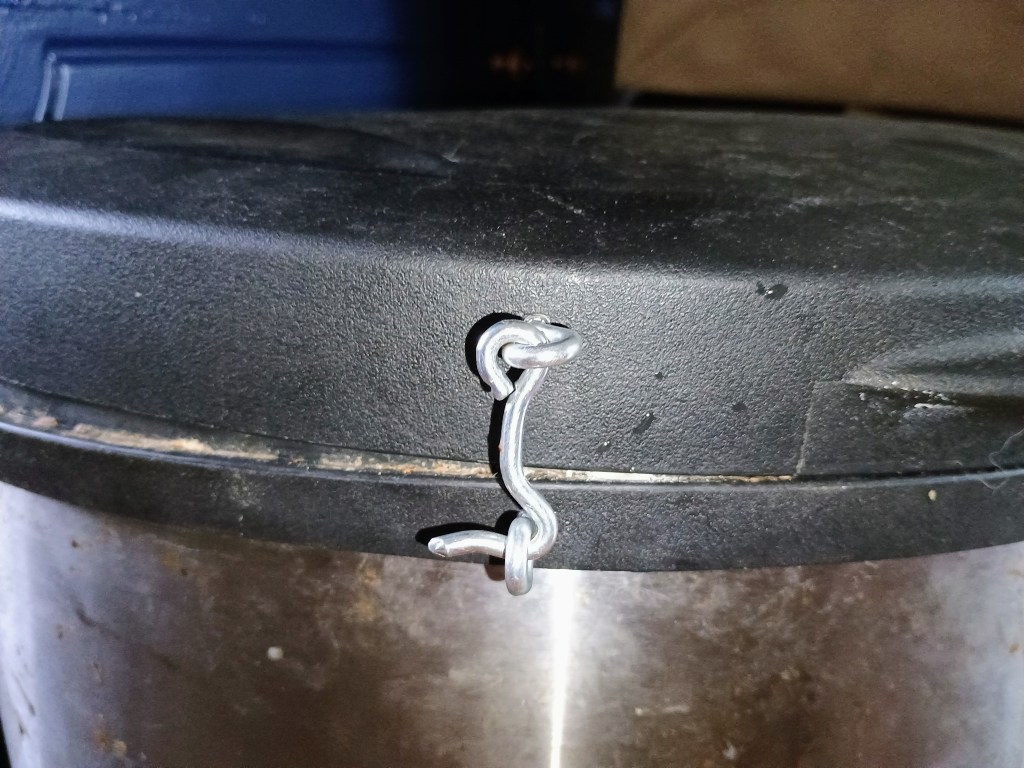
The dogs getting in the trash issue went on for a long time. Our usual solution was to place an empty cardboard box on top between the lid and overhang of the kitchen island. The problem with that was that often the box was not in place, plus one of the dogs (the husky) learned to push it aside.

The situation was actually solved by my daughter, who works in a hardware store. For pocket change, she brought home a metal hook and eye and installed it on the trash can.

Problem solved.

So what’s my point?

There is plenty to get spun up about these days. The world is pretty crazy, and as an astrologer, I can see what’s going on out there in the cosmos and that it’s not going to change any time soon. In other words, much of what may get you spun up is entirely out of your control.

How much of what’s going on out there really affects your daily life? Does it really matter?

Even if it does, there isn’t much you can do about it.

Thus, it’s a good idea to take care of those things that you can.

For example, if your daily commute is a nightmare, try listening to music your love, your favorite podcasts, or something else you enjoy to upgrade the value of time spent in a situation you can’t control.

Decide what matters and what doesn’t. Take control of what you can. This crazy planet isn’t going to get better anytime soon.

Namaste.