Writing Tip: Irony

It’s been a while since I posted a writing tip and one came to me the other day that has a bit of history behind it. Many years ago, when I took a “Writing Short Stories” class in college, the professor was giving me A’s but told me repeatedly that they were not, by definition, short stories.

Now that I look back, how negligent was he as the professor for that class not to define what constituted a short story on day one? Duh!

Kind of like how many grammar rules did you actually learn, much less understand, in high school or even college English classes? All I remember is diagramming sentences and making mistakes I didn’t understand. I have no love lost for the English and math teachers I had over the years. Now I’m an award-winning author and a physicist who worked for NASA for 21 years with no thanks to any of them! These were things I eventually figured out myself.

Like “What exactly is irony?” several decades later.

Am I that dense or are teachers seldom capable of teaching a subject? At this point in my life, I’m sure they’ve all passed on so if I were so inclined I’d list their names, but I don’t remember them. Ironic? Maybe. But right there, that tells you how impressed I was. My memories of high school in particular are not complimentary for my teachers, believe me.

So back to the short story class and my point for this “Tip du Jour.” I asked the professor why they weren’t short stories. He said that they were “slices of life” but not short stories because they lacked irony. So, next I asked the $64,000 dollar question: “What is irony?”

He couldn’t define it!

I think he may have referred me to a few classics that had it, but I still didn’t get it. Here I am, many years later when I’ve written 8 novels, accumulated several awards, and I’m just now figuring it out.

Is that more irony?

And I must say, I’ve wondered about it for more years than I care to count until the other day it came to be like a blast out of the blue.

Irony is when something you’ve put a lot of effort into turns out to be very wrong.

More irony that the English professor teaching a short story class couldn’t tell me what irony was. Also ironic is the fact that throughout that class I got an A on every assignment and an A in the class, yet never wrote a short story.

Once I had that epiphany, my memory flooded with examples. The biggest one that came to mind was back in the 70s, when I wanted to buy my aging parents a garage door opener for Christmas. I don’t remember why, but it probably related to them complaining about opening the heavy garage door by hand in freezing Utah winter weather.

We didn’t have much money and had a bunch of kids to buy for, so it was a challenge how to afford it. I saw an ad in the paper that some guy was buying up silver. I had some old sterling silver candlesticks, silverware, and so forth, that no one wanted. Long story short, I cashed it in and got enough for the garage door opener. (Of course, I’d give blood and pay money to have them back at today’s silver spot price which is probably at least ten times more than it was then.)

The irony of the story?

They weren’t happy!

At least my father wasn’t. He didn’t want to go to the trouble of installing it or hiring someone to do it. After all the effort I put into getting it for them and being very excited, thinking they’d love it, that was a real downer I remember to this day.

If I’d understood what irony was, I would have written that up as a short story, which would have actually fit the definition! And if that prof had given me a concise definition I could understand, I probably would have.

So here’s a note to any teachers reading this and probably shaking their head at my ignorance: Not all students can learn by assimilation. A clear definition is essential to understanding! What’s intuitively obvious to you is not to someone learning a subject for the first time! Even Einstein said if you can’t explain something to a kid in kindergarten, then you really don’t understand it yourself!

So now you know what constitutes a “short story.” In many cases, those stories you’re putting together for your memoirs or family history are just “slices of life.”

Does it matter? Absolutely not. Unless you have a professor who isn’t as generous as mine was if your short story doesn’t fit the definition.

P.S. As an astrologer, I’ll add that you’re lining yourself up for some irony if you buy anything electronic or mechanical during Mercury retrograde. Mars retrograde is similar, but in that case, it will probably function properly, but you’ll realize at some point it was a waste of money because you really don’t need it, your regret proportional to how much you paid for it.
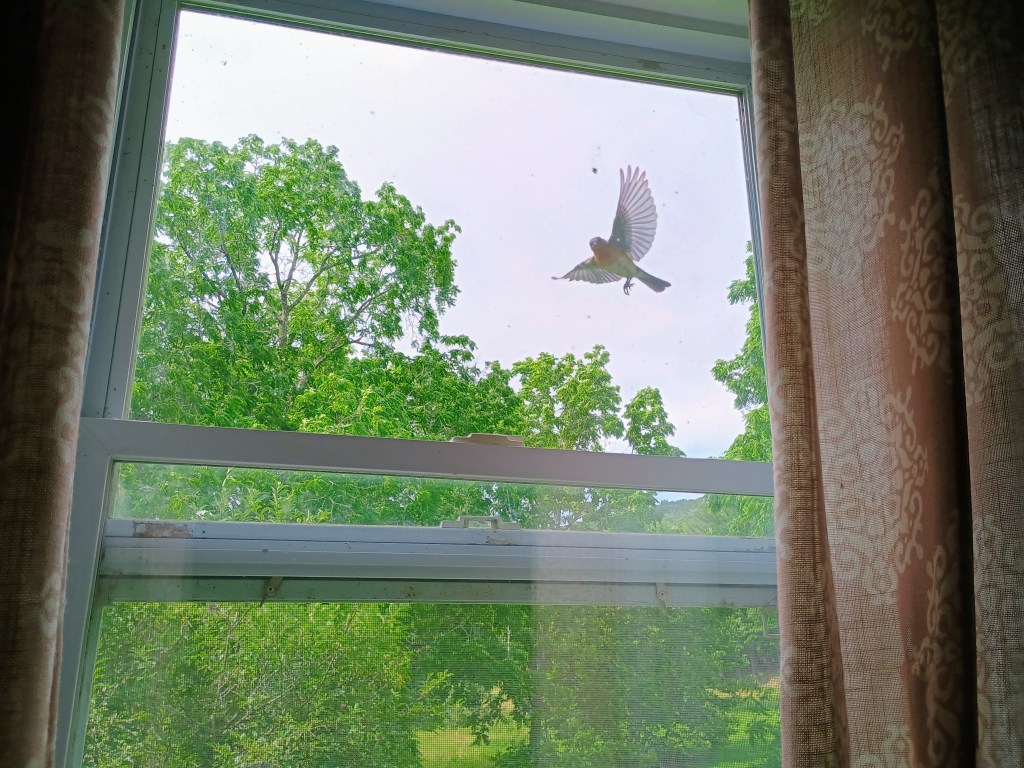
One Determined Bluebird

You can learn a lot about a person, including yourself, by looking at your thumb. Yes, that side-mounted digit that enables humans and primates to do things other animals can’t. According to palmistry, the upper joint represents will and the lower joint, logic. Ideally, they’re the same size. If so, you’ll have the will to put forth the effort to see your ideas to completion.

If the top joint (will) is larger (which is the case with me), your will/determination is stronger than your ability to see things logically. What does that mean? You’re likely to be inclined to beat a dead horse.

If the lower joint prevails, you may have a plethora of great ideas but lack the will to make them happen.

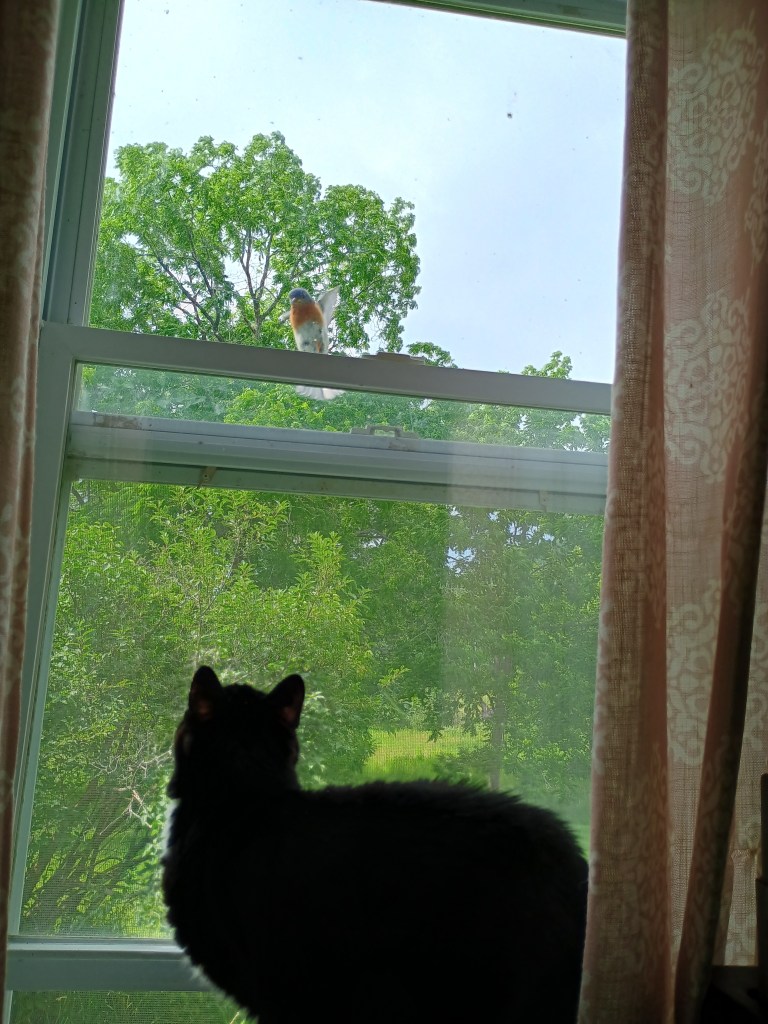
Obviously, a bird does not have a thumb. However, if the bluebird attacking my window had one, clearly the top joint would prevail.

Why is he attacking my window?

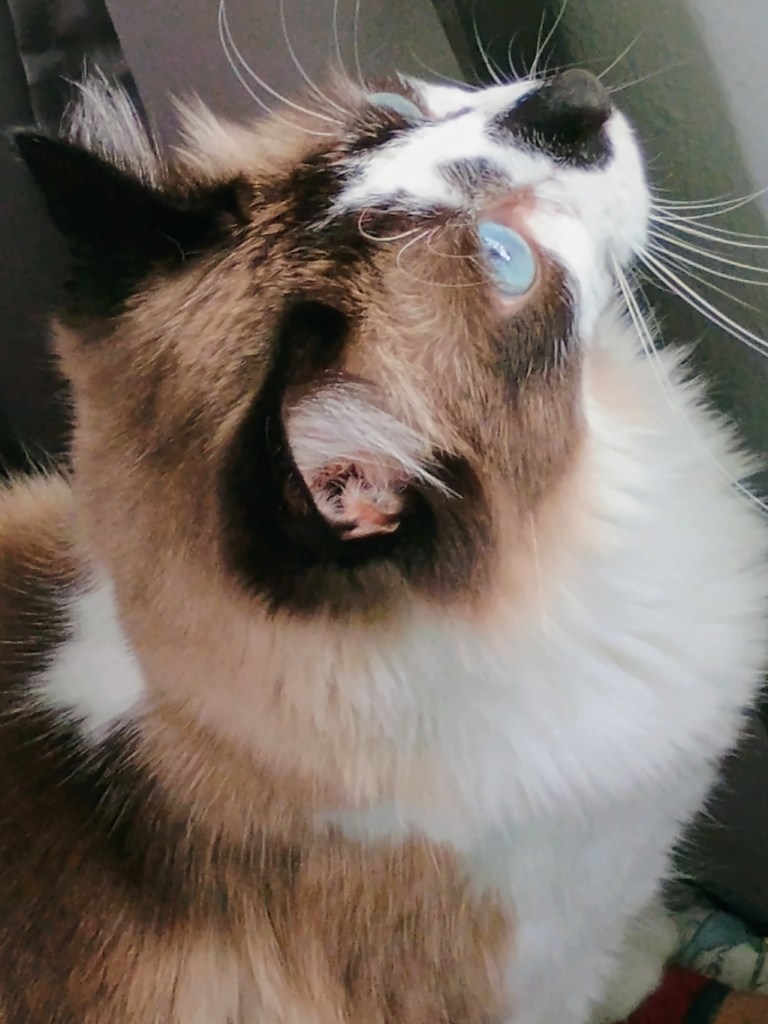
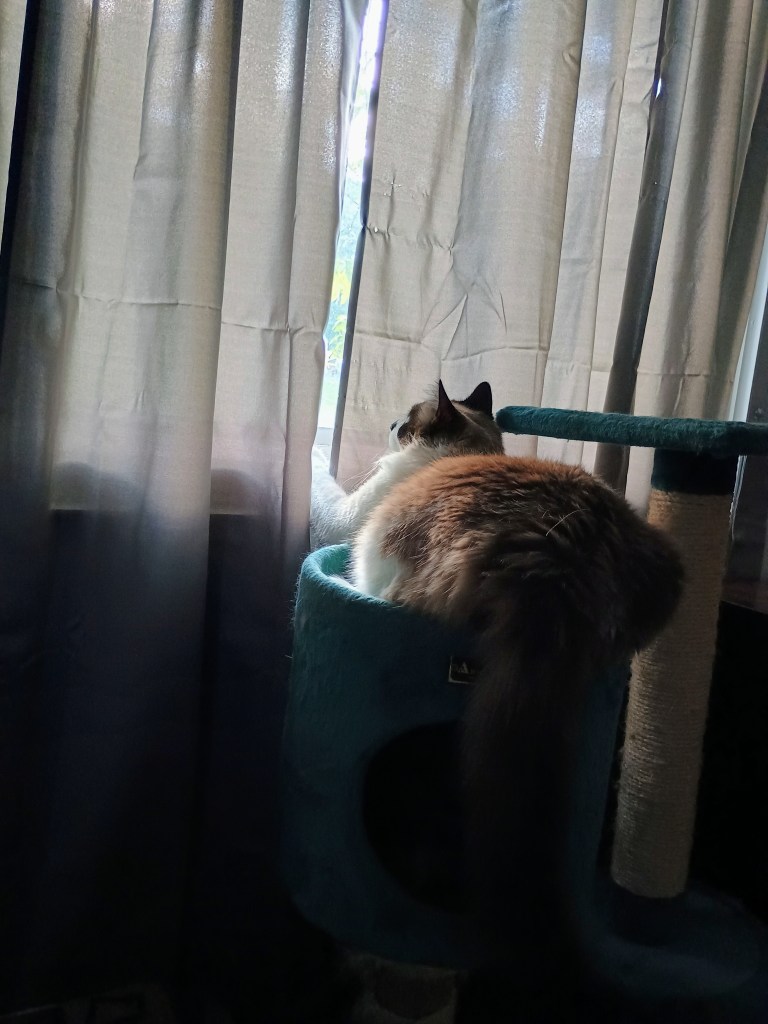
cat  inside looking at a bird outside the window

Because I have two indoor cats. Apparently, he and his mate have a nest in the purple martin house in the front yard and he’s concerned.

So let’s think about this.

As I said, the felines in question are “indoor cats.” They do not go outside. Thus, the danger does not exist.

So far, this daddy bird has been attacking my windows since yesterday afternoon. After a few hours of the thumping sound of him hitting the window, I closed the curtains. He still continued until dark. First thing this morning, right around dawn (which comes early this time of year, i.e. 5:30 a.m.) he was at it again.

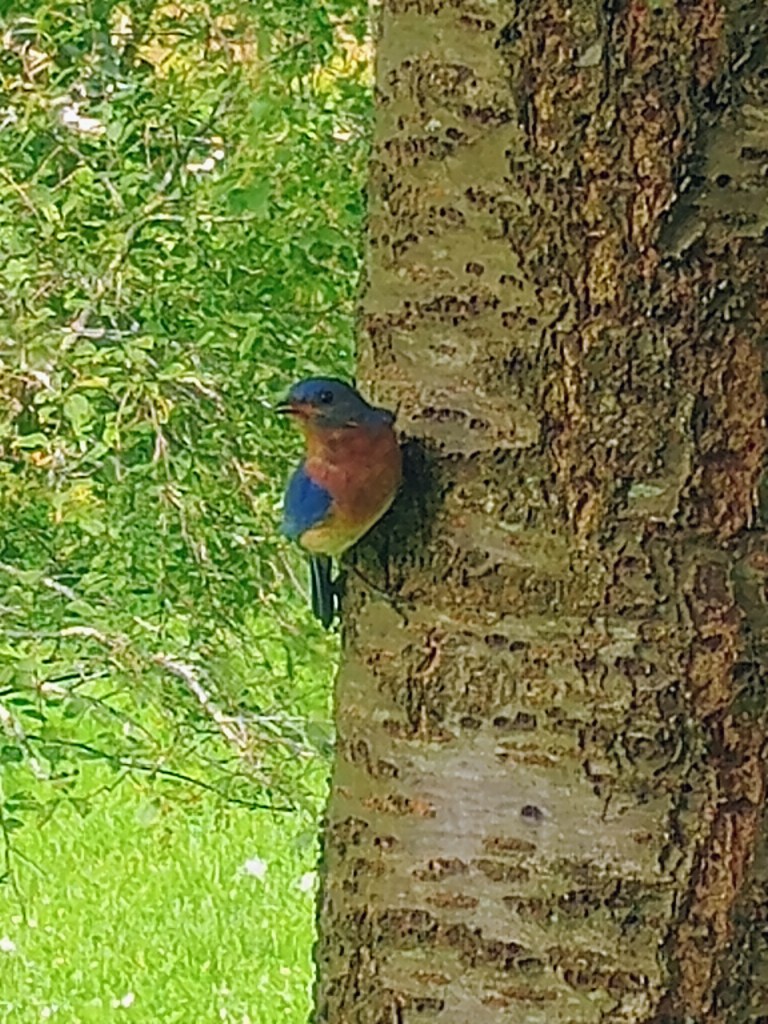
bird perched on the trunk of a tree

Thump, thump, thump.

The odds are (hopefully) very low that the cat or bird will break the window in their ongoing confrontation. If the barrier between them were removed, the cat is the definite favorite. It’s not that far to the ground, so then he’d have a definite opportunity to pursue the bird. Would the bird retreat? Or attempt to fight?

I have two cats who have entirely different views of the situation. My tuxedo cat, who is female and a very good mouser, is also around twelve years old. She found it amusing, but after awhile returned to her napping. However, my ragdoll/Maine coon male, who’s a little over a year old, is thoroughly enjoying the show.

Most the time he just lays there, watching the bird with a bemused expression. Occasionally, he’ll lunge for the window, but no telling what his expectations are.

cat looking out a window

As the assault continues I wondered: Is this bird a spirit animal with a message? While perseverance is usually a virtue, when it becomes an exercise in futility, then what? And at what point do you know it’s a battle you’ll never win? When do you know it’s time to walk away?

There are various quotes and  a couple poems that have encouraged me not to give up. The simplest is, not surprisingly, on my wall: “Never give up! Never surrender!” from the movie Galaxy Quest. Another favorite is: “Aiming for the stars and dragging your feet in the treetops is better than aiming for the treetops and dragging your feet in the mud.” (Anonymous)

Here’s my favorite poem, which has seen me through various challenges:

 Good Timber

by Douglas Malloch.

The tree that never had to fight
     For sun and sky and air and light,
But stood out in the open plain
     And always got its share of rain,
Never became a forest king
     But lived and died a scrubby thing.

The man who never had to toil
     To gain and farm his patch of soil,
Who never had to win his share
     Of sun and sky and light and air,
Never became a manly man
     But lived and died as he began.

Good timber does not grow with ease,
     The stronger wind, the stronger trees,
The further sky, the greater length,
     The more the storm, the more the strength.
By sun and cold, by rain and snow,
     In trees and men good timbers grow.

Where thickest lies the forest growth
     We find the patriarchs of both.
And they hold counsel with the stars
     Whose broken branches show the scars
Of many winds and much of strife.
     This is the common law of life.

Douglas Malloch. “Good Timber.” Family Friend Poems, https://www.familyfriendpoems.com/poem/good-timber-by-douglas-malloch

Here’s another favorite:

Keep Going

By Edgar A. Guest

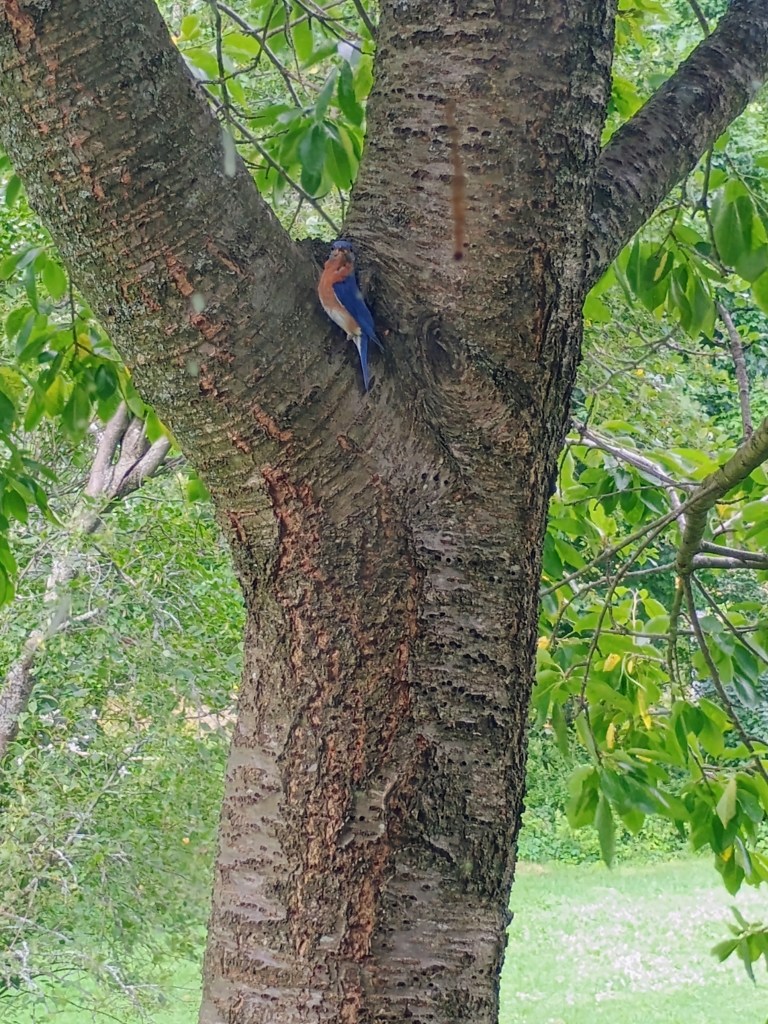
same bluebird perched in the crotch of a tree

When things go wrong, as they sometimes will,
When the road you’re trudging seems all up hill,
When the funds are low and the debts are high,
And you want to smile, but you have to sigh,
When care is pressing you down a bit,
Rest if you must—but don’t you quit.

Life is queer with its twists and turns,
As every one of us sometimes learns,
And many a failure turns about
When he might have won had he stuck it out;
Don’t give up, though the pace seems slow—
You may succeed with another blow.

Often the goal is nearer than
It seems to a faint and faltering man,
Often the struggler has given up
When he might have captured the victor’s cup,
And he learned too late, when the night slipped down,
How close he was to the golden crown.

Success is failure turned inside out—
The silver tint of the clouds of doubt,
And you never can tell how close you are,
It may be near when it seems afar;
So stick to the fight when you’re hardest hit—
It’s when things seem worst that you mustn’t quit.

Edgar A. Guest. “Keep Going.” Family Friend Poems, https://www.familyfriendpoems.com/poem/keep-going-by-edgar-guest

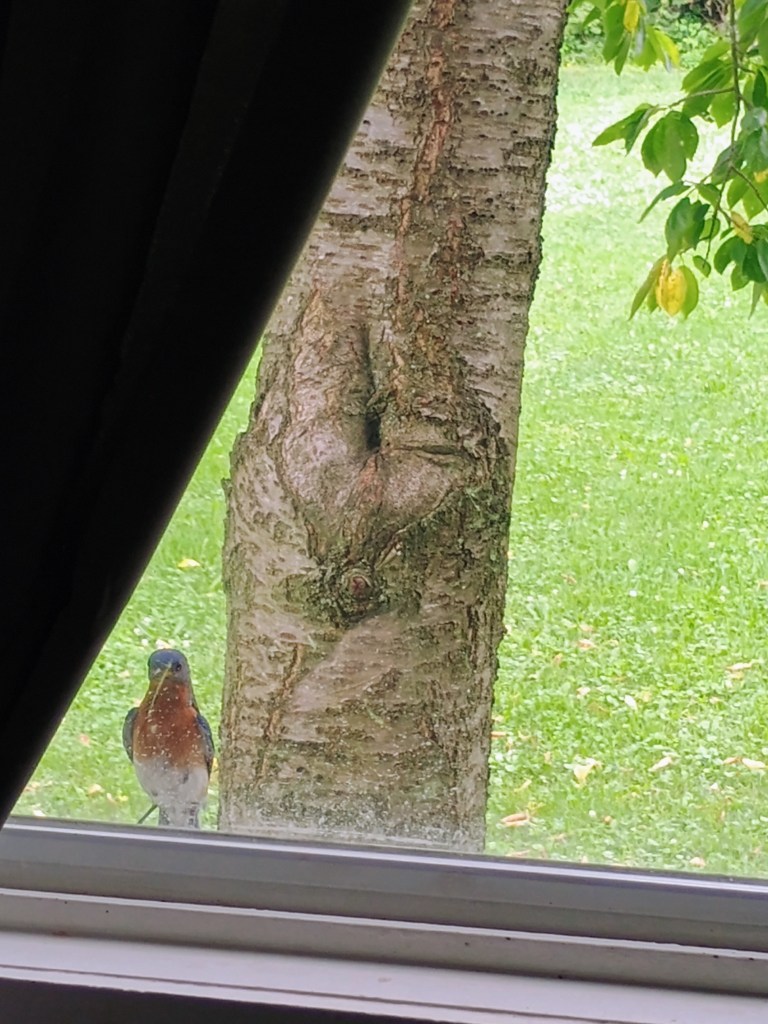
same bluebird sitting on the windowsill looking inside.

So, given that, when do you give up?

I’m in the midst of a project that may very well be a little too similar to that determined daddy bird valiantly defending his family.

Should I give up?

If so, when? At what point have I done enough?

I have never been able to figure that out.

Let’s just say I feel better about myself beating a dead horse than quitting. I usually land in the treetops, but I’ve never wound up in the mud.

cat parting curtains with his paw to look outside

How about you?

Take a look at your thumb. Do the joints line up with your natural inclination when confronted with what could be an insurmountable challenge? Are you a tree dweller or confined to the ground?

Feel free to leave your thoughts in the comments below.

Meanwhile, I need to get back to work.

P.S. It’s been quiet outside for quite awhile. I just hope he figured it out and I don’t find a dead bluebird outside my window…

Never mind. He’s back.

Today’s Writing Tip

laptop-copy

There are various pros, cons, and opinions with regard to how many characters to include in your story. I’m not going to go into that argument here, especially since I’m probably unqualified to do so in a fair and unbiased manner. By stories tend to be highly populated, though they will all serve a purpose somewhere along the plot line.

This tip is about how to manage a huge cast of characters, assuming they’re justified being there in the first place. Major characters who appear regularly throughout the story are well-established enough that reminding your reader who they are will be annoying. However, they may need a reminder about the minor ones from time to time so they can keep them straight. Placing them in a scene that fits their role sometimes will suffice. Otherwise a word of two about who they are (such as “police captain, doctor, or grocery clerk so-and-so, blah blah blah”) is helpful.

Having a dramatis personae is also highly recommended, though they are more difficult to refer back to in an ebook..

Today’s Writing Tip

nobody-copy

This tip is an offshoot of yesterday’s, which related to maintaining a strong sense of space and time. Flashbacks are often important to your story. They provide background, either to events or  the character’s experience base as it relates to the plot. Entering and exiting a flashback properly is important, again so you don’t lose your reader.

Thus, if you end a chapter or section with a flashback, be sure to take the reader back to the present so they’re not lost when the story returns to its normal time frame. This can be done at the flashback’s conclusion or at the beginning of the next section, whichever works better. It goes without saying you should do this clearly if it’s mid-section or mid-chapter as well.

Today’s Writing Tip

notes-copy

This is another tip that makes sure you keep your reader engaged and thus avoid any confusion that throws them out of the story. When you start a new chapter or section, if a significant amount of time has passed, be sure to tell the reader so s/he doesn’t think something was missed or lost.

A sense of time and place is important to a story. It’s one of the things that grounds your reader. If this is unclear and they feel lost, you may lose them entirely. If they have to go back and reread something, or conversely, keep reading while scratching their head until it’s more clear, you have failed in your execution.  Frustration or not feeling comfortably entrenched in a story does not contribute to a positive reading experience.

As an author, such things may be perfectly clear to you, but make sure your transitions are such you don’t leave your reader behind, eating your dust.

Today’s Writing Tip

paper-2 copy

As you’ve probably noticed if you’re a regular reader of these short blogs, poor formatting is one of my pet peeves. This is one I consider a fairly minor faux pas, but shows a bit of savvy when employed. You may have never noticed; I didn’t until I had to format my first book. Like most formatting conventions, it’s noted in reliable sources, but can be easily overlooked or missed.

In traditional fiction publishing, the first paragraph in a chapter or section is not indented, but flush with the margin. What’s the point? There are two main ones. First, it helps set the stage, even subconsciously, that what follows is not a direct continuation of the previous scene, but something new. Second, if only spaces are used to show section breaks, this may be the only clue that a new section has begun. This is particularly true for ebooks, where extra spaces are often lost.

This is not a “big deal” as some formatting issues goes. However, it is one more way to show consideration to your reader by including subtle clues to what’s going on with your story.

Today’s Writing Tip

paper-copy

Be familiar with the archetypal “Hero’s Journey”. It resonates with humanity and has been a literary vehicle for millennia. I have to admit that what follows is not my original material, it is something I had on file with no attribution. If I knew who the originator was I would gladly give credit, but I’m afraid I don’t know. However, since the information is so valuable, I’m passing it along. If anyone knows where it came from, feel free to enlighten us all in the comments.

The Hero’s Journey describes the typical adventure of the archetype known as The Hero, the person who goes out and achieves great deeds on behalf of the group, tribe, or civilization. Some kind of polarity in the hero’s life is pulling in different directions and causing stress.

Its stages are:

  1. THE ORDINARY WORLD. The hero, uneasy, uncomfortable or unaware, is introduced sympathetically so the audience can identify with the situation or dilemma.  The hero is shown against a background of environment, heredity, and personal history. Some kind of polarity in the hero’s life is pulling in different directions and causing stress.
  2. THE CALL TO ADVENTURE. Something shakes up the situation, either from external pressures or from something rising up from deep within, so the hero must face the beginnings of change.
  3. REFUSAL OF THE CALL. The hero feels the fear of the unknown and tries to turn away from the adventure, however briefly. Alternately, another character may express the uncertainty and danger ahead.
  4. MEETING WITH THE MENTOR. The hero comes across a seasoned traveler of the worlds who gives him or her training, equipment, or advice that will help on the journey. Or the hero reaches within to a source of courage and wisdom.
  5. CROSSING THE THRESHOLD. At the end of Act One, the hero commits to leaving the Ordinary World and entering a new region or condition with unfamiliar rules and values.
  6. TESTS, ALLIES AND ENEMIES.  The hero is tested and sorts out allegiances in the Special World.
  7. APPROACH. The hero and newfound allies prepare for the major challenge in the Special world.
  8. THE ORDEAL. Near the middle of the story, the hero enters a central space in the Special World and confronts death or faces his or her greatest fear. Out of the moment of death comes a new life.
  9. THE REWARD. The hero takes possession of the treasure won by facing death. There may be celebration, but there is also danger of losing the treasure again.
  10. THE ROAD BACK. About three-fourths of the way through the story, the hero is driven to complete the adventure, leaving the Special World to be sure the treasure is brought home.  Often a chase scene signals the urgency and danger of the mission.
  11. THE RESURRECTION. At the climax, the hero is severely tested once more on the threshold of home.  He or she is purified by a last sacrifice, another moment of death and rebirth, but on a higher and more complete level. By the hero’s action, the polarities that were in conflict at the beginning are finally resolved.
  12. RETURN WITH THE ELIXIR. The hero returns home or continues the journey, bearing some element of the treasure that has the power to transform the world as the hero has been transformed.

Today’s Writing Tip

technology-3 copy

Remember your main character needs to have a fatal flaw. This is what allows your reader to relate to them. It’s also what makes them seem real. Flaws don’t make a person weak, only human.

Often when we think of flaws, we think of some disposition to do evil or propensity to fall prey to some horrible temptation. While this can definitely work, it’s not always necessary. A fatal flaw’s primary function is to stand between your character and what he wants.

Any number of character traits can fill the bill. It could be something as simple as being too honest, outspoken, having too much pride, lack of confidence, too impulsive, hot temper, doesn’t know when to quit, guilt over past mistakes, too idealistic, stubborn, easily distracted, too emotional, perfectionist, indecisive, spiteful, knows everything, control freak, unrealistic, etc.

If you don’t know, you need to figure it out. What do they have to overcome to grow as a person so they can get what they want?

Today’s Writing Tip

technology-copy

Other than a chosen few authors, the people making the most money are those that provide promotion services and author classes. I would bet dollars to donuts that most authors put out more money than they take in, no matter how diligently they work at their craft. Some of these are well-worth it, others, not so much.

Thus, it’s essential to choose them wisely to make sure you get your money’s worth. Here are a few ways to help you decide.

  1. Does the service have a favorable reputation,  i.e. good reviews or recommendation from a fellow author?
  2. How many books will you have to sell as a result to cover the service’s cost?
  3. If it’s a class, would it be less expensive to hire someone to do that for you versus learning to do it yourself? (One way to counter this expense is to perform that service yourself once you’ve mastered it, such as making promotional videos.)
  4. If it’s a skill, could you teach yourself via online blogs or other information available for free?
  5. Is the service or class relevant to your particular genre? Will it help you reach your target audience?

Those selling these services tend to be masters of promotion themselves. They will make you believe that writing a best seller is within reach if you take their class or employ their services. Hope springs eternal, but don’t be a fool.

Today’s Writing Tip

technology-3167297_1280 copy

No matter how you feel about it, social media presence is important for readers and fans to connect. This is one thing that has made being an independent author possible beside ebooks and print on demand publishers. Having a lot of followers helps find your audience, though quality is important. Whatever you do, don’t waste your money buying followers. First of all, in most cases the people aren’t real and second of all, even if they are real, there’s a good chance they are not your audience.

One way to connect with those who will like your work is to post engaging content to draw them in. Selling yourself as an interesting person is another way to draw them in. Some authors seem to think that if they send out a daily email or dozens of daily tweets promoting their books that they’ll eventually connect. This could not be farther from the truth. Spamming doesn’t work any better for authors than anyone else out there.

Personal connections are best. The very best by far is face to face, such as at book signings or local clubs where you volunteer to speak. These are not always possible, however, if you live in a remote area or are too much of an introvert to get out there and promote yourself.

That would be me….