Day 7 of the 1/2-Acre Challenge

IMG_0028

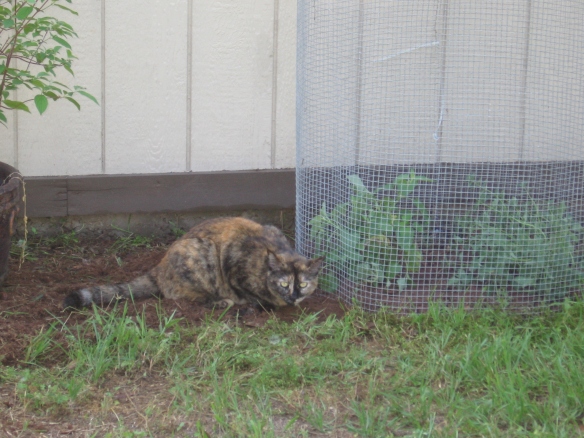
I’m happy to report that so far for an entire week I have spent at least two hours a day working in my yard. The progress so far is not that dramatic, but I hope the cumulative effect will be. Yesterday I went to Home Depot and picked up some plants, one of which is pictured above on the far right.  Can you guess what it is?  Gizmo, my feral cat, provides a hint with her disgruntled expression.

Right, it’s cat mint and the plant closest to her is catnip. If I didn’t have the protection around it, by tomorrow it would be gone with numerous very happy cats lazing around the yard in an inebriated state. Gizmo, of course, does not agree with my decision, much as children protest when their parents ration Easter or Halloween candy.

Don’t worry, she’ll get her share, as will my indoor cats, who are regular “nipheads”, a term coined by fellow blogger, Jeanne Foguth, in her series, “The Sea Purr-tector Files”, which stars my favorite feline 007, Xander de Hunter. If you’re a cat fancier looking for a fun read, check out volume one here on Amazon! You can start the series for free with the prequel, “Latitudes and Cattitudes.”

Tomorrow I’ll continue my quest and provide another update when I do something interesting enough to report.


Keeping up with Technology — Barely

cropped-brain-fingerprint-300x296

It blew me away today when I discovered this article on Futurism.com about brainprints. The reason is that in my last science fiction novel, “Refractions of Frozen Time,” I had the bad guys collecting what I called mindprints, which were a unique identifier. So here we go again, science fiction has become science fact.

What’s a sci-fi author to do?

It gets harder and harder to come up with futuristic technology. Since I started my novels several years ago I had to do various “upgrades” for them to keep up. I had internet, the equivalent of Craig’s List, and electronic currency in my novels long before they were reality.

About the only thing I have in my novels, short of faster-than-light (FTL) space travel, that I 15442253_sTHOUGHT was still science fiction is the c-com device my hero uses for any number of functions. C-com stands for “cerebral companion” and was like a smart phone on steroids driven by psi-waves, a.k.a. telepathy.  But EVEN AS I WAS WRITING THIS BLOG, an email came in from Futurism that stated you can now send text messages via your brainwaves! You can find the article here.

Holy cow…

What’s a sci-fi author to do????

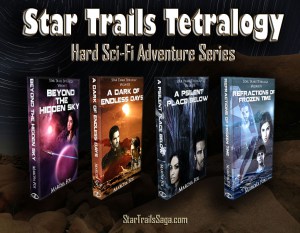
Please, buy my books quick, before they jump genres into historical novels!  The box set of the entire series is currently on sale for only $3.99.

STTlpostcardVP2 copy


Eating an Elephant One Bite at a Time

yard

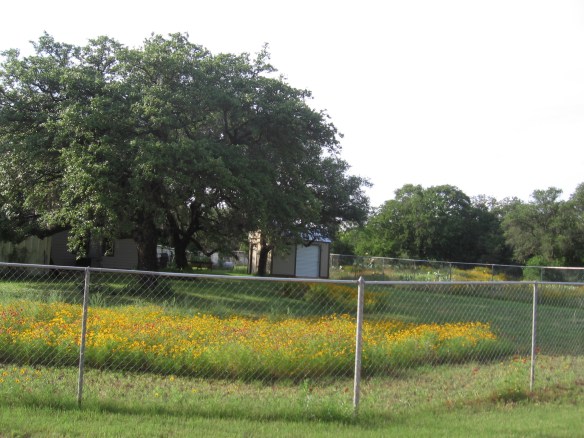
I live in a rural area on a half acre that I’m trying to tame. I must say that during the nasty drought that Texas experienced that past seven-plus years it was a lot easier to sit in my air-conditioned house and go outside as little as possible, like to the mailbox and back. Period.  Now that the drought appears to be over, everything is green again and our lake is back up where it should be, I’ve decided it’s time to make my place look the way I’ve always dreamed it could on the outside.

Usually I get totally overwhelmed looking at it, but have finally adopted a common sense approach of taking it on one thing at a time, about an hour a day. It usually takes me three separate days to mow the yard with a walk-behind mower, so today I finished what I started Friday. I cut back the cactus by my front door that was taking over the porch, and have a list of manageable chores on my list for the coming days, like cutting down several volunteer hackberry trees and saving the irises from that unruly cactus.

So often when a task is utterly overwhelming, it’s easy to ignore or dismiss it entirely. How many things are you putting off because you don’t know where to start? Here’s the secret: Just start.  The satisfaction feeds your resolve and before you know it you’ve gained enough momentum to keep at it. I just hope I can get enough done before serious heat sets in, but until then I’ll tackle taming my little patch of land one bite at a time.

Was Houston Flood the Fault of the Stars?

Video of Houston Flood

If you’re a fan of The Old Farmer’s Almanac, you’re most likely aware that it contains weather predictions as well as advice regarding when to plant, harvest, and numerous other activities. Most likely anyone who’s drawn from its wisdom hasn’t questioned its source or wondered what it was. If that’s a burning question you’ve had for most your life, then I have good news for you because I’m about to tell you where that advice comes from.

Ready? Are you sitting down? Okay. It’s astrological.

Whether or not you believe in astrology makes no difference. It works and doesn’t much care whether people recognize it or not and neither do I.

As an example of how it works for weather, I couldn’t resist doing another extreme weather blog regarding the astrological influences in effect at the time, in this case, the massive flooding event in Houston, Texas. This blog, like numerous others involving astrology, is in the category best known as “You can’t make this stuff up” or “What are the odds?”

As a professional astrologer I tend to speak in astrologese, which of course makes no sense to anyone unfamiliar with its terminology. I will do my best here to explain things in lay terms which will of necessity include a few brief, albeit essential, astrology lessons.

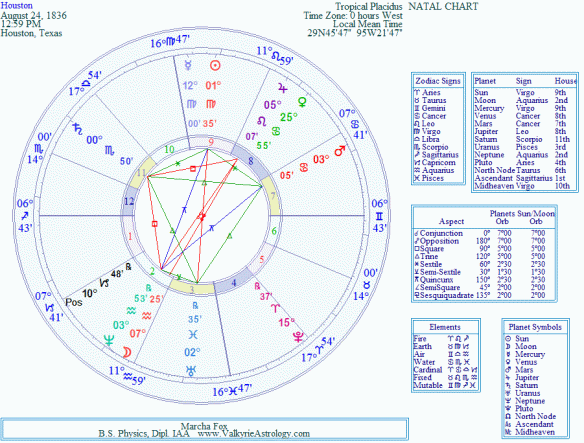
First of all, what you see below is the “birth chart” of Houston, Texas. Since it is a major city, detailed information about it’s founding is available in the historical record. In reality, the worst part of this recent flood was centered slightly northwest of the city in a city called Katy, but an actual date much less time of its incorporation or naming (which occurred when they applied for a post office in 1896) were unavailable. Houston felt the effects too, so thus, we’ll look at Houston.

houstonnatal

Planets, signs and houses (of which there are twelve as you can see from the numbers around the smaller inside circle) each represent a variety of things. Planets and signs have their own distinctive energies while houses indicate different categories relative to life.

If you look at the city’s horoscope, which represents the location of the Sun, Moon and planets at that moment in time, you can see a variety of different lines in the center. These indicate relationships known as aspects between the Sun, Moon and planets. In general, the red ones are stressful, the green ones favorable, and the blue ones somewhat unstable, except when two of them come together, like they do here, with a green line connecting them at the base.

This aspect pattern is known as a yod or “finger of god” and typically has a fated flavor to it. From time to time, as the actual location of the planets in our solar system form other aspects to these natal planets, events are triggered. Seriously. The yod is comprised of Houston’s Virgo Sun, Cancer Mars and Aquarius Neptune, which is represented by a glyph that looks a lot like Neptune’s famous trident. Neptune is in a position in the yod known as its eye, which is where the Sun’s energy (Sun being indicative of personality) and Mars’ energy (symbolic of activity) are directed.

If you know a little about mythology, you know that Neptune is the God of the Deep. In astrology, he rules anything related to liquids among other things. Houston’s nickname is “The Bayou City.” The Houston Ship Channel is a major influence on its economy. Oil, another biggie for Houston, is also ruled by Neptune. Being not too far from the Gulf of Mexico, Houston is often troubled by hurricanes, such as Ike in 2008.

So we have Neptune very prominently placed in Houston’s horoscope and it’s easy to see its influence has been a big one on this city as expressed by the yod, which basically states that the city’s personality and activity is going to relate a lot to Neptunian matters such as water and oil.

Get the idea?

Coincidence? Maybe. Let’s see what else is going on.

Neptune is also related by aspect to some other planets as well. Note the red triangle, an aspect pattern known as a T-square. These are stressful. The other planets involved are Saturn, which represents structures, responsibility and tradition, and Jupiter, which tends to exaggerate and inflate matters. Saturn is in the 11th house which includes groups and organizations and Jupiter is in the 8th house, which includes matters that are intense, transformational or involve shared resources. It also includes death and is usually involved for severe weather events. For Houston, this house is particularly sensitive to the Moon.

Thus, this T-square can easily be related to major storms and floods that damage structures of both a physical and societal variety with extreme impact on the infrastructure as well as the potential for loss of life.

The green lines that look like a big triangle is what is called a Grand Water Trine. I swear I’m not making this up. That is because the three planets involved are in Water Signs which include Cancer, Scorpio and Pisces. The smaller green triangle on top of the big one, which makes the entire configuration look like a kite, ties the Sun into the Grand Trine. While this configuration is often favorable, all it really means is that the planets all communicate their energy well, so if that energy isn’t good, then the influence isn’t, either.

The glyph at the bottom of the Grand Trine, which looks like an old-style television antenna, represents Uranus. This is appropriate since Uranus is associated with technology. He is also related to surprises, unexpected events, upsets, rebellion, explosions, freedom and so forth. Uranus, in turn, is connected back to Neptune by an aspect that tends to denote friction. The implication is for numerous unexpected and disruptive events related to water. The main point here is that so many planets are connected such that when one is affected it will reverberate throughout making things a bigger deal than if they weren’t tied together.

If you’re wondering what the planet labeled “Pos” represents (probably not what you think), that’s the asteroid named Poseidon, also associated with water. We’ll get to him in a moment.

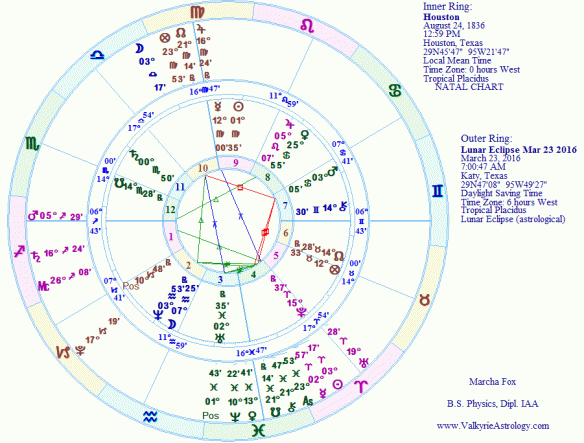
There are certain cosmic events that tend to have tremendous impact astrologically. One of those is eclipses, which are even recognized by stock market gurus as influential. Look it up some time. In March there were two eclipses, one a solar eclipse and the other lunar. The location of the Sun and Moon for the lunar eclipse was in a zodiacal degree that slammed Houston’s Neptune creating an astrological tsunami.

houeclipsebiwheel

Neptune was aspected by the Moon and the Sun, both of which were in houses that typically indicate important events, which in this case include a lot of public attention and the property and residents of the city itself. Uranus, master of the unexpected and upsets, was involved as well. Part of the “You can’t make this stuff up” department, and why I love the asteroids in astrology, is that Poseidon’s current position is irritating Uranus PLUS opposite Houston’s Sun, kind of an “in your face” kind of aspect, to say the least.

Jupiter’s current location is at the top of the chart, which indicates major attention from the public, in this case worldwide.

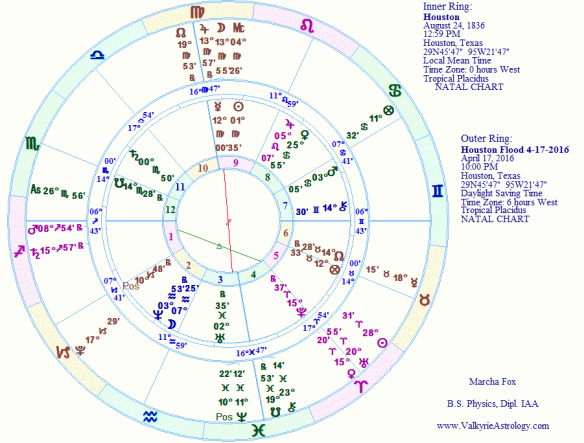
You’ll note that the eclipse was March 23 while the flood didn’t occur until April 17, but eclipses set events in motion with their effects strong enough to last for months. The night the rain began that started this debacle, a few things had changed in the planetary configurations which were far from helpful.

houfloodbiwheel

This looks like a relatively quiet chart until you look a little closer. Out in space, Jupiter and the Moon were aligned and parked on Houston’s Mercury, which is all about news and movement. Neptune’s cosmic position was opposing them, making it a key player. The Moon is always important, but as noted earlier,it’s particularly influential for Houston’s ominous 8th house of death and such. So first there’s a lunar eclipse, now the Moon is stirring things up some more.

Holy guacamole! On top of all that, the asteroid, Poseidon, is in a different zodiacal sign but in the same degree as the natal chart, increasing his energy, plus he was cozied up to Neptune, so both mythological gods of the deep were in cahoots, too. Saturn, which relates to structure, as noted earlier, and Pluto, god of the underworld, were also combined in a malefic blast, though Venus did provide some intervention, enough to keep this from being a lot worse than it already was, such as the fact most of the rain came down overnight when less people were out, though Houston is definitely another city that never sleeps.

There are various other indicators in these charts that tie in even more of Neptune’s soggy influences as well as several others that I won’t go into, because I think I’ve made my point and there’s a good chance you didn’t even make it this far and if you did, your eyes have long since glazed over and you’ve set this aside for bedtime reading.

So be it. Once again, at least as far as I’m concerned, astrology has not failed me, if nowhere else in the domain of “What are the odds?” Poseidon, if nothing else, is the coup de grace, much as the asteroid, Marathon, was for the Boston Marathon bombing several years ago, where he was in a key location of the event chart.

You can’t make this stuff up.

The Astrolabe: Ancient Analog Computer with 1K Apps

1280px-Planispherical_astrolabe_mg_7100

Figure 1. Planispherical astrolabe. Marocco, 16th century. Engraved brass. On display at Paris naval Museum.

Whether you’re an astronomer, astrologer or steampunk fan, you’re bound to fall in love with this ancient analog computer.  Even better, you can make one for yourself by downloading the directions from the Resources section below.

The astrolabe is an ingenius device used for nearly two thousands years, from the time of Hipparchus (c. 190 – 120 BCE) until the turn of the 17th century.  It’s typically a disc constructed from wood or brass, about 10 – 20 centimeters in diameter, and a few millimeters thick.  In 1391, medieval writer and poet, Geoffrey Chaucer, wrote a treatise on the subject for his son, describing how to build one as well as its use.  Astrolabes had over a thousand uses, including timekeeping, navigation, surveying, solving equations, and so forth.  Mastering them all required an entire university level course.

While at first appearance an astrolabe is intimidating, breaking it down into its components, combined with the information contained on each one, brings a strong sense of familiarity if you’re an astronomer.  Appreciation for the knowledge ancient civilizations acquired of the stars and their relationship to the Earth quickly follows at the thought of designing, much less crafting, such a clever precision instrument.

The main components of a planetspheric astrolabe are the mater, climate plate or tympan, and rete, which all function together, demonstrating how Earth’s place in the cosmos provides the ultimate reference frame.

Astrolabe (Front)
scan-astrolabe-front copy

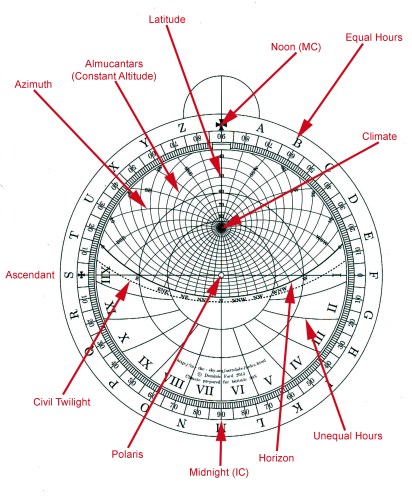
Figure 2. Astrolabe Front: The Mater

The front of the astrolabe, called the mater, (which means mother and is sometimes referred to as such) looks mind-boggling, until you break it down into its components.

Starting from the outside, you see most of the letters of the alphabet around the circumference.  These represent the twenty-four hours of the day, more specifically, the equal hours system, which is what we use now, i.e. each hour is 60 minutes long.  However, at one time, there were twelve hours of daylight and twelve hours of darkness.  Needless to say, unless you live on the equator, the days and nights are NOT of equal length except at the equinoxes.  Thus, the unequal hours system meant that the duration of hours were adjusted, according to the time of year.  The astrolabe thus accounted for them as well, as shown by the designated lines in Figure 1.

The numbers just inside the letters represent degrees from the horizon, where’s it’s zero, to a maximum of 90 degrees at the zenith (Noon) or nadir (Midnight).

The horizon is represented by an oblique line. Unlike most of the maps we see these days, East is on the left, West on the right, North at the top, South at the bottom. ( If you’re familiar with astrology, you should not be surprised that these are the same as a horoscope with the ascendant on the left, Midheaven (Noon) on the top, descendant on the right and Imum Coeli (Midnight) on the bottom.) Just below the horizon is a dotted one, which is somewhat difficult to see at this scale, but represents the period known as Civil Twilight, or the time in the morning or evening when the Sun isn’t above the horzon, yet there’s a certain level of light.

So, to recap, so far we have 24 hours around the outer edge, perpendicular lines representing the cardinal directions, and an arc indicating the horizon.

Due North, represented so conveniently by Polaris, a.k.a. the North Star, is located dead-center.  Its position in the sky varies with latitude, indicated numerically on the vertical line extending upward from the climate’s center.

The climate, sometimes referred to as the tympan, comprises the section that looks like a spider web with a center just North of Polaris, which represents the zenith, or portion of sky directly overhead. The curved lines mark azimuth readings, while the concentric rings are lines of constant altitude or almucantars. These vary with latitude, like the view of the night sky, so astrolabes used in multiple locations required suitable climate plates, which fit into this area. Note the degree markings along the edge of the azimuth lines, which you’ll use later.

A rotating ruler with degree markings which represent declination, the altitude above the celestial equator, is attached to the center of the mater. It’s also used as a convenient pointer in the process of telling time, as explained further below. [NOTE:–The concentric rings, which are unlabeled in Figure 1, are duplicated on the rete and therefore explained in that section as well as defined in Figure 3.]

Astrolabe (Back)
Astrolabe-Back-Labels copy

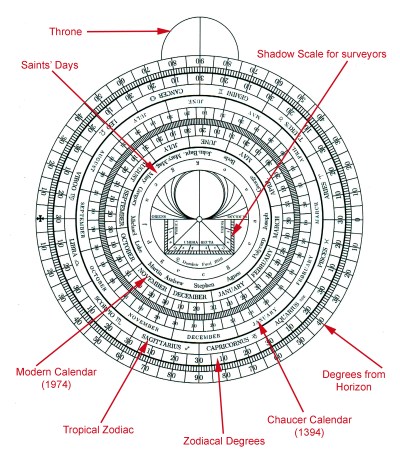
Figure 3. Astrolabe Back: Calendars and Shadow Scale.

The back of the astrolabe is equally daunting at first sight, until you break it down. However, it’s this complexity that allowed this ancient instrument to provide so many functions. For example, the box labeled “Shadow Scale for surveyors” gives a hint of one of its many uses.

The top, called the throne, was used to hang the instrument or hold it in the proper position.

The outer ring has degrees from the horizon, like the front, with zero on the horizontal axis and 90 degrees on the vertical. Just inside the degrees are another ring of numbers, this time corresponding to the degrees of the tropical zodiac signs named in the next ring.

There are two calendars represented, one from Geoffrey Chaucer’s time (1394), which is included since Chaucer wrote a popular treatise on the astrolabe for his son, a copy of which you can find online. The modern calendar, closer in toward the center, is based on 1974, but this is close enough since it takes centuries for precession to change enough to worry about.

Near the center, several Saints’ Days are noted.

Thus, there’s a lot of information, but most of it’s familiar. Another pointing device called the alidade is placed on the back, which is similar to the ruler on the front except it has either pinholes or notches used to sight in the altitude of the chosen star or landmark, if being used for surveying.

The Rete
scan-astrolabe-rete-Labels copy

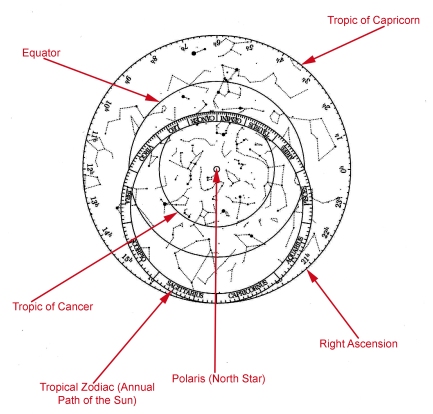
Figure 4. The Rete

The rete comprises the main component of a planisphere, i.e., a stereographic projection of the celestial sphere on a flat surface. Polaris is at the center with several constellations included with the brighter stars emphasized.

The outer ring represents the Tropic of Capricorn, the one in the center, the Equator, and the innermost ring, the Tropic of Cancer. The hours of Right Ascension are shown along the circumference as well.

A diagram of the annual path of the Sun, a.k.a. ecliptic, is offset from the center and includes markings for the signs and degrees of the tropical zodiac.

For a homemade astrolabe, the rete is printed on a sheet of clear transparency which allows the stars to be superimposed on the mater. Obviously, in ancient times, that wasn’t available, their solution not only innovative but artistic as well. The rete, like most of the other components, would be constructed of brass, but numerous areas cut away so you could see the mater underneath.

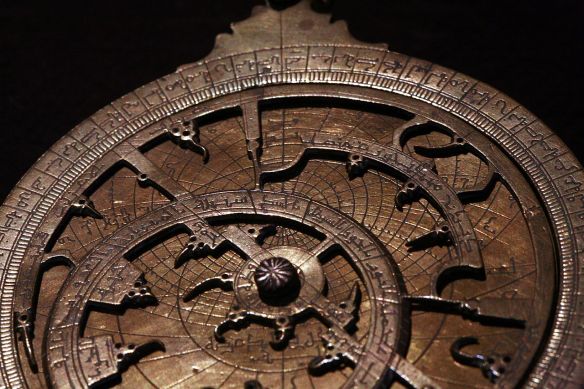
Most astrolabes were carefully crafted precision instruments which were much larger than the homemade version, allowing for a more accurate position determination, but nonetheless, a relatively accurate reading is possible with a homemade version, a source of which is included in the resource listing.  The ancient Turkish astrolabe in Figure 5 shows the mater and rete on the front and calendar and alidade on the back.  Note the incredible artistry and workmanship of this 17th Century device.

Planetary Position

To determine the position of a planet, use its relationship to the Fixed Stars on the rete.  By rotating the rete so that the position of the planet is on the horizontal axis, i.e., zero degrees, then following that line to the tropical zodiac on the ecliptic circle, to determine its position. The ruler provides its declination.

Telling Time

This process is relatively simple and shows the genius of using Earth’s position combined with celestial alignments to determine the time of day.

  1. First, using the back of the astrolabe, find the current date and note the corresponding zodiacal degree of the Sun.
  2. Next, select a specific star visible in the night sky that’s represented on the rete.
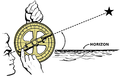
  3. Using the back of the astrolabe, align the device’s horizon line with the visible horizon and use the alidade to measure its altitude. (Warning: This could be the most
    120px-Astrolabe_(PSF)

    Figure 6. Sighting in the altitude with the alidade.

    difficult part of the process. Furthermore, in many cases the visible horizon is not the actual horizon due to elevation, buildings, trees, mountains, and so forth. If nothing else, consider that the Moon appears to be, on average, a half-degree across, or approximately the width of your thumb, which you can use to approximate the altitude.)

  4. Identify the star on the front of the astrolabe (rete).
  5. Move the rete so the altitude you measured of the star matches the azimuth scale behind it.
  6. Align the rule on the rete with the zodiacal position for the Sun for that day.
  7. The rule will point to the time represented on the outer rim of the mater, indicated by a letter. (Don’t forget to adjust for Daylight Savings Time.)

If you know any two of the variables (date, time, rete star position), you can always solve for the third.

Conclusion

The innovative talents of the ancients who invented this device provide a new appreciation for their knowledge of the heavens, Earth, and their celestial relationships.

Even more astounding, and perhaps even a progenitor or technological cousin of the astrolabe, is the antikythera mechanism, an invention attributed by researchers to Aristotle.  It included the positions of the Moon and planets using a complex system of gears and pins that compensated for their elliptical orbits, plus had the ability to predict when eclipses would occur.  Researchers believe it was lost when General Marcellus sacked Syracuse, then surfaced later via the Byzantine Empire (500 A.D.) where it was most likely the inspiration for Persian astrologers to reinvent the astrolabe, then bring it to Spain in the 13th century via the Moors.

During the 14th century Renaissance, sophisticated gear trains came back to drive astronomical clocks found in various European cities such as Strasbourg, France and Prague, Czech Republic.  The sophistication of these devices demonstrates the knowledge of celestial mechanics and engineering possessed by past civilizations, tangible testimonials to man’s ingenuity, long before such calculations became the domain of application programmers creating smartphone apps.

Resources

Directions for Making an Astrolabe

https://in-the-sky.org/astrolabe/index.php

Some Places to Buy Astrolabes

http://leelehman.com/wp/index.php/2015/11/02/brass-astronomical-and-astrological-instruments/

http://www.chronos-manufaktur.de/

Video on How to Use an Astrolabe

http://www.ted.com/talks/tom_wujec_demos_the_13th_century_astrolabe

Additional Information

http://www.chronos-manufaktur.de/en/astrolabes_principle.htm (Includes the TED video plus additional resource information)

References

Wikipedia: https://en.wikipedia.org/wiki/Astrolabe

“Building a Model Astrolabe” by Dominic Ford, Journal of the British Astronomical Association, 122, 1, 2012, https://in-the-sky.org/astrolabe/index.php

“Western Astrolabes” by Roderick and Marjorie Webster, Copyright 1998, Adler Planetarium & Astronomy Museum, 1300 South lake Shore Drive, Chicago, Illinois 60605

Picture Credits

Figure 1: Creative Commons Attribution Share Alike License, By Rama – Own work, CC BY-SA 2.0 fr, https://commons.wikimedia.org/w/index.php?curid=7294462

Figures 2 – 4:  (c) Dominic Ford, 2013, https://in-the-sky.org/astrolabe/index.php

Figures 5a & b: Creative Commons Attribution Share Alike License, By Pom² – Own work, CC BY-SA 3.0, https://commons.wikimedia.org/w/index.php?curid=4039477. Description: Astrolabe planisférique Mère et tympan : Turquie ottomane, 1098 H / 1686-1687 Araignée: maghreb, vers 1850 Laiton à décor gravé et incisé D. 10,2cm Paris, musée de l’Institut du monde arabe, AI 86-45 Legs Destombes

Figure 6: Wikimedia Commons, Public Domain, https://commons.wikimedia.org/wiki/Astrolabe

Copyright (c) 2016 by Marcha Fox, All Rights Reserved

 

Some Benefits of Backstories

26572416_s

As an author you’re probably already familiar with backstories.  These may reside nowhere but inside your head, but in order to develop authentic characters and plots, they need to exist.  Even if a character has amnesia, such as Jane Doe in the popular TV program Blindspot, he or she needs to have a past.  Life experiences, even for fictitious characters, are what make people interesting, provide motivation and bring out their personality.  As an author, if you don’t know this about your character, it’s going to make it more difficult to tell his story.  Dialog and action may be stilted or artificial without knowing what makes him tick.

If you’re having difficulty getting into a character, talk to him or her to find out more about their background.  You might be surprised what you’ll discover.  Character interviews are common these days in blogs, which further demonstrate this principle.  Talking about a character with other writers or your beta readers can bring out all sorts of great ideas as well.  If you get stuck, try this out.  I can have as much fun brainstorming with other writers about their current WIP as I can with my own, whether it involves character motivation or plot development.  Backstories are also great practice for new authors not only to develop their cast but their writing style as well.

It’s worth noting, however, that you shouldn’t confuse your readers by giving unimportant characters a name.  If you do, they’ll wonder later what happened to so and so.  The general rule is that any character who doesn’t contribute to the plot doesn’t need to be there, anyway, except in the case of certain group situations, like extras in a movie.  If they’re important enough to deserve a name, then they should have a backstory, no matter how simple.

For main characters, these backstories tend to come out in the course of the story to a greater or lesser degree, but not always so much for minor characters.  However, if you find a detailed backstory developing for a minor character, chances are he/she/it has something interesting to say.  You’ve undoubtedly noticed how various sit-coms have had spinoffs over the years, typically when a minor character becomes interesting enough to have his or her own program.  One that comes to mind is Frasier, which evolved from Cheers.  Another example would be the ewok stories that evolved from Star Wars.

It used to be that backstories were useful to the writer, but often sat in a file that never saw the light of day.  Now that ebooks are so popular and relatively easy to produce, they can serve a useful purpose for keeping readers and fans engaged, either as your full-length novel develops, between books in a series or even to add additional depth to a story that’s already out there.  Who knows?  It could evolve into another full-length story as you dive into what makes a character tick.  This is often how series and trilogies are born, when there’s a lot more to tell.  Fans who become attached to a character love to hear more about them.  And these are not always limited to the main ones.  How many movies have you seen where one of the supporting actors grabs your attention?  You never know who another person will connect with or for what reason.

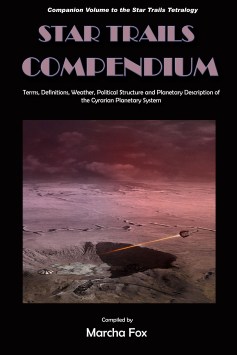
Since this background information is often already written up, or could be relatively easily if it’s parked in your brain, it’s worth it to do some editing and get it into ebook form.  Print form works, too, since these books are usually short and make great giveaways or ultra-inexpensive samples.  As expected, the cover is the most expensive element of a book, so they might not be as cheap as you’d expect, but usually your cost will be around $2.  For example, my Star Trails Compendium, which is 135 pages long, costs me $2.48 while The Sapphiran Agenda is only 29 pages but $2.15.

Backstories work well for giveaways and teasers, both before and after a book is released.  My Star Trails Tetralogy series has two, which are free on Smashwords and its outlets and 99c on Amazon.  The Star Trails Compendium comprises all the terms, definitions and cultural background information for the series while The Sapphiran Agenda is a true backstory for a minor character, Thyron, who’s a flora peda telepathis, i.e. telepathic walking plant.  Many readers noted he was their favorite, though at least one found him annoying, demonstrating how you never know how they’ll be accepted.  Thyron has at least one more story to tell which I hope to have out soon.

Put backstories to work for you to gain new fans, retain old ones, and provide short samples of your writing style.  Short reads are popular these days as well, even having their own category on Amazon, which further increases their appeal and potential for finding new readers.  Whether you’re in the middle of a lengthy novel, between books or perhaps stuck with a case of writer’s block, these gems can be fun and easy to write and provide a means to maintain contact with your existing fan base.  If you need ideas or examples, feel free (literally and figuratively) to check mine out at the links below.

StarTrailsCompendium copy

The Star Trails Compendium

Pageflex Persona [document: PRS0000039_00005]

The Sapphiran Agenda

Top image copyright 123RF


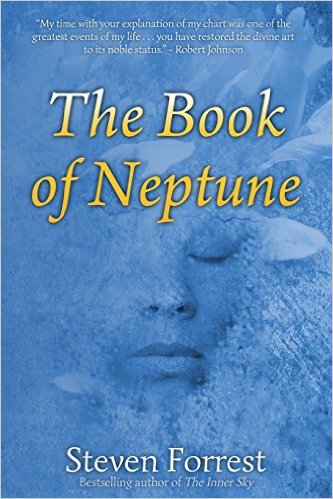
Review of “The Book of Neptune” by Steven Forrest

bookofneptunecover

[NOTE:–To get the most out of this book requires at least a rudimentary knowledge of astrology.  This need not be extensive, but should include knowing Neptune’s sign and house position in your natal chart, any aspects between Neptune and the other planets as well as where he currently resides in sign and house placement by transit.  A transit, for those of you unfamiliar with the term, refers to the current zodiacal location of a planet or other cosmic entity, including any aspects it forms to a planet in your natal or some other astrological chart, of which there are too many to get into here.  You can obtain this information for free from astro.com.  Once you have that, you’re all set to apply the information Forrest has provided in this outstanding book.  If you’d like to learn astrology’s basics, I recommend my own book, “Whobeda’s Guide to Basic Astrology”, which contains what I would have liked to have found when I was first learning about this ancient discipline.]

Even though I’m a professional astrologer myself, I’d been struggling with a Neptune transit for three years as this bad boy aspected first my ascendant, then Mars, then my Moon.  Neptune’s influences are often elusive while contributing to a foggy, lazy, dreamy, ungrounded feeling.  This was entirely foreign to me, though I must say it has certainly lent me a tremendous dose of understanding for those who are programmed that way.

As someone with a Capricorn Sun, Virgo ascendant, and Gemini Moon, everything about it was contrary to my basic cosmic imprint.  For those of you out there who are fellow astrologers, I’ll point out that my progressed Sun has been in Pisces for over a decade, which has been uncomfortable as well, but these Neptune transits have been like weathering a tsunami in a leaky boat whereas before it was simply a matter of being afloat in a swimming pool on an air mattress.

Needless to say, I was very uncomfortable with it, and some of my fellow astrologer friends, who are more familiar with these energies, tried to help, but the main thing they accomplished was only to convince me I wasn’t losing my mind.  Which reminds me, delusions and numerous forms of insanity are in Neptune’s domain along with drugs, alcohol and all forms of escapism.  Fortunately, one of those peers, who is also a close friend, was aware of this book, told me about it and I immediately bought a copy.  It’s a considerable understatement to say that I’m glad that I did.

Prior to Neptune swamping me with other-worldly, space cadet ditziness, I’d been an organized, disciplined, responsible, hardworking person.  Now I couldn’t stay focused to the point that if I hadn’t realized it was Neptune, I would have been deeply concerned that I was developing Alzheimer’s.  I kid you not.  As the cosmic surfactant, Neptune tends to dissolve what he touches, and I believe that includes your brain.  Not surprisingly, the god of the deep is associated with loss, disappearances, deception, psychic phenomena and abilities, spiritual experiences such as enlightenment and so forth.

To sum it up, Neptune left me in a state best described by WTF?  I advise my clients that there’s always a positive side to any transit, no matter how grueling, but I was having serious difficulty finding anything about this one that was useful.  The usual approach with a transit is to identify it, then direct that energy to something productive, yet I had never been less productive, more confused and generally feeling as if I were adrift in the ocean with no land in sight.  I had never felt so lost.

Then I was fortunate enough to get a copy of Forrest’s book and I must say that he nailed it.  He starts out by explaining Neptune’s realm, on the edge of the solar system, beyond which lie Pluto, Eris and possibly other planets or minor planets, the domain of comets and then interstellar space.  It’s an area filled with mystery and the unknown, so it’s no wonder it’s unfamiliar to someone who’s practical, logical and responsible by nature.

In describing Neptune’s effect when connected with the other planets, Forrest provides both the “Light Side” and the “Dark Side.”  This is tremendously helpful because sometimes with Neptune it’s not easy to tell which is which.  For the twelve houses, he provides snapshots which include an overview, significant quote and a sentence or two regarding “Leaking Energy” as a preface to several pages of in-depth explanation.  This is particularly helpful if you’re desperate, as I was, so you can grab the highlights before diving into the book as a whole.  He discusses loss, often experienced during a Neptune transit, as well as navigating those murky waters in a positive way.  He talks about synchronicity, which is typically ramped up during this time, both of a favorable and less favorable nature.  His section on how the zodiac sign Neptune resided in influenced the music for different eras is fascinating, as is his journey through history, recounting key events that occurred when Neptune was previously in his home sign of Pisces, as he is now.

As an astrologer, Forrest’s books have provided me with a much deeper understanding of Neptune’s influence than I had before.  It helped me understand numerous things which have occurred during this period and provided excellent ideas for dealing with them and channeling that energy that will contribute to my personal evolution in a positive way.  I feel as if he has thrown me a life-jacket when I needed it most, the fact this book came into my hands at this time an example of the synchronicity he describes.  It also makes sense that in the past few months I’ve become involved with a local astronomy group that conducts star parties every month where I’ve had the opportunity to look into Neptune’s realm, now understanding why this experience has felt so profound.  Somehow gazing out into space helped me feel more grounded.  Now I understand why.

If you feel as if you’ve lost your footing, are sinking in quicksand or adrift on a large body of water with no land in sight, there’s a good chance that Neptune is involved.  If that’s the case, I can’t recommend this book highly enough.  The price is a far cry less than a psychologist, especially one who doesn’t augment his or her practice with astrology.  It has not only provided me with the answers I was looking for, but made me a better astrologer who can be more helpful to any of my clients going through Neptune’s often dark and mysterious waters.

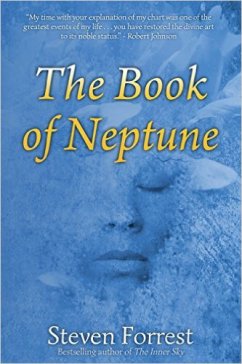
You can pick up a copy of Steven Forrest’s “The Book of Neptune” on Amazon here.

Teleportation: Science Fiction or Science Fact (Take Two)

startrekbeam2

My first blog on this subject focused primarily on the similarities between Lawrence Krauss’ description of teleportation found in his book, The Physics of Star Trek, to that contained in the Teleportation Physics Study done for the Air Force Research Laboratory by Eric W. Davis at Warp Drive Metrics.  I found that particularly amusing since the steps involved in the latter were nearly verbatim to Krauss’ speculations.  The show stoppers to this method, however, were, if nothing else, the computing requirements to track every subatomic particle, convert it to energy, transport it at the speed of light and then get everything put back together again.  Formidable, indeed.

A Form of Psychokinesis

This time I’m going to look at one of the other possible means that has enjoyed positive experimental results, i.e. P-Teleportation, which is a form of psychokinesis (or PK) similar to telekinesis.  Telekinesis is the moving or bending of stationary objects without using any known physical force other than mental energy.  Often considered no more than a cheap parlor or magician’s trick, this phenomena has been investigated scientifically for years with numerous demonstrations provided for high ranking military officials and trained observers.  I swear I’m not making this up.

This teleportation method is particularly fascinating to me as an science fiction author since two of the novels in my Star Trails Tetralogy employ mentally induced teleportation augmented/ amplified by a mysterious (fictitious) crystal I named cristobalite.  Needless to say, real-life experimentation in this regard blurs the lines between science fiction and science fact.

Robert Jahn (Dean Emeritus of the School of Engineering at Princeton) conducted scientifically controlled PK experiments at the Princeton University Engineering Anomalies Research laboratory and reported consistent results in mentally affecting material substances.  In the 1980s, Jahn noted at a meeting on the topic at the Naval Research Laboratory that such methods could be used by foreign adversaries to compromise aircraft.  It’s certainly no surprise that the military has a keen interest in such a phenomena, regardless of what “conventional wisdom” has to say about it.  If it works, it works, regardless of whether we understand why.

To quote a conversation from my sci-fi novel, Refractions of Frozen Time:
“My first thought is that they’re either more pure or maybe a different isotope than Tank crystals,” Creena stated.  “I’ll have Aggie run some tests and see if we can figure out what makes them work.”

“Who cares how they work?” Deven commented.  “Why does it matter? Can’t you just see what they can do instead?”

Creena paused, mouth agape, dumbfounded by his simple, yet profound logic.  He’s right, she thought.  It doesn’t matter.  Just because they didn’t know how the Think Tank connected thoughts with a specific location, much less got them there, didn’t make it any less effective.”

Documented Experimental Evidence

So, meanwhile, back to the teleportation report, psychic Uri Geller “was able to cause a part of a vanadium carbide crystal to vanish.  The crystal was encapsulated so it could not be touched, and it was placed in such a way that it could not be switched with another crystal by sleight of hand.”

Similar experiments were conducted in the Peoples Republic of China, the results of which were published clear back in 1981.  Gifted children were able to cause the apparent teleportation of small objects to another location meters away.  More research was conducted by the Aerospace Medicine Engineering Institute in Beijing which was reported in the Chinese Journal of Somatic Science in 1990 and translated into English by the Defense Intelligence Agency (DIA).  All objects teleported were “completely unaltered or unchanged from their initial state, even the insects were unaffected by being teleported.”

The collective results from several Chinese experiments corroborated similar conclusions.  Different research groups, experimental protocols and psychics were used as well as a variety of test specimens ranging from insects to radio micro-transmitters sealed within sealed containers comprised of a variety of different materials.  Time required for teleportation varied, ranging from a fraction of a second to several minutes, which didn’t depend upon the item, containment barrier, protocol or psychic involved.

Recording methods included high-speed photography and videotaping, which showed that, in some cases, the specimens would physically “meld” or blend with the walls of the sealed container, while others simply disappeared and reappeared elsewhere.  There was no indication that the object disintegrated/reintegrated.  The report noted that “The average person’s sensory organs were unable to perceive the specimen’s (ambiguous) existence during the teleportation process.”

I find the implications of the insects particularly interesting since they represent a living entity.  The micro-transmitter was also notable in that it showed “large fluctuations in the intensity (in both amplitude and frequency) of the monitored signal to the effect that it would either completely disappear or become extremely weak”, indicating the object was “nonexistent” or in an altered physical state during teleportation.

There was no change to either the specimen or the container’s wall/barrier with both complete, solid objects.  Best of all, these results were repeatable, and thus not a fluke, plus any possibility for fraud or sleight of hand were eliminated by the experiment protocols with several highly credible witnesses present.

During the Cold War era, the Soviet Union and its Warsaw Pack allies conducted numerous experiments on parapsychology and paraphysics, a field they referred to as psychotronics research.  The U.S. Army conducted similar experiments, now unclassified, that related primarily to remote viewing.

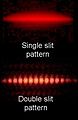
78px-Single_and_double_slit_4Some researchers indicated a new physics, which combined human consciousness with quantum and spacetime physics, was required to fully explain PK phenomena, a concept with which I heartily agree.  After all, early quantum physics experiments such as the double slit experiment indicated the affect of an observer from the git-go, but of course “rational” scientists have made every possible effort to explain this away.
Discouraging the belief in such things continues in varying degrees, from Dr. Venkman’s bogus telepathy experiments in the movie Ghostbusters to stories found in tabloids like The National Enquirer.  Is it possible that discouraging the belief in such things via mockery is an effort to prevent individuals from uncovering abilities that could endanger the powers that be?

Evidence of a 4th Dimension?

The author of this paper suggested a hypothesis based on mathematical geometry, i.e., the existence of a 4th dimension which introduces an extra degree of freedom.  He states, “It has been proposed that our space actually possesses a slight four-dimensional hyperthickness, so that the ultimate components of our nervous system are actually higher dimensional, thus enabling the human mind/brain to imagine four-dimensional space.”

This implies we can see into a 4th dimension and have four-dimensional thoughts.  This reminds me of the “thoughts become things” belief prominent among various motivational proponents such as Mike Dooley and others plus explained in the movie “The Secret”.  My thoughts also turn to all those items that I’ve carefully deposited in the proverbial “safe place” only never to find again.  Did I perhaps inadvertently send them to a 4th dimension where they are forever safe, albeit lost?

Physical or Metaphysical Phenomena?

I’m a physicist who spent over two decades working in the very corporeal aerospace industry.  In spite of my training as a physicist, however, I turned to the “dark side” to embrace astrology, so much so that upon my retirement in 2009 I came “out of the closet” as the professional astrologer who’s behind the website, ValkyrieAstrology.com.  In case you haven’t figured it out, I walk that nebulous line between physics and metaphysics with ease.  Astrology, as you probably know, is enthusiastically debunked by scientists in spite of the fact that it’s been around for millennia and works quite nicely in spite of their disbelief.

bookofneptunecoverLooking at things from the astrological side, weird, woo-woo phenomena like P-Teleportation resides largely within the domain of the planet, Neptune.  Steven Forrest is renowned worldwide as astrologer who has recently released a book entitled, “The Book of Neptune.”  Forrest explains that currently Neptune is in the sign of its astrological dignity, i.e. Pisces, in which Neptune’s energy is not only particularly strong but has historically delivered a huge shift in spiritual paradigms.  Forrest explains:
“Aquarius is a Fixed sign of the Air family.  Fixity, expressed negatively, is simply rigid–think of rigor mortis.  And Air is mental energy; it is about ideas.  Add Neptune to the mix, and you see spiritual ideas that have lost their elasticity and their ability to excite and enliven anyone.  The scholars and the bureaucrats have eclipsed the mystics.  This morbid condition is eternally the natural prelude to Neptune’s entry into Pisces and the spiritual awakening it implies.  Before the spiritual renaissance can happen, there is a period of spiritual deadness, in which dull, unchanging ideas and interpretations of the divine have replaced genuine magic.” (The Book of Neptune, p. 297)

“I would add yet another piece to the puzzle: the convergence of physics and mysticism.  Religion and science have often had an uneasy relationship. They still do, in many ways. And of course science itself is a religion to many people…And yet, I believe that the division between science and spirituality is healing–that science, at its best, is simply human reason struggling toward the truth of things…” (Ibid, pp. 304-305)

Forrest further suggests that the time between now and 2026 will see quantum leaps in this area.  I, for one, can hardly wait.

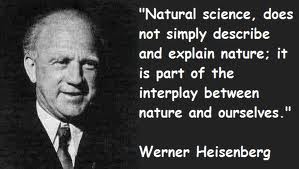
heisenbergquoteThis brings to mind forward thinkers like Fritjof Capra, author of The Tao of Physics, published initially clear back in 1976.  This book definitely served as a prelude to a melding of science and mysticism.  He begins this fascinating work with one of my all-time favorite quotes from Werner Heisenberg, which states, “It is probably true quite generally that in the history of human thinking the most fruitful developments frequently take place at those points where two different lines of thought meet.  These lines may have their roots in quite different times or different cultural environments or different religious traditions: hence if they actually meet, that is, if they are at least so much related to each other that a real interaction can take place, then one may hope that new and interesting developments may follow.”
deanw-bookPerhaps Neptune’s subtle influences will facilitate the removal of the stigma associated with metaphysical phenomena sufficiently to allow such collaboration.  I suspect researchers such as Dean Radin, whose specialty is psi phenomena, and popular physicist Michio Kaku, a proponent of a multi-dimensional universe, could come up with some incredibly interesting insights.
The coming decade indeed promises to be an interesting one.  My fondest hope is that I’ll figure out how to recover all those items I secured in that safe place, somewhere in the 4th dimension.


Teleportation: Science fiction or science fact?

startrekenterprise2

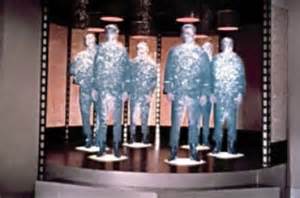
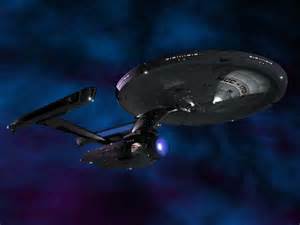
The first time I read Lawrence M. Krauss’ masterpiece, “The Physics of Star Trek”, was in January 1996, which is hard to believe. Time, among other things, definitely does fly, but doesn’t diminish my memory of how much I enjoyed that book. Being a physicist and a life-long science fiction fan, I absolutely devoured it, even though some of his conclusions were disappointing. For example, he virtually discounted the possibility of teleportation. He recounted the basic steps as defined in the Star Trek Next Generation Technical Manual as follows:startrekbeam1

  1. Transporter locks on the target.
  2. Scans the image to be transported.
  3. Dematerializes the item (or person).
  4. Retains the information in a “pattern buffer”
  5. Transmits the “matter stream” in an “annular confinement beam”.
  6. Reassembles it based on data retained in the “pattern buffer.”

Krauss then proceeded to explain in meticulous, often amusing detail, what the requirements would be to create both a matter stream of the atoms comprising the teleportee’s body coupled with an information stream of how to put it back together.

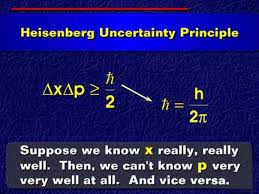
startrekbeam2To wit, considering that a person consists of approximately 10^28 atoms (ten followed by 28 zeros, for those of you who don’t recognize that notation), turning a 50 kilogram person into pure energy according to Einstein’s E=mc^2 would release more energy than that of a thousand 1-megaton hydrogen bombs. To do so would require heating him/her to a temperature a million times the temperature at the center of the Sun. Accelerating the resulting plasma soup to near the speed of light is another feat, to say nothing of also transferring around 10^28 kilobytes of data to the “pattern buffer” to reassemble it. On top of that, there’s Heisenberg’s Uncertainty Principle and various other quantum mechanical difficulties.

heisenbergprincRemember, however, that this was written back in the 90s and science has made vast advances since then as has our computational capacity. Personally, I would bet it could be done using the principles of quantum entanglement, but Krauss’ points are nonetheless well-taken. After all, he’s a professor of physics in his own right, at Case Western University when he wrote that particular book.
However, in Stephen Hawking’s foreword to said book, this phenomenally brilliant physicist stated, “Today’s science fiction is often tomorrow’s science fact. The physics that underlies Star Trek is surely worth investigating. To confine our attention to terrestrial matters would be to limit the human spirit.”

And apparently someone has done exactly that. At government expense. And much to my delight, quantum entanglement was indeed mentioned.  See?  I’m not as dumb as I look.

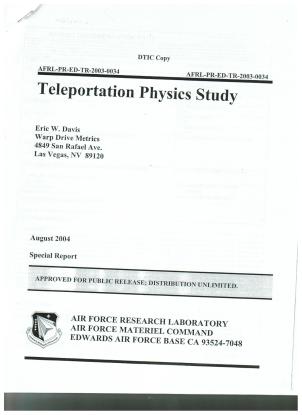
I never know what I’ll turn up when I go on a cleaning frenzy, more often than not, a desperate search for something in that proverbial “safe place” which I suspect lies in some other dimension. This last quest didn’t produce what I was hoping for, but instead I stumbled upon something even better, a paper from the Air Force Research Laboratory, Document AFRL-PR-ED-TR-2003-0034 entitled “Teleportation Physics Study.” This report is 88 pages long and is in front of me as I write.

USAFTeleportSeriously. I swear I’m not making this up.
When I worked at NASA, I came across all sorts of similar goodies and usually kept a copy, either electronic or hardcopy, provided it wasn’t classified, of course. In truth, I never saw anything of that nature, but plenty of stuff that was borderline and certainly not publicized.

This study was conducted by an organization known as Warp Drive Metrics located in Las Vegas for the Air Force Research Laboratory at Edwards Air Force Base. I don’t know about you, but I can’t help but notice that they’re both conveniently located not far from the infamous Area 51.

In the Introduction to this study the author states: “Beginning in the 1980s developments in quantum theory and general relativity physics have succeeded in pushing the envelope in exploring the reality of teleportation. . . . It has been recognized that extending the present research in quantum teleportation and developing alternative forms of teleportation physics would have a high payoff impact on communications and transportation technologies in the civilian and military sectors.”

He names five types of teleportation of which the science fiction version is one, but discounted as not included in the study, or so he says. Sad but true, you never know what jewel one of us sci-fi authors might come up with via our respective muses.

Of the five mentioned, my personal favorite is, as you would expect, the method using quantum entanglement, dubbed q-Teleportation, which he defines as the “disembodied transport of the quantum state of a system and its correlations across space to another system.”

I was particularly amused by Section 3.0, which addresses this particular category. The steps he summarized were as follows:

  1. Object placed inside the teleporter and scanned by a computer-generated and controlled beam.
  2. Scan beam encodes entire quantum information contained within the object into organized bits of information, forming a digital pattern of the object.
  3. The information is stored in a pattern buffer.
  4. The scan beam dematerializes the object into a matter stream.
  5. Teleporter transmits matter/energy stream and quantum information signal in the form of an annular confinement beam to its destination.
  6. The receiving teleporter reconstitutes the matter based on quantum information stored in the pattern buffer.

Hmmmmm. Am I the only one who thinks that sounds an awful lot like what Krauss described from the Star Trek Next Generation Technical Manual?

Section 3.0 goes on to describe many of the same calculations Krauss did.

Bah! Sci-fi discounted, indeed!

In Section 3.2.3 entitled “Recent Developments in Entanglement and q-Teleportation Physics”, he states, “Technical applications of entanglement and q-Teleportation are just becoming conceptualized for the first time, while a small number of basic physics breakthroughs and their related applications are in experimental progress at present.” (Emphasis added.)

You can’t make this stuff up.

Note that this study was conducted between January 2001 and July 2003. No telling what advancements have been made in the past 15 years.

My second favorite, p-Teleportation, is the “conveyance of persons or inanimate objects by psychic means” which he describes in Section 5.0. He goes on to mention psychics Uri Geller and Ray Stanford, who “claimed to have been teleported on several occasions. Most (emphasis added) claimed instances of human teleportation of the body from one place to another have been unwitnessed.”

Really? Ya think?

15385125_mlHe goes on to say, “There are also a small number of credible reports of individuals who reported being teleported to/from UFOs during a UFO close encounter, which were scientifically investigated….”   Plus: “There is a wealth of factual scientific research data from around the world attesting to the physical reality of p-Teleportation and related anomalous psi phenomena. The skeptical reader should not be so quick to dismiss the subject matter in this chapter, because one must remain open-minded about this subject and consider p-Teleportation as worthy of further scientific exploration.” He even mentions my favorite psi researcher, Dean Radin, PhD, of whom I’m a tremendous fan.


deanw-book

Dean Radin PhD has done highly respected research on psi phenomena such as telepathy.

e-Teleportation, defined as “exotic”, comprises “the conveyance of persons or inanimate objects by transport through extra space dimensions or parallel universes”. This involves superstring theories, electromagnetic – gravity unification theories, and brane theory.  Don’t mind me, but just because they can do the math doesn’t mean it’s possible, if you know what I mean.

Last but not least, vm-Teleportation involves wormholes and “engineering the spacetime metric” which was supported by numerous pages of mind-bending math including linear algebra, trigonometry and multi-variable calculus equations loaded with enough Greek letters to be its own fraternity.

I don’t know how much money the author received for this study, which took two and a half years, but it could probably be found in the public record using the contract number. I must say that it would be just about any physicist’s dream job. In no way do I mean to dismiss the knowledge and expertise required to put this together. This is a comprehensive, thoroughly investigated study which includes 253 references, most of which were to prestigious journals such as Physics Review Letters, Physics Today, Military Intelligence, Nature, Science, numerous books published by Cambridge and Oxford University presses and various others by esteemed physicist authors. The original document’s distribution list included 54 individuals, 36 of whom were PhDs.

Personally, I don’t have a problem with my tax dollars going for such research, even though it’s undoubtedly hidden in all those “black projects” such as those conducted at Area 51, Dulce Base, Wright-Patterson AFB and probably Dugway Proving Grounds. Better spent there than numerous others I can think of but won’t name so as to remain politically correct in today’s volatile environment.

Nonetheless, the truth is out there.  Possibly more than we could begin to imagine.  Including me, as a science fiction writer.

You can pick up a copy of Krauss’ book on Amazon here. For a copy of the “Teleportation Physics Study” contact the Air Force Research Laboratory, Air Force Materiel Command, Edwards Air Force Base, CA 93524-7048 and ask for Report AFRL-PR-ED-TR-2003-0034. By now it might even be available online since it was released for “unlimited distribution.”

6 Tips for Serial Writers

writingprocess

Or maybe, for clarity’s sake, I should say “Writers of Serials”. A “serial writer” could simply be someone who can’t stop writing, regardless of what it is, which fits more authors than I could begin to name. The folks I’m addressing are those of us who love our characters so much and get so enmeshed in our plot that it goes on and on, far beyond the binding of a single book. I admit to this freely, since my supposed single novel quickly evolved into at least a trilogy and ultimately a four volume tetralogy. An argument could be made that this is sheer laziness or ego, but for me there was just so much more story that needed to be told.

Just for the record, there’s a difference between a serial and a series. A serial is one where the basic plot line and story continues, often preceded by a cliffhanger in the previous book. Trilogies are often a serial, as is my Star Trails Tetralogy. Think of them as an epic story told in installments.

A series, on the other hand, may include the same characters, but not necessarily. Each will depict an independent plot or story line, such as the Nancy Drew series. Some series may even be thematic in nature, revolving around similar plots such as romance, romantic suspense, mystery or just about any other imaginable genre, but featuring an entirely different cast.

KONICA MINOLTA DIGITAL CAMERA

Now that we have that out of the way, let’s talk about writing a serial.

If your novel refuses to end because more plot twists, back stories and characters bombard you relentlessly, then you may as well recognize that you’re destined to be a serial writer. Be warned, however, that once you indulge yourself in that manner, you’ll probably never be able to produce a stand-alone story again. This is certainly not a bad thing, but there are a few things that are useful to know coming right out of the gate with that first book. So here are some tips I’ve developed from my own writing as well as numerous others I’ve read.

1. Don’t assume your readers are already familiar with your plot and characters. As an author it’s easy to just plunge forward with your story line, but there’s no guarantee that all readers will be familiar with what has transpired so far. Even if they read the previous book or books, time and numerous other stories may have separated them from yours, so a few quick reminders are always in order. This includes key plot elements leading up to the current problem as well as details such as what your characters look like. You may have them permanently ingrained in your head, but more than likely your readers won’t. In fact, it never hurts to have an occasional reminder throughout any book regarding their appearance. It’s always helpful to give them a certain habit you can throw in here and there that triggers an image as well as makes them more real.

Past events don’t require a long, boring summary. They can usually be worked in easily through character dialog such as a “Remember when?” conversation or short reference to something that occurred in a previous volume. These references can be humorous as well. Readers who remember that particular scene will enjoy the “inside joke” and new readers will feel as if they missed something good and be enticed to go back and read it. It adds depth and life to the characters and their relationships. How often do you reminisce with friends or relatives about important events? Allow your characters the same experience.

If you have an extremely complex plot it can be more difficult to bring new readers up to speed. I have jumped into a serial midstream before and had no problem figuring out what was happening while in others I was entirely lost and never made it through the book. In rare cases, if I was truly hooked, I’d go back and read the initial volumes, but I usually just quit reading and moved on to something else. Others, I read out of order but know I would have enjoyed it more in sequence.

This problem is particularly applicable to fantasy and science fiction stories where a new world or culture is involved. The more complicated the story’s context, the more important it is to fill in the reader and continue to remind them. Again, recaps don’t have to be long and distracting, only sufficient to make what’s going on make sense. Balance is required, of course. Too many reminders or redundancy are frustrating, too. This is where it’s great to have input from beta readers, including some who have not read the initial volumes.

2. “First the worst, second the same, last the best of any game.” I remember my kids chanting that little ditty as rebuttal when they would come in last in a competition, but ironically it can apply to serial writers. All skills improve with practice, which certainly includes everything we put into words, whether it’s another book, a blog, an article, website content or even something as dry as technical writing. The craft of assembling words together continually evolves. Thus, there’s a good chance that subsequent books will demonstrate your improved skills.

This is all well and good, but doesn’t mean that your first one shouldn’t be the best possible product. If it’s not, readers are less likely to continue on with the story. If you’re a new writer, this requires extra effort to make sure that first tome is in the best possible shape. This is likely to involve some investment on your part in a good editor as well as a professional book interior and cover designer. In some cases, you may even want to go back to that first one at some point and refine it, using your improved skills. I will be doing that for the first book in my tetralogy which has garnered a couple bad reviews due to missing commas. I felt a whole lot better about this when a friend and fellow author admitted she was also re-editing volume one of her series.

3. Avoid over-populating your story with extraneous characters. If they don’t move the plot along, then they don’t belong and usually shouldn’t be named. Too many people milling around in a book can be as confusing as going to a party where you don’t know anyone and are trying to learn plus remember everyone’s name much less what they do for a living. Red herrings may require a few people who pass quietly into oblivion, which is an entirely different situation. If you’re going to have a cast of thousands, then at least introduce them gradually and give the reader a chance to connect with each one individually before bringing in too many others. Once they’re all established, then it’s okay to have a massive group scene or discussion.

Which reminds me of another thing to avoid, names that sound or appear too similar, such as starting with the same letter of the alphabet and/or having the same number of letters. You want names that are distinctly different as well as fit the character, which is a subject in and of itself. Being visually distinct applies particularly to making life easier for speed readers. For example, don’t have one person named Horace and another named Hector. Names that are unique also make your character more memorable.

pageheart4. Don’t forsake minor characters from the previous work. Many times the hero or heroine is not the one a reader favors most. Thus, they may be disappointed or downright angry when a subsequent volume excludes him, her or even it. The character may have less emphasis that in the previous episode, but at least allow him/her/it a cameo appearance from time to time or explain their absence. For example, consider R2D2 and C3PO from Star Wars. They were part of the team and you expected them to hang around. In some cases, minor characters can provide a bridge to new major characters as well.

5. Cliffhangers: Pros and Cons. The ideal cliffhanger will make your reader want desperately to know what happens next and thus immediately buy the next book. On the other hand, they might be annoyed, feel cheated, and move on to more self-contained novels. Readers’ tastes vary tremendously, not only with regard to genre, but length. Some may be too ADHD to make it through a full length novel much less trilogy while others thrive on something they can get their teeth into. If you’re writing a serial, then you can always hope for fans like those who loved Harry Potter so much they’d stand in long lines at book stores awaiting the release of the next episode.

A cliffhanger that leaves one or more characters in dire straits with no obvious way out can be particularly annoying, especially if the sequel isn’t written yet! If the reader has to wait for months or longer for the sequel, you run a huge risk of losing them along the way. No matter how much they loved your story, once that time has passed there’s a good chance they will have all but forgotten it. Of course this is why you want to engage your readers, get them on your mailing list, tease them with excerpts on your Facebook page and so forth. If you have a great following, this may not be that much of a problem, but if you’re a new author it could be.

angry_girl_reading_bookHowever, for reader satisfaction, it’s often a good idea to at least provide some semblance of closure for the book at hand while leaving enough unanswered questions to entice them to continue on. Don’t drop them like a bad habit in the middle of an adrenaline rush. Put yourself in the reader’s place for a moment and consider how you react to such an ending. I think doing so may be fun for the author but painful for the reader. Maybe evoking an emotional reaction will make your book more memorable, but if it’s anger they may not come back. I always rank a book that can make me laugh or cry higher than those that don’t elicit a reaction. Emotional reactions stay in your heart (literally) as opposed to your head and thus will make your story more memorable, but it’s better to do this via lovable characters than irritating endings. I can still remember books I read decades ago that made me cry or laugh.
I’ve read the first volume of numerous stories, yet never made it to the sequel for several. Sometimes it’s simply a matter of time. As an author I do a lot of reading, editing and beta-reading for my peers which means I often don’t have the time to read something just because I want to know what happens. I have time for very little of what I would call “recreational reading.” How much I care about the characters is a big driver on whether I make it back for a sequel, but I have to admit if the plot is intriguing enough, I’ll want to know what happens even if I’m not thoroughly attached to the people involved. Another factor is length. If the episodes are more in the novella range as opposed to making “Gone With the Wind” look like a beach read, I’m more likely to make the time to read on.

6. When your serial is complete, consider making it a box set. Once my tetralogy was complete, I made it into a box set for both the print and electronic versions. This can have grand appeal to those who favor lengthy stories and of course minimizes the cliffhanger dilemma. It also gives you another opportunity for a big release party! I’ve been more than pleased with how well Star Trails has done as a set compared to the individual books.

In conclusion, I must say there’s tremendous satisfaction in writing a serial. Your characters continue to flesh out and assume a life of their own, often to the point where they virtually write the story for you. Mine got themselves into a variety of fixes, many of which I had no idea how they could possibly be resolved, until my characters themselves came up with the answers on their own. I must say that wrapping it all up was bitter-sweet, yet satisfying.

blackboard_writer2If you’re headed in the serial direction, or even just starting your first story, I highly recommend being a beta reader for other authors, which has taught me so much. We’re often blind to our own weaknesses until they glare at us from another’s work. I can’t begin to count how many times something has jumped out at me in someone else’s story, only to realize that I was guilty of the same faux pas.

Authors tend to be voracious readers, which is highly advised since it provides a wealth of information, if you but tune into it. This may take some of the enjoyment out of reading, but the writing lessons are worth it. One of my favorite sayings, No life is never wasted, you can always serve as a bad example, also applies to numerous works of fiction we’ve all encountered, especially in the Indie world where competent editing may be lacking. Needless to say, you don’t want your baby to be in that category.  Ironically, there’s more to be learned from bad writing than that which is so well-written you’re entirely immersed in the story.  Nonetheless, when you find yourself enjoying a book to that level, study it afterwards to determine why it worked so well.

I hope these tips garnered from my experience writing as well as reading the works of others will make your journey as a serial writer a little smoother.