Sci-Fa Epic Adventure: Review of “Thunder Moon” by Jeanne Foguth

thundermooncover

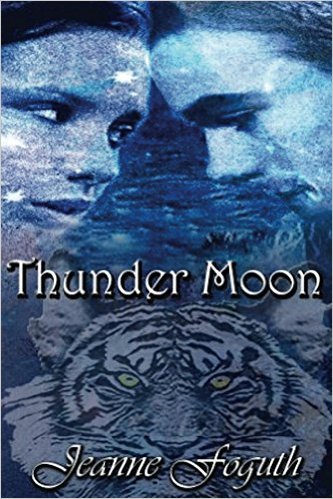
The second volume in Jeanne Foguth’s Chatterre Trilogy, “Thunder Moon”, picks up where “Star Bridge” ends. As someone who’s read all three volumes, but not in order, I highly recommend that they be read in sequence so that the complex plots and character relationships are easier to follow. Each builds upon the other, weaving a fascinating and intricate Sci-fa saga.

In this episode, Nimri’s brother, Thunder Cartwright, is worried the madrox will invade his world unless the star bridge is closed. He borrows his brother-in-law, Larwin’s, environmental suit, and sets out to do so with the assistance of GEA-4, Larwin’s androtic assistant. Meanwhile, Larwin’s sister, Tem-Aki, is looking for her brother, who’s been missing from his world long enough that she’s concerned that he’s dead. (Background on Larwin’s arrival on Chatterre can be found in volume I, “Star Bridge”.)

As you’d expect from any misbehaving and unstable Star Bridge/wormhole, Thunder winds up on yet another world, Kalamar, which is covered with what he fears most–water. Furthermore, he’s severely injured, but fortunately, rescued by Raine, a dragon shepherd, who’s on patrol in her ship, Nambaba, trying to recover a rogue dragon calf.

And thus the fun begins.

As always, the science fiction/fantasy elements of these stories are masterfully integrated as simple matters of planetary diversity. Dragons, a.k.a. madrox, are Chatterre’s mortal enemy, threatening to reduce it to ashes. However, on Raine’s planet, Kalamar, they’re carefully managed, a seeming paradox that further drives the story’s plot and suspense.

Mistaken identities, culture clashes, alien creatures, and a variety of interpersonal conflicts, including sibling rivalry and political intrigue, ultimately explode in this fast-moving, complex tale. The world building is exceptional, particularly with regard to how a human culture would operate on a world comprised mostly of water. Not only are the mundane details addressed, but other intelligent species introduced as well as a convincing and convoluted political structure.

If you like an intricate plot, lots of action and continual suspense with all sorts of surprises you can get your teeth into, then this trilogy is for you. But don’t forget to read “Star Bridge” first and then this one before move on to the satisfying conclusion in “Fire Island.” (Note that all three volumes are “clean reads” suitable for all ages.)

You can pick up a copy on Amazon here.

A Trip Down Memory Lane to a Galaxy Far, Far Away

star-wars-episode-4-advance-poster

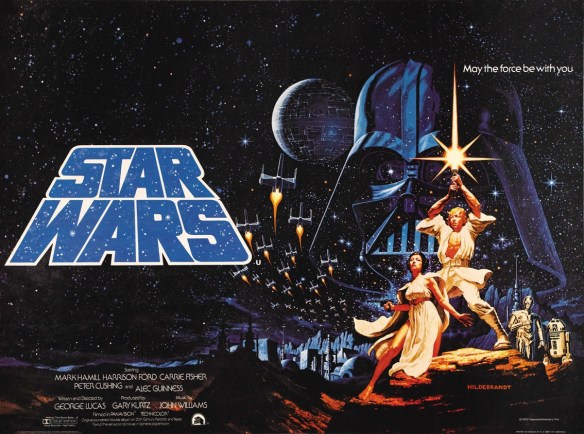
I don’t know if it was the Force, but something definitely awakened this past week when I FINALLY went to see the latest Star Wars episode, “The Force Awakens.” I’ve been a Star Wars fan since seeing the very first one back in May of 1977. I find it incredibly amusing that George Lucas was worried that it would be a flop and kept a low profile for its release, fearing humiliation if it did. Right. A flop that has spanned four generations, at least in my family.

I saw this latest one with my 42 year old daughter, who was three years old when the first one came out. Way back then, I was 29. Now she could take her three year old grandson to see it. That does something to me on so many levels that I’m not sure I can even describe it.

First of all, on an intellectual level, I marvel at anything that maintains its popularity for that long. Of course if you like old movies, you can find them, whether it’s on Netflix, the cheap video bin at Walmart or Turner Classic Movies. But few single titles can sustain that kind of audience. The only one I can think of that might even begin to compete would be “Gone With the Wind” which my mother saw when it was released in the 30s, then I enjoyed and subsequently my children. But it comes and goes, waning and waxing in popularity, whereas Star Wars has NEVER being invisible. In 39 years. Give that some thought.

I’ve always wanted to be a novelist, but I seriously wonder if I’d be writing science fiction if it weren’t for Star Wars. My initial idea for “Beyond the Hidden Sky” came from the opening scenes of that first flick, where R2D2 and C3PO blast off in an escape pod. The first step toward any story is “What if?” and for me that comprised “What if a rebellious teen-aged girl moving from one planet to another with her family got blasted off accidentally in an escape pod?” The result of that premise launched my Star Trails Tetralogy of four novels and a companion volume which number over 1500 pages. I know other authors similarly inspired.

I really enjoyed this latest episode, which was reminiscent in style and energy to the original trilogy. I really liked the new characters, at least the good guys, particularly Rey and Finn. My all-time favorite from the series was “The Empire Strikes Back” and, quite honestly, I wasn’t quite as enchanted by the more recent three. “The Phantom Menace” put me to sleep, actually, and the two after that were so-so, in my opinion. But this latest one resonated, right from the blasting of that iconic theme introducing the now-classic opening crawl. Instantaneously, I was back in 1977.

My eyes tend to water in places like the grocery store and Walmart, plus it’s allergy season here in Central Texas, so it may have only been that effect, which had me wiping my eyes from that point on. I’ve mentioned in a previous blog (see “RIP Columbia: Picking up the Pieces”) how memories are stored in both your head and heart with those that reside in the latter coming back full-force, replete with a physical reaction, when stimulated. Clearly, that’s where my memory of Star Wars resides.

That feeling of being taken back in time, coupled with lightspeed flashes of all that has transpired in my life since 1977, had a profound effect.

Not to digress, though I tend to do that a lot, but I remember reading about a study several years ago where they investigated the effects, if any, on rest home residents when they were exposed to music that was popular when they were young. Interestingly enough, the oldsters figuratively got younger! They acted younger and the physiological indicators such as blood pressure and such improved as well. It’s like when all those old feelings come back, your body responds and reverts to that place in space and time.

Time certainly is an illusion, something I may understand slightly better that some folks since I have a physics degree. I’ve had a tremendous amount of fun playing with such possibilities in my novels. But here on planet Earth, so far we haven’t conquered time. I may have been 29 when Star Wars was first released, but now I’m a great-grandmother. Believe me, I don’t feel that old, and I certainly didn’t feel that old watching Episode VII earlier this week.

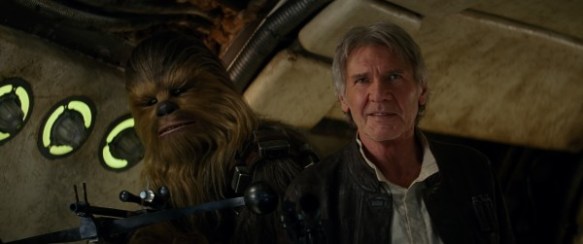
At least I didn’t until Han and Leia came on screen. Seeing them OLD reminded me that I, too, was OLD! How could that be? I was jolted back to the present and that rush of nostalgia slammed through me like decelerating from lightspeed. I tend to be pretty hard on myself, expecting to look and have the energy I did when I was say, well, to be reasonable here, even 50. After all, I don’t feel that old inside my head. But I am. I look it, no matter how much I try to deny it, and my body feels it, particularly my right knee which functions similar to an odometer.

hanandchewie

Yes, something happened when I saw Han and Leia in all their 60s glory. Time marches on and waits for no one.

Will this movie have a similarly profound effect on me like the first one? Maybe. It’s made me acutely aware that time is not standing still. If there’s anything I want to do before I die, then I’d better figure out what that is and get to it. I’ve already been reminded of that a few times recently when contemporaries of mine have passed on, which is starting to happen with increasing frequency. It’s time to forget about the things I didn’t do in the past 39 years and concentrate on what I want (or could) to accomplish in the years I have left.

They say that your life flashes before your mind’s eye when you die. Perhaps compressing 39 years into a nanosecond was a freebie from the Universe, reminding me that time, indeed, does not stand still. I remember a similar feeling the first time I heard “Sunrise, Sunset”, that sentimental song from “Fiddler on the Roof,” back when my children were still young. Now they’re all grown and even their children are grown or will be soon. It’s incomprehensible that I have a grandson in the U.S. Marines with two others married and having children of their own.

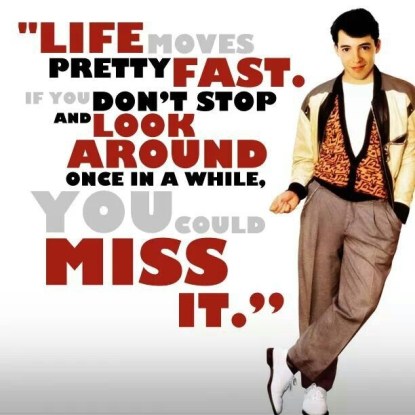
buellerquotePerhaps Ferris Bueller said it best when he declared “Time moves pretty fast. If you don’t stop and look around once in a while, you could miss it.” That was in 1986, a mere 30 years ago. Matthew Broderick is no spring chicken these days, either.

OMG, where has all that time gone?


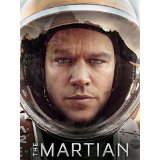
Challenges of Space Exploration: A NASA Insider’s View of “The Martian” (Movie Version)

martiancover

[Spoiler Alert: This constitutes one massive spoiler if you haven’t already seen the movie. I comment on specific situations depicted onscreen based on my experience working as a NASA contractor for over 20 years. So if you’re even slower to see movies than I am, are planning to see it, and prefer to thoroughly enjoy the suspense, then bookmark this blog and read it later.]

First of all, I want to say I thoroughly enjoyed this movie which I finally saw over the holidays while visiting family. My intent here is not to criticize since I believe it was exceptionally well done. It employed a lot of fascinating details, ingenuity and great suspense throughout. Fortunately, Hollywood has come a long, long way depicting NASA-related movies since the movie, Armageddon, which I considered a complete debacle as far as the technical details were concerned.

I suppose being a physicist and geek who worked for NASA as a contractor from 1988 – 2009 are what drive me to pick at technical details, perhaps as a matter of ego to show my knowledge. Whatever it is, I can’t help it, and to me such details are interesting while most normal people would simply enjoy the movie for what it is and give me one of those looks that screams, “What’s your problem, Bozo?” I’ve mellowed on this a bit myself, but I still maintain that a certain level of scientific accuracy is important. But I’m a geek, so what do I know other than it was science fiction that inspired me to become a geek in the first place? Does it really matter if it’s factual? Probably not.

IDL TIFF file

Anyway, “The Martian” is based on the book of the same name by Andy Weir, whom you can learn more about on his Amazon Author page. There’s also an interesting forum on Amazon where various readers have commented on the technical accuracy of the story (or lack thereof), which of course appealed to my inner geek. Having seen and enjoyed the movie, I plan to read the book. I assume that the author did a lot of research putting this story together and can thus take credit for the fact the movie was realistic enough to be credible and even admired by someone like myself. Based on my experience, here are a few comments.

1. My first job with NASA was in the Life Sciences Division at Johnson Space Center in Houston, Texas. Part of their purview was the well-being of the astronauts. The majority of their experiments conducted on the space shuttle and International Space Station were directed primarily at how exposure to microgravity, increased radiation, close quarters and isolation affected an astronaut’s mind and body. Colonization of distant worlds such as Mars has been a topic of NASA research for many years, including what crops would grow and thrive in conditions different from Earth. Needless to say, being self-sufficient is the ultimate goal.

That said, I suspect that if we had an outpost on Mars that by that time we’d know enough about such things as potential crops that there would have been more for the story’s hero, Mark Watney, to work with besides potatoes which were intended to be consumed as food. I’m reasonably sure that part of the mission would entail planting a variety of things, perhaps for the benefit of the next crew.

Which brings me to my next comment, the length of the movie’s mission being 60 days.

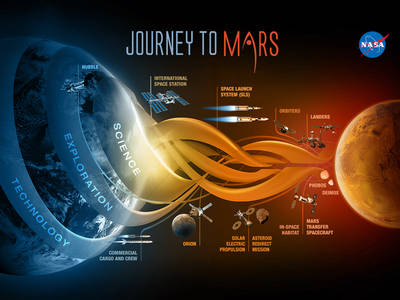
journey_to_mars

2. It takes a long time to get to Mars, depending on the available propulsion technology, but let’s just say using currently known or at least acknowledged sources, it’s going to be around a year or more. I suppose for the very first mission to the Red Planet that a duration of two months is possible, but I suspect that it would be longer. I also suspect that the habitation module constructed would be one that would be designed to be permanent, part of an elaborate colonization plan and not a primitive throwaway. Given the sophistication of their space vehicle, Hermes, which even had sectors that rotated to create artificial gravity, it’s more likely that part of that spacecraft would have constituted their living quarters and been left behind when their mission ended. This would have lightened the return load as well.

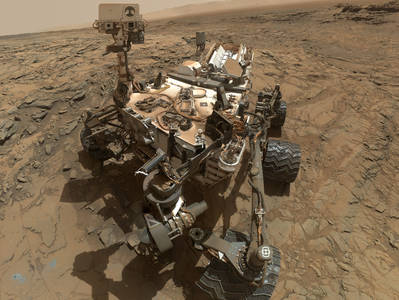
3. I thoroughly enjoyed the connections to previous Mars missions and how they provided resources for Mark to contact NASA. Whether that could actually be achieved I don’t know, but for me it was feasible and clever enough that I had no problem with it.  If you’re not at least partly awed by these previous accomplishments that comprise sending and then actually controlling a vehicle on another planet, then you simply don’t understand what it entails.

marsrover4. NASA has definitely been known to blow up rockets, not only in the early days of the initial space race with Russia to get to the Moon in the late 50s and 60s, but even more recently as many of you may recall with the Space Shuttle Challenger accident on January 28, 1986. Private rocket companies more recently are having a similar problem. Rocket fuel is highly volatile, systems complex, and problems are inevitable. Thus, when the rocket they put together in record time to send supplies blew up it wasn’t much of a stretch. Anyone who didn’t see that one coming hasn’t been paying attention to the space industry and its explosive history (pun intended).

But there’s more to it that that. Having worked in Safety and Mission Assurance for most of my years at JSC, I was privy to quite a few dirty little secrets. NASA makes every effort to identify every possible hazard and document them all in Hazard Reports. These go far beyond acknowledging the problem itself. Some are classified as Critical, i.e., could cause a problem but not a lethal one, while others are classified as Catastrophic, which entail loss of life and/or millions of dollars worth of equipment. Once hazards are identified, it’s mandatory to identify preventative controls. The severity of the consequences of failure determine how many controls need to be in place. Systems that can cause a catastrophic hazard are required to be three-fault tolerant, meaning three things need to fail before the worst case scenario can occur.

InSight in ATLO with back shell

The back shell of the InSight spacecraft is lowered onto the lander in a clean room at Lockheed Martin.

However, there are some systems that defy that level of safety via controls and are thus considered an accepted risk. For example, unless you’re a pilot you probably would never think of a “bird strike” as being in that category, but if a spacecraft on takeoff or landing strikes a bird, it can have dire consequences. Other risks are accepted for a variety of reasons, but it gets complicated so I’ll save further explanation for a future blog, such as some of those “dirty little secrets” that relate to the two space shuttle tragedies. [NOTE:–With the 30th anniversary of the Challenger accident coming up this month, you can watch for one soon.]

Back to the point of the rocket blowing up in the film, besides the inherent danger of propulsion systems in general, bypassed quality assurance inspections or those performed by over-worked technicians would increase the likelihood of problems, making that unfortunate event quite feasible.

5. The next safety-related situation would be the malfunction and subsequent explosion that destroyed Mark’s potato garden. Certainly he did some modifications beyond its original intent, but it’s still unlikely it would have been that fragile. Considering some of the nasty substances that go along on a space mission, explosions are always a possibility. This also refers back to the fact that I doubt their outpost would have been so makeshift in the first place. Mars’ thin atmosphere is not as efficient at destroying meteorites as Earth’s, plus the main asteroid belt lies between Mars and Jupiter, so they’re a bigger problem by proximity as well. I sincerely doubt that NASA would ever erect such a cheesy structure as part of a planetary outpost. This, of course, applies to the matter of the antenna being destroyed as well. Furthermore, as mentioned in the Amazon forum, the force of the Martian wind is lower, given the reduced atmospheric pressure compared to Earth’s.

6. Several of the means employed in the movie were theoretically feasible but unlikely, such as ditching the capsule nosecone and replacing it with canvas or blowing the Hermes module for some extra propulsion. A gravity assist is certainly a possibility since that technique is used routinely for interplanetary exploration missions.

mars1

7. Lastly, I’m really skeptical about Mission Control not telling the crew earlier that Mark was alive. That just doesn’t make sense to me. However, NASA employees, no matter what rank they happen to be, are human and subject to bad judgement calls and mistakes, so it’s certainly not impossible. Subsequently, such individuals tend to quietly disappear, probably reassigned to the USA equivalent of Siberia.

In a situation like that in the movie, such a decision would undoubtedly be routed through the Astronaut Office and I suspect that the returning crew would be given that information posthaste. It’s important to know that communications between Mission Control and a manned craft are channeled through  a single source known as the Capcom, short for “capsule communicator”, a vestige derived from the early days of the space program.  This individual is traditionally an astronaut.  This person would undoubtedly be aware of the situation and thus wield considerable influence.

Not distracting the returning crew from their mission simply wasn’t sufficient rationale. Astronauts are human, too, and certainly have emotions which can drive them to do some crazy things in their private lives, but given the story’s circumstances and my experience at NASA, I really believe they’d be treated as the professionals they are and given all available information. They’d be far beyond pissed off to find out they’d been kept out of such an important loop.  Whether they’d go “rogue” or not is a possibility but doubtful without full ground support.  Spacecraft systems are beyond complex with each one having a team of experts who would assist with calculations for possible solutions.

Consider, as stated in the end of the movie credits, that it took 15,000 people to produce that movie.  Far more than that support the space program with each system component typically having a dozen or more engineers that know it inside out.  Astronauts couldn’t possibly have the necessary knowledge to make technical decisions that deviate from their training for a specific mission.

If you’re still with me at this point, thanks for listening. I really loved this movie, technical and operational flaws notwithstanding, because this is exactly the kind of film I love. My hope is that it inspires future generations, the ones who will someday walk on Mars, hopefully with a three-fault tolerant infrastructure as opposed to what astronaut Mark Watney had to deal with in “The Martian”.

You can pick up a DVD of the flick on Amazon here.

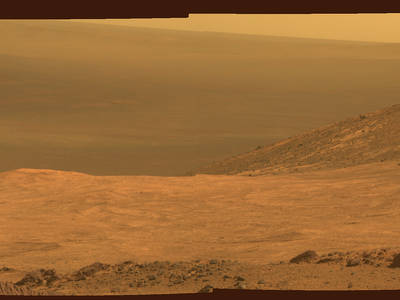
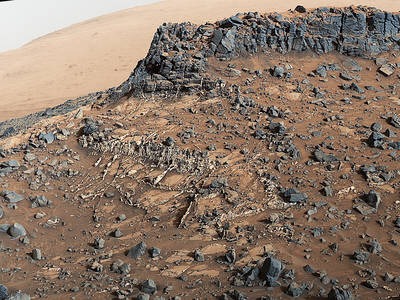
Mars Photos courtesy of NASA


An Outstanding & Thought-Provoking Time-Travel Tome

talesofelasticlimitcvr

While the premise of going back in time to alter history isn’t new, the author’s skill in its presentation coupled with his unique insights will satisfy science fiction and history buffs as well as anyone with an eclectic taste for literature. Indeed, this story possesses the makings of a classic. It’s highly intelligent, flawlessly edited, and I love the author’s straight-forward yet ethereal style which flows with the essence of timelessness that you’d expect in a book that involves time travel. His skillful writing combined with the fact his name is a pseudonym leaves the impression that he may, indeed, be a time traveler himself. The title is perfect, a thought-provoking glimpse of the nature of time and how far it could be stretched were it breached or controlled, the scope of its content undoubtedly epic.

As this tale begins, time travel has already been achieved and a multi-disciplined committee of academics privy to the technology directs its use to keep humanity’s history on the proper track. Three previous attempts didn’t work out as hoped, but the problems have supposedly been solved by scientist, Lawrence Henry, a.k.a. Hank, whose breakthrough discovery removes the troublesome paradoxes. Thus, Hank and his fiancée, Frances Newton, set out to establish humanity in a New Historical Age.

Those with whom they interact see them only as a very tall, mysterious gentlemen and a red-headed woman who serendipitously slip into their respective eras at historically important times. Each fable is independent and captures a nexus where a decision made by an individual, some famous historical figures, others not, takes the world in a new direction. These included encounters with Thomas Jefferson, Albert Einstein, King Henry VIII, Marcellus and Archimedes. As a reader I was immersed in the flavor of the moment and felt as if I was observing a profound moment in history unfold.

Events prior to those in recorded history were touched on as well, such as the invention of writing and numbers, the wheel, the transition to an agrarian society and even a new look at man’s best friend. The episodes operate on multiple levels which will satisfy casual readers as well as history lovers or those with philosophical tendencies. Each carefully selected situation demonstrated the author’s thorough understanding of history, was well researched, and included some little known facts packaged as a tremendously enjoyable story stylishly written. I haven’t read the preceding volumes in the Elastic Limit series, but this one stood well on its own while nonetheless leaving me with the desire to read the previous volumes, which this one ties together.

Pick up your copy on Amazon here.

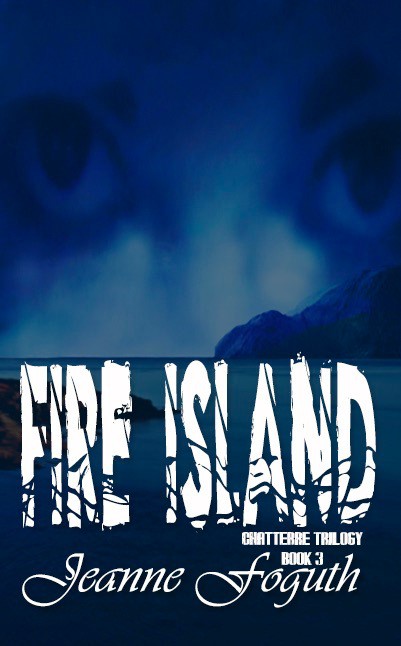
“Fire Island” (Chatterre Trilogy Vol. 3): Sci-Fa at its Best

fireislandcover

This well-written novel is the worthy third book in the Sci-Fa Chatterre Trilogy. The author does an excellent job of melding science fiction and fantasy together in another convincing story of another world. This particular world is similar enough to what ours was a century or two ago to be vaguely familiar then mixed with high technology imported via a spaceship wreck you can learn about in the first book, “Star Bridge.” Having not read the second book, “Thunder Moon,” I was a bit lost on the full context of this one, but the immediate action and suspense were enough to grab my interest without knowing the full story of how Tem Aki got into her precarious situation.

Tem Aki is on a quest to find her brother, Larwin, whom you meet in “Star Bridge.” Her journey is substantially complicated when she finds herself on the other side of the planet via an encounter with a time/space anomaly. Fortunately, there’s a settlement nearby where once again you are treated to Jeanne Foguth’s outstanding ability to depict major culture clashes when Tem Aki meets Cameron, the somewhat reluctant leader of a tribe-like culture. Since she emerged from the ocean, albeit in a spacesuit, he thinks that she’s a goddess who has arrived to help him celebrate an upcoming religious ceremony as well as deal with some troublesome individuals who are losing their religious faith as well as trying to undermine Cameron as their leader.

Cameron’s culture is well-developed as is their traditional belief in the madrox dragons, specifically the great dragon-mother, Shaka-uma. The problem lies in that fact that no one has seen her in a long time so a few troublesome doubters are declaring that they never existed. Meanwhile, Cameron is trying to prepare for their annual pilgrimage to honor Shaka-uma, which his adversaries are trying to sabotage. Tem Aki is thrown into this controversy which is further complicated by the fact that there are no other females around in the immediate environment which can best be compared to a monastery.

The misunderstandings between them are at times hilarious and if nothing else demonstrate how easily such confusion can develop when two cultures collide. Tem Aki’s technology, which includes my favorite android, GEA-4 (whom you can also meet in earlier volumes), of course convinces Cameron of her godhood. His fascination when GEA-4 stares into the sun to recharge is classic. Tem Aki’s revulsion toward the primitive, chauvinistic culture is certainly convincing as is the rationale Cameron maintains that she’s some form of divinity.

Cameron’s challenges alone would make a fascinating read but adding Tem Aki into the mix is the coup de grace for a great story. I don’t want to delve any further into the plot because I don’t want to throw any spoilers out there, but believe me when I say that there are plenty of complications, surprises, believable characters, Kazza is joined by another delightful mystic cat, and a satisfying ending. I recommend reading the books in sequence, though this one can stand on its own if you’ve at least read “Star Bridge.”

Pick up your copy on Amazon here.

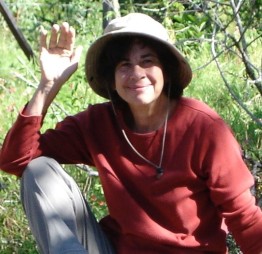
jeanne

Connect with the author, Jeanne Foguth:

Visit Webhome Jeanne Foguth

Follow on Twitter @JeanneFoguth

Get Pet tips, etc. http://foguth.wordpress.com

Another One Bites the Dust

2015over copy

Year, that is.

I suppose that title gives some clue to my age, at least to those who remember its context. They go by faster and faster. I’ve always liked the analogy comparing life to a roll of toilet paper, i.e. it goes faster toward the end. Scary but true.

Every December I always look back at the list of goals I made the previous year to see how I did. I usually achieve most of them, which is a testimony for writing them down so you don’t forget what they are. Of course that works both ways. If you don’t record it then you may forget to pursue it in the first place but on the other hand, if you finished something without listing it then it could slip into the past unnoticed, meaning you don’t take credit for it. I don’t know about you, but sometimes I need all the credit I can get.

Fortunately, I have tangible proof of at least some of the things I accomplished. Some have been hanging over my head for years. For example, finishing up my science fiction series, the Star Trails Tetralogy. I think I originally said the final volume would be coming out back in 2013. Hahahaha! That sure didn’t happen. But this year it finally did. Refractions of Frozen Time came out in March, about the same time my contractor, Tracy, finished up remodeling my sunroom into a guest room. I could have quit right there and taken pride in my achievements, with due credit to Tracy, of course. Both those goals had been on my list for years so those were biggies.

But once all four books were complete, then I set to work putting together the box set I’d envisioned ever since I realized my story would require more than one book to complete. I had some extra incentive to get that one accomplished when I agreed to share a book fair booth with three other authors. It took a lot more work than expected, but somehow I finished that one, too. Yay!

Then I had a couple nonfiction ebooks I wanted to get in print. Particularly Whobeda’s Guide to Basic Astrology and The Family History Fun Factor. Done! I still have one more to go but plan to get that out by the first of 2016.

So I’m celebrating and invite you to join me.

GIVEAWAYS!

GRGivestars copy

I’m giving away 3 copies of the Star Trails Tetralogy Deluxe Box Set here.  All books are autographed by yours truly and it includes a fun swag pack of goodies, too.

WGTA-userfriendly

If you’re interested in astrology, sign up to win one of three autographed copies of Whobeda’s Guide to Basic Astrology here.

Both giveaways end December 13 which will hopefully allow enough time for the winners to receive them by Christmas. (Sorry, USA only)


Here are some other deals you might like. If you have any sci-fi fans on your holiday gift list, remember you can always “gift” them a copy.

Pageflex Persona [document: PRS0000039_00005]


THE SAPPHIRAN AGENDA

The Sapphiran Agenda, backstory of Thyron, the telepathic walking plant everyone loves in Star Trails, is now FREE on Smashwords here.

bthsreallydoneit copy

BEYOND THE HIDDEN SKY

Star Trails Volume 1, Beyond the Hidden Sky, is free if you join my Preferred Readers here.

STTtiredofwait150ppi copy

STAR TRAILS TETRALOGY EBOOK BOX SET

Get the entire Star Trails Tetralogy box set electronically for half-price on Smashwords here.

Promotional price: $2.99
Use Coupon Code: VP22Z
Expires: January 5, 2016

WGTAFrontCoverHC150ppi


WHOBEDA’S GUIDE TO BASIC ASTROLOGY

Get Whobeda’s Guide ebook for 75% off here.

Promotional price: $0.99
Use Coupon Code: QD49E
Expires: January 5, 2016

If you’d like a paperback copy you can get one for 20% off at Create Space here.   Use Discount Code 4KCHSKEW

Merry Christmas, Happy Holidays and may you have a prosperous New Year!  Meanwhile, I’m going to go back and work on that list for 2016.  After I take a nap.  I’m pretty tired after realizing how much I actually got done this year…


Science Fiction and Fantasy Converge in Jeanne Foguth’s “Star Bridge”

starbridgecover

This delightful tale bespeaks another scenario where a spacefighter jock from a world annihilated by war and greed is shipwrecked on a lush world where its occupants are in tune with nature, superstitious and possess psychic as well as mystical abilities. While this is not a new theme as anyone who has seen “Avatar” or “Dances with Wolves” can attest, the characters are unique and refreshing, their interactions convincing and the descriptions vivid from the massive sequoia trees in which their dwellings are built to the vast array of herbs that the heroine, Nimri, uses in her role as a healer. Some themes never wear out in spite of repeated use when skillfully adapted to new characters facing age-old dilemmas.

Nimri’s peaceful life has been disrupted by the death of her harsh great-grandfather who was their tribe’s former leader, placing her in the role in which she’s expected to take up the Staff of Protection and assume the role of Keeper of the Peace between her tribe, the Chosen, and their nemesis, the Lost, who reside on the other side of the river.

Her great-grandfather has done a sorry job of preparing her, however, having bombarded her with constant criticism and demeaning comments which have left her devoid of confidence in her nascent abilities. Before she can even consider her new responsibilities, however, she must deliver his ashes to Sacred Mountain and scatter them at The Guardians’ feet, a journey from which no one has ever returned. Nonetheless, she swore an oath that she would do so and being a woman of her word, Nemri sets out on the hazardous path to her destination, joined along the way by her 600 pound feline companion, Kazza. Upon finding the sacred spot, she release’s her progenitor’s ashes. A moment later a disturbance shakes the ground and a tree falls, shoving her into the mysterious dark space between the looming stone Guardians.

Meanwhile, Colonel Larwin Atano, a Guerreterre Shadow Warrior, crashes unexpectedly on what he believes to be an uncharted planetoid. He blames the accident on software faults in the sexy-voiced android, GEA-4, which he is beta testing. As they exit their ship to seek shelter on what appears to be a lifeless rock, they find a tunnel which they follow. Eventually they encounter a beautiful, unconscious woman amidst the rubble in the cavern and the fun begins.

The misunderstandings resulting from Nimri and Larwin’s vast cultural differences are at times downright hilarious. Once he sets eyes upon a verdant world covered with vegetation, he envisions the vast wealth that will be his when he somehow gets back to Guerreterre where only the richest of the rich can afford house plants much less trees. Nimri, of course, thinks he’s the personification of one of the Guardians. Fortunately, GEA-4 facilitates the language barrier but while some understanding follows, the often humorous cultural barriers persist. Kazza adds yet another dimension, tying it all together with that wisdom seen in the eyes of his many feline cousins, large and small.

There is much more substance as well as plot intricacies in this enjoyable story than I can go into here to say nothing of avoiding spoiler territory as well. The imagery and details of this distant world are vivid and convincing, particularly Nimri’s gardens and tree-based abode. The culture with its myths, superstitions and traditions is well-developed, providing a strong basis for a trilogy of which this is the first volume. This charming crossover between science fiction and fantasy has elements that should satisfy fans of both genres. The main characters are complex and engaging while the supporting cast lends additional color and conflict. There are plenty of surprises along the way, especially in the finale, which brings a satisfying ending while leaving plenty of room for sequels that I look forward to reading. If you’re looking for an entertaining read with great characters and just the right amount of suspense highlighted by some great culture-clash humor, “Star Bridge” should fit the bill. You can pick up your copy at the Amazon link below.

Star Bridge on Amazon

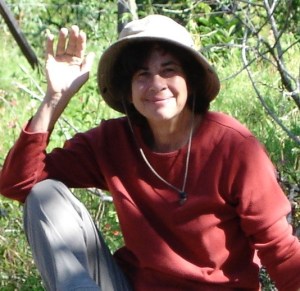
Meet Multi-talented, Multi-genre Author, Jeanne Foguth

jeanne

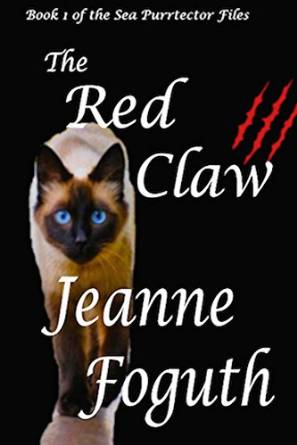
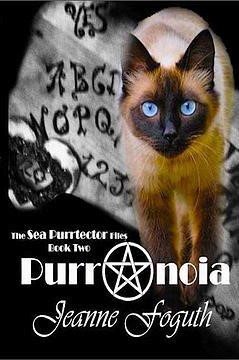
Jeanne Foguth’s story of Xander de Hunter as chronicled in “The Red Claw” was an absolutely purr-fect light read which you can learn more about in my review of that title. As a cat lover I am hooked. To my great delight, she has just released Xander’s latest tale (or perhaps I should say “tail”?) entitled “Purr-a-noia” with another “Sea Purrtector Files” episode promised for next year.

Yet these charming cat adventure stories are but a small part of Jeanne’s repertoire. If you’re a romantic suspense, fantasy or science fiction fan you’ll want to get a hold of her other novels as well. Her vast travel experience coupled with her attention to detail create engaging characters in the midst of exotic settings which will pull you in and leave you wanting more. So without further ado, let’s learn more about this fascinating author and creator of my favorite cat hero.

MF: Clearly you’re an avid cat lover, which seems to be the case with numerous writers. What besides a strong affection for felines inspired you to write The Red Claw and its upcoming sequels starring Xander de Hunter?

JF: Yes, I love cats. In fact, I like most types of animals and over the years, we have had a wide assortment of furry and feathered friends. In 1981, we were adopted by Rom a.k.a. The Ramakazi, who became my good friend, fellow gardener and writing partner. We shared an L-shaped desk where he lounged on his keyboard while he looking out the window and tweeting to the birds. This allowed me to write freelance projects without him feeling the need to edit my work.

Rom was a major part of our lives until he died at 16.5. For years, I thought of various ways to write a memorial to him and when we were living aboard EvenStar, our Gemini 105MC, I imagined how Rom would have enjoyed the adventure…. by the time we got to Jamaica, where The Red Claw is set, I began putting notes in a file. Initially, I thought that I would only write one book, however I had so much fun that The Sea Purrtector Files is turning into a series. Purr-a-Noia (#2) is newly released and The Vi-Purrs (#3) will be out in early 2016.

MF: Do you have a favorite real-life cat that demonstrates Xander’s traits?

JF: Rom, who Xander is based on, loved technology and seemed very adept at turning things on and opening things – not so good at turning them off or closing drawers and doors. His technical expertise is the main reason we realized we could not share a keyboard and mouse. He was also “Mr. Cool’ when startled, so even when he decided that retreat was the wise choice, he never tucked tail and ran – he exited with dignity. In your review of The Red Claw, you suggested that Xander was sort of a feline 007 and that captures Rom’s character quite well.

BTW, the Siamese cat on The Red Claw‘s cover is Rom. We don’t have many photos of him, so my cover artist, Kiara Graham, adapted the same photo for Purr-a-Noia‘s cover.
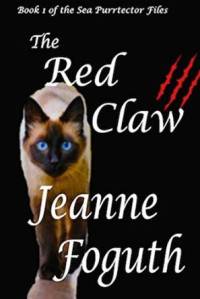
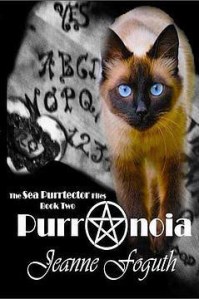
redclawcoverpurranoia

MF: He was certainly beautiful and it’s like he’s looking through you with those blue eyes. I can’t think of a better way to immortalize a beloved pet than in a series of novels. What other animals have you had for pets besides cats?

JF: Hmmm, that is a long list. When I was a child, we lived on a dairy farm, which was at least a half mile from the next neighbor. Aside from cows, we had horses, a dog, sheep (rams are NOT good pets, but lambs are adorable), pigs and chickens.

Over the years, we have usually had a cat and sometimes a dog, but we’ve also had a variety of outdoor pets, which included birds, bunnies and even a few goats (I called them my gardening crew and used them in my war on kudzu ;-).

MF: Your biographical sketch mentions that you have a background in technical writing. Which industry was it applied to?

JF: Initially, I helped write J.C.H.A.(hospital procedure manuals) and preventive maintenance guidelines. Later, I wrote computer-user manuals as well as several free-lance projects that included policy and procedure manuals for some small companies.

MF: How do feel your technical writing experience influenced your fiction writing?

JF: I am a stickler for accuracy. It was drilled into me that J.C.H.A. manuals were used by hospital staff as a guide to treat life-threatening conditions.

MF: I can relate. Accuracy was drummed into my head when I was a techwriter at NASA. Speaking of accuracy, clearly you have traveled extensively which enriches your writing’s sense of place with a strong sense of authenticity. Your descriptions of Jamaica made me feel as if I was there such that I would recognize it if I ever was.  Which location is your favorite and why?

JF: My favorite is wherever our next destination is 😉

I also like where I am and where I have been. Each place has had good and bad points. For example: in Alaska, the Northern Lights were amazing, but the mosquitoes were horrid (BTW, catnip is ten times better than DEET as an insect repellent and if you use it, you might make a new feline friend).

MF: LOL! I have a hard time growing catnip because it always gets ravaged long before harvest. I have one plant surrounded by a hardware cloth cage which so far has survived.

As you’ve gone to these fascinating locations do you find that you’re always thinking like a writer in that new experiences automatically evolve into a new story idea? Or does the story come first with travel and research following?

JF: Yes to both. For instance, the initial idea for Star Bridge (#1 of the Chatterre Trilogy) came to me on a sweltering day, as I was sitting in traffic, waiting to make a left turn. I had the thought that there wouldn’t be traffic jams and pollution on a world where humanity chose to live in harmony with nature. Of course, when I actually began writing the book, I needed to research a variety of things. For instance, Nimri, a main character, is an herbal healer, so I needed to verify what each herb that I used in the book was good for and also to confirm that if people decided to use something, it should not have an adverse reaction to something I mentioned in a scene.

MF: I’m a real fan of accuracy myself. You never know who might be reading your book and if they’re familiar with the subject and you get it wrong then you lose all credibility. Such details in fiction should be trustworthy as well as contribute to the substance and reality of the story. Speaking of accuracy, I assume that you’ve spent some time living on a boat based on the terminology the average non-mariner wouldn’t know in “The Red Claw.” What’s your favorite part about that life? What would you recommend to someone considering such a lifestyle?

JF: We lived aboard EvenStar for a few years. My favorite part was that I didn’t need to pack a suitcase when we moved to the next country – we only needed to pull up the anchor.

If anyone was considering the lifestyle, I would recommend:

1) that they be a good jack-of-all-trades because once you get off shore, you and your shipmates need to be capable of dealing with a wide variety of problems.

2) that they be competent sailors and good at plotting an accurate course.

3) that they be adventurous and open-minded, yet realize there are dangers out there, so avoid inviting problems aboard and stay away from trouble spots.

4) that they expect to learn new languages and understand cultural sub-text and not expect people in a new country to adapt to them.

MF: Makes sense! Have you had any frightening experiences living on a boat?

JF: Of course, but I’ve had worse and more life-threatening experiences on land.

MF: I can believe that. So which of your many books and/or characters are your personal favorites?

JF: That is a difficult choice, but I think Kazza and Xander are my favorites. Interestingly enough, both are cats, so I guess that brings us full circle to your initial observation that I am an avid cat lover.

Be sure to connect with Jeanne via her social media sites listed below and pick up one or more of her books today!  Also note that both Xander and Kazza have their own blogs which have links on Jeanne’s blog site.

CONNECT WITH JEANNE:

Website: www.jeannefoguth.com

Amazon Author Page: http://www.amazon.com/Jeanne-Foguth/e/B00JDW7TC8

Twitter: https://twitter.com/PurrtectorFiles

Blog: https://foguth.wordpress.com/

Facebook: https://www.facebook.com/jeannefoguth

Goodreads: https://www.goodreads.com/author/show/1452089.Jeanne_Foguth

Jeanne’s Books on Smashwords: https://www.smashwords.com/books/search?query=%22Jeanne+Foguth%22

Jeanne’s Books on Barnes & Noble: http://www.barnesandnoble.com/s/-Jeanne-Foguth-?store=allproducts&keyword=%22Jeanne+Foguth%22

AMAZON BOOK LINKS

The Red Claw: http://www.amazon.com/Red-Claw-Purrtector-Files-Book-ebook/dp/B00OYAXK6I/

Purr-a-noia: http://www.amazon.com/gp/product/B00ZFUKBAO

Star Bridge (Chatterre Trilogy Book 1): http://www.amazon.com/Star-Bridge-Book-Chaterre-Trilogy/dp/099133387X/

Thunder Moon (Chatterre Trilogy Book 2): http://www.amazon.com/Thunder-Moon-Chatterre-Trilogy-Triology-ebook/dp/B00S2WGH82/

Deadly Rumors: http://www.amazon.com/Deadly-Rumors-Jeanne-Foguth/dp/0991333810/

Fatal Attractions: http://www.amazon.com/Fatal-Attractions-Jeanne-Foguth-ebook/dp/B00JDNBS7O/

Passion’s Fire: http://www.amazon.com/Passions-Fire-Jeanne-Foguth/dp/0991333845/

The Peacekeepers: http://www.amazon.com/Peacekeepers-Jeanne-Foguth/dp/193092870X/
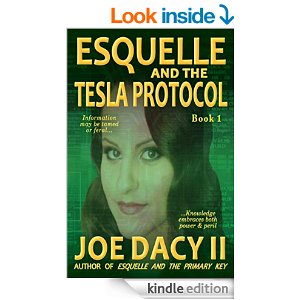
If You’re a Technophile or Conspiracy Buff, “Esquelle and the Tesla Protocol” is for You!

esquelle

This skillfully crafted story has it all. Non-stop action, intrigue, dry wit and humor, incredible detail, and a nearly invisible line between science fiction and fact that yielded tremendous credibility. While at least one other reviewer compared it to Clancy, it reminded me more of Robert Ludlum’s Bourne series except in this case it’s a sociopathic NSA director as opposed to the CIA.

The author broke numerous fiction writing conventions yet this contributed to the book’s credibility, originality and appeal. For one thing, numerous readers of this genre are self-admitted techies and nerds who thrive on the technical side. I know because I’m one of them. I saw an article not long ago which as I recall was written by Stephen King who advised authors to keep their research material invisible in their stories. To the contrary, Dacy plastered his extensive research throughout the story like excerpts from a technical paper or dissertation and I loved it. He even included various illustrations, which further added to the story’s imagery, depth and interest. Whether it was the nuts and bolts of advanced technology, covert ops, or the chapter numbers in binary code, it was apparent he knew what he was talking about. Nonetheless, there were sections where his dry wit practically had me rolling on the floor or his ability to build suspense had me perched on the edge of my seat, wondering what would happen next. While it may be considered incorrect to drop into the omniscient viewpoint from time to time, in this case it worked.

The story is about two genius level adult French siblings, Esquelle and her brother, Bernard, who possess a technology that permits communicating across the time barrier. Bernard’s patent application has not only been denied but he’s been told in no uncertain terms that he cannot release it in any manner at home or abroad based on the Tesla Protocol, the means by which the details of Nikola Tesla’s inventions were secreted away roughly a hundred years prior. Of course neither of them plan to listen and thus the chase begins, though neither Esquelle nor Bernard have any idea what they’re in for.

The plot is complex and loaded with characters but unlike some overpopulated stories I didn’t have any trouble keeping them straight. The players were well fleshed-out and believable. The level of detail is outstanding, right down to the clever basis for the heroine’s name, which I’m not about to tell you but as someone who’s done some database programming myself I must say it was great. I thoroughly enjoyed this book and am looking forward to the next episode.

My only criticism is if, indeed, this novel had a copy editor, the individual should be fired. If it didn’t, which I suspect, then it needs one who can catch the numerous missing words and other minor goofs. The syntax of the French dialog was often incorrect, but the author blamed that on Google, who was credited with the translations. I had French in high school back when the dinosaurs roamed the Earth and even after longer than I care to admit I can remember that adjectives follow the noun and the conjugation of verbs is entirely different than English. Thus, word for word translations seldom work.

This fantastic story deserved a good copy editor. These editorial blemishes, which most readers may not even notice (except, perhaps, other techies like me), detracted from what would otherwise be an incredibly awesome story, which, considering the level of detail otherwise, I find rather sad. Providing the reader with clean copy is as essential as maintaining a consistent plot and accurate research.

I suspect that the author was thinking and keyboarding so fast to get the story down that he inadvertently skipped over various prepositions and articles along the way. It didn’t ruin the story by any means, but it was a distraction which precluded my ability to be entirely absorbed in it. In many ways I long for the days when you could sit down with a good book and get thoroughly lost in it, perhaps finding one or maybe two, if any, such mistakes. I find it especially sad when a story as good or better than many that passed through traditional publishing houses lacks that final bit of polish.

Besides that, this was my kind of book. Quite honestly, I loved it. Nonetheless, even while my techy side ate up his research, technical details, quotes, inside jokes and speculative sci-fi excursions, that same part of me cringed at every missing or misspelled word. Precision is just as important in writing as it is in engineering. If you painted a masterpiece, would you toss it in a $3 plastic frame from Walmart? No. And as a potential masterpiece in so many ways, forgive me when I say yet again that this story deserved a good copy editor.

BUY LINK

The Nebulous Boundary Between Science Fiction and Science Fact

15442253_s

One of the biggest challenges for science fiction authors is keeping up with the technology. For those of you who have read my books, specifically the 2nd one in the series (“A Dark of Endless Days”) and beyond, you’ll remember Laren’s c-com, short for cerebral companion. This clever little device, essentially a smart phone on steroids, linked directly to his brain via psi link so he could access virtually any information in the Universe and likewise download his own thoughts. It could do just about anything, but there was one caveat, i.e., he had to ask it to do what he wanted. It wouldn’t volunteer information, as he discovered in “Refractions of Frozen Time.” And that’s enough of that before I get into spoiler territory.

As “high tech” as the c-com is, it’s nonetheless a little too easy to imagine such a device in the real world. I just saw an article in R&D Magazine (http://www.rdmag.com/news/2015/04/phone-ultimate-macro-feature) that reported there is now a device that can turn any smart phone into a “DNA-scanning fluorescent microscope.”

Seriously?

Holy cow, I want one!

Not!

No, that’s not exactly on my Amazon wish list, but I’m sure for geneticists and CSI types it would be.

Clearly science and engineering is well on its way toward developing a c-com, taking it from science fiction to science fact. When I first started writing sci-fi my fictitious world had the internet, the equivalent of Craig’s List as well as a currency comparable to Bitcoin, all before their time. It’s been said that whatever man can perceive he can achieve and there’s no doubt that science fiction has been the inspiration for several of the technological marvels you see today. Undoubtedly you’ve seen that picture circulating on Facebook of an old Radio Shack advertisement from twenty or so years back hawking the electronics of the time. It included a television, radio, cameras (both still and video), tape recorder, stereo, a desktop computer, and of course, telephones, with the caption that everything on that entire page had been replaced by the smart phone.

Charles_H._Duell

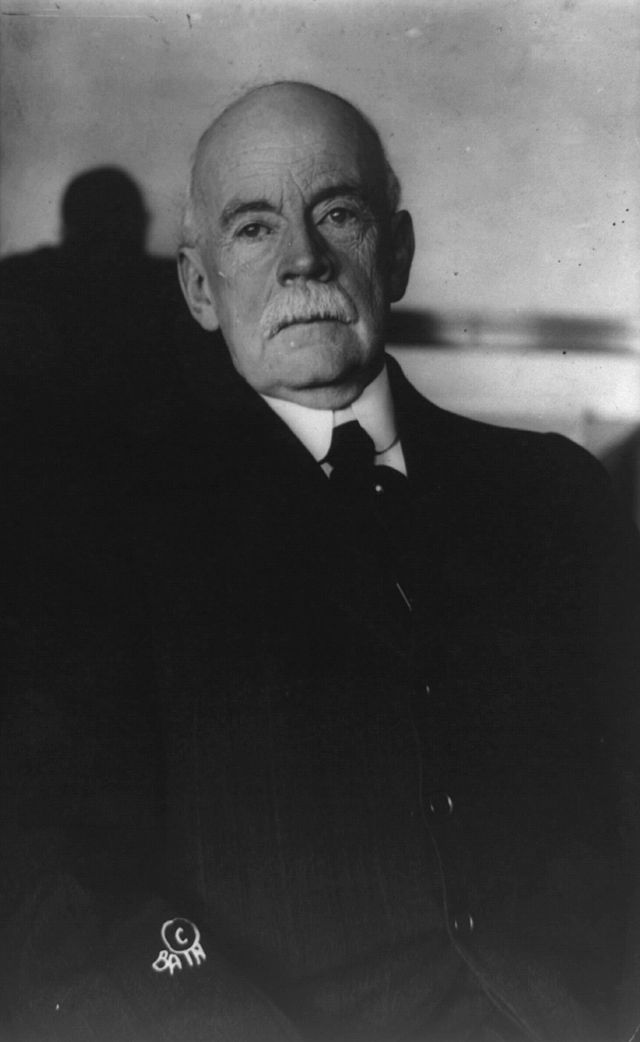
Charles Holland Duell (shown above), Commissioner of the U.S. Patent and Trademark Office from 1898 to 1901, supposedly once said, “Everything that can be invented has been invented.” This has been debunked but what he did say was, “In my opinion, all previous advances in the various lines of invention will appear totally insignificant when compared with those which the present century will witness. I almost wish that I might live my life over again to see the wonders which are at the threshold.” (Thank you, Wikipedia.)

That was in 1902. He died in 1920. What do you think he would say about what’s out there today?

Case in point, my mother was born in 1906, the time when the Wright brothers were developing their flying machine into the first fixed-wing aircraft. She lived long enough to not only see men walk on the Moon but her daughter (yours truly) eventually work for NASA. She marveled at the internet and I shudder to think what her final years in a rest home would have been like without cable television. And that was just the 20th century. What can we expect in the 21st? What will top 3D printers?

1685453_s

You’ve probably heard of Moore’s Law which hypothesizes that technology doubles every two years. This statement originated back in 1965 with Gordon E. Moore, co-founder of Intel and Fairchild Semiconductor, whose original statement related to the complexity of integrated circuits but has applied remarkably well to technology in general which, of course, is largely driven by just that. The miniaturization of devices fits in there as well. This “law” has proven to be accurate enough that tech companies have used it for planning purposes.

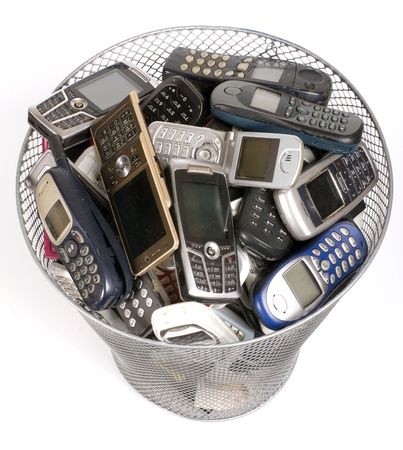
Science fiction writers, including myself, would do well to bear that in mind. Technology doubles every two years! It can easily take longer than that to write a book! That’s an exponential rate that’s hard to grasp. We’re all quite aware of the present but have often forgotten much of the past. Can you remember what it was like before cell phones or the internet? How about computers? Were you even born yet???

Trying to imagine what will come next taxes your imagination, yet as sci-fi writers that’s our job, to not only keep up but surpass it! That, my friend, is easier said than done. And I certainly don’t mean to throw stones at my fellow writers, but when I read science fiction I thoroughly enjoy noting how different authors extrapolate technology to the future, especially the near-future, such as another fifty years. Gasoline fueled cars? Paper? Really? Ya think? When technology doubles every two years? I particularly enjoy reading about paper documents on planets equipped with interstellar vehicles. Uh huh. Right. I’m as guilty as anyone, hard as I may try. In my novels I had security devices I called “palm locks” to gain entry to a room. Science fiction is now science fact.

10253627_s

But there’s one area that science fiction writers can always pursue and that’s where technology will take us. Will it eventually all come crashing down? Then what? Are we really better off with our smart phones than we were without them? Or on a path to humanity’s demise? After all, there are those who use smart phones to trigger bombs and incendiary devices. Furthermore, a massive solar flare could destroy the power grid and all those cell towers. Then what? What if our addiction to electronics was forced into cold-turkey withdrawal?

4574511_s

No wonder dystopian stories are so popular these days. Such scenarios are easier to imagine. Which is scary as hell.

[Illustrations credit 123RF Stock Photos]