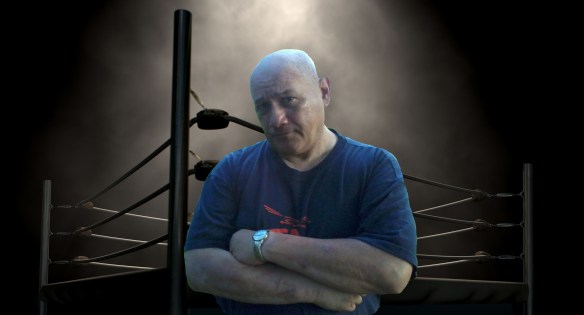
Interview with Multi-genre Author John Reinhard Dizon

smokyring3 copy

John Reinhard Dizon is one of my favorite authors and definitely one of the most versatile. His literary repertoire includes thrillers, family sagas, historical settings, steampunk, sports, suspense and techno-horror to name a few.  His latest release, Both Sides Now, is a romantic comedy, and I must say that I have a bit of a personal interest in this book since I designed both the interior and the cover plus my daughter is the model on the back. While formatting the interior, I gleaned enough of the story’s basics that I’m looking forward to reading it properly in the near future.

I interviewed John a few years back, but in view of this new release, I thought it was time for a rerun with some specific questions directed at him about this latest work. While he dubs it a romantic comedy, it struck me as much more substantial, especially with its unique setting and situations. So let’s see what he has to say.

MF:  The protagonist in your latest novel, “Both Sides Now”, is an intellectual wrestler. You are a highly intelligent person and were a wrestler in a “previous life”, which explains the authentic feel and terminology of the sport. How much of this story is autobiographical?

JRD: Actually it’s far more biographical. Hans “The Great” Mortier was one of my mortierWorld Wide Wrestling Federation childhood favorites. There was a major roster change when Vince Mc Mahon bought the Company from his father at the end of the Sixties, and the stars from the old regime were swept under the rug. Mortier was not a German professor, so that is all ‘what-if’. However, a large portion of the story is going to be instantly recognizable to fans of the era. The novel is as much a testament to the era as it is to Hans Mortier.
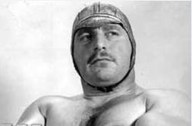
MF: Ray Karpis, quite a shady character from the early 20th Century, has made an appearance in two of your books, this latest one as well as “The Triad.” What do you find most appealing about him?  Did you ever meet him?
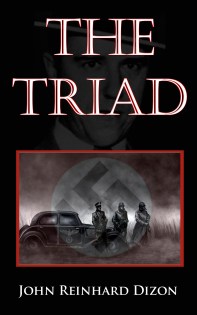
TheTriadCover1 copyJRD: As a criminologist, I have to say that Alvin Karpis is my favorite gangster. He was the last of the Public Enemies but was so elusive and shadowy that hardly anyone knows of him. I wrote Both Sides Now before The Triad and paid homage to Karpis by naming the Lou Thesz-based character after him. Outside of his autobiography and the Public Enemies biography and movie, there is almost nothing out there about Karpis. Hence The Triad. I think I did a good job of bringing his personage to life. He was considered a genius, loyal and generous to a fault, and very much in touch with the modern world and technical developments. Like most of the great gangsters, he would have been a tremendous success in society and the real world had he not gone the wrong way.

MF:  You do a great job of capturing the flavor of other eras as well as places.  You’ve lived through quite a few yourself, but when you get beyond your experience, what’s your favorite research method for your stories?
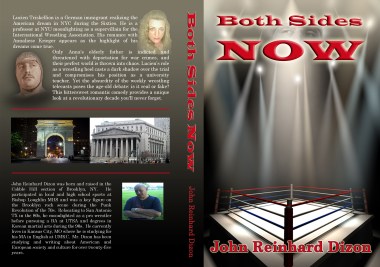
bothsidesnowcover6.jpgJRD:  The Internet usually helps you find the resources you need to make your story work. Only in this case, as you mentioned, I lived through most of this. Ergo, it was mostly a matter of documenting my recollections. I spent a lot of time in the NYU neighborhood, Soho and Greenwich Village, so most of what I did was pull up addresses. I read hundreds of wrestling magazines so was familiar with the old-time arenas. I was also a paralegal, so that helped me make the courtroom drama all the more realistic.

MF:  You’ve certainly held a wide variety of jobs, which undoubtedly contributes to your writing. Authenticity is important if you want to be taken seriously as an author and when you can say, “Been there, done that, got the t-shirt” the details bring the story alive. As far as the plot itself, do your stories reveal themselves as you write or do you know what’s going to happen, start to finish, when you first sit down to write them?

JRD:  Many times the characters end up helping write the stories, as Sabrina Brooks does in the Nightcrawler series. She just makes things happen around her. In this story, Ray Karpis greatly influenced the conflict in the storyline (pun somewhat intended). He becomes the voice of reason, letting Lucien clearly see all the possibilities if he chose that direction in life along the road to wrestling superstardom. I think it also lets the reader see ‘both sides now’ and will stimulate discussion as to whether or not Lucien makes the right choice.

MF: Ethical dilemmas make great material because the reader is forced to think.  You have a huge list of published work. How long does it take you, on average, to finish one of your novels?

courthouse1JRD:  It varies, considering how complex the story is. The action/adventure stories move along pretty quickly as there’s the adrenaline rush that keeps you writing. Historical fiction such as this takes a bit longer because you have to authenticate your work. Getting names, places and events wrong will leave your story dead in the water. The courtroom storyline in this novel took almost as much research as all the wrestling background. It probably took the better part of a year to put it all together.

MF: Wow! That’s so true, though, if you want to be taken seriously as an author. When a reader stops to roll his or her eyes because something is inaccurate it pulls them out of the story, which is the last thing an author wants to do. Of the numerous books you’ve written, do you have one particular character who’s your favorite? Why?

JRD:  I’m having to go with Sabrina Brooks, aka the Nightcrawler. Every one of her novels is an adventure in itself. She’s a beautiful woman who moonlights as a crimefighter, who seems to target the Russian Mob. She’s the CEO of a chemical company, which means she doesn’t have to do this but does anyway. She’s very compassionate and is a churchgoer, which makes her all the more unique. Her personal relationships suffer greatly as she gets beat up, and the Nightcrawler’s successes come at the expense of her personal life. I enjoy writing her story as much as people love reading it.

MF:  Multi-dimensional characters are essential to a good story.  So what’s your favorite part of the writing process? Which part is the most difficult?

JRD: It’s the dialogue. It may be my strong point as a writer, and it helps me develop the characters and give the reader the best insight as to the speaker’s personality and motivation. The reason why reality TV shows get over is because people want to see their heroes behind the scenes. In literature, the author allows readers to listen to the characters giving up their innermost hopes and fears. The most difficult part is bringing it all together, making the story plausible. You do your homework, you authenticate your background, you flesh out your characters, but your audience has to buy your story. That’s the make or break part, and I think I make that happen every time.

MF:  Yes, you certainly do! When did you decide you wanted to be an author?

JRD: I was writing dialogue for my stick-figure cartoons when I was six. I was fascinated by TV and the movies and wanted to tell my own stories. Many people will say my entire life was about turning my fantasies into reality.

MF: So obviously you were born to write, which isn’t surprising considering how prolific you are.  You’ve worn a variety of hats over the years in a wide variety of jobs and places. What can we expect from you in the future? At what stage is your next novel and when do you expect it to be out?

JRD:  The Blight is about a decorated fire team of Navy SEAL commandos working as an elite unit for the St. Louis PD. They are taking on a mass murderer intent on destroying the ‘social blight’ plaguing the city. Kirsten Streicher is a typical JRD bad-ass female protagonist. Only her team is heavily impacted by the madman known as X, and the writing is on the wall as their group is slowly disbanding. Kirsten is forced to move forward with a whirlwind romance beckoning, though she feels compelled to bring the killer to justice before her career comes to an end. As usual, there’s lots of social issues and moral conundrums discussed, and the standard JRD reflections of current-day controversies. I’m hoping to release it by Summer 2016.

MF:  Sounds like another winner! Is there any particular author or authors who have inspired you the most?

JRD:  Shakespeare, Ian Fleming and Robert E. Howard. The Bard for his conciseness and verbal dynamism, Fleming for his ability to take the reader to a myriad of locations, societies and situations, and Howard for his gift of lurid description and breathtaking action. I hope my readers see my work in a favorable light in comparison.

MF: From what I’ve read, I believe you can rest assured that they will.

You can pick up a copy of Both Sides Now on Amazon here.

Connect with John Reinhard Dizon:

Facebook:  https://www.facebook.com/johnreinharddizonUSA

Amazon Author Page:  http://www.amazon.com/John-Reinhard-Dizon/e/B00DU9JNUQ/

Twitter:  https://twitter.com/JohnRDizon


Blog Tour: Annie Douglass Lima’s Latest YA Adventure Tale

I’m excited to be part of Annie Douglass Lima’s blog tour to announce her latest young adult action and adventure novel, The Gladiator and the Guard, is now available for purchase! This is the second book in the Krillonian Chronicles, sequel to The Collar and the Cavvarach.

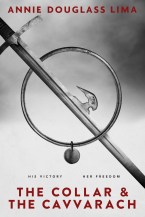
The Collar and the CavvarachFirst Things First: a Little Information about Book 1: 
Bensin, a teenage slave and martial artist, is desperate to see his little sister freed. But only victory in the Krillonian Empire’s most prestigious tournament will allow him to secretly arrange for Ellie’s escape. Dangerous people are closing in on her, however, and Bensin is running out of time.  With his one hope fading quickly away, how can Bensin save Ellie from a life of slavery and abuse?

What is the Collar for, and What is a Cavvarach?

The story is set in a world very much like our own, with just a few major differences.  One is that slavery is legal there.  Slaves must wear metal collars that lock around their neck, making their enslaved status obvious to everyone.  Any slave attempting to escape faces the dilemma of how and where to illegally get their collar removed (a crime punishable by enslavement for the remover).

Another difference is the popularity of a martial art called cavvara shil.  It is fought with a cavvarach (rhymes with “have a rack”), a weapon similar to a sword but with a steel hook protruding from partway down its top edge.  Competitors can strike at each other with their feet as well as with the blades.  You win in one of two ways: disarming your opponent (hooking or knocking their cavvarach out of their hands) or pinning their shoulders to the mat for five seconds.

Click here to order The Collar and the Cavvarach from Amazon for $2.99 a discounted price of just 99 cents through May 30th!

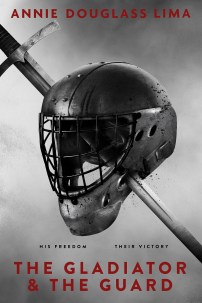
And now, The Gladiator and the Guard, with another awesome cover by the talented Jack Lin!

The Gladiator and the Guard

Bensin, a teenage slave and martial artist, is just one victory away from freedom. But after he is accused of a crime he didn’t commit, he is condemned to the violent life and early death of a gladiator. While his loved ones seek desperately for a way to rescue him, Bensin struggles to stay alive and forge an identity in an environment designed to strip it from him. When he infuriates the authorities with his choices, he knows he is running out of time. Can he stand against the cruelty of the arena system and seize his freedom before that system crushes him?

EXCERPT:

“Hey, it’s the new guy,” someone said, and heads turned. “What’s your number?”

“My number? Oh, um, I think they said I’d be Fifty-Eight.” A tasty-looking bowl of chicken and potatoes came within reach, but someone else picked it up, scooped some onto his own plate, and then passed it away down the table before Bensin could get any.

“So, you beat Ninety-Nine,” a Skeyvian gladiator across from him commented, his dark skin laced with pale jagged scars. “Soon as he gets out of the clinic, you better watch out. He’ll be out for blood.” He set down the vegetables he had just served himself, and Bensin picked up the dish, but the guy next to him plucked it out of his hands and sent it in the other direction.

“I didn’t actually mean to hurt him,” Bensin began, looking around for another dish of food. He was interrupted by derisive laughter from everyone within earshot.

“Fifty-Eight didn’t mean to hurt him! Ha! What kind of gladiator are you, kid?”

Bensin couldn’t think of an appropriate response. “Hey, could somebody pass me the chicken?”

“Dude, you better start meaning to hurt people if you want to make it here,” the burly Tarnestran beside him advised. “You can’t manage that, Gile will plan a blaze of glory for you sooner rather than later.”

Bensin wasn’t sure what the man was talking about, and his stomach was still rumbling. Everyone around him was eating now, but the serving dishes had all been passed down to the other end of the table.

“Gile won’t have to plan a blaze of glory for this one,” another gladiator predicted. “At this rate, he’s gonna starve to death first.”

* * *

Click here to order The Gladiator and the Guard in Kindle format from Amazon for $2.99 a discounted price of just 99 cents through May 30th!

 Click here to order The Gladiator and the Guard from Smashwords (for Nook or in other digital formats) for $2.99 a discounted price of just 99 cents through May 30th!

About the Author

Annie Douglass LimaAnnie Douglass Lima spent most of her childhood in Kenya and later graduated from Biola University in Southern California. She and her husband Floyd currently live in Taiwan, where she teaches fifth grade at Morrison Academy. She has been writing poetry, short stories, and novels since her childhood, and to date has published twelve books (two YA action and adventure novels, four fantasies, a puppet script, and five anthologies of her students’ poetry). Besides writing, her hobbies include reading (especially fantasy and science fiction), scrapbooking, and international travel.

(See my previous interview with Annie here.)

Connect with the Author Online:

Email: AnnieDouglassLima@gmail.com

Blog: http://anniedouglasslima.blogspot.com

Facebook: https://www.facebook.com/AnnieDouglassLimaAuthor

Twitter: https://twitter.com/princeofalasia

Goodreads: http://bit.ly/ADLimaOnGoodreads

Amazon Author Page: http://bit.ly/AnnieDouglassLimaOnAmazon

Smashwords: https://www.smashwords.com/profile/view/AnnieDouglassLima

LinkedIn: http://bit.ly/ADLimaOnLinkedIn

Google Plus: http://bit.ly/ADLimaOnGooglePlus

Now, enter to win an Amazon gift card or a free digital copy of The Collar and the Cavvarach!

 a Rafflecopter giveaway


Some Benefits of Backstories

26572416_s

As an author you’re probably already familiar with backstories.  These may reside nowhere but inside your head, but in order to develop authentic characters and plots, they need to exist.  Even if a character has amnesia, such as Jane Doe in the popular TV program Blindspot, he or she needs to have a past.  Life experiences, even for fictitious characters, are what make people interesting, provide motivation and bring out their personality.  As an author, if you don’t know this about your character, it’s going to make it more difficult to tell his story.  Dialog and action may be stilted or artificial without knowing what makes him tick.

If you’re having difficulty getting into a character, talk to him or her to find out more about their background.  You might be surprised what you’ll discover.  Character interviews are common these days in blogs, which further demonstrate this principle.  Talking about a character with other writers or your beta readers can bring out all sorts of great ideas as well.  If you get stuck, try this out.  I can have as much fun brainstorming with other writers about their current WIP as I can with my own, whether it involves character motivation or plot development.  Backstories are also great practice for new authors not only to develop their cast but their writing style as well.

It’s worth noting, however, that you shouldn’t confuse your readers by giving unimportant characters a name.  If you do, they’ll wonder later what happened to so and so.  The general rule is that any character who doesn’t contribute to the plot doesn’t need to be there, anyway, except in the case of certain group situations, like extras in a movie.  If they’re important enough to deserve a name, then they should have a backstory, no matter how simple.

For main characters, these backstories tend to come out in the course of the story to a greater or lesser degree, but not always so much for minor characters.  However, if you find a detailed backstory developing for a minor character, chances are he/she/it has something interesting to say.  You’ve undoubtedly noticed how various sit-coms have had spinoffs over the years, typically when a minor character becomes interesting enough to have his or her own program.  One that comes to mind is Frasier, which evolved from Cheers.  Another example would be the ewok stories that evolved from Star Wars.

It used to be that backstories were useful to the writer, but often sat in a file that never saw the light of day.  Now that ebooks are so popular and relatively easy to produce, they can serve a useful purpose for keeping readers and fans engaged, either as your full-length novel develops, between books in a series or even to add additional depth to a story that’s already out there.  Who knows?  It could evolve into another full-length story as you dive into what makes a character tick.  This is often how series and trilogies are born, when there’s a lot more to tell.  Fans who become attached to a character love to hear more about them.  And these are not always limited to the main ones.  How many movies have you seen where one of the supporting actors grabs your attention?  You never know who another person will connect with or for what reason.

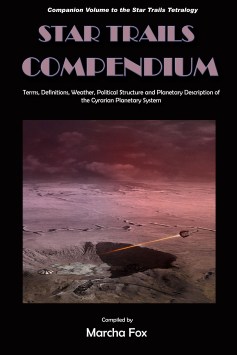
Since this background information is often already written up, or could be relatively easily if it’s parked in your brain, it’s worth it to do some editing and get it into ebook form.  Print form works, too, since these books are usually short and make great giveaways or ultra-inexpensive samples.  As expected, the cover is the most expensive element of a book, so they might not be as cheap as you’d expect, but usually your cost will be around $2.  For example, my Star Trails Compendium, which is 135 pages long, costs me $2.48 while The Sapphiran Agenda is only 29 pages but $2.15.

Backstories work well for giveaways and teasers, both before and after a book is released.  My Star Trails Tetralogy series has two, which are free on Smashwords and its outlets and 99c on Amazon.  The Star Trails Compendium comprises all the terms, definitions and cultural background information for the series while The Sapphiran Agenda is a true backstory for a minor character, Thyron, who’s a flora peda telepathis, i.e. telepathic walking plant.  Many readers noted he was their favorite, though at least one found him annoying, demonstrating how you never know how they’ll be accepted.  Thyron has at least one more story to tell which I hope to have out soon.

Put backstories to work for you to gain new fans, retain old ones, and provide short samples of your writing style.  Short reads are popular these days as well, even having their own category on Amazon, which further increases their appeal and potential for finding new readers.  Whether you’re in the middle of a lengthy novel, between books or perhaps stuck with a case of writer’s block, these gems can be fun and easy to write and provide a means to maintain contact with your existing fan base.  If you need ideas or examples, feel free (literally and figuratively) to check mine out at the links below.

StarTrailsCompendium copy

The Star Trails Compendium

Pageflex Persona [document: PRS0000039_00005]

The Sapphiran Agenda

Top image copyright 123RF


Review of Jeanne Foguth’s “Vi-purrs”

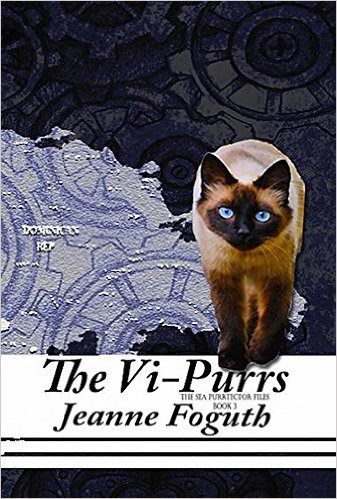
vipurrscoverXander de Hunter fans will be delighted to know that their favorite undercover cat is at it again in this exciting and vividly rendered adventure tale (or tail, as the case may be). If you’ve already read “Purranoia” (and you should, to fully appreciate this sequel) you’ll know that there were many unanswered questions at the end. Furthermore, Xander picked up a lovable sidekick, appropriately named Mischief. Her rebellious and inquisitive yet highly intelligent nature adds another important member to Catamondo. She continually rubs Xander’s fur the wrong way, especially her weird love of water sports, making the Sea Purrtector wonder if choosing to mentor her was really a good idea or not. The tension between these two adds conflict and more suspense, further enriching the story and plot.

The tale gets started when Xander’s buddy, Merlin, reminds him of the many unsolved issues from their Haitian adventure, driving him to follow up on the situation. This takes them to Jimaní in the Dominican Republic’s Independencia Province, where Mischief’s tante, Lucy Fur (be sure to say that aloud to get the implications) resides. They’d never fully determined the objective of Dr. Moreau’s genetic engineering operation. Furthermore, what happened to Damon, Chester, Mingus, Matsu as well as Clade and Allele, the odd cat-snake mix known as the vi-purrs?

An entertaining cast of characters including a rat named Scar, a chameleon named Mars, another cat named Sharkey who loves to quote Native American wisdom, and numerous others join with Xander and Mischief to find the answers. Their efforts are further complicated by a hurricane, adding to the suspense and intrigue. As always, the settings are described in vast detail such as can only be accomplished by an author who’s been there.

The complex world of Catamondo just gets better and better. If you love cats and a good adventure story that would make an excellent animated movie, this series is for you.

Pick up your copy in ebook or print format on Amazon here.

Other Books in the Purrtector Files Series:

Connect with Author, Jeanne Foguth:

jeanne

Amazon Author Page: http://www.amazon.com/Jeanne-Foguth/e/B00JDW7TC8/

Blog: https://foguth.wordpress.com/

Website: www.jeannefoguth.com

Review of Glory on Mars by Kate Rauner

gloryonmarscover

If you’re a fan of hard science fiction, and I mean really HARD, then you will love this book. In fact, I’m inclined to say that it’s only on the borderline of sci-fi, that it’s more what I would call science faction, i.e. so close to being reality that it’s not even that futuristic. Indeed, many people reading this book are likely to live to see a Mars colony in their lifetime. If you loved the movie “The Martian” then this story is a great follow-up to keep your imagination well-grounded on the Red Planet.

The Mars base the author designed is brilliant. She has thought of just about everything imaginable and described it at a technical level detailed enough to make you feel as if you’re there. She has hab modules, jumpships, walkabouts, surface suits and any number of other goodies. At the least, you know she’s not just making this up because her engineering background truly shows. Since I worked as a NASA contractor for over 20 years, I found many familiar things in this story, from the space technological presence in Noordwick, The Netherlands, since I’d been there more than once, and other terminology such as “frangible nuts” used with explosives to release their hold in various spacecraft applications.

By the time you finish this story, you feel as if you’ve completed a tour of duty on Mars. Anyone who may aspire to go there someday can get a very sound idea of what it would be like, from eating worms to the various hazards that abound on a planet that is not fit for human habitation without serious, high-tech intervention. There are radiation issues, maintaining an appropriate pressurized volume with the correct oxygen mixture, psychological challenges, vehicles for getting around on the surface, sometimes at a great distance, and so forth. In this respect it is exceptionally well-done. The author’s knowledge and undoubtedly a whole lot of research is evident and available for readers to enjoy. The side stories were excellent as well, adding additional detail and background which I highly recommend readers take the time to enjoy. They’re not required, but add to its richness. Thus, as an outstanding science fiction novel, I give this book a strong five stars.

However, if you want a bit more than engineering and science in a story, there are a few things I would have recommended be included, had I been a beta reader for this book. I realize that all reviews have a high degree of subjectivity, and the comments that follow are strictly my opinion and may not be shared in the slightest by other readers, especially if all you want is hard sci-fi. Nonetheless, that’s part of the point of a review, to share one’s opinion, and why over all I give this story four stars, so here we go.

While the numerous characters clearly had different personalities, to me they were faceless. Their physical descriptions were lean at best and missing at worst. She did a great job giving them very diverse and memorable names, many of which implied the individuals’ international heritage, but I never was able to “see” them in my mind, other than perhaps Yin and Yang, which were handled in a very clever manner that worked. I like to be able to picture the characters in a story and didn’t feel I had enough description of the others to do so.

The point of view (POV) was limited to one member in particular named Emma, with whom I connected somewhat. One thing to be said about the single POV is that it does lend the feeling that you were Emma and experiencing what she did. Nonetheless, with so many characters, it would have been interesting to get into their heads and viewpoint as well. The first half of the book contained a lot of description about the base and getting things set up along with the challenges involved, which could have been handled through other crew member’s POV so the reader got to know them as well. This would have rounded out the other characters a bit more and provided an opportunity to describe their appearance.

A little more conflict among the crew members would have added a bit more realism as well. This was touched on a little, but it’s highly likely that roughly a dozen people confined as they were under stressful and sometimes life-threatening conditions would have had a few clashes along the way. There was some tension, but people simply aren’t that mature and logical all the time, even if they’re engineers. This I know, given I’ve managed them in my previous life.

Another thing that bothered me was the cat. As a cat owner and lover, I expected the cat to have a more significant role, perhaps along the lines of Pete in Heinlein’s “The Door Into Summer.” I couldn’t believe it that when this kitten was taken onboard as they began their journey that he was not immediately given a name! Maybe I’m just a crazy animal lover, but I can’t imagine that someone in that group wouldn’t have done so. At the least, when they arrived on Mars, someone already there would have done the honors, since it was that group who’d requested the cat in the first place.

The cat could have been worked into the plot more as well. The base’s AI even recognized the cat as a team member! Cats are curious, (Curiosity would have been a great name, in honor of a previous Mars mission) they get bored just like people, and he would have undoubtedly had some interesting experiences in the zero-gravity environment during the journey as well as once they arrived on the base. Mine get into trouble all the time in a regular earthbound house. Owning a pet isn’t simple and it certainly wouldn’t be on Mars. He could have caused any number of problems and conversely, even provided ways to solve others.

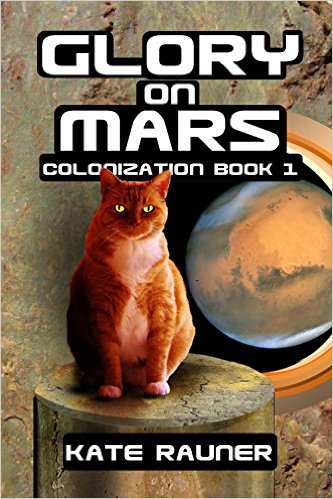
Why did the previous crew request a cat in the first place? Pets add warmth, affection, and a new dimension of “home” to say nothing of comic relief. He could have contributed an additional touch of reality to an unreal situation. I probably wouldn’t harp on the cat issue so much other than the fact the cat is so prominently displayed on the cover. I found this very misleading, since the cat played essentially no role in the story, whatsoever, other than a few cameo appearances, where he could have easily become an endearing and potentially major character.

That precious piece of visual real estate known as a book cover would have been much better used to fill other gaps in the story. It would have been very helpful to have a drawing of the base, for example, with all its modules and such, which was well-described in the text, but not always easy to picture. Any artist would have had a blast with that. It also would have benefited by some people as well, which could have compensated for the lack of description in the text. A newly designed book cover would be a great investment for this story and thus represent its content more accurately. Potential readers for this book include hard sci-fi fans, preppers into self-sufficiency, and cat lovers, based on the cover. The cat on the cover could actually turn off some readers who would enjoy it the most.

Speaking of preppers, a bit more of the self-sufficiency side of growing food, raising fish and so forth would have been great as well. The use of heritage seeds, saving some of the potato harvest to plant for the next generation, or even the use of aquaponics could have further enhanced the story and also fit nicely with switching viewpoints.

In spite of all my grumbling above, I truly did enjoy and appreciate this book and what it took to write it. As a physicist and former “rocket scientist” myself, I found very few things I wondered about on the technical side. There were a few places where I thought about making a few calculations, then reminded myself it was only a novel and to lighten up! It provides a realistic view and excellent vicarious experience of what it would be like to be a space pioneer. For that, I highly recommend it. Just don’t expect much from the cat.

You can pickup your copy on Amazon here.

6 More Tips for Serial Writers

faulknerquote

Most of the tips in my previous post for serial writers were picked up from reading and beta reading the works of others. Afterwards, I realized that I’d learned quite a few things that were also worth passing along from writing my own tetralogy. These comprise either things I did that helped the process or I wish I’d known as opposed to figuring out the hard way. So, without further ado, here are a few more tips for those of you working on a story that refuses to end.

1. Read any previous volume(s) to assure consistency. Some details such as the color of a minor character’s hair or eyes can easily be missed, yet picked up by an astute reader. Trying to explain that Edith’s eyes are blue in certain light and green in others is somewhat lame, so it’s best to avoid it by being accurate. If you keep a file on your characters that includes such details it will simplify things later. Quite frankly, I don’t, but believe me, I will next time because it can be time-consuming and a real pain to hunt down later. Of course, while you’re reading, you can note these things, too, which is part of the point.

The best part of rereading the stories that precede you current work is you can usually find some seemingly small details that you can tie in. This is especially true when you’re wrapping everything up at the end. Fans in particular love this sort of thing and it may even drive them to go back and reread the earlier stories as well. Some of them may actually function like an inside joke. If you know anything about fandom you know how dedicated fans thrive on such things.

Assuming you have print copies of your book(s), using sticky notes or page markers works best. If you want to get fancy, you can even color-code them for different types of information. I was amazed and delighted at how some of the seemingly simple details in previous episodes related to the grand finale.

Also note how your style may have changed as your story unfolded, especially if the first one was your debut novel. (See the section in my first “Tips for Serial Writers” blog entitled “First the Worst, Second the Same…” for more on that.)

2. Use flashbacks, albeit brief, to tie in past events from previous books. Important events that ripple over into subsequent volumes should be recapped to refresh the memory of those who read previous works but did so long enough in the past to need reminders. It also puts things in context for new readers who may be reading the episodes out of sequence. These don’t have to be long and drawn out, which will bore your fans, but enough to get them back on track. Prologues can sometimes be used in this way as well.

father3

Flashbacks add depth as well as context.

In some cases, if your serial is complete, readers may start with volume one and blow straight through, especially if it’s a box set, but there’s a good chance that other books may have intervened or perhaps time, dimming their memory. If it’s not yet complete, it’s even more important. If a reader feels lost, it pulls them out of the story and they’re likely to be frustrated, which is one of the last things you want to do. If they wind up scratching their head or digging through previous books to find the event in question, unless they’re madly in love with your story they may toss it aside and pick up something else. Once they stop reading there’s always the chance they won’t be back. Confuse ’em, you lose ’em. Not good.

3. Timing is Everything. Serials are usually sufficiently complex to involve numerous characters who grab the spotlight from time to time and thus the point of view (POV). Keeping the timing correct can be a challenge, especially if coincident scenes are not written in sequence and have to be integrated later. I tend to write a scene when the idea arrives so I have all sorts of things to pull together as I attempt to wrap up a single volume, much less the entire serial. If you maintain a detailed outline, it helps, since you can insert POV excursions accordingly.

Mapping out key events visually is helpful, using project management software the ideal, but often unfamiliar or unavailable. The last thing any author needs is a stiff learning curve on a software package when they’re writing a novel. Using Excel is the next best option, the timeline broken down to suitable increments, whether hours, days, months or years. These go across the top with each column representing a unit of time. Events are listed in the rows below with the proper time element highlighted. You can do this by hand if you prefer; graph paper makes it a little easier.

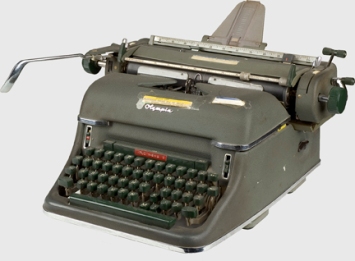
typewriter

My first two novels were written on a typewriter that looked a lot like this one.

This can be done out of sequence if that’s how you write, either by inserting a row if everything is in order or organized later based on event timing, which is shown where time marks overlap. Including a column that contains the chapter number right after the first one with the scene description can be used to sort them as well, which also reveals any that need to be adjusted.

I remember seeing a comment from an author one time regarding how difficult it was to keep track of plot action occurring in different time zones. I laughed. My tetralogy involved coordinating events on different planets, spacecraft affected by Einstein’s theory of special and general relativity, and even time travel itself as my story shifted amongst the various characters. Keeping everything in the proper sequence to maintain story continuity was definitely a challenge. Again, Confuse ’em, you lose ’em. Remember that. Not all readers have the patience to read on with literally millions of other books begging to join their TBR list.

4. Insights regarding how your characters have evolved. How a character changes in a story is important, a key element, in fact, to good fiction. In a serial this may be a gradual process, perhaps so much so that the reader doesn’t notice. It doesn’t hurt to remind them using internal dialog on the part of the character(s), as an observation by another character in thought or dialog, or even in the narrative. For example, something as simple as “Before arriving in New York, Patsy was afraid of crowds, but now she navigated 5th Avenue with confidence” does the job.

5. Include the fate of all characters, not just your protagonist. You never know who’ll be a reader’s favorite character. I was surprised how many of my readers favored Thryon, my telepathic walking plant. Thus, you need to make sure everyone’s exit, whenever or however it occurs, provides closure. Don’t simply leave them behind. Characters who ride off into the sunset can also provide fodder for spinoffs.

6. Expect to miss your characters, who by now have become old friends. You may want to consider leaving things open enough at the conclusion to allow for spin-offs. Fully developed characters are just begging for another appearance. You know them as well, maybe even better than your own children or best friend, so if they’ve earned fans along the way, consider using them again. On the other hand, if you’re bored with them, readers may be, too, so this is not something that’s required or should be forced. Back stories are often at least partially written and can be put together for a quick short story that you can use as a giveaway enticement in your marketing efforts. Back stories are also great for holding readers’ interest until the next episode is released if it’s taking you a while to get the next one together.

Pageflex Persona [document: PRS0000039_00005]

It was fun writing this back story to my tetralogy which kept fans engaged and also served as a hook for new ones.

I’ve found that my short stories evolve into novels and my novels apparently evolve into a serial. Go figure. I simply get bombarded by ideas too good to leave out, especially once my characters come to life and take over the story. Other writers can crank out a single novel or novella in a few weeks or less whereas mine, for various life-related reasons, took years.

Fortunately, readers have a variety of preferences as well, whether it’s a quick “beach read” or something they can get their teeth into. Note that back stories can provide fans with both! My next one will be a spin-off from one of my Star Trails characters, which will hopefully prevent it from likewise expanding. But only time will tell.

Sci-Fa Epic Adventure: Review of “Thunder Moon” by Jeanne Foguth

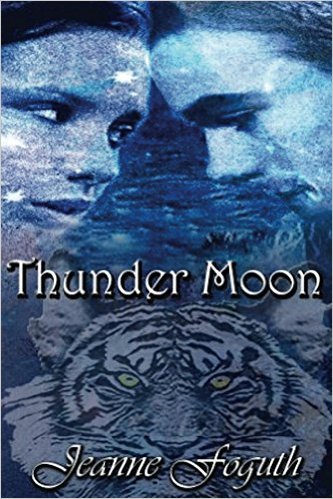
thundermooncover

The second volume in Jeanne Foguth’s Chatterre Trilogy, “Thunder Moon”, picks up where “Star Bridge” ends. As someone who’s read all three volumes, but not in order, I highly recommend that they be read in sequence so that the complex plots and character relationships are easier to follow. Each builds upon the other, weaving a fascinating and intricate Sci-fa saga.

In this episode, Nimri’s brother, Thunder Cartwright, is worried the madrox will invade his world unless the star bridge is closed. He borrows his brother-in-law, Larwin’s, environmental suit, and sets out to do so with the assistance of GEA-4, Larwin’s androtic assistant. Meanwhile, Larwin’s sister, Tem-Aki, is looking for her brother, who’s been missing from his world long enough that she’s concerned that he’s dead. (Background on Larwin’s arrival on Chatterre can be found in volume I, “Star Bridge”.)

As you’d expect from any misbehaving and unstable Star Bridge/wormhole, Thunder winds up on yet another world, Kalamar, which is covered with what he fears most–water. Furthermore, he’s severely injured, but fortunately, rescued by Raine, a dragon shepherd, who’s on patrol in her ship, Nambaba, trying to recover a rogue dragon calf.

And thus the fun begins.

As always, the science fiction/fantasy elements of these stories are masterfully integrated as simple matters of planetary diversity. Dragons, a.k.a. madrox, are Chatterre’s mortal enemy, threatening to reduce it to ashes. However, on Raine’s planet, Kalamar, they’re carefully managed, a seeming paradox that further drives the story’s plot and suspense.

Mistaken identities, culture clashes, alien creatures, and a variety of interpersonal conflicts, including sibling rivalry and political intrigue, ultimately explode in this fast-moving, complex tale. The world building is exceptional, particularly with regard to how a human culture would operate on a world comprised mostly of water. Not only are the mundane details addressed, but other intelligent species introduced as well as a convincing and convoluted political structure.

If you like an intricate plot, lots of action and continual suspense with all sorts of surprises you can get your teeth into, then this trilogy is for you. But don’t forget to read “Star Bridge” first and then this one before move on to the satisfying conclusion in “Fire Island.” (Note that all three volumes are “clean reads” suitable for all ages.)

You can pick up a copy on Amazon here.

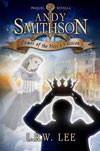
JUST RELEASED! Vision of the Griffin’s Heart, Andy Smithson, Book 5

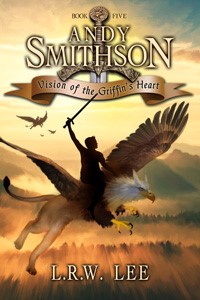
Book5cover

I’m delighted to participate in this blog tour for L.R.W. Lee’s latest episode in the Andy Smithson fantasy series for Middle Grade readers!  I had the pleasure of sharing a booth with her at the Austin Book Festival last October and thoroughly enjoyed getting to know this intelligent and fascinating person. Learn more about the fifth book in the series, get to know more about the author and then be sure to grab a copy from the buy links at the end.

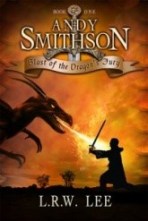
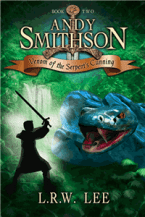
Four years ago, Andy Smithson discovered he is the Chosen one to break a 500-yr-old curse plaguing the land of Oomaldee when he unexpectedly and mysteriously found himself there. To do so, he must collect ingredients for a magical potion. Thus far he has gathered the scale of a red dragon, venom from a giant serpent, a unicorn’s horn, and the tail feather of a phoenix. Now he must ask a griffin for one of its talons. There’s just one problem…humans have poached griffin treasure, causing these mythical creatures to attack on sight.

Complicating matters, the evil Abaddon, sovereign of Oomaldee’s northern neighbor, is turning more and more citizens into zolt in his ongoing campaign of terror as he sets in motion the final steps of his plan to conquer the land. Things really start to heat up in book five!

If you loved Harry Potter, you’ll love the Andy Smithson series chalk full of mythical creatures, newly invented animals like zolt, herewolves, and therewolves, a complex plot with evolving characters, and positive themes including responsibility, diligence, dignity, friendship and more.

Purchase Kindle and Paperback

 THE BUZZ

5 Stars! – “A marvelous book in a great series!” – Erik Weibel (Age 14) This Kid Reviews Books Blog

“Readers of this series have come to anticipate a host of challenges, intense battles, and on an epic scale. In Vision of the Griffin’s Heart, you won’t be disappointed. For lovers of fantasy, I consider it a must read.” – Richard Weatherly, Author

“One of the admirable qualities I like about the entire series is seeing Andy’s growth from a self-absorbed kid to a more thoughtful teen as he learns how to deal with the various crises which face him, all the while knowing that the future may hold unpleasant consequences.  The watchword for Vision of the Griffin’s Heart is “courage.” – Wayne Walker, Home School Book Review

THE DEPTH OF THE ANDY SMITHSON SERIES

If you’re an adult looking for a clean series you can sink your teeth into, Andy Smithson is definitely it! In it I develop four layers simultaneously: 1) Andy Smithson in Lakehills, TX 2) Andy in Oomaldee 3) the Afterlife 4) a meaning layer. A few examples to demonstrate the depth…

Symbolism is used extensively (a couple examples):

  • The fog of the curse symbolizes blindness and oppression.
  • The magic key unlocks doors, brings stone statues to life, as well as revives. Put another way, it symbolizes bringing forth, opening up, and revealing (aka taking responsibility).
  • Methuselah is not only a weapon and helper, but also represents justice as it divides good and evil. Consistent with life, justice requires diligence to uphold.

Names are also important in this series (a few examples):

  • Andy means brave or courageous.
  • Alden means helper.
  • Hannah means favor or grace.
  • Imogenia means blameless.

Alchemy used throughout the series (a few examples):

  • Alchemy played a significant role in the development of modern science. Alchemists sought to transformbase metals into the gold or silver and/or develop an elixir of life which would confer youth and longevity and even immortality.
  • In the series, the first instance of alchemy begins with the gold weavers, Max, Oscar, and Henry, spinning straw into gold to manufacture the wealth of the kingdom.
  • The four elementals: air, earth, fire, and water are then seen on Methuselah’s hilt.

 The titles of the books manifest yet another layer of meaning and reveal Imogenia’s evolution.

  • Beginning with Blast of the Dragon’s Fury, Imogenia is furious at what has happened to her and she fuels her emotional hurt.
  • In Venom of the Serpent’s Cunning, Imogenia turns venomous (or spiteful) and cunning in seeking ways to continually punish her brother.
  • Disgrace of the Unicorn’s Honor has Imogenia act in a manner disgraceful to the honor of royalty.
  • In Resurrection of the Phoenix’s Grace we see Imogenia’s grace reborn as she begins to reflect.

In Vision of the Griffin’s Heart, Imogenia realizes she is gripped by hatred and distrust she has harbored for so long. Unlike griffins who choose to trust others, Imogenia cannot yet make that leap when it comes to her brother.

ABOUT THE AUTHOR

lindanewpix

R. W. Lee credits her love of fantasy with her introduction to C. S. Lewis’ Chronicles of Narnia. Later on, she enjoyed the complex world of Middle Earth brought to life by J. R. R. Tolkien in Lord of the Rings and The Hobbit. The multiple dimensions of the worlds mixed with a layer of meaning, captivated her and made her desire to invent Young Adult Fantasy and Epic Fantasy worlds others could get lost in, but also take meaning away from. More recently, L. R. W. Lee has found inspiration from J. K. Rowling and her Harry Potter series as well as Brandon Mull and his best selling Fablehaven, Beyonders and Five Kingdoms series.
R. W. Lee writes to teach her readers principles that can transform their lives – overcoming frustration, impatience, fear and more. She also shows why responsibility, diligence and dignity are the keys to true success in life. She lives in scenic Austin, TX with her husband. Their daughter is a Computer Engineer for Microsoft and their son serves in the Air Force.

Website | Facebook | Twitter | Goodreads | Amazon | Email

L.R.W. LEE INTERVIEW

  1. How did you come up with your main character, Andy Smithson? Did he just pop into your imagination or did you specifically develop him?

Andy is patterned after my son. After our first child who was what I would call compliant and seemed to need little to no correction, our son arrived on the scene. As with most 2nd children, he was polar opposite and provided much fodder for an engaging main character.

  1. How did your experience with building a business help with your writing?

It has been invaluable for I understand that writing is only 50% of the writer’s success equation. Unlike Field of Dreams, with so many good books available today, just launching it, even on a well trafficked platform like Amazon, does not get recognition. Because of my corporate background, from day one I began working to build a platform – Twitter and Facebook primarily and now also Book Nerd Paradise. As well, I understand the importance of the author community, for no author can succeed these days without the support of fellow authors. My background has also helped in understanding the need to optimize my books to rank well on the variety of sites they are listed on. There’s much more, but those are the biggest helps I would say.

  1. Was there any particular book or author whom you feel had the most influence on your work?

I have to say JK Rowling. The imagination she revealed, the strength of her characters, the world building, the depth of plot over multiple books…she definitely shaped how I think about writing.

  1. What do you love the most about writing for young people?

Young people are moldable. My passion for writing is to share with readers principles that from my experience can help them live more peaceful lives. A few of these principles include overcoming fear, frustration and impatience as well as understanding that true success in life is not from riches, fame or power, but rather responsibility, diligence and dignity. If they can finish any of my books closer to understanding these principles, I feel very fulfilled.

  1. Which part of the creative process is your favorite? Least favorite?

Designing the story arc is my favorite part of the creative process for you can take a story anywhere your imagination can go. My least favorite part is editing/revising. Even though I know the narrative gets much stronger as a result, it’s still my least favorite part.

  1. How long does it usually take you to write one of your stories from when you get the idea to when it’s finished?

Usually about 6 months.

  1. I know that most authors love all their characters but which of your many “children” is your favorite (besides Andy) and why?

I have to say Mermin, the kindly old wizard who speaks with a lisp. I love him most after Andy because he’s so warm, humble and approachable. He’s fallible and he knows it, which is why he doesn’t apologize for his mistakes, rather he is comfortable in his own skin.

  1. Do you ever plan to branch out into other genres besides middle grade/young adult fantasy?

Funny you should ask. Yes, I’m actually noodling with a story arc of a YA Sci Fi story.

  1. How do you feel your writing has evolved since your first novel?

I can see how much I’ve changed and improved in showing rather than telling my readers what’s happening. I want them to engage and to show – providing sight, sounds, touch, smell, and taste cues is a big part of that. I was particularly thrilled when my editor came back a full week sooner than expected with this current book because I had improved so much between book three and four. My pocketbook also appreciated that J

OTHER BOOKS IN THE ANDY SMITHSON SERIES:

book1cover

Blast of the Dragon’s Fury (Andy Smithson, Book One) ebook is FREE. Download a copy at Amazon, Smashwords, Kobo, Google, B&N.

Listen to the FREE podcast of Book 1 by L. R. W. Lee on Podiobooks.

Book one is also available in paperback.

book2cover

Venom of the Serpent’s Cunning (Andy Smithson, Book Two) is available in Kindle and Paperback.

Download the professionally recorded audiobook at Amazon

It’s only $1.99 if you download the eBook first…Savings of $16!

book3cover

Disgrace of the Unicorn’s Honor (Andy Smithson, Book Three) is available in Kindle and Paperback.

book4cover

Resurrection of the Phoenix’s Grace (Andy Smithson, Book Four) is available in Kindle and Paperback.

prequelcover

Power of the Heir’s Passion (Andy Smithson, Prequel Novella) ebook is FREE. Pick up a copy at Amazon, Google, B&N, Smashwords. It’s also available in paperback.

Download the professionally recorded audiobook at Amazon

It’s only $1.99 if you download the eBook for $.99 first…Savings of $1!

Challenges of Space Exploration: A NASA Insider’s View of “The Martian” (Movie Version)

martiancover

[Spoiler Alert: This constitutes one massive spoiler if you haven’t already seen the movie. I comment on specific situations depicted onscreen based on my experience working as a NASA contractor for over 20 years. So if you’re even slower to see movies than I am, are planning to see it, and prefer to thoroughly enjoy the suspense, then bookmark this blog and read it later.]

First of all, I want to say I thoroughly enjoyed this movie which I finally saw over the holidays while visiting family. My intent here is not to criticize since I believe it was exceptionally well done. It employed a lot of fascinating details, ingenuity and great suspense throughout. Fortunately, Hollywood has come a long, long way depicting NASA-related movies since the movie, Armageddon, which I considered a complete debacle as far as the technical details were concerned.

I suppose being a physicist and geek who worked for NASA as a contractor from 1988 – 2009 are what drive me to pick at technical details, perhaps as a matter of ego to show my knowledge. Whatever it is, I can’t help it, and to me such details are interesting while most normal people would simply enjoy the movie for what it is and give me one of those looks that screams, “What’s your problem, Bozo?” I’ve mellowed on this a bit myself, but I still maintain that a certain level of scientific accuracy is important. But I’m a geek, so what do I know other than it was science fiction that inspired me to become a geek in the first place? Does it really matter if it’s factual? Probably not.

IDL TIFF file

Anyway, “The Martian” is based on the book of the same name by Andy Weir, whom you can learn more about on his Amazon Author page. There’s also an interesting forum on Amazon where various readers have commented on the technical accuracy of the story (or lack thereof), which of course appealed to my inner geek. Having seen and enjoyed the movie, I plan to read the book. I assume that the author did a lot of research putting this story together and can thus take credit for the fact the movie was realistic enough to be credible and even admired by someone like myself. Based on my experience, here are a few comments.

1. My first job with NASA was in the Life Sciences Division at Johnson Space Center in Houston, Texas. Part of their purview was the well-being of the astronauts. The majority of their experiments conducted on the space shuttle and International Space Station were directed primarily at how exposure to microgravity, increased radiation, close quarters and isolation affected an astronaut’s mind and body. Colonization of distant worlds such as Mars has been a topic of NASA research for many years, including what crops would grow and thrive in conditions different from Earth. Needless to say, being self-sufficient is the ultimate goal.

That said, I suspect that if we had an outpost on Mars that by that time we’d know enough about such things as potential crops that there would have been more for the story’s hero, Mark Watney, to work with besides potatoes which were intended to be consumed as food. I’m reasonably sure that part of the mission would entail planting a variety of things, perhaps for the benefit of the next crew.

Which brings me to my next comment, the length of the movie’s mission being 60 days.

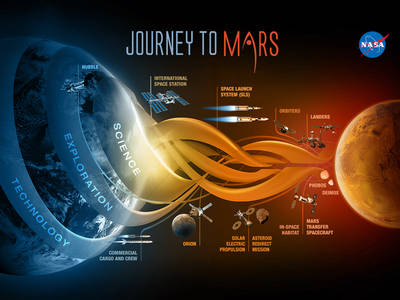
journey_to_mars

2. It takes a long time to get to Mars, depending on the available propulsion technology, but let’s just say using currently known or at least acknowledged sources, it’s going to be around a year or more. I suppose for the very first mission to the Red Planet that a duration of two months is possible, but I suspect that it would be longer. I also suspect that the habitation module constructed would be one that would be designed to be permanent, part of an elaborate colonization plan and not a primitive throwaway. Given the sophistication of their space vehicle, Hermes, which even had sectors that rotated to create artificial gravity, it’s more likely that part of that spacecraft would have constituted their living quarters and been left behind when their mission ended. This would have lightened the return load as well.

3. I thoroughly enjoyed the connections to previous Mars missions and how they provided resources for Mark to contact NASA. Whether that could actually be achieved I don’t know, but for me it was feasible and clever enough that I had no problem with it.  If you’re not at least partly awed by these previous accomplishments that comprise sending and then actually controlling a vehicle on another planet, then you simply don’t understand what it entails.

marsrover4. NASA has definitely been known to blow up rockets, not only in the early days of the initial space race with Russia to get to the Moon in the late 50s and 60s, but even more recently as many of you may recall with the Space Shuttle Challenger accident on January 28, 1986. Private rocket companies more recently are having a similar problem. Rocket fuel is highly volatile, systems complex, and problems are inevitable. Thus, when the rocket they put together in record time to send supplies blew up it wasn’t much of a stretch. Anyone who didn’t see that one coming hasn’t been paying attention to the space industry and its explosive history (pun intended).
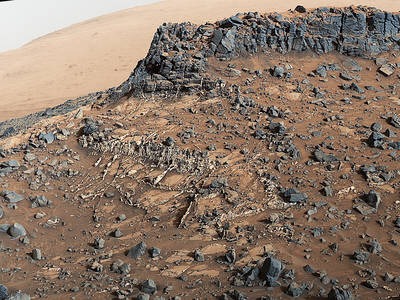
But there’s more to it that that. Having worked in Safety and Mission Assurance for most of my years at JSC, I was privy to quite a few dirty little secrets. NASA makes every effort to identify every possible hazard and document them all in Hazard Reports. These go far beyond acknowledging the problem itself. Some are classified as Critical, i.e., could cause a problem but not a lethal one, while others are classified as Catastrophic, which entail loss of life and/or millions of dollars worth of equipment. Once hazards are identified, it’s mandatory to identify preventative controls. The severity of the consequences of failure determine how many controls need to be in place. Systems that can cause a catastrophic hazard are required to be three-fault tolerant, meaning three things need to fail before the worst case scenario can occur.

InSight in ATLO with back shell

The back shell of the InSight spacecraft is lowered onto the lander in a clean room at Lockheed Martin.

However, there are some systems that defy that level of safety via controls and are thus considered an accepted risk. For example, unless you’re a pilot you probably would never think of a “bird strike” as being in that category, but if a spacecraft on takeoff or landing strikes a bird, it can have dire consequences. Other risks are accepted for a variety of reasons, but it gets complicated so I’ll save further explanation for a future blog, such as some of those “dirty little secrets” that relate to the two space shuttle tragedies. [NOTE:–With the 30th anniversary of the Challenger accident coming up this month, you can watch for one soon.]

Back to the point of the rocket blowing up in the film, besides the inherent danger of propulsion systems in general, bypassed quality assurance inspections or those performed by over-worked technicians would increase the likelihood of problems, making that unfortunate event quite feasible.

5. The next safety-related situation would be the malfunction and subsequent explosion that destroyed Mark’s potato garden. Certainly he did some modifications beyond its original intent, but it’s still unlikely it would have been that fragile. Considering some of the nasty substances that go along on a space mission, explosions are always a possibility. This also refers back to the fact that I doubt their outpost would have been so makeshift in the first place. Mars’ thin atmosphere is not as efficient at destroying meteorites as Earth’s, plus the main asteroid belt lies between Mars and Jupiter, so they’re a bigger problem by proximity as well. I sincerely doubt that NASA would ever erect such a cheesy structure as part of a planetary outpost. This, of course, applies to the matter of the antenna being destroyed as well. Furthermore, as mentioned in the Amazon forum, the force of the Martian wind is lower, given the reduced atmospheric pressure compared to Earth’s.

6. Several of the means employed in the movie were theoretically feasible but unlikely, such as ditching the capsule nosecone and replacing it with canvas or blowing the Hermes module for some extra propulsion. A gravity assist is certainly a possibility since that technique is used routinely for interplanetary exploration missions.

mars1

7. Lastly, I’m really skeptical about Mission Control not telling the crew earlier that Mark was alive. That just doesn’t make sense to me. However, NASA employees, no matter what rank they happen to be, are human and subject to bad judgement calls and mistakes, so it’s certainly not impossible. Subsequently, such individuals tend to quietly disappear, probably reassigned to the USA equivalent of Siberia.

In a situation like that in the movie, such a decision would undoubtedly be routed through the Astronaut Office and I suspect that the returning crew would be given that information posthaste. It’s important to know that communications between Mission Control and a manned craft are channeled through  a single source known as the Capcom, short for “capsule communicator”, a vestige derived from the early days of the space program.  This individual is traditionally an astronaut.  This person would undoubtedly be aware of the situation and thus wield considerable influence.

Not distracting the returning crew from their mission simply wasn’t sufficient rationale. Astronauts are human, too, and certainly have emotions which can drive them to do some crazy things in their private lives, but given the story’s circumstances and my experience at NASA, I really believe they’d be treated as the professionals they are and given all available information. They’d be far beyond pissed off to find out they’d been kept out of such an important loop.  Whether they’d go “rogue” or not is a possibility but doubtful without full ground support.  Spacecraft systems are beyond complex with each one having a team of experts who would assist with calculations for possible solutions.

Consider, as stated in the end of the movie credits, that it took 15,000 people to produce that movie.  Far more than that support the space program with each system component typically having a dozen or more engineers that know it inside out.  Astronauts couldn’t possibly have the necessary knowledge to make technical decisions that deviate from their training for a specific mission.

If you’re still with me at this point, thanks for listening. I really loved this movie, technical and operational flaws notwithstanding, because this is exactly the kind of film I love. My hope is that it inspires future generations, the ones who will someday walk on Mars, hopefully with a three-fault tolerant infrastructure as opposed to what astronaut Mark Watney had to deal with in “The Martian”.

You can pick up a DVD of the flick on Amazon here.

Mars Photos courtesy of NASA


An Outstanding & Thought-Provoking Time-Travel Tome

talesofelasticlimitcvr

While the premise of going back in time to alter history isn’t new, the author’s skill in its presentation coupled with his unique insights will satisfy science fiction and history buffs as well as anyone with an eclectic taste for literature. Indeed, this story possesses the makings of a classic. It’s highly intelligent, flawlessly edited, and I love the author’s straight-forward yet ethereal style which flows with the essence of timelessness that you’d expect in a book that involves time travel. His skillful writing combined with the fact his name is a pseudonym leaves the impression that he may, indeed, be a time traveler himself. The title is perfect, a thought-provoking glimpse of the nature of time and how far it could be stretched were it breached or controlled, the scope of its content undoubtedly epic.

As this tale begins, time travel has already been achieved and a multi-disciplined committee of academics privy to the technology directs its use to keep humanity’s history on the proper track. Three previous attempts didn’t work out as hoped, but the problems have supposedly been solved by scientist, Lawrence Henry, a.k.a. Hank, whose breakthrough discovery removes the troublesome paradoxes. Thus, Hank and his fiancée, Frances Newton, set out to establish humanity in a New Historical Age.

Those with whom they interact see them only as a very tall, mysterious gentlemen and a red-headed woman who serendipitously slip into their respective eras at historically important times. Each fable is independent and captures a nexus where a decision made by an individual, some famous historical figures, others not, takes the world in a new direction. These included encounters with Thomas Jefferson, Albert Einstein, King Henry VIII, Marcellus and Archimedes. As a reader I was immersed in the flavor of the moment and felt as if I was observing a profound moment in history unfold.

Events prior to those in recorded history were touched on as well, such as the invention of writing and numbers, the wheel, the transition to an agrarian society and even a new look at man’s best friend. The episodes operate on multiple levels which will satisfy casual readers as well as history lovers or those with philosophical tendencies. Each carefully selected situation demonstrated the author’s thorough understanding of history, was well researched, and included some little known facts packaged as a tremendously enjoyable story stylishly written. I haven’t read the preceding volumes in the Elastic Limit series, but this one stood well on its own while nonetheless leaving me with the desire to read the previous volumes, which this one ties together.

Pick up your copy on Amazon here.