Orion the Hunter easy to spot in January | Tonight | EarthSky

Sky watching in cold weather tends to make for better “seeing” but somewhat less comfortable for observers!  Nonetheless, it’s worth it.  Today is a New Moon which makes for great dark skies.

—-

It’s identifiable by Orion’s Belt, three medium-bright stars in a short, straight row at the mid-section of the Hunter.

Source: Orion the Hunter easy to spot in January | Tonight | EarthSky

Comma, give me a break!

booksinbox

I think we all realize that whether or not a person likes a book is highly subjective. I’ve read (or tried to read) books with numerous five-star reviews that I didn’t like and couldn’t get through. Some were well-written, just boring or populated with unappealing characters, while others were poorly written and/or edited. I’m a bit of a grammar/typo Nazi myself so I hide my head in shame that someone put one of my books in that category.

I’ve heard that no literary agent or publisher takes an indie book seriously until it has a few three-star reviews. Thus, when I got my first one as an untimely present for my Christmas birthday, I had mixed feelings. I now had the obligatory mediocre review and, to be perfectly honest, the reason had been noted by a previous reviewer, i.e. the lack of commas. I acknowledge this as a valid complaint and have it on my to-do list to rectify. Sadly, at one point I’d actually taken several of them out because they seemed to slow the story down! How ironic is that?

Okay, you may have already guessed that I have a couple confessions to make. First of all, I edited my own books, which I realize is a major no-no, but let me explain. First of all, there were various times when this particular book, which was admittedly my first novel, was set aside for years. When I would get back to it, I could read it like it wasn’t my own and, for the most part, edit effectively. Like I said, I’ve been accused of being a grammar Nazi with other people’s work, and I definitely fixed a lot over time.

Another factor was finding an editor I could trust to do the job. I mean, really do the job. I’ve seen too many acknowledgements in various novels where authors extol and thank their editor while I, nonetheless, find a plethora of things they missed when I read the work in question. Call it pride, if you must, but it was hard not to feel I could do as good or better of a job than some of the supposed pros out there.

And the coup de grace was that I was on a budget. While I don’t mind paying for services that are done correctly, cost combined with not being sure I could find a competent editor resulted in doing it myself. Oh, well, my bad.

The second one is that, even though I have a minor in English, I am not that well-versed in grammar. Seriously. Most of what I know has been learned through my mother correcting me as a child, reading, and, heaven forbid, intuition. I’ve been an avid reader all my life and been writing since I could hold a pencil, yet never liked English classes or understood some of the rules. Diagramming sentences to me was worse than algebra, which made more sense. I really don’t like to point fingers, but in this case I’m going to point one at a prof I had in college who taught the obligatory grammar class for those majoring or minoring in English. That class was, like we say here in Texas, as useless as teats on a boar hog.

The prof, who is probably now dead and gone, couldn’t find a textbook that he liked so we had none. He would lecture, but with no logical order or continuity that I could recognize. All we did the entire term was–you guessed it–diagram sentences. Punctuation was rarely mentioned. One thing I remember him (or perhaps someone else) saying was that English, unlike Latin, was a living language that evolved, that such things as punctuation styles changed over time, and things like comma usage was becoming somewhat optional. You can bet I jumped on that like a duck on a June bug!

judgeongrammar

But for purists who were more astute at learning the rules than I was, it was a major faux pas. And apparently the person who left this three-star lambasting was one of them.  I must say that the reviewer was generous in giving it three-stars since s/he didn’t even finish reading it.

Back to the subjectivity of what we like, science fiction is certainly one of those genres that everyone doesn’t care for. (Oops, ended that sentence with a preposition! OMG! Let’s correct that to “one of those genres for which everyone does not care.” Right? Right.) Even with proper punctuation it’s likely s/he wouldn’t have liked it. That I understand. And I do admit s/he has a point and I will fix the problem because, believe it or not, I really am a bit of a perfectionist, but that doesn’t mean that I know everything by a long shot. I’m teachable but, as noted earlier, I never had a decent English teacher or at least one I could follow. Math is much simpler to me with its concrete, easy to follow rules and black and white answers. Equations make a lot more sense.

pageheart

So what have I learned that I can pass on to other writers? If I had this to do over, it would be to do a beta reader exchange with someone who has equal editing skills to my own. Fortunately, for subsequent books I was able to find such individuals. And that is what saddens me the most, the other books in the series are in much better shape. I’ve actually received compliments on the editing of at least one of the others. This was my first book and I’ve heard it said that everyone’s first novel should go in the trash bin labeled “tuition.” My problem was that it was the start of a series with so much more to tell! The characters evolved and so did the plot to the point that it took four full-length novels to complete the story. I’m a much better writer now, as all of us become, the more we write.

So, bottom line, I’ll go back eventually and correct the comma situation. I don’t know all the rules, but at this point I’m reasonably confident that I’ll be able to do so in a competent manner. The worst part, as most indie authors know, is that there are so many different formats to deal with, i.e., both print and electronic versions, which complicates the process considerably. Nonetheless, I’ll have the satisfaction of debunking that uncomplimentary review when it’s corrected, unless, of course, those who would appreciate a properly copy edited work are turned off by that seething diatribe, which is actually so excessive that it’s downright amusing. Fortunately, most geeks and nerds, who are my primary audience, anyway, aren’t quite so concerned, though there are exceptions, of course, many of whom I met at NASA.

<Sigh.>

Rant over.

Thanks for listening.

P.S. If you’d like an ecopy of the book in question, “Beyond the Hidden Sky,” for free, join my mailing list, which qualifies you for a free download. You can do so here.

Venus-Saturn conjunction January 9 | Tonight | EarthSky

Early risers, take note!  Looks like a wonderful month ahead for sky watchers.

—–

Closest conjunction of two planets since 2013, and a fitting prelude to the five-planet spectacle later this month!

Source: Venus-Saturn conjunction January 9 | Tonight | EarthSky

Tiny 3-D glasses confirm insect 3-D vision

I’m pretty amazed at some of the thing scientists investigate.  Interesting nonetheless.

—–

Miniature glasses have proved that mantises use 3D vision – providing a new model to improve visual perception in robots.

Source: Tiny 3-D glasses confirm insect 3-D vision

Dates of lunar and solar eclipses in 2015 and 2016 | Astronomy Essentials | EarthSky

Here’s some more great information for sky watchers.  I love this site!

—-

The next eclipse is a total solar eclipse – caused by a supermoon – on March 8-9, 2016.

Source: Dates of lunar and solar eclipses in 2015 and 2016 | Astronomy Essentials | EarthSky

JOURNEY TO A STAR – ASTEROID BELT

Here’s a bit of info on the asteroid belt you might enjoy!

hotenka's avatarimagine life else where?

 Between the orbits of the planets Mars and Jupiter lies the asteroid belt; a huge region of asteroids and minor planets presenting its own dangers to our star mission.

So not only do we have to set a collision course for Jupiter [previous post] but we have to navigate the equivalent of a solar minefield of objects ranging in size from 400 – 900 km diameter down to billions of dust sized objects. The largest object is Ceres, a dwarf planet at 950 km diameter, followed by Vesta, Pallas and Hygiea which are all in excess of 400 km.

But avoiding these is relatively simple due to their large size. It is the millions of smaller objects that pose the highest danger to our spacecraft. There are estimated to be around 1 million asteroids in the belt of diameter greater than 1 km. There are billions…

View original post 364 more words

Astronomical events in 2016 | Astronomy Essentials | EarthSky

Here’s another great reference for your sky watchers out there!

—-

Dates of major moon phases, conjunctions and oppositions of planets, meteor showers and other important dates in 2016, from astronomer Fred Espenak.

Source: Astronomical events in 2016 | Astronomy Essentials | EarthSky

Astrological Archetypes & The History Channel

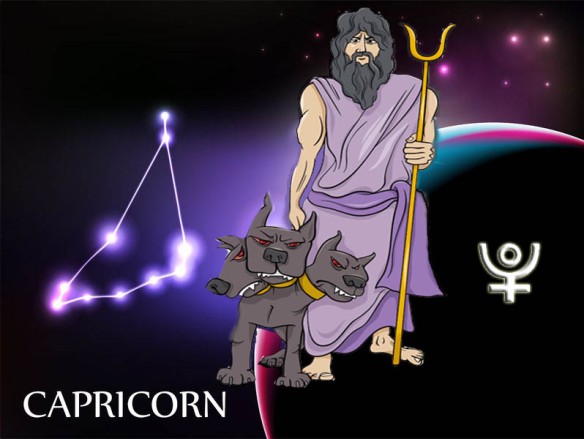
plutocap2 copy

Astrology is so much more than a person’s sun sign. Yet that’s usually about all the average person knows about it. Some may have a vague idea of the basic personality traits of those born under theirs and perhaps other signs. As a professional astrologer, I see the influence of this ancient art all around me. The ancients declared “As above, so below” with good reason. Astrology is much more than the placement of the Sun; it includes the sign each planet occupies as well, and when you really get into it, the stars, constellations and asteroids as well. It’s mind-boggling to say the least, yet fascinating, as you see influences that fit like the proverbial glove.

One that has recently stood out for me is the influence of the planet, Pluto, while he transits through the sign of Capricorn. This began January 27, 2008, though there were a few times after that when Pluto returned to Sagittarius due to retrograde motion. This occurred between June 15 and November 27 of that same year. Since then he’s been there to stay, at least until March 24, 2023 when he’ll first set foot in Aquarius.

At this point you’re probably wondering “So what?” Patience, dear reader, I’m getting to that. In order to notice, much less appreciate, these effects, you first need to understand the underlying meaning of both Pluto and his current sign of residence, Capricorn. As you probably know, Pluto is the Roman god of the Underworld, known by numerous other names, depending on which culture’s mythology you favor. Most mythological characters represent an archetype, defined by The American Heritage Dictionary as “an original model or type after which other similar things are patterned.”

To get a general idea of what this means, read the myth about Pluto (Greek Hades); Proserpina (Greek Persephone); and Ceres (Greek Demeter) where, through intrigue, Pluto kidnapped Cere’s daughter, Proserpina, and took her into the Underworld to be his queen. Using this myth as a model, some of the things Pluto represents astrologically are derived, e.g., power, control, corruption, the Underworld, anything buried beneath the surface, intrigue, and abductions. His domain also includes atrocities, death, catacombs, dictators, pirates, vampires, devastation, holocausts, and oddly enough, transformations such as rebirth (e.g., resurrection or the Phoenix arising from the ashes). Forensics and anything that exposes and eliminates corruption such as that required for purification and healing are included as well. These are but a few examples of the type of energy that Pluto emanates.

The zodiac sign in which a planet resides provides it with a specific environment where this energy is expressed and thus directed toward certain areas influenced by that sign. For example, Capricorn is considered the ruler of governments and their officials, politicians, building foundations, cemeteries, bones, excavations, administrators, anything old, order, time (think of the decrepit old man who represents the outgoing year at New Year’s Eve which just happens to be when the Sun is in Capricorn), and responsibility, to name a few. Also note that “history” is ruled by Saturn, Capricorn’s ruler, and is obviously something old. Neptune rules secrets and mysteries, and he’s involved, too, as he hangs out in Pisces, the sign he rules, so solving old mysteries that touch upon history through excavations is another thing to look for.

So what do you think Pluto will be up to during his trek through Capricorn? One way to see it manifested would be power grabs and control efforts by governments and administrators. All you have to do is pay attention to the news to see evidence of that. Exposure of corruption and those things that lie beneath the surface, literally and figuratively, is another expression of this energy. Think there’s any of that going on? Let’s take a look at some of the most popular televisions shows for clues.

The following examples just happen to be on The History Channel or its high definition version known simply as H2. Most are viewable online. I realize this blog is turning into a plug for The History Channel, which wasn’t my initial intent.  Nonetheless, it’s one of my favorite channels due to its content and I’m familiar with most of these shows, which fit the Pluto in Capricorn archetype so nicely. Indeed, they were so obvious that they inspired this blog in the first place.

The Curse of Oak Island – Two brothers investing a significant amount of resources in trying to find the various treasures supposedly hidden by everyone from pirates to the Knights Templar on this island off the coast of Nova Scotia.

Hunting Hitler – Investigates claims made by formerly classified FBI files which indicate Adolf Hitler did not commit suicide in his bunker at the conclusion of World War II but followed a carefully constructed plan supported by an alliance with Spain to escape to South America.

Pirate Treasure of the Knights Templar – Explores possible connections between what you would expect would be very diverse groups.

America Unearthed – A forensic geologist investigates various North American sites that provide evidence of pre-Columbian presence from the Great Lakes to Arizona and various other locations inbetween.

Brad Meltzer’s Decoded – Author, Brad Meltzer, assembled a team comprising an historian, attorney and engineer to investigate any number of mysteries ranging from Secret Societies to UFOs at Area 51.

Engineering Disasters – Investigates the cause of various disasters that involved engineering. Some may have had unknown causes or been suppressed from public knowledge.

Cities of the Underworld – Little known, less-than-charming facts about underground features of various cities around the world.

A broad scope of documentaries that prompt and/or investigate archaeological digs worldwide are out there as well on PBS channels and various others. See how many you can find that fit the mold. Give some thought, also, to the renewed fascination with vampires, which just doesn’t seem to go away, as well as the zombie frenzy.

In case you’re wondering what happened the last time Pluto was in Capricorn, that was over two hundred years ago. With an orbital period of 246 years he’s a bit of a slow mover. The last time the God of the Underworld entered Capricorn was on January 8, 1762, to be exact. The American Revolution occurred during that passage. No telling what this one will bring.

For more about Pluto’s astrological influences through the signs, visit my astrological website http://www.valkyrieastrology.com/Makeover/Planets/Pluto.htm.

P.S. I confess that the illustration above is not astrologically correct. The first person to tell me why can have a free download of “Whobeda’s Guide to Basic Astrology.”

Stock images copyright 123RF.com

January 2015 guide to the five visible planets | Astronomy Essentials | EarthSky

Here’s some good information for you sky watchers out there, provided you’re an early riser!

———-

A great drama unfolds in the predawn sky throughout January, 2016. By the month’s end, all five visible planets will appear simultaneously before dawn.

Source: January 2015 guide to the five visible planets | Astronomy Essentials | EarthSky

Challenges of Space Exploration: A NASA Insider’s View of “The Martian” (Movie Version)

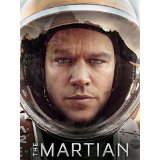
martiancover

[Spoiler Alert: This constitutes one massive spoiler if you haven’t already seen the movie. I comment on specific situations depicted onscreen based on my experience working as a NASA contractor for over 20 years. So if you’re even slower to see movies than I am, are planning to see it, and prefer to thoroughly enjoy the suspense, then bookmark this blog and read it later.]

First of all, I want to say I thoroughly enjoyed this movie which I finally saw over the holidays while visiting family. My intent here is not to criticize since I believe it was exceptionally well done. It employed a lot of fascinating details, ingenuity and great suspense throughout. Fortunately, Hollywood has come a long, long way depicting NASA-related movies since the movie, Armageddon, which I considered a complete debacle as far as the technical details were concerned.

I suppose being a physicist and geek who worked for NASA as a contractor from 1988 – 2009 are what drive me to pick at technical details, perhaps as a matter of ego to show my knowledge. Whatever it is, I can’t help it, and to me such details are interesting while most normal people would simply enjoy the movie for what it is and give me one of those looks that screams, “What’s your problem, Bozo?” I’ve mellowed on this a bit myself, but I still maintain that a certain level of scientific accuracy is important. But I’m a geek, so what do I know other than it was science fiction that inspired me to become a geek in the first place? Does it really matter if it’s factual? Probably not.
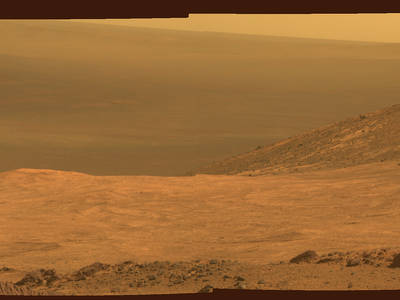
IDL TIFF file

Anyway, “The Martian” is based on the book of the same name by Andy Weir, whom you can learn more about on his Amazon Author page. There’s also an interesting forum on Amazon where various readers have commented on the technical accuracy of the story (or lack thereof), which of course appealed to my inner geek. Having seen and enjoyed the movie, I plan to read the book. I assume that the author did a lot of research putting this story together and can thus take credit for the fact the movie was realistic enough to be credible and even admired by someone like myself. Based on my experience, here are a few comments.

1. My first job with NASA was in the Life Sciences Division at Johnson Space Center in Houston, Texas. Part of their purview was the well-being of the astronauts. The majority of their experiments conducted on the space shuttle and International Space Station were directed primarily at how exposure to microgravity, increased radiation, close quarters and isolation affected an astronaut’s mind and body. Colonization of distant worlds such as Mars has been a topic of NASA research for many years, including what crops would grow and thrive in conditions different from Earth. Needless to say, being self-sufficient is the ultimate goal.

That said, I suspect that if we had an outpost on Mars that by that time we’d know enough about such things as potential crops that there would have been more for the story’s hero, Mark Watney, to work with besides potatoes which were intended to be consumed as food. I’m reasonably sure that part of the mission would entail planting a variety of things, perhaps for the benefit of the next crew.

Which brings me to my next comment, the length of the movie’s mission being 60 days.
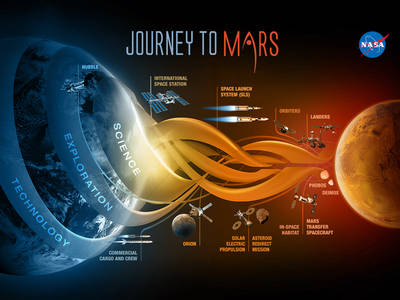
journey_to_mars

2. It takes a long time to get to Mars, depending on the available propulsion technology, but let’s just say using currently known or at least acknowledged sources, it’s going to be around a year or more. I suppose for the very first mission to the Red Planet that a duration of two months is possible, but I suspect that it would be longer. I also suspect that the habitation module constructed would be one that would be designed to be permanent, part of an elaborate colonization plan and not a primitive throwaway. Given the sophistication of their space vehicle, Hermes, which even had sectors that rotated to create artificial gravity, it’s more likely that part of that spacecraft would have constituted their living quarters and been left behind when their mission ended. This would have lightened the return load as well.

3. I thoroughly enjoyed the connections to previous Mars missions and how they provided resources for Mark to contact NASA. Whether that could actually be achieved I don’t know, but for me it was feasible and clever enough that I had no problem with it.  If you’re not at least partly awed by these previous accomplishments that comprise sending and then actually controlling a vehicle on another planet, then you simply don’t understand what it entails.
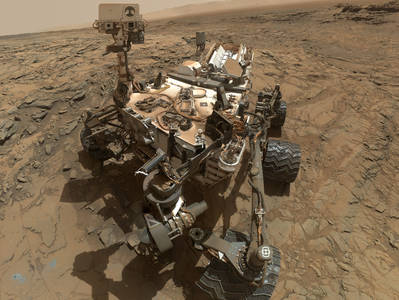
marsrover4. NASA has definitely been known to blow up rockets, not only in the early days of the initial space race with Russia to get to the Moon in the late 50s and 60s, but even more recently as many of you may recall with the Space Shuttle Challenger accident on January 28, 1986. Private rocket companies more recently are having a similar problem. Rocket fuel is highly volatile, systems complex, and problems are inevitable. Thus, when the rocket they put together in record time to send supplies blew up it wasn’t much of a stretch. Anyone who didn’t see that one coming hasn’t been paying attention to the space industry and its explosive history (pun intended).

But there’s more to it that that. Having worked in Safety and Mission Assurance for most of my years at JSC, I was privy to quite a few dirty little secrets. NASA makes every effort to identify every possible hazard and document them all in Hazard Reports. These go far beyond acknowledging the problem itself. Some are classified as Critical, i.e., could cause a problem but not a lethal one, while others are classified as Catastrophic, which entail loss of life and/or millions of dollars worth of equipment. Once hazards are identified, it’s mandatory to identify preventative controls. The severity of the consequences of failure determine how many controls need to be in place. Systems that can cause a catastrophic hazard are required to be three-fault tolerant, meaning three things need to fail before the worst case scenario can occur.

InSight in ATLO with back shell

The back shell of the InSight spacecraft is lowered onto the lander in a clean room at Lockheed Martin.

However, there are some systems that defy that level of safety via controls and are thus considered an accepted risk. For example, unless you’re a pilot you probably would never think of a “bird strike” as being in that category, but if a spacecraft on takeoff or landing strikes a bird, it can have dire consequences. Other risks are accepted for a variety of reasons, but it gets complicated so I’ll save further explanation for a future blog, such as some of those “dirty little secrets” that relate to the two space shuttle tragedies. [NOTE:–With the 30th anniversary of the Challenger accident coming up this month, you can watch for one soon.]

Back to the point of the rocket blowing up in the film, besides the inherent danger of propulsion systems in general, bypassed quality assurance inspections or those performed by over-worked technicians would increase the likelihood of problems, making that unfortunate event quite feasible.

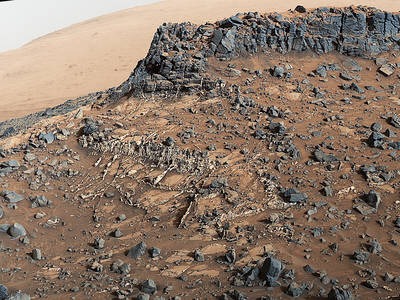
5. The next safety-related situation would be the malfunction and subsequent explosion that destroyed Mark’s potato garden. Certainly he did some modifications beyond its original intent, but it’s still unlikely it would have been that fragile. Considering some of the nasty substances that go along on a space mission, explosions are always a possibility. This also refers back to the fact that I doubt their outpost would have been so makeshift in the first place. Mars’ thin atmosphere is not as efficient at destroying meteorites as Earth’s, plus the main asteroid belt lies between Mars and Jupiter, so they’re a bigger problem by proximity as well. I sincerely doubt that NASA would ever erect such a cheesy structure as part of a planetary outpost. This, of course, applies to the matter of the antenna being destroyed as well. Furthermore, as mentioned in the Amazon forum, the force of the Martian wind is lower, given the reduced atmospheric pressure compared to Earth’s.

6. Several of the means employed in the movie were theoretically feasible but unlikely, such as ditching the capsule nosecone and replacing it with canvas or blowing the Hermes module for some extra propulsion. A gravity assist is certainly a possibility since that technique is used routinely for interplanetary exploration missions.
mars1

7. Lastly, I’m really skeptical about Mission Control not telling the crew earlier that Mark was alive. That just doesn’t make sense to me. However, NASA employees, no matter what rank they happen to be, are human and subject to bad judgement calls and mistakes, so it’s certainly not impossible. Subsequently, such individuals tend to quietly disappear, probably reassigned to the USA equivalent of Siberia.

In a situation like that in the movie, such a decision would undoubtedly be routed through the Astronaut Office and I suspect that the returning crew would be given that information posthaste. It’s important to know that communications between Mission Control and a manned craft are channeled through  a single source known as the Capcom, short for “capsule communicator”, a vestige derived from the early days of the space program.  This individual is traditionally an astronaut.  This person would undoubtedly be aware of the situation and thus wield considerable influence.

Not distracting the returning crew from their mission simply wasn’t sufficient rationale. Astronauts are human, too, and certainly have emotions which can drive them to do some crazy things in their private lives, but given the story’s circumstances and my experience at NASA, I really believe they’d be treated as the professionals they are and given all available information. They’d be far beyond pissed off to find out they’d been kept out of such an important loop.  Whether they’d go “rogue” or not is a possibility but doubtful without full ground support.  Spacecraft systems are beyond complex with each one having a team of experts who would assist with calculations for possible solutions.

Consider, as stated in the end of the movie credits, that it took 15,000 people to produce that movie.  Far more than that support the space program with each system component typically having a dozen or more engineers that know it inside out.  Astronauts couldn’t possibly have the necessary knowledge to make technical decisions that deviate from their training for a specific mission.

If you’re still with me at this point, thanks for listening. I really loved this movie, technical and operational flaws notwithstanding, because this is exactly the kind of film I love. My hope is that it inspires future generations, the ones who will someday walk on Mars, hopefully with a three-fault tolerant infrastructure as opposed to what astronaut Mark Watney had to deal with in “The Martian”.

You can pick up a DVD of the flick on Amazon here.

Mars Photos courtesy of NASA