Today’s Writing Tip

desk-2158142_1280 copy

Releasing your series as a boxed set can give it new life, perhaps snagging readers who missed out when the others were published individually. Existing fans love having all your books in one place, and for anyone who hates cliffhangers, problem solved!

A boxed set also shows that you’re a prolific writer. Nothing is more frustrating than finding an author you love, only to discover they never wrote anything else. Fans like to know you’ll keep them coming!

Today’s Writing Tip

coffee-3047385_1280 copy

When writing a series, it’s helpful to go back and reread the previous stories before starting the next one. You’ll be surprised how many little details you can tie in or use to create new plot twists. Fans love it when they encounter and recognize such connections, which make them feel like an insider.

Rereading also helps you regain momentum established in the previous story, especially if it’s been a while since you wrote it. Being consistent with details is essential, such as character eye color, relationships, location descriptions, and so forth. Don’t ever assume no one will notice because you don’t even remember yourself. If a reader binge-reads the series later or has a steel-trap memory, you’re going to hear about it, probably in a less than friendly manner. Thus, it’s to your advantage to take the time to do it right. Your fans will appreciate it.

Historical Fiction at its Best: Review of “Finding Billy Battles: The Lost Years” by Ronald E. Yates

9781545632819_cov2.indd

5stars

This well-written conclusion to the Billy Battles trilogy is its crown jewel. This series’s characters are so vivid and compelling it’s hard to believe that this is a work of fiction. Their involvement in the events of the late 19th and early 20th century brings history alive as well. The author has outdone himself in researching that era and many of the events of which only true history buffs would be aware. In doing so, he has performed a great service bringing them to readers’ attention because these various international skirmishes laid the foundation for much of the contention seen in today’s world.

As they say, victors are the ones who write history. It’s also true that what you hear in history class is based on what higher powers want people to believe and incorporate into their view of the world. There is nothing more enlightening than to see familiar situations from the other side of the fence. Through these novels, Ron Yates has done a stellar job of placing the reader in the middle of various international situations and, in the true spirit of journalism, objectively presenting both sides. Sadly, today there is so much bias in the news media that true journalism has virtually disappeared. But even before they stooped to fake news and blatant lies, the stories presented by the media were designed to maintain a certain mindset that fueled nationalism at its worst.

When the U.S.A. entered World War II, they were definitely invited. Western European countries still appreciate us for the victory made possible by our intervention. For example, to this day Luxembourg places a wreath every Veterans Day on George S. Patton’s grave, which is in a U.S. Military Cemetery within that country. However, there have been times when our actions were nothing less than intrusive, albeit based on self-protection. That is justifiable to a point, but once that goal is achieved, hanging around terrorizing other country’s native populations is flat-out wrong. If you’ve ever wondered why Mexico hates us, this book will provide some answers.

European colonialism, which we supported, is another thorn in the side of many countries, especially in Far East countries like Korea and Vietnam. Bringing our version of civilization to these foreign shores, which we were convinced to consider a favor, in many cases wasn’t. How we’ve treated indigenous populations in other lands is shameful and even persists to this day with regard to Native Americans.

Of course America did not start this practice, which originated millennia ago. Not that long ago, we were a colony ourselves, who were being oppressed, which ultimately resulted in the American Revolutionary War. So what did we do, but turn around and support colonization by those who had once been our enemy. When our borders or way of life are threatened, that’s one thing. If someone attacks us, we have the right to defend ourselves, but our intrusion into these other battles has often made us the invader. It’s no wonder that other countries fear us, and it spirals down from there. However, the world is now entangled in the unfortunate consequences of thousands of years’ worth of conquests. Cliché though it may be, it’s true that those who fail to learn from history are indeed doomed to repeat it.

I didn’t intend for this review to turn into a political essay. However, it demonstrates how effective this novel and its predecessor, “The Improbable Journeys of Billy Battles”, have been in enlightening me to some of the less than savory facts embedded in U.S. history, thanks to the exploits of Yates’s amazing characters. Their interaction with actual historical figures makes it all the more interesting and convincing. Astounding imagery puts you right in the thick of things, whether geographically or via the use of the conversational vernacular of the time. In more ways than I can count, this book is a masterpiece. Do yourself a favor and get started on this series today. You’ll not only be entertained, but see the world in an entirely different way. Isn’t that what great fiction is all about?


You can pick up your copy on Amazon of “Finding Billy Battles: The Lost Years” here.

You’ll also want to read “Finding Billy Battles: An Account of Peril, Transgression, and Redemption”, Book 1 of the series, which you can find here.

Book 2, “The Improbable Journeys of Billy Battles”, can be found here. My 5* review of this one is here.

Ron at Southcoast WineryLearn more about the fascinating background of author, Ronald E. Yates, and how it prepared him to write such outstanding stories from our interview here.


Today’s Writing Tip

blogging-336375_1280 copy

If your story becomes a series, remind your readers the fundamentals, such as what the characters look like and any important backstory information. This benefits not only those who read the earlier books sometime in the past, but helps those who start with a later episode.

As an author, your series is one continuous story, but it’s unlikely your readers will read all books in sequence, especially if they’re released at different times. You’ll want to draw them back into the story and plot as quickly as possible so they’re comfortably established. Also consider that your books may not be read in order. Thus, including a plot summary here and there or flashback to a previous story is essential; a prologue is another possibility.

You can find additional tips for writing a series here and here.

Today’s Writing Tip

alphabets-2306479_1280 copy

Remember to include scene transitions, especially when a significant amount of time has passed or the location has changed. Failing to  address such details first and foremost can stall readers, causing them to go back and reread what came before, wondering what they missed. As the author, you know exactly what’s happening, but a reader may not if you don’t provide sufficient information.

If in the previous conversation your characters were talking about going to the beach, then picking up the next scene at the beach isn’t a problem. However, if in the next scene they’re in a courthouse and you don’t establish that immediately, they’re going to have one of those “WTF?” moments that throw them out of the story. Do this too often and you’ll have frustrated readers who just might cross you off their favorite author list.

“Gravity Waves” by Scott Skipper: Another Hilarious Addition to the “Alien Affairs” Series

gravitywaves

This is one of my very favorite series, ever, and this episode further confirmed that whatever science fiction sub-genre this happens to be, it’s what I’d choose if I had to, over just about anything else. I guess it could be called something like “snarky, politically incorrect, hard sci-fi” and I love it. It has technology and theoretical physics speculations to feed my nerdy, physicist brain; sarcasm that makes me wish I could be as witty; and snarky undertones to evoke hysterical laughter, such that my cat glares at me for disturbing her sleep when I’m reading in bed.

It was so much fun to get a glimpse of half-breed, Terrie Dreshler, now fully grown not only to adulthood, but middle age, to say nothing of her mother, Carrie Player, now an old lady, at least chronologically, and stepping into that role where she admonishes those around her for their every faux pas.

Every time Terrie called Deshler “Dad” I cracked up. I can just see this entire series as an uproarious sit-com that comprises a family where the father is a grey alien; the mother, human; and the daughter, well, mostly human, other than her eyes. It just gets better and better. Such a show could even beat out my two favorite sit-coms of all times, “Third Rock from the Sun” and “Alf.”

Situations involving interdimensional time travel sometimes left my head spinning with regard to when and where they were, but things sorted themselves out eventually. The new alien, Emelda, a towering Nordic wonder, was a great addition to the group. Her penchant for Uncle Eddy was hilarious, as well as her insisting repeatedly that Mars was still a “sh*thole”, in spite of  the earthlings’ innovative terraforming efforts. Then there’s Terrie’s renewed relationship with Marcus, which adds a touch of something bordering on romance. The inclusion of a character who was supposedly Elon Musk’s grandson, to say nothing of the involvement of SpaceX, tied the story into current events, which gave it even more credibility. Frankly, I wouldn’t be surprised to see Terrie turn up on the news one of these days, or an equivalent of their electronic personal assistant, Casseopeia, in the local Wal-Mart.

While the author does a tremendous job of tying in events from previous books as reminders and plot gap fillers, I highly recommend reading this series from the start. The evolution of the absurd situation that started in Roswell in 1947 as well as the roles of this diverse cast of characters is priceless. Trust me when I say you don’t want to miss out on any of it.

Anything that can make me laugh is worth its weight in gold. I’ve already read the first book twice. These are definitely stories that I’ll read again and again, which is extremely unusual for me since I tend to have a very long To-Be-Read list. But who doesn’t go back to their favorite stories, whether it’s a two year old wanting mommy to read the same tale every night, or a great-grandma who’s found a series that couldn’t be more perfect if it were written expressly for me?

Keep ’em coming, Scott! I think the entire “Alien Affairs” series is nothing short of magnificent. (But be warned, you probably won’t agree if you think it’s important to be politically correct. It’s not, but some things just need to be said.)

You can get your copy from Smashwords, Amazon, or your favorite online retailer.

Today’s Writing Tip

writer-1421099_1280 copy

Avoid giving characters similar names, such as those starting with the same letter or sound, or names that rhyme. Using unique or unusual names makes them easier for readers to keep track of and more memorable as well.

For example, Shelley and Sherry; Allen and Andrew; Michelle and Rochelle; Allison and Madison; Jerry and Terry; Kelly and Kerry, etc. can cause confusion, especially if they’re minor characters who aren’t around for the entire story. Any time a reader has to stop and figure out who’s what it breaks the story flow.

On the other hand, unique names in and of themselves make a person stand out. Surnames are popular given names, so if you can’t think of anything else, you can always use your grandmother’s maiden name. My paternal grandmother’s surname was Jarry. Not bad for a character, unless you already have a Harry, a Barry, or a Larry. My other grandmother’s name was Gale. Another good option.

Ronald E. Yates: Premier Journalist in Fact…and Fiction!

Ron at Southcoast Winery

Today I have the pleasure of introducing you to Ronald E. Yates, former foreign correspondent, professor emeritus, and author of the highly acclaimed Finding Billy Battles series.  If you haven’t experienced his work, you are missing out on some of the finest novels I’ve had the pleasure of reading.  Not only do his characters jump off the page, but you’ll find yourself transported back in time to historical events of which I, for one, had little knowledge or understanding. His stories brought me to an entirely new comprehension of the Spanish-American and Vietnam Wars, as well as how and why the USA is often viewed in a negative light. You can find more regarding my thoughts on “The Improbable Journeys of Billy Battles”, second volume in his series, in my review HERE. I am now an avid fan and hooked on properly researched and objective historical fiction.

Meanwhile, here’s a glimpse of the person behind these landmark works, demonstrating that personal experience contributes greatly to the stuff of which an outstanding writer is made.


MF: You had a long and interesting career as a journalist, not unlike your protagonist, Billy Battles. Does any one particular correspondent assignment stand out above the others? If so, why?

RY: Hmmm. Let me count the assignments. There are several but I would say covering the end of the war in Vietnam between Jan 1974 and April 30 1975. The last day was chaos incarnate. Russian made 122mm rockets were slamming into buildings, 130mm mortars were hitting Tan Son Nhut airport, and the U.S. Embassy was surrounded by frantic South  Vietnamese desperate to get out of the country because they had worked for the American military or some U.S. agency. The city was in full panic mode. Several of us made our way to the sprawling Defense Attaché Office building at Tan Son Nhut and we were finally evacuated by a U.S. Marine CH-53 Sea Stallion helicopter. It was a relief until the door gunner told me later aboard the U.S.S. Okinawa that the pilot apparently had to drop flares to misdirect a SAM-7 (surface to air missile) that had been fired at our chopper.

Every year I post a story detailing the last 24 hours in the fall of Saigon. People can find it on my blog. I could add a few more such as the Tiananmen Square massacre in 1989 and the time I was taken prisoner in El Salvador by anti-government guerillas, but that would take up the entire interview.

scan0015 (2016_01_14 15_27_28 UTC)

MF: One thing that impressed me the most about the Billy Battles stories is how well you maintained his objectivity. I learned so much about historical events that have colored other country’s opinion of America. It seems the old standards of journalistic objectivity have gone the way of landlines and 20 megabyte hard drives. How do you feel about today’s highly biased reporting?

RY: As someone who spent 25 years as a journalist practicing it at the highest levels and then another 13 years as a professor and Dean at the University of Illinois where I taught journalism, I am terribly disappointed and disgusted by the lack of fairness and accuracy I am seeing—especially in Washington. It seems to me that too many journalists today see themselves as subjective opinion leaders rather than impartial purveyors of information that is fair and accurate. Coming as I did as a neophyte into the cavernous news room of the Chicago Tribune back in 1969 right out of college, I had editors who made sure that I didn’t stray from accurate, evenhanded and unbiased reporting into opinion and rumor. When I did, I heard about it from some crabby City Editor.

An even worse sin at the Tribune was the sin of omission. That occurred if you took it upon yourself NOT to report something because doing so might not coincide with YOUR interpretation of the event or your political predilection. Good journalism, somebody once said, is a nation talking to itself. Sadly, it is the public that suffers when journalists become advocates for one party or cause at the expense of providing unbiased news. Some say journalism in America is dead. I won’t go that far. But I believe it is in a coma.  

Ron Yates in Bangkok with title 2 (2016_01_14 15_27_28 UTC)MF: Billy is one of the most memorable and realistic characters I’ve encountered in fiction. Did he just spring to life or is he mostly you time-traveling to historical settings?

RY: That is very perceptive of you, Marcha. Aren’t all novels (or trilogies in my case) supposed to be autobiographical in some way? I guess if I’m honest I would agree that Billy is me time-traveling to the past. There are parallels in Billy’s life and mine. For example, both of us grew up in Kansas and we both attended the University of Kansas. Of course I graduated and Billy didn’t. We both spent a lot of time in Asia and Latin America in places like Saigon, Manila, Hong Kong, Mexico City, Veracruz, etc. We both lived in Chicago and we both worked for newspapers there. Even though my wife is German she is not a baroness as Billy’s second wife was. I only had two daughters, not three like Billy. We both owned guns. That’s where the similarities end. Unlike Billy, as far as I know, I never killed anybody.

MF: If you had access to a time machine, which period of history would you go to first?

RY: There are two periods that I have always been fascinated with. One is the 19th Century during the period my trilogy begins. I grew up in Kansas and I was always fascinated by what life was like there in the 19th Century when the state was still quite wild. One of my passions during my time in Kansas was the state’s past, with its cow towns, gun slingers, law dogs, and other assorted characters. I spent a lot of time learning about some of the people whose reputations were made in Kansas—Wyatt Earp, Doc Holiday, Bat Masterson, Wild Bill Hickok, etc.

One of my forefathers from that time knew some of these people and I used that fact in having Billy rub shoulders with them. The other is the period between 100 BC and 200 AD during the height of the Roman Empire. I would love to be able to walk through ancient Rome now that I have walked through it in the 21st Century.

BB Trilogy 3-21-18

MF: How much harder would it have been to write your Billy Battles stories without the research capabilities of the internet?

RY: Let me see, how much more difficult? How about 10 times more difficult. The internet has opened up myriad avenues for conducting research. I have a fairly substantial library containing lots of reference books countless subjects, as well as books on Asia and Latin America, etc. because of my time as a foreign correspondent. I use those a lot—especially if I need to double check something I find on the internet that seems a bit off. Believe me, there is plenty of misinformation on the internet—even in Wikipedia, which I support annually with a modest contribution. I had a lot of books on Asia’s colonial period and those were invaluable. Same with books about 19th century and early 20th century Mexico, but I still found myself surfing the internet almost every day. For a writer the internet is an invaluable tool.

MF: Do you (or have you) physically travel to the locations where your stories take place or do you do so vicariously? If the former, what new insights and inspiration came from any of them that made a significant difference in the story?  Did any new plot twists come as a result?

RY: Because I was a foreign correspondent posted to Asia and Latin America I spent years in the places I write about in the Finding Billy Battles Trilogy. I actually lived in the same hotel (The Continental Palace) in Saigon that Billy lives in when he is there in 1894-96. In fact, I had him stay in the same room I lived in, so I could describe the scene outside his window quite accurately. I think it is really important for any author to have visited, if not lived for a while, in the places he or she writes about. There is a ring of truth that you simply cannot achieve by visiting these places virtually on the internet or in travel books, etc. For one thing, you can’t effectively describe the heat, the smells, the way a place can envelope you unless you have been there.

As for plot twists, there are a few in each of the three books. Probably the most significant one in Book 1 is when Billy encounters the Bledsoe clan for the first time and winds up accidentally shooting the matriarch of that family of outlaws. It changes his life and sets him on a path that borders on criminality. In Book 2, it has to be the way Billy and Katharina grow together despite their many differences. I hadn’t originally planned to have the two of them fall in love, but somehow they forced me to do it! In Book 3, I would have to say it is tragedy that sends Billy very definitely on a lawless path along with his cousin Charley Higgins. I won’t say any more. I don’t want to spoil the book for those who haven’t read it yet.

MF: Did you always aspire to become a novelist some day or did it simply evolve over time?

RY: I knew when I went into journalism that I wanted to write novels. But I also knew, that like Ernest Hemingway, George Orwell, Edna Buchanan, Graham Greene, and the late Tom Wolfe who started as journalists, I needed to learn the craft of writing. I needed to develop a style and I needed to develop confidence in my writing. I didn’t want to write fiction while I was still working as a foreign correspondent, but doing that job allowed me to collect scores of characters for the books I knew I would write someday. My experiences as a journalist have been priceless and vital as I transitioned from journalism to fiction. I think any author who started as a journalist will tell you that. Hemingway once said, “everything I ever learned about writing I learned from the Kansas City Star style sheet and covering the streets of Kansas City.” I could say the same about my 25 years with the Chicago Tribune.

MF: What’s your favorite part of being an author? Your least favorite?

RY: I really enjoy telling stories. It’s what I have done all my life. Journalism is essentially storytelling, but in a different format. Of course, writing fiction is quite different. In fact, I think being an author is both a curse and a gift. It is a wonderful gift if you allow the process to come to you and don’t force it. However, don’t let anybody tell you it is not damned hard work. It is. As I said, the joy of writing for me is telling a good story. I don’t care about imparting a “message.” Nor do I care about creating any hidden “meanings” that some literature professor will hold forth about in a writing class when I am no longer around to rebut him/her. I just want to tell a good story. That, to me, is the ultimate goal of writing.

The curse is that writing can take over your life, isolate you from family and friends, and turn you into a kind of inscrutable recluse if you are not careful. Writers need to take breaks from working. If they don’t I believe they run the risk of becoming stale, self-absorbed, and misanthropic.

MF: Besides Billy, who’s your favorite character in the series and why?

RY: There are a few, but if I had to single out two they would be Charley Higgins, Billy’s shadow rider cousin who has spent part of his life south of the law. Charley is a tough hombre who never shrinks from a good scrap. He is a man-killer and were it not for him, Billy might not have lived to reach old age. Then there is the Baroness Katharina von Schreiber whom Billy meets on the SS China in 1894 on the way to Asia. At first Billy is not attracted to Katharina. She seems aloof and caustic and Billy avoids her until one night she knocks on his cabin door and his life is forever changed.

MF: What’s the most fascinating historical fact you uncovered doing your research?

RY: French Indochina was home to lots of rubber plantations and I was planning on having Billy become involved with them in some way. Then I learned that there were no rubber plantations in French Indochina until after the turn of the century. So between 1894-96, when Billy is there I discovered that coffee and black pepper plantations were the main crops. I was fascinated by the black pepper plantations, how pepper is grown and harvested, etc. so I had him involved in those. I learned a lot.

MF: What are you working on now?

RY: I am beginning a book on a woman named Iva Toguri, AKA “Tokyo Rose.” I wrote a series of stories back in the late 1970s that resulted in President Ford giving her an unconditional pardon. Iva was convicted in 1949 on one of eight counts of treason—one of only 11 Americans ever convicted of treason in American history. However, that one count was based on the testimony of two men who confessed to me that they had been forced to lie at her trial. “Iva never did anything treasonous,” one of the men told me. “Just the opposite. She was fiercely pro-American.” The two men asked for Iva’s forgiveness. They never got it. And with good reason. As a result of their lies Iva spent 6-1/2 years in Alderson Federal Women’s Prison, was fined $10,000 and essentially lost the rights of American citizenship. Those convicted of treason can never vote, never be certified for any profession, never get a passport. My stories went all over the world and, as his last act as president, Ford pardoned her. Iva and I got to be good friends. She lived on the North side of Chicago while I was with the Tribune. We had planned a book together, but in 2002 she suffered a minor stroke and we never got the book off the ground. She died in 2006, but she always told me she wanted to tell her story in her own words. That’s what I plan to do in this book.


9781545632819_cov2.inddBilly Battles: The Lost Years, third and final volume of the trilogy, is now available as an ebook; the print version will take a few more days. If you haven’t already enjoyed the other books in the series, you probably should start with them so you can travel alongside Billy, witness his progression as a character, and chronologically experience history through his eyes.

Link to Finding Billy Battles (Volume I)

The Improbable Journeys of Billy Battles (Volume II)

Billy Battles: The Lost Years (Volume III)
 

Today’s Writing Tip

write-593333_1280 copy

Not every character who strolls on scene in your story deserves a name, only those who contribute to the plot in some way. Consider that you encounter numerous nameless people every day, whether on your daily commute or even at work. In fiction, these often include incidental characters such as waiters, people in the elevator, some coworkers, etc. Describing their appearance for the sake of imagery, however, makes them seem real. This is when unusual or outstanding characteristics help them stand out and add to the story, even if they have no plot significance.

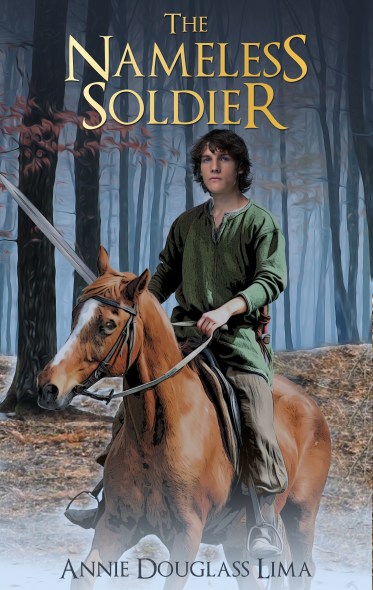
NEW YA FANTASY RELEASE from Annie Douglass Lima!

Nameless Soldier KINDLE cover

The Nameless Soldier is book 4 in the Annals of Alasia young adult fantasy series. Haven’t read all (or any) of the others? That’s okay! The books can be read in any order, and each one can stand on its own.

Description:

What do you do when you’re the only survivor?

Nineteen-year-old Tarvic bears the name of a mighty hero from Alasia’s past. However, the young soldier feels anything but heroic when he regains consciousness to find himself the lone survivor of a brutal attack by invaders from the neighboring kingdom.

Forced to leave his identity behind, Tarvic is thrust into civilian life in the role of protector to three war orphans. When the four of them encounter a mysterious stranger, he must choose between keeping the young girls safe and taking on a mission that could help free his kingdom. Can Tarvic live up to his noble name and find a way to balance his duty and his dreams?

Where to Get a Copy:

Click here to buy the ebook or paperback from Amazon. (The ebook is $2.99 just $0.99 through June 6th!)

Not sure if you’ll like the story or not? Take a look at the first chapter and see!

The Nameless Soldier

Chapter One

Tarvic woke to the sound of a distant yell, abruptly silenced. He pushed his blankets aside and sat up, puzzled, but heard only the light patter of rain on the canvas. “What was that?”

Drevel, his roommate in the barracks and tentmate out on campaigns like this, stirred and rolled over. “What?”

“I heard something. Someone shouting.”

“It’s probably just another drill.” But Drevel sat up too, shoving his own blankets away, as Tarvic crawled over and untied the tent flap.

A blast of wintry air and raindrops greeted him as he leaned out, peering across the tent-studded hillside. Clouds hid the moon and stars, and on every side the thick dark of the forest leaned in from the edges of the large clearing. But the telltale flickering light of distant torches sent shadows leaping over tents and across the open spaces between them. Why would someone be using torches out here? Any soldier in camp had easy access to lanterns among the supplies.

Something was wrong. Very wrong. Tarvic pulled back into the tent and yanked on his breeches and jacket.

They both heard the next yell, closer this time, and then the unmistakable clash of swords. Both men snatched up their own swords, jamming their feet into their boots and fumbling for shields. From all around them, shouts of alarm erupted as men in their company woke up.

And then the enemy was upon them. Horses exploded through the camp, trampling tents and the soldiers just crawling out of them. Riders leaned low off their mounts’ backs, swinging swords and waving torches.

Halfway out of his tent, Tarvic threw himself flat on his face to avoid a slash that would probably have decapitated him. He scrambled to his feet, only to be knocked off them again by a blow that he barely caught on his shield.

Light, shadows, horses, blades, rain. Chaos raged through the clearing to the sound of crashing metal, pounding hooves, shouts of challenge and desperation. Tarvic regained his feet and fought as best he could from the ground while enemy riders thundered around him. Dodging and ducking, he aimed for the men’s legs and tried to keep out from under their horses’ hooves. With no idea who he was fighting or why, his only goal to stay alive for the next heartbeat, he dodged and darted through the tumult looking for spots where horses and enemy swords weren’t. All around him, men fought and ran and crumpled to lie as limply as the trampled tents.

Slipping and stumbling in the mud, Tarvic felt a surge of satisfaction as his sword met flesh and an enemy yelled in pain. And then the man wheeled his horse and charged back toward him, and Tarvic turned to flee.

He tripped on something soft that groaned. Pain shot through Tarvic’s wrist as he caught his fall, and only a quick roll saved him from being trampled as the man’s horse cantered over him.

Its rider wheeled again, and Tarvic rose to his knees, barely raising his shield in time to protect his face. The force of the blow threw him backward, jarring his already sore wrist.

Another horse leaped over him, and Tarvic cried out in pain as a hoof struck him on the shoulder. He stumbled to his feet, ducking low to present as small a target as possible, and ran through the melee.

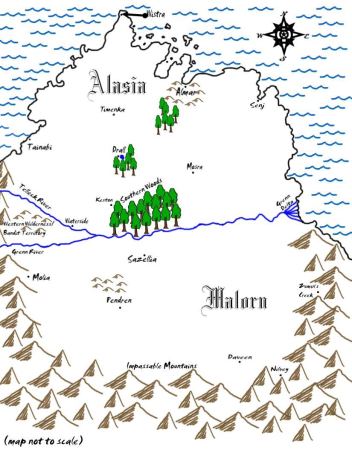
map of Alasia & MalornHe saw fewer people on foot now, more obstacles in the mud. Was it cowardly to flee from a battle you couldn’t win? Nothing in Tarvic’s eight months in the military had prepared him for this. Not counting occasional minor border skirmishes, the kingdom of Alasia hadn’t seen an actual war in six generations. Besides routine patrols, city peacekeeping, and the frequent drills and training, the military’s primary duties involved escorting merchant wagons through robber-frequented stretches of rural highway and keeping an eye on the sections of coastline where seafaring raiders were known to attack. Tarvic had never fought in a battle that involved more than a handful of opponents at a time, and none of those opponents had been anywhere near this organized — or this deadly.
If we escape, we can regroup somewhere safer and — A hard blow to the back knocked him to the ground again as another horse pounded over him. Giving up all pretense of courage, Tarvic scrambled to his feet once more and fled for the edge of the clearing and the relative safety of the trees beyond. I can’t do anything here. They’re going to slaughter us all!

He was practically there when another rider appeared in front of him, leaning low with sword outstretched. Tarvic almost impaled himself on the blade, raising his shield just in time. He fought back frantically as the man slashed, swinging his weapon again and again. I need my horse! Military training had included nothing about how to fight a mounted enemy from the ground. But Lightning was tethered in the row of makeshift stalls on the far side of the camp, probably prancing restlessly under his blanket and wondering why his rider didn’t come to spur him into battle.

Tarvic didn’t even see the blow that almost killed him. His ears barely registered the thudding of more galloping hooves from behind, nearly drowned out by the rain and the sounds of battle. But the world exploded in light and pain as something struck the back of his head harder than anything had ever hit him before.

He lurched forward, feeling his sword drop from limp fingers. Managing two steps before his legs buckled, he was just conscious enough to recognize the urgent need to crawl. Don’t stop. Don’t stop. Don’t stop. Or they’ll kill you out here. That was the only thought left in his mind as he pulled himself toward the concealing shadows behind the line of tree trunks. And then even that faded, giving way to darkness.


Want to know what happens to Tarvic? Click here to purchase the book and find out!

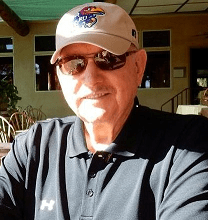
 Annie Douglass LimaAbout the Author:

 Annie Douglass Lima spent most of her childhood in Kenya and later graduated from Biola University in Southern California. She and her husband Floyd currently live in Taiwan, where she teaches fifth grade at Morrison Academy. She has been writing poetry, short stories, and novels since her childhood, and to date has published seventeen books (four YA action and adventure novels, five fantasies, a puppet script, six anthologies of her students’ poetry, and a Bible verse coloring and activity book). Besides writing, her hobbies include reading (especially fantasy and science fiction), scrapbooking, and international travel.

Connect with Annie:

Email: AnnieDouglassLima@gmail.com

Blog: http://anniedouglasslima.blogspot.com

Facebook: https://www.facebook.com/AnnieDouglassLimaAuthor

Twitter: https://twitter.com/princeofalasia

Goodreads: http://bit.ly/ADLimaOnGoodreads

Google+: http://bit.ly/ADLimaOnGooglePlus

Amazon Author Page: http://bit.ly/AnnieDouglassLimaOnAmazon

LinkedIn: http://bit.ly/ADLimaOnLinkedIn