Today’s Writing Tip

desk- copy

I’ve mentioned this before with regard to your character’s occupation. This goes slightly beyond that to the entire story environment if all or even part of your story takes place in the military. Most of us know someone who has been in some branch of the military. Of course they all have their own personality and in some cases rank designation. For example, the lowest rank differs for all of them, though some, such as the Army and Air Force start to overlap as they go up the ranks. The Navy is different all around.

Make sure you use rank, terminology, and dialog correctly. Rank is easily checked online. Terminology is a bit more of a challenge and should be given a sanity check by someone who knows. Authenticity adds to the flavor and credibility of your story while missing the mark erodes your credibility as a writer.

Today’s Writing Tip

desktop- copy

Creating characters that stand out can be a challenge. One way you can add color to your characters is by giving them a regional accent. This will automatically have an influence on their personality as readers will associate them with someone they already know from that locale. If they don’t, then they get to meet one through your character. How fun is that?

Capture their accent in writing by deliberately misspelling their dialog to reflect how it sounds phonetically. This is most easily done if you’re familiar with the accent. For example, I have lived in Texas for over thirty years, so I definitely know what someone from Texas sounds like, y’all!

If you really want to get into this, which also requires intimate knowledge of the region, you can add colloquialisms specific to the area. A few here in the Lone Star State include such things as “I was up all night like a tree full of owls” (insomnia) or “When he got home late, she was on him like white on rice” (chewed him out). These can often add some comic relief as well as further defining your character.

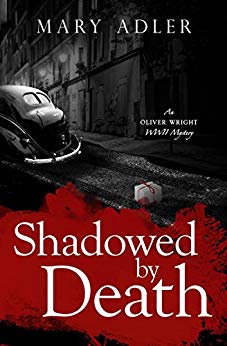
“Shadowed by Death” Another Excellent Historical Novel from Mary Adler

shadowedbydeath

Mary Adler has done it again, sweeping me away to another time and place with this second book of her Oliver Wright mystery series. Like the first one, it’s set in the San Francisco Bay Area in the early 40s, while the country was in the throes of WWII. Again I experienced the culture in that locale during that era as well as the prejudice and suspicion that prevailed against immigrants.

Of course the fact we were at war with some of the counties from which these people hailed, to say nothing of all sorts of intrigue in progress due to the convoluted political situation in Europe, nothing was simple. While the majority of these immigrants came to the USA to escape oppression as well as possible annihilation, it’s not surprising that their motives could be questioned. These interactions and the history behind it, most of which few of us know, made the story that started out as a murder mystery all the more interesting.

The characters were engaging and well-drawn, including Oliver’s awesome German Shepherd, Harley. Relationships are believable and convincingly complex, both interpersonal and familial as well as between ethnic group. The plot is gripping, loaded with historical information, and full of suspense and surprises. Mary Adler is one of my favorite authors with her smooth, imagery-rich style, historical value, and authentic cultural context. All in all, an outstanding read.

You can pick up your copy on Amazon here.

Today’s Writing Tip

laptop-copy

Watch for proper subject-verb agreement. This may seem obvious, but beyond the basics, such as “Writing skill IS important” vs. “Writing skill and grammar ARE important”, it isn’t always so clear.

This is often the case if there’s a prepositional phrase somewhere between the subject and verb. It’s really easy, and I’ve done this a lot myself, to take the subject of the prepositional phrase as the subject for the verb. I’ve even seen such things slip past editors from time to time. For example, “The mother of the kittens IS grey and white”. To get rid of the troublesome prepositional phrase you could say “The kittens’s mother is grey and white.”

I think everyone hated diagramming sentences, but this is a good example where having those skills helps. Too many people think because they can talk that they can write. Thus, they “may be talking as they be speaking”. Correct grammar is important if you want to build a solid reputation as a professional writer.

Today’s Writing Tip

laptop-4 copy

Every now and then a short story contest comes along that has a tight deadline. Thus, if you don’t already have an idea in mind, you’re stuck. There’s one formula to come up with a story that is fun and can help you put something together quickly. It’s as easy as filling in the blanks.

This involves using the classic “What if?” premise: What if a ____ and a ____ went to _____ and ______.

The wackier your answers, the better and more original it will be. For practice, fill in the blanks based on your favorite sit-com or movie. You can sometimes get an idea rolling with no more than the “What if” portion. For example, the old sit-com ALF was based on “What if a space alien crashed into someone’s house and couldn’t leave because his ship was damaged?”

Today’s Writing Tip

laptop-3 copy

If a paragraph is too long, it’s hard on the reader’s eyes. Break them up for visual appeal, even if in a technical sense it’s only one thought. I don’t know about you, but when I come to a paragraph that takes up an entire page, there’s something daunting about it. Sometimes they’re even hard to read, depending on the font size and spacing.

There are so many ways to distract a reader it’s pathetic. Long, run-on paragraphs are one of them. Even if it’s the same thought, be sure to break it up if it takes up half or more of the page. If it happens to be dialog, you may want to break it up with some action. Otherwise, remember that when the same speaker continues to the next paragraph, you don’t use a close quote on the previous one.

Today’s Writing Tip

laptop-2 copy

Paragraphs should contain connected thoughts and have an introductory and closing sentence. Of course, this is not always easy to do when writing a novel, but essential for nonfiction.  However, they should have some degree of coherence. If the subject or thought line changes, then start a new paragraph.  More on this tomorrow when I’ll talk about paragraph length.


Today’s Writing Tip

home-office-3 copy

Using correct punctuation in dialog is essential, yet it is one thing I see done incorrectly as much as anything. For example, when someone asks a question, be sure to punctuate with a “?” I can’t begin to tell you how many times I’ve seen dialog that was clearly a question, yet didn’t employ a question mark.

Admittedly, there are times when this is not 100% clear.  “He wondered whether the police had all the evidence” is a statement, but “Did the police have all the evidence?” is a question. One way to figure it out, if you’re in doubt, is to say it out loud.

Today’s Writing Tip

home-office copy

There are several ways to say “said”, but don’t overdo it; that gets annoying as well. In other words, if you get too creative, that’s another distraction. These should also be commonly used/familiar words such as “replied”, “answered”, “stated”, etc. Using a word like “opined”, while perhaps correct for the dialog, may be unfamiliar to your average reader. Depending on the story, there could be exceptions, but how many times have you seen that word at all, much less in a novel?

Using the correct synonym for “said” can also help you avoid adverbs. It’s much more efficient to say “he yelled” or “he hollered” or “he bellowed” than to say “he said loudly.”

Today’s Writing Tip

e-mail- copy

There’s a place in your story for description and there’s a place for action. When something intense is happening, such as a chase scene, you don’t want to slow down the pace by stopping to describe the locale. This is not to say the imagery isn’t important. However, one way to avoid interrupting the flow with descriptions is to tell your reader what that area looks like BEFORE the action begins, perhaps in a much earlier scene.

Then all you need to do is include a couple brief reminders, then let fly with the action.