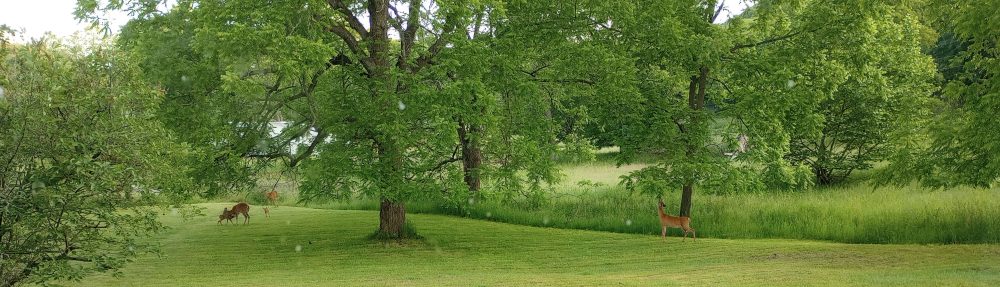
Woohoo! I’m definitely excited about this honor!
Category Archives: Random Musings
“In the Shadow of Lies” by M.A. Adler: Outstanding Depiction of California in the Early 1940s


This book reminded me of butter, the writing style was so rich and smooth. It is one of the most skillfully written books I’ve read in a long time. The prose was like ambrosia, the imagery vivid and memorable. I always appreciate an author who can render emotions properly and thus draw the reader into the characters. Again, Adler did a stellar job.
This story is far more than a murder mystery. Its coverage of the early 1940s, i.e. the historical period during the early days of WWII, was outstanding. That was such a different time and so much has changed since then. I was particularly drawn in because I have personal connections to the Oakland-San Francisco Bay Area as well as that time period through family and in-laws.
For starters, my father was in the U.S. Navy during WWII. He had fond memories of his time on leave in the Bay Area, so much so that many years later, in 1960, our family moved from New York State to the East Bay. However, it did not turn out to be the Utopia he had imagined. He’d been a diesel mechanic for the New York Central Railroad in New York for a decade and assumed he’d be able to get a job, possibly with a trucking company. As it turned out, however, the labor unions at the time made this impossible. To get such a job you needed to be a union member, and to be a union member you had to have a job. The ultimate catch-22 supported by pure nepotism. As the cliche says, it’s not what you know but whom you know. My father had a few insignificant jobs, like working for a lawnmower repair shop, then eventually transitioned from unemployment to retirement. This had a devastating effect on our family.
But I digress.
Back to the story. Even though I was a teenager in the 60s, I had no idea how bad racism was a few decades before, much less that the KKK had been so active there. I also had no idea how badly Italians were treated during the war, due to their assumed sympathy toward Mussolini. I had in-laws who were Hungarian and some married Italians. Now I understand why some of them were so resistant to providing information when I was doing genealogical research back in the 70s. It’s sad they didn’t share their stories, but they may have been too painful for them to recount. On top of it all, some were Jewish, and had fled Europe just in time; some left behind were exterminated by Hitler.
I’ve never been a history buff. The way it was taught when I was in high school was a horrible bore. Even as a child, I preferred to learn about history through historical novels and this one definitely provided a treasure trove of information for a period I didn’t know much about. For that I am most grateful to the author for her meticulous and comprehensive research. This made reading the book an actual experience that had a strong impact on my understanding of the world at that time.
There were a lot of different characters in the story. I mean LOTS. So many that they were a bit difficult to keep track of. Fortunately, the author included a dramatis personae in the beginning, but this was not that easy to access with an ebook; I wish I’d read this in a print book, where I could have flipped back to refer to it more easily. I know I would have been doing a lot of highlighting and dogeared many pages in an actual book. Since I don’t exactly have what you’d call a “steel trap” memory, I probably should have taken notes while I was reading. LOL. Okay, I’m weird like that, when I really get into a book. This one and some others I’ve read recently (more specifically the “Finding Billy Battles” series by Ronald E. Yates) have reminded me of why I should be reading more historical novels; usually I prefer science fiction.
The one thing about having so many characters with their own prejudices and agendas is that it does make the story seem very real. My familiarity with the East Bay Area added to this, especially when references were made to streets and other areas with which I was familiar. This made it very easy for me to connect to this book.
I’m grateful the author used multiple viewpoints in different sections to get into the characters’ heads as opposed to omniscient, which would have been entirely mind-boggling. She is a very skillful writer. The story did wander about somewhat, yet it added to its rich texture and sense of real-life as opposed to one with a classic, straight-line plot. She broke some rules, but did so in such as way that it worked, which is exactly how it should be done.
This book would not be for everyone, especially those that want to whip through a story and not wander about, really getting into the time, place, and people. However, if you appreciate a well-written, complex story with considerable historical significance, I highly recommend it.
Pick up your copy on Amazon here.
Perfect for WORLD UFO DAY!
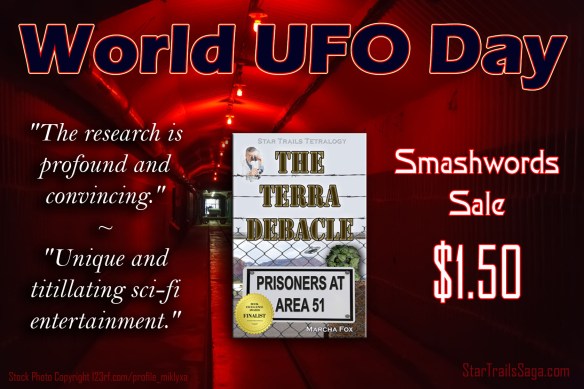
What could be more perfect to celebrate World UFO Day than a great UFO story? And better yet, it’s on sale at Smashwords for half price! If you’re an audio book fan and liked the old TV show, ALF, you’ll love Thyron. If you’re an Audible member and would like to listen for free, I still have a few promotional codes left, so give me a holler in the comments if you’re interested. If you’re not a member, you can get two free audible books when you join. Sign up here. Find out more about the story on the Star Trails Tetralogy website.
I believe. How about you?
An Author’s Lament on a Hot Summer Day
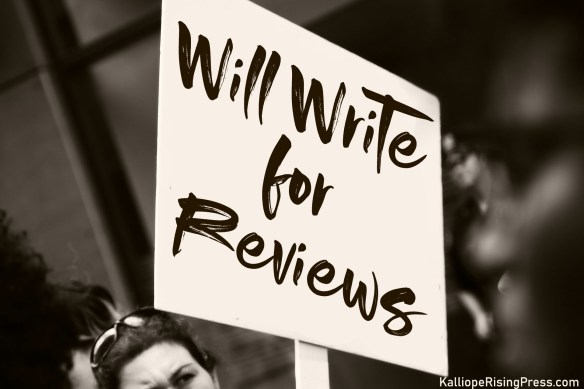
No doubt you’ve seen those unfortunate individuals on the side of the road with a sign that says “Will Work for Food.” Somehow I can relate, though I admit I’m not quite as destitute as those poor souls. Nonetheless, if you’re an author, unless you have a patient spouse who pays the bills or an alternate source of income such as a day job, retirement, or you have the good fortune to be a trust fund baby, chances are your income could be in a similar range, or possibly even less. Way less, like in negative numbers.
It seems no one these days wants to pay for anything, especially if it’s creative. The starving artist has been a familiar entity for eons. People want their music for free, their reading material for free, their games for free, and their artwork for free. This is what the electronic age has brought us. Now that books, music, pictures, and even movies are no longer on tangible media, they’re expected to be free. And of course, now that they’re teaching AI to create, in no time artists of all varieties could be out of business entirely. Muses today get no respect.
So tell me–who out there in any other profession, whether it’s accounting, engineering, administrating, or heaven forbid, even politics, is willing to work for free? To coin an apropos phrase from “Ferris Buehler’s Day Off,” Anyone? Anyone? When’s the last time you went into the grocery store and got your food for free?
Now that I’m retired, I can indulge in pursuing my work as an author. Unfortunately, lately that’s been directed more at marketing and promoting than creating. And the frustration some days is downright scream-inducing. The cash going out for services far outweighs what little comes in. If I were a logical person, I’d quit. If it were only about money, I’d quit. But do I? No. Because writing is in my blood (at least my astrological imprint, which features Kalliope, the muse of epic poetry on my ascendant). While I can make ends meet (barely) through other means, I’d love nothing more than to make a generous (or even adequate…okay, even meager) income from my writing. Tax write-offs are nice, but after a while it gets old. Just once I’d like to finish in the black.
The one thing authors appreciate (most the time, anyway) is a review, especially when we give away our books. And trust me, selling it for 99c is virtually the same as giving it away. Thinking about how long it took to write, edit, and publish it is verboten, because that’s downright depressing. I couldn’t even begin to calculate what I make per hour when selling a book for 99c, most likely less than a Mexican peso per hour, maybe even per day, if that. Yet people who are qualified to do no more than repeat the mantra, “Do you want fries with that?” want $15/hour. Right. And people in hell want ice water.
Reviews are important. Once you get a certain amount, vendors such as Amazon give your book a little more attention and help. If you want to look for an agent, be accepted by certain promoters (for a generous fee, mind you), or even expand into the audio book world, reviews are one measure of your popularity.
Thus, to me, it’s no more than common courtesy to leave a review, especially when you get a few hours entertainment and enjoyment out of a book that took someone a considerable amount of time and effort to produce. If you don’t like it or don’t finish it, fine. No review is better in most cases than a really bad one. Yet, some don’t take your book seriously until you have a few bad ones to show it wasn’t just your family and friends posting them (which isn’t as easy to achieve as you may think, unless you have some serious blackmail material). Granted, reviews are subjective and one man’s trash is another man’s treasure. I get that.
More than likely, unless you’re a fellow author you haven’t even made it this far in my rant du jour. But even fellow authors aren’t always diligent in leaving a review. It doesn’t have to be an essay worthy of a Pulitzer Prize; a few sentences will do.
We authors ask so little. Is it really that difficult to log into Amazon? You know it’s not. If you bought it there, they’ll even remind you and send a link. And the next time you get a book for free or less than you pay for a good cup of coffee, feel it’s your obligation.
I, for one, would rather work for royalties, but reviews, especially a good one, can make it seem at least marginally worthwhile.
So get off your lazy ass and leave one today for a starving author who, in return, will not only love you forever, but might even keep writing. Capisce?
Today’s Writing Tip
Not every character who strolls on scene in your story deserves a name, only those who contribute to the plot in some way. Consider that you encounter numerous nameless people every day, whether on your daily commute or even at work. In fiction, these often include incidental characters such as waiters, people in the elevator, some coworkers, etc. Describing their appearance for the sake of imagery, however, makes them seem real. This is when unusual or outstanding characteristics help them stand out and add to the story, even if they have no plot significance.
Today’s Writing Tip
Know the difference between omniscient point of view and multiple points of view. Omniscient goes into everyone’s head in any given scene. Multiple viewpoints concentrate on one character at a time, but covers several throughout the course of the story.
Multiple is usually more effective for reader engagement. Your POV character should be able to tell a lot about what others are thinking by their actions, body language, and facial expressions, just like you do every day. Remember that verbal communication is a very small percentage of what a person projects. Such cues are often more effective for conveying emotion than dialog alone.
Today’s Writing Tip
When you have a huge cast of characters, remind readers who the minor ones are from time to time so they can keep them straight. Placing them in a scene that fits their role sometimes will suffice. Having a dramatis personae is also highly recommended. This is a list of the people in your story and who they are. In highly populated novels these are greatly appreciated by readers, especially those without steel-trap memories or who may take a little longer to finish a book.
If your book is published in both print and electronic form, make sure the character list is included in the e-book’s table of contents so readers can refer back to it more easily.
Today’s Writing Tip
If you end a chapter or section with a flashback, be sure to close it out properly so you take the reader back to the present. Otherwise, they might be lost if the story returns to its normal time frame in the next scene. Remember that readers often stop reading at the end of a chapter or scene. By the time they pick up the story again, they may have forgotten what had just happened and, without a clear transition, wonder what they missed.
Today’s Writing Tip
When you start a new chapter or section, if a significant amount of time has passed, be sure to tell the reader so s/he doesn’t think something was missed or lost. These breaks are intuitive indicators that something has shifted, unless it’s one of those chapters that ends with a cliff hanger. Assuming that’s not the case, if the change is dramatic, such as years have gone by or the viewpoint has shifted to another character, clue in your reader as quickly as possible. Remember that losing your readers doesn’t build suspense, only annoys them.
Today’s Writing Tip
In traditional fiction publishing format, the first paragraph in a chapter or section is not indented, but flush with the margin. This helps set the stage, even subconsciously, that it’s not a direct continuation of the previous scene, but something new. This is particularly important in e-books, where extra spaces are often lost.
Book interior formatting is something that you seldom notice, unless there’s a problem. Which is as it should be. The last thing a reader needs is distractions. Rather, it should facilitate the flow of the story, indicating scene and viewpoint breaks in a smooth and intuitive manner.
 Marcha's Two-Cents Worth