Unknown's avatar

About Marcha's Two-Cents Worth

I'm a science fiction author of the Star Trails Tetralogy, retired after two decades working at NASA, defected from my physics training to become a professional astrologer, and various other acts of rebellion. More recently, I've teamed with Pete Risingsun in writing "The Curse of Dead Horse Canyon: Cheyenne Spirits" which was released in July 2020 with all three books in the trilogy now complete. Check them out at https://dead-horse-canyon.com.

Interview with Author Extraordinaire and Literary Chameleon, John Reinhard Dizon

Image

Fellow author and good friend, John Reinhard Dizon, is a talented and diverse author whose work spans numerous genres. It’s no exaggeration to say that he has truly written something for everyone whether you’re a fan of steampunk, international intrigue, medical thrillers, murder mysteries, or historical fiction to name a few. Learn more about what’s behind his incredible talent and ability to create original plots populated with unforgettable characters you feel as if you know personally by the time the story ends.


While most authors who have written as extensively as you have would typically develop their own style, I have unofficially nicknamed you the Literary Chameleon due to your ability to adapt so well to so many genres. I have read Stxeamtown, Tiara, Transplant and most recently, Generations, and am amazed by your ability to completely change your writing style from one book to the next. How do you do that?

I think it’s more a question of adapting rather than changing. My four main ingredients are a dynamic plot, compelling characters, snappy dialogue and a powerful finish. You’ll find that common quality in all my novels. As far as genre goes, I made it a point to explore as many as possible in order to give a future fan base a wide variety of reading material. The way I saw it, there would be something for everybody. At this point in time I’ve been working on sequels, the logic being that it gives readers something to latch onto in following their favorite characters. You know how it goes, if at first you don’t succeed.


You have been writing books for much of your adult life. At what point did you realize you wanted to be an author?

I started writing dialogue for my stick-figure cartoons since I got out of diapers. I wrote my first novella, Enemy Ace, in sixth grade. I only wish I had more encouragement and guidance earlier in life. It wasn’t until my later years when I published my first novel. That should be something for parents out there to think about.


Of all your novels, was any one in particular your all-time favorite?

I’d have to go with Tiara and Nightcrawler. Berlin Mansfield and Sabrina Brooks are two of my favorite characters. The expository narrative in Tiara provides everything everyone wants to know about the Troubles in Northern Ireland, which can get extremely complicated with all the factions and politics involved. Nightcrawler discusses numerous women’s issues as well as LGBT concerns that give readers plenty of food for thought. I can name a few of my other novels that raise major social and political questions, but Berlin and Sabrina make these two special.


You grew up in Brooklyn, spent time living in San Antonio and now live in Kansas City. Have you been a chameleon adapting to the different cultures represented by those cities similar to how your writing adapts to the different genres or do you consider one “home” or more comfortable above the others?

I’ve always been a wrestler and a punk rocker first and foremost, that’s what defines me. Broadway Turk Superstar hasn’t changed much, though the response from the communities I’ve lived in have differed somewhat. Alternately, as a writer I’ve been able to absorb the lifestyles and cultures in each area and translate them in my novels. The big city glamor of NYC, the Southwestern flavor of San Antonio and the Midwestern flair of Kansas City provided me with a wide diversity of American culture that was worth the cost of the journey.


Tiara and Generations have extensive and convincing descriptions of Ireland as well as Irish culture, past and present and its rich history. How did you come by this understanding and obvious love for the Emerald Isle and its people?

My mother’s ancestry was Protestant Irish, though she celebrated St. Patty’s Day like every other good Irishman in NYC. I grew up with that solidarity, and it wasn’t until Bloody Sunday in 1972 that I realized something was amiss in the Old Country. I did vast amounts of research and wrote a couple of stories, but nothing came of it until I visited Northern Ireland in 2000. The experience gave me the push I needed to have Tiara published in 2003.


You have a definite talent for convincing dialog, even to the point of capturing foreign and local accents. This suggests that you are a master of observation. Do you do this naturally or was it acquired by necessity?

It’s a bit of everything. I’m somewhat of a historian, and did extensive research on 20th century Germany which led me to explore the development of European society and culture. I’ve also studied anthropology, which helped me trace the history of the human race from the Middle East to the diasporas which forced the Israelite tribes to migrate across the Caucasus Mountains into Europe. When you find the common denominator between people of all races and creeds, it makes it a lot easier to pick up on their distinguishing characteristics as well.


Which trait or characteristic do you believe is the most important for a new writer to develop? Any other advice for someone aspiring to be a novelist?

Imagination is the most important ingredient. If you’re just trying to mimic other people’s ideas, you’ll never be creating anything but cheap imitations. If your basic premise is something that hasn’t been explored before, then you’re onto something. Alternately, there’s the whole concept of paying tribute to a person, place or thing. I wrote Transplant with the idea of putting a new spin on the Frankenstein novel. Only I incorporated the idea of bionic limb research, which has proliferated as the number of disabled vets in our nation has multiplied. In other words, although there’s nothing new under the sun, you want to make your readers envision your storyline in a way it hasn’t been seen before.


You have a vast array of experience and education behind you that shows up in the authenticity inherent in your novels. How much of it is based on experience and how much on research?

I’d have to say it’s a fifty/fifty split. Most of my personal experience comes into play when it comes to character interaction. I’ve known people from all walks of life in my time – children, teens, the elderly, blue-collar workers, corporate administrators, politicians, clergymen, gangsters, you name it. I know how they walk, talk and think. As far as specific areas of interest or geographical locations, that normally requires a lot of research to get it right. If you’ve done a lot of traveling as I have, you have a plan of action as far as finding the main highways, places to stay, areas to visit, et cetera. That’s what I do when I decide on a locale for the novel to take place. I want people to think, `Hey, he’s been there, done that’. Sometimes I get into uncharted waters, which requires a little extra work. Sabrina Brooks, for example, owns a chemical research company. I didn’t get far in chemistry because I suck at math. I had to do a lot of homework on processing different chemicals, like methane and fentanyl. It’s hard to bullspit a bullspitter, but I think I did a good job.


You’ve pursued some rather unusual means for earning a paycheck over the years such as rock star and pro wrestler. Do you find writing as exciting or do you still like to go out and participate in something that gives you an adrenaline rush? If so, such as?  

At this age, you’re always looking for that last hurrah. I think I can have one more wrestling match, a few more hockey games, and a few more rock shows. Like they say, the spirit is willing but the flesh is weak. Plus, I think I’ve fairly well worn out my warranty. I don’t have too many more bumps left on my bump card. I’d hate to go flying through the air someday and find out something’s not working right when I land.


Do you base your characters on people you’ve known or do they simply evolve with the story? Do you maintain control over their actions or do they sometimes get out of hand or surprise you? Any examples?

Most of my supporting characters are based on people I know. I think they’d be delighted if they ever read one of my books and saw themselves in a story. The major protagonists and antagonists are larger-than-life creations. What’s so great about Sabrina Brooks is the little girl inside her, that Shirley Temple who sees the world through rose-colored glasses. The Nightcrawler is her way of making sure it stays that way. Conversely, I’ve got Jack Gawain in The Standard series, who pushes the envelope right off the table. Sometimes it’s amusing to see just how far he will go. The basic premise was giving a serial killer a 007-type license to kill. The series poses the question as to just how far we will go to protect and defend our national interests and preserve our security. After Guantanamo Bay and drone strikes, Jack Gawain may be a natural progression.


Which part of the writing process is your favorite, i.e., coming up with the premise, developing the characters, perfecting the plot, writing the first draft, perfecting the final draft, or what?

I think the ending is the most important part of the process. I know everyone can name a great movie they saw that had an unbelievably crappy ending. As I mentioned, I usually have my ending before I even start writing. Only my plots have so many bizarre twists that sometimes the storyline doesn’t always connect with the climax. That will necessitate a rewrite, and most of the time it turns out even more controversial than I had planned.


Which book or books and character(s) will you present in the upcoming Facebook Mega-Event, Dreams, Fantasies, Nightmares & Visions?

Sabrina Brooks [Nightcrawler] will be featured at the two-hour event on Sunday. Princess Jennifer of Tiara will appear for one hour at the Wednesday night showcase. I had Adolf Hyatt (King of The Hoboes) at the last two Facebook parties, so this will be a welcome diversion for one and all.
 

Image

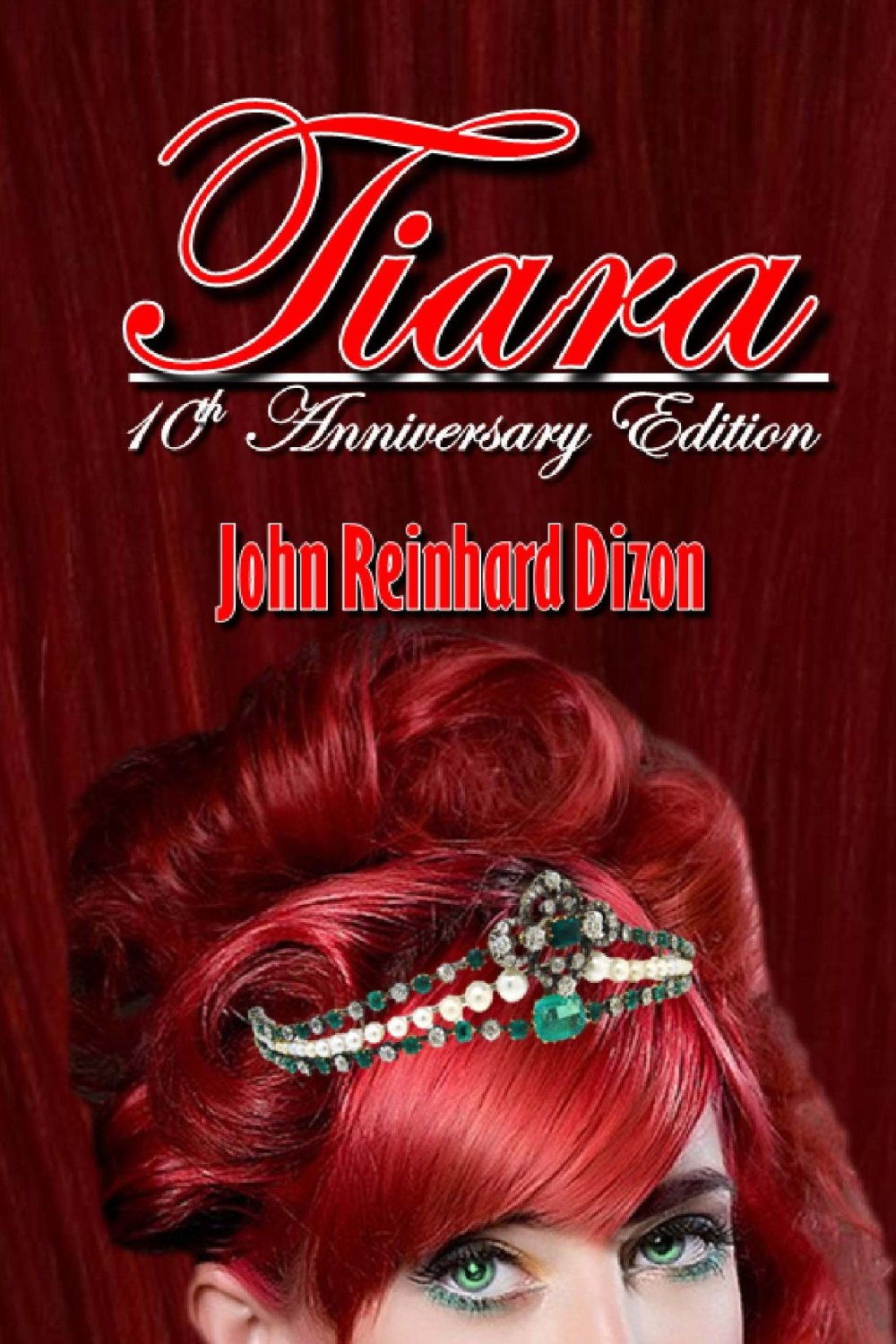
About Tiara:

Tiara is an action-packed, historical fiction, romantic thriller centering around the Good Friday Agreement in Northern Ireland in 1998. The main female protagonist is Princess Jennifer of Edinburgh, a civil rights activist involved in the negotiations between the British government and the coalition groups in Ulster. She becomes an object of fascination to Berlin Mansfield, an international terrorist of Irish descent who is equally intent on attending the historic event as it transpires. The two eventually cross paths in a tale of intrigue and suspense with the future of a nation at stake.

http://www.amazon.com/Tiara-Anniversary-John-Reinhard-Dizon/dp/1494366878/ref=pd_rhf_gw_p_tnr_9
 

Image

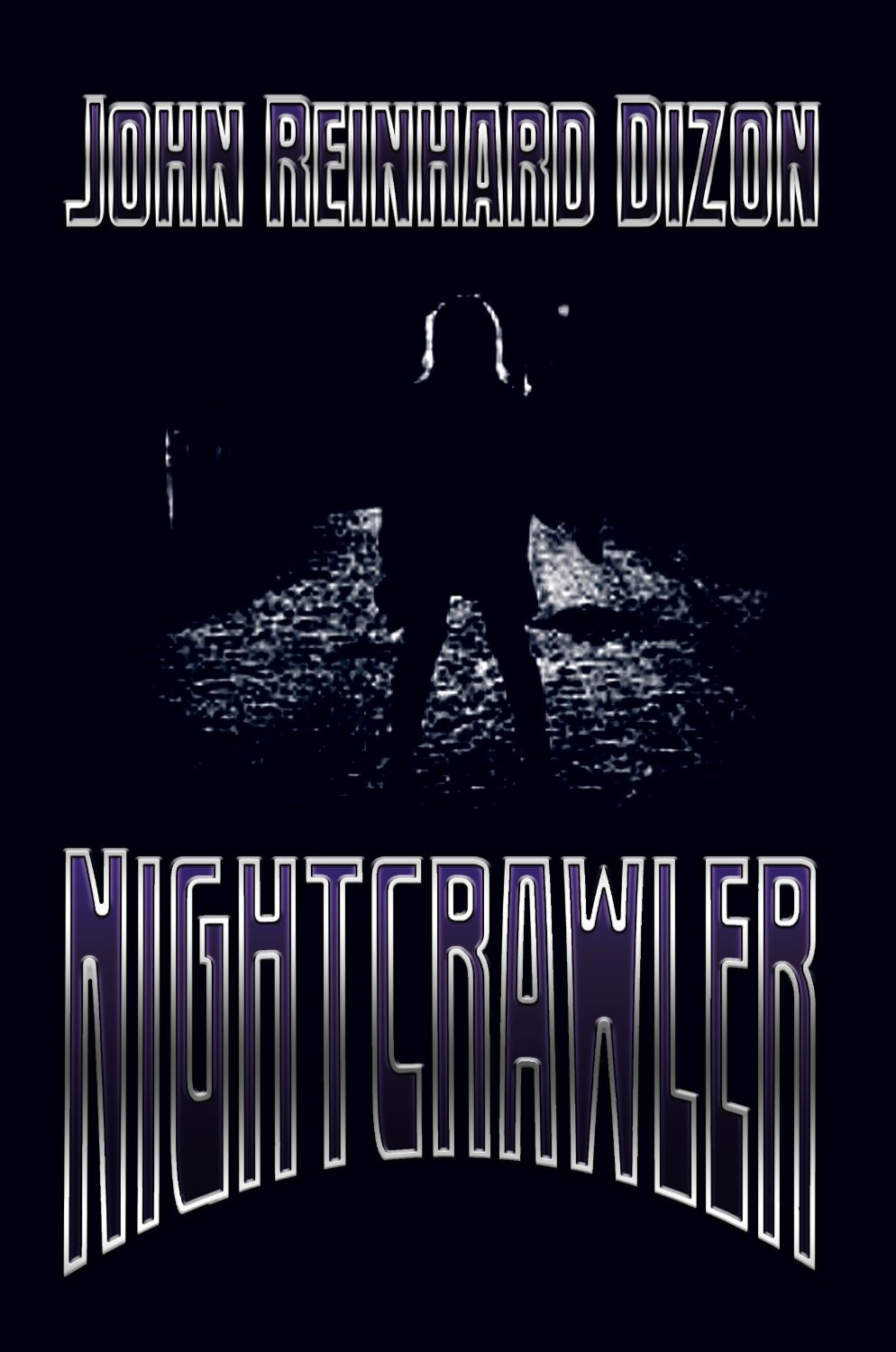
About Nightcrawler:

Nightcrawler is about the exploits of Sabrina Brooks, the heiress to the Brooks Chemical Company. Bree is trying to pick up the pieces after her father’s death, and is now in a position to live up to a personal commitment to use her resources to benefit the oppressed. She is intrigued by the notion of conducting a guerrilla campaign against drug gangs in New York City, and accesses top-secret archives detailing Government contracts for developmental research of chemical weapons. She uses her wizardry in chemistry to concoct weapons for her own use as a vigilante known as the Nightcrawler. NYPD undercover officer Hoyt Wexford becomes friends with Bree, and begins to suspect she knows the identity of the Nightcrawler. Her sudden interest in a series of terrorist attacks in the New York area makes him believe she may be investigating a group called the Octagon. He tries to follow her but is too late to prevent a showdown between the Nightcrawler and the mysterious Reaper. Hoyt rescues Bree and learns her secret identity, and together they plan to stop the Octagon once and for all in preventing a chemical attack in NYC on the Fourth of July. This is a pulse-pounding thriller straight out of world headlines, with an unforgettable heroine fighting impossible odds against fiendish arch-criminals. For suspense fans looking for some chick lit with international intrigue, Nightcrawler is one not to be forgotten. 

http://www.amazon.com/Nightcrawler-John-Reinhard-Dizon-ebook/dp/B00I0K9QEI/ref=la_B00DU9JNUQ_1_9_title_0_main?s=books&ie=UTF8&qid=1402505429&sr=1-9

Connect with John Reinhard Dizon:

Facebook: https://www.facebook.com/johnreinharddizonUSA

Amazon Author Page: http://www.amazon.com/John-Reinhard-Dizon/e/B00DU9JNUQ/

Twitter: https://twitter.com/JohnRDizon
 

Interview with Susanne Leist, author of “The Dead Game”

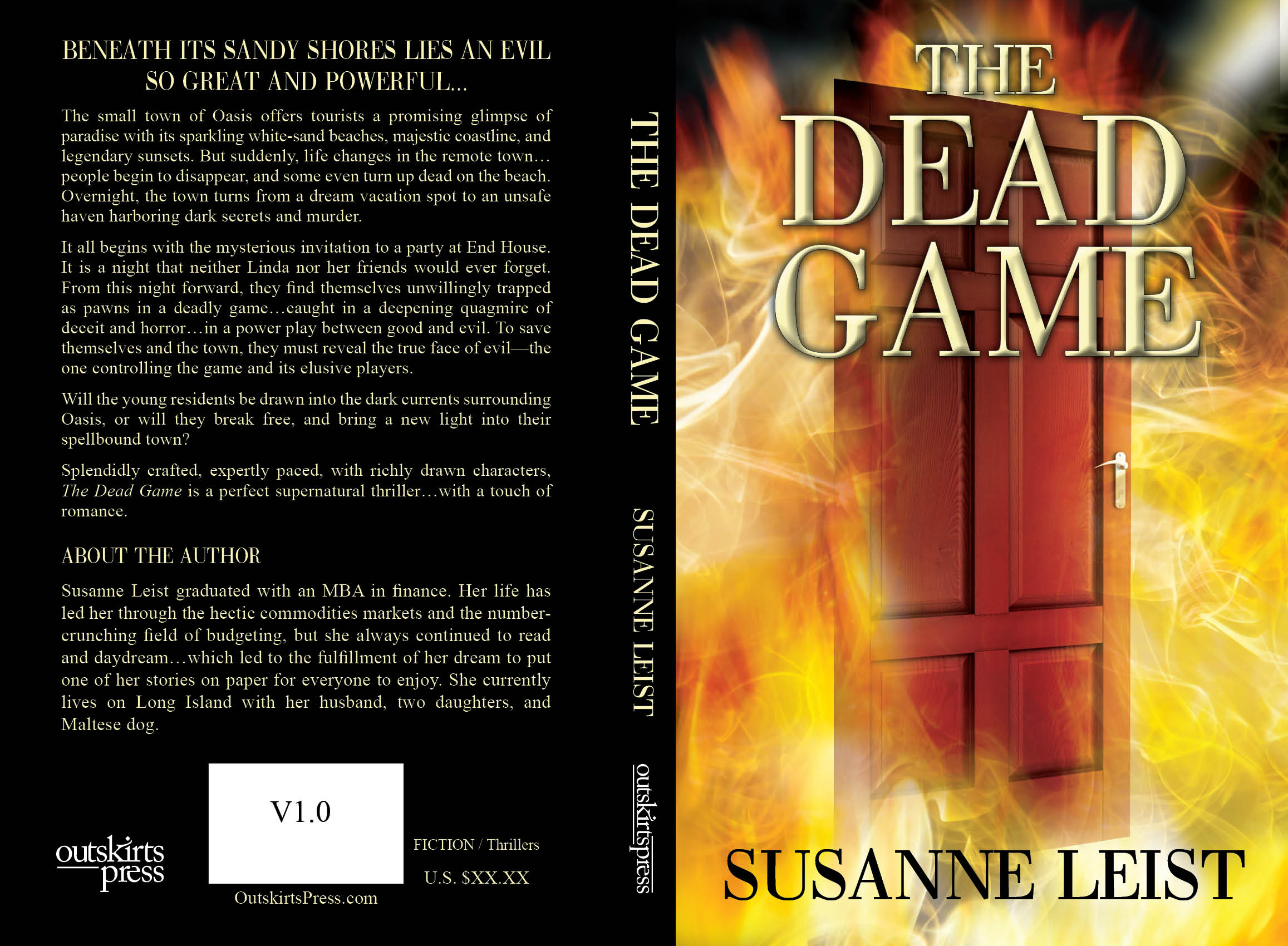
ImageImageSusanne Leist is the author of “The Dead Game,” a thriller with a twist. Like so many authors she writes the kind of book she loves to read herself and her fans obviously agree considering all the 5-star reviews it’s generating on Amazon.com.

MF: Your book “The Dead Game” is a suspense-filled supernatural thriller. What inspired you to pursue writing in this particular genre? Has it always been your favorite?

SL:   I have been reading murder mysteries and thrillers since I was a teenager. I’ve read all types of mysteries, from Agatha Christie to Sherlock Holmes. In recent years, I’ve begun to read paranormal mysteries. These books bring fantasy and the surreal to the simple murder mystery.

It’s hard to find books that combine paranormal with mystery. That’s why I’ve decided to write a paranormal, murder mystery of my own. It’s the type of book that I search for and love to read.

My book, The Dead Game, has dead bodies and suspects like a traditional murder mystery. However, it also has humans, vampires, and vampire derivatives. And don’t forget the haunted house—we must have one of these.


MF: What was the inspiration for your story?

SL: I believe the true inspirations for this particular story are the T.V. shows, Supernatural and The Originals. Supernatural brings wit and humor to the paranormal genre while The Originals brings passion, loyalty, and betrayals.

I want my readers to care about my characters and to cheer for them as they fight the bad guys or in this case, The Dead. You can’t have supernatural creatures without a dose of humanity thrown into the frightful mix.


MF: Is your background in finance reflected in your fiction work or characters or is fiction writing an escape to get as far away as possible from your daily reality?

SL: My book takes me away as far as possible from the world of finance and the real world. It takes me to a world of my imagination, where anything can happen and usually does.


MF: Are you currently working on your next book? Can you tell us something about it?

SL: The Dead Game is the first of two books. The first book resolves the murder mystery, but at the same time, opens a Pandora’s Box of new mysteries. Its surprise ending will lead to more surprises.

I have just begun to work on the sequel. My outline and notes are ready. My writing often leads me in unknown directions, so I won’t know how the book will end until it does.


MF: Do you consider writing a hobby or your next career?

SL: Writing will continue to be a hobby to me until I become a best seller. So hobby it will be for now.


MF: Which part of writing do you find the most challenging? The most satisfying?

SL: The most enjoyable part was the writing. I began with a basic idea in mind. I wanted a murder to take place in a small town. This murder would involve a house that was rigged with supernatural or mechanical traps and moving rooms. But I had no idea how the story would evolve or end. The end turned out to be a surprise to even me.

The hardest part was the editing. I had it edited by Outskirts Press, but I still found mistakes. I listened to my reviewers and removed the extra adverbs that weren’t really needed. I also had a proof reader check the book for me. It was a long process.


MF: What advice would you give to someone aspiring to write their first novel?

SL: After my book was published, it sat on Amazon and Barnes & Noble without a description, bio, background, or anything for a few days. When the self-publisher had sent me an email—everything was done through email—saying that I was published, I hadn’t been told that my book was immediately available for sale. I had to quickly write up summaries and descriptions. Then I had to learn how to use Twitter, Facebook, and Google. I had to create blogs. I now have blogs on Tumblr, Blogspot, and WordPress.

My advice to a new author is to have everything prepared before the book is published. Blogs and online accounts should be open and already have your bio and details about the book. It shouldn’t be a surprise to anyone but an anticipated event.


Susanne’s Links

http://susanneleist.blogspot.com

http://susanneleist.wordpress.com

http://www.amazon.com/author/susanneleist

https://twitter.com/SusanneLeist

https://www.facebook.com/pages/The-Dead-Game/245820408898288

Book Links

http://www.amazon.com/Dead-Game-Susanne-Leist-ebook/dp/B00F3IWF70/ref=sr_1_1?s=digital-text&ie=UTF8&qid=1402359634&sr=1-1&keywords=the+dead+game

http://www.barnesandnoble.com/w/the-dead-game-susanne-leist/1116825442?ean=2940148410881

Blog Interview # 1 – With Author John Dizon

Great interview on someone I consider a literary chameleon. John Dizon can handle any genre in spades.

hutt1234's avatarjohntuckermustlive

Image

John Dizon is the author of over Twenty Books. He’s a charismatic, good-natured individual who’s also become a valued friend of mine on Facebook. He’s had a full life and you can tell in the way he writes. Read on and find out a few nuggets of truth and fun facts from John and be sure to check out his books, touch bases with him on Facebook, and see if I’m wrong.

What made you become a writer? Did it start as a hobby or meant to be a side-business?

I started writing dialogue for my stick-figure cartoons when I first got out of diapers. I wrote my first novella in sixth grade as an A+ student in English, and the general consensus was that I ‘had something’. I always thought that it was going to be something to fall back on, so after coming up short as a rock…

View original post 2,045 more words

Interview With Marcha Fox

Here’s an interview fellow author, friend and blogger did with me! He asked some very thought-provoking questions and my responses were not always politically correct. Those who know me will not be surprised by that.

spoiler2010's avatarCenter Stage With John Reinhard Dizon

marcha

Marcha Fox is another good friend and fellow author whose Star Trails Tetralogy series is an essential contribution to the indie sci-fi genre. She is also an accomplished astrologer and spent twenty-one years at NASA. Marcha brings a lot to the table and I was fortunate to have her share with us…

You’ve gone from being a professional astrologer to a science fiction author. It appears as if a flawless transition, yet the lack of reference to astrology in your novels seems somewhat surprising.

Actually I’ve been a science fiction author long before I became an astrologer.  Would the truth be known, I was writing an SF novel back in the 80s and was developing the character of the physicist protagonist’s ex-wife who I thought would be all the more annoying if she was into astrology.  At the time as a college student majoring in physics I didn’t believe in…

View original post 2,173 more words

Interview With John Tucker

John Tucker is a fascinating person, blogger and prolific author who loves to help other Indie authors.

spoiler2010's avatarCenter Stage With John Reinhard Dizon

PicofMe

John Tucker is another one of my partners in prose, a trusted friend and ally in my war against the publishing industry. His Bemused and Bedeviled series and The Rask Trilogy have established his reputation as an indie author, and he is admired by his colleagues for his ongoing projects in presenting new writers to the Internet community. 

The most noticeable works in your repertoire are the Divisive series and the Bemused and Bedeviled series. It seems like your antagonists always get the upper hand and continually escape justice. Is it a way to keep readers hooked or is there a message being conveyed?   

Both. Every good novel should have a protagonist and an antagonist, and I think the villain should be the strongest of the two. Readers react to a novel with a mixture of emotions – anger, grief, joy, shock, and awe.  The bad guy will get the…

View original post 1,352 more words

Interview With Chris Birdy

Fascinating interview with author Chris Birdy. I love authors who write from experience. Good stuff.

spoiler2010's avatarCenter Stage With John Reinhard Dizon

chris

Chris Birdy is another Internet friend whose The Girl In White Pajamas has proved an essential contribution to the indie suspense/thriller genre. Having spent twenty-five years as an investigator, her professional experience provides the novel with an authentic narrative. Here’s a revealing look at this personable and intriguing author… 

You’re a very private person for an author. I had to pull teeth to get your profile photo. Have you ever considered what life will be like when The Girl in White Pajamas receives the international recognition it deserves?

If is such a big word.  Over the years, I’ve learned not to live on speculation.  I would love to have a best seller, but I won’t change my life now in anticipation of that happening.

You’re also exceptional in that you’re not cranking out novels like comic books, like so many other indie authors. Are we going to be looking for…

View original post 1,335 more words

What Exactly IS Einstein’s Theory of Relativity?


Image

Is time travel possible? Why can’t we travel faster than the speed of light? Do clocks really run at different speeds depending on how fast you’re moving? Does gravity really warp space and time as well as bend light?

These possibilities have been used in science fiction for decades. H.G. Wells’ classic, “The Time Machine,” was published in 1895, before Einstein’s Special Theory of Relativity was even published in 1905. This goes to show that man’s imagination was exploring the possibility of such things long before it was proven scientifically. In fact, Einstein stated himself that “Imagination is more important than knowledge” and it was his own propensity for what he called “thought experiments” that brought him to the concept of relativity in the first place. Supposedly, he was staring at a gas light one foggy night wondering what it would be like to travel on a light beam and shortly after that the Special Theory of Relativity (STR) was born.

The main point of the STR is that the only thing that’s constant is the speed of light; time is not, space is not. The speed of light, 186,000 miles per hour, is often referred to simply as c. In fact, the term “miles per hour” which you hear every day contains the basis of a physics equation related to time and distance. In other words, if you only know simple algebra you can understand how the distance you travel (length or L) depends on how fast you’re going (velocity or v) and for how much time (t), or L = vt. Simple.

But there’s a catch. That only applies to what is known as an inertial reference frame, or one that is not moving. Now I’m sure you know that the Earth is moving, through space as well as around the Sun, but as far as you’re concerned when you’re riding in a car the Earth is standing still. However, when you get into what are known as relativistic speeds or those closer to the speed of light, that equation changes.

For L = vt, any of those values is considered a variable, meaning it can change. However, the speed of light is constant. Therefore, the only things that can change are the distance (L) or time (t). And that’s where things start to get weird. The scientific terms are length contraction and time dilation. Length contraction means that distances get shorter when traveling near the speed of light and time stretches, meaning that time passes more slowly for someone traveling at the speed of light even though to them clocks would appear to move at the same rate as they do to you.   This is why they say that someone who traveled to a distant planet may only think they’ve been gone for a few years while a century or more will have passed on Earth. Time and distance are both relative and thus the term “relativity.”

As far as a time machine is concerned, going forward in time seems more feasible than going back but that’s not to say it’s impossible. However, the STR really doesn’t postulate going back in time, only that clocks run at different rates. This has been proven at the atomic level by observing atoms that have a known rate of decay (or lifetime) traveling at relativistic speeds where they last longer as measured by Earth clocks.

So why can’t we travel faster than the speed of light? This comes back to the speed of light being a constant. Energy of movement, or what is required to move something, is defined by the mass of the object times its velocity squared, or E = mv2. Starting to sound familiar, like the infamous E=mc2? Here we go again, velocity can’t change so the others must and what this boils down to is that the energy required far exceeds what can be achieved as the mass increases, which also occurs at the speed of light. So, according to Einstein, the reason we can’t travel at the speed of light is because at those speeds the mass of the vehicle will exceed its ability to carry the fuel necessary.

Of course if you’re a UFO fan like myself, you may wonder how they could possibly get here and move erratically like they do. And that brings us to Einstein’s Theory of General Relativity which relates to gravity. Gravity is a force that creates acceleration, or a change in velocity. Drop something and it accelerates to the floor or ground. According to Einstein, the gravity of large objects like the Earth or Sun will also warp space and time. When you see those pictures depicting a blackhole they usually show a funnel-shaped grid, indicating how the force field around it warps space.

Gravity can even change the path of light, which was proven by Sir Arthur Eddington during a solar eclipse on May 29, 1919. When you look up at the sky the stars are in predictable locations, which is why they have been used for navigation, even by the “star tracker” on the Space Shuttle until the advent of the Global Positioning System, a.k.a. GPS. However, during a solar eclipse, there is a massive gravitational object available in the sky (the Sun) that when darkened by the passage of the Moon, allows the stars to be visible during the day. Knowing where the stars should be versus where they appeared showed a difference that proved Einstein’s Theory of General Relativity. This has been proven repeatedly since then by observing distant stars, an effect known as gravitational lensing, which will sometimes even cause an object to appear to exist in two places.

As far as UFOs are concerned, it appears that they utilize extremely high magnetic fields combined with certain radioactive elements to create a gravity field around the craft itself. This, in turn, provides the vehicle with its own gravitational field, essentially creating its own reference frame so that it no longer is subjected to Earth’s gravity and can thus move in ways that defy what our known technologies can currently achieve as far as hovering and drastic changes in direction.

Einstein wanted to discover a Grand Unified Theory that explained how all the forces in the Universe related to one another. He was never able to do that and scientists today continue his quest. The evidence today, however, suggests that they are getting close! Various new theories continue to evolve such as String Theory, which relates to subatomic particles (or those smaller than an atom) and M-Theory which suggests there are multiple universes. Quantum Theory is another fascinating subject that’s been around for a while with significant potential for science fiction such as telepathy. More on that next time.

Marcha Fox is the author of the Star Trails Tetralogy which includes the novels “Beyond the Hidden Sky,” “A Dark of Endless Days,” and “A Psilent Place Below.” The final volume, “Refractions of Frozen Time” was released in March 2015. With a physics degree from Utah State University and over 20 years working at NASA’s Johnson Space Center in Houston, she is never at a loss for something new to incorporate into her stories. Her Facebook Page is https://www.facebook.com/marchafoxauthor and her book website is http://www.startrailssaga.com. Follow her on Twitter @startrailsIV.

A Roughneck and a Rocket Scientist Went to a Movie…

Back in 1998 when the movie “Armageddon” first came out I went to see it with a friend who was in the oil business. I was working at NASA at the time, so we’re talking about a roughneck and a rocket scientist going to a movie, which somehow sounds like the prologue to a bad joke. While it may have been a fairly decent Bruce Willis flick, at least at the time, my friend and I did so much eye-rolling at the inaccuracies in the movie’s script that we hardly saw what was going on. Later when we were home and still ranting about how technically incorrect it was, my teenage daughter just shook her head at us.

“Mom! It’s only a movie!” she said, not understanding what all the fuss was about.

To me as well as my friend the fuss was about doing something correctly. Since we were both in technological fields we knew that was important. Do something wrong in either of our career fields and someone could die. Furthermore, with all the money spent producing movies it was nothing short of lazy to not hire a science and/or engineering consultant to get it right. Around that same time the movie “Deep Impact” came out, a Steven Spielberg movie, and to his credit, the science in that movie was accurate but apparently Robert Duvall didn’t have the drawing power of good ol’ Bruce.

My point, however, remains the same. If you’re going to do something, do it right. Seriously. Or as Yoda so eloquently put it, “Try not, do. Or do not. There is no try.”

I have wanted to be a writer since I was in elementary school. And I wanted to do it right. I wanted to write science fiction and knew that would require not only research but the background necessary to understand the principles and apply them properly. So I went back to school and got a physics degree. I thought I would know a lot more than I did by the time I graduated but I still knew a whole lot more than when I started. So many people say they stupider after going to college than before because they then realize how much there is to know about our amazing world.

After graduation I went to work in the aerospace industry, ultimately winding up at NASA’s Johnson Space Center in Houston, Texas where I worked for over 20 years. And even after that, what I know is relatively little compared to everything that is out there.

Science is loaded with theories that make fantastic plot material. The subject of physics and how it applies to the Universe is often so weird that it actually makes the story more interesting when you tell it like it is. Like they say, truth is stranger than fiction and that certainly applies to science as much as anything. Science fiction is all about taking science to its limits and showing the effects it could have on mankind. There is nothing more exciting than that.

What’s Behind the “Science” in Science Fiction? (Part 1)

You don’t have to be a scientist to enjoy science fiction. If you’re lucky, you may learn a few scientific facts painlessly while enjoying a good read, or at least that’s my goal as a science fiction author. But what exactly lies behind stories categorized as science fiction?

Science, of course, but it goes beyond that because it often addresses the impact of technology on society. Science alone is a real snoozer if you don’t combine it with how it affects your life. Unless you happen to be a rocket scientist, however, much of the actual science in science fiction stories often gets lost in the plot. But guess what? Then you’re missing a lot of the fun, too. If you’re someone who thinks that science is really cool stuff, you may want to know more about the actual science behind such things as time travel, teleportation, other dimensions and telepathy. But here’s the bad news. You needed to learn to crawl before you could walk or run and know the alphabet before you could read, so before you can get to the good stuff you need to know the basics.

In the Beginning there was Classical Physics

Originally physics only dealt with, big surprise, physical phenomena. It related to mass, motion and time, things which were apparent in the world around us. Math was used to create formulae to calculate their relationship to one another. Using algebra, if you knew two of the quantities you could figure out the third. A common example is D=vt (Distance equals velocity times elapsed time) which when rearranged become v = D/t. If that sounds vaguely familiar maybe it’s because in a more familiar form, velocity = miles/hour or miles per hour.

Classical physics derived from D=vt. To do so gets into higher math called calculus which is an interesting subject in and of itself. It was invented simultaneously way back in the 17th century by Isaac Newton and Gottfried Liebniz in order to solve more complicated problems such as orbital dynamics. More on that some other time. For now just file away the notion that the world of classical physics mostly involves the movement of objects in your everyday world such as how long it takes to get to work or school, how much momentum a baseball has when hit by a star player or how much energy there is in a garbage truck moving at 65 mph.

For a long time scientists thought that these basic formulae could explain everything in the universe. After all, they do a pretty good job of dealing with everyday life. They also thought that if you took everything down to the most fundamental level you could predict anything that might happen in the future. This was called determinism and in many ways reinforced the concept of fate and denied the idea of free will. This was the philosophy of the day, as noted in the movie “A Knight’s Tale,” where it was pointed out that it was extremely difficult if not impossible to “change your stars.”  You were dealt a certain hand in life that you had to play.  Period.

As is often the case, however, when an individual or group of like-minded people think they know everything there is to know, they eventually find out otherwise. Indeed, life isn’t that simple and toward the end of the 1800s and early 1900s new discoveries showed that indeed they were flat-out wrong. Not just a little wrong, but really wrong. For starters, the elements definitely did not consist of air, water, earth and fire.

More on that next time when we get into atomic theory. Stay tuned.

© Copyright 2014 by Marcha Fox  All Rights Reserved