Unknown's avatar

About Marcha's Two-Cents Worth

I'm a science fiction author of the Star Trails Tetralogy, retired after two decades working at NASA, defected from my physics training to become a professional astrologer, and various other acts of rebellion. More recently, I've teamed with Pete Risingsun in writing "The Curse of Dead Horse Canyon: Cheyenne Spirits" which was released in July 2020 with all three books in the trilogy now complete. Check them out at https://dead-horse-canyon.com.

Interview with Author T.L. Chester

TLCHESTER2014
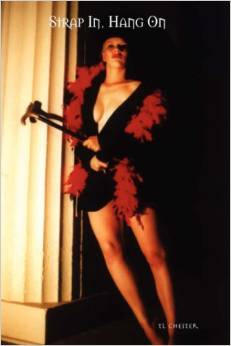
T.L. Chester is a highly creative individual with an exceptionally original and captivating style in both her literary and photographic endeavors. I found To Penetrate one of the most intriguing and suspenseful books I’ve ever read. Her first published work, a book of poetry, entitled “Strap In, Hang On,” is an apropos description of what it was like to read her novel, a warning of sorts which certainly reflects upon an amazing and interesting author who bears watching.

MF: Your first published work of poetry, “Strap In, Hang On,” obtained some excellent critical reviews and then spawned a rather lengthy and lively discussion amongst the reviewers, many comments of which were deleted by Amazon. What was your take on all the fuss?

TC: This was my first publication, and the expression itself was more for the love of it, and I can only hope readers sincerely enjoyed it. Grady Harp is notorious for Amazon reviews and has been slated to determine the fate of future authors. In my case, the review was very critical, such that his fans didn’t appreciate it, and I greatly appreciated their support, it became a controversial matter on Harp’s turf.

MF: It appears that your poetry was an outlet for painful experiences and events in your life, much of which was quite personal. What motivated you to share that with the world?

TC: We all have these things we must overcome over long term, and event inspired. It was an accumulation of all those events that the only justified thing to do was a creative outlet. We are all going through something; we are all experiencing this rollercoaster. It was therapeutic in nature, and turned into sharing. Sharing these thoughts in community speaking events, online through blogs and various outlets created a demand and that’s how the first book was born.

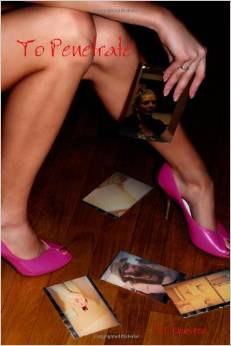
MF: Your novel, “To Penetrate,” is described as “a deeply chilling tale of psychosomatic secrecy and unveiling, “and a psychological thriller suitable for the “instinctual reader who appreciates nonlinear stories.” I found it yanked me in and didn’t let me go until the last, incredible page. How did you come up with the idea for this story?

TC: My thought process is certainly fragmented, but I thoroughly enjoy organizing processes. Though I had done various works with short stories for publications, I had never created a book like this. My thoughts for this book came through various concepts, a song might have inspired a chapter, a symbol had relevancy to the characters, so I kept notes, what inspired this and what I planned to do with it. The story was just somehow always there. After noting all these concepts over time, the book wrote itself, it was the transitional pieces that took time; this very much explains why there are so many eggs.

MF: What is your favorite part about the creative process?

TC: Purging is my favorite part of the creative process. I’d be lying if I said there was no part of me in what I write. It’s a creative expression of what it might be like to be in someone else’s shoes, feeling life in a manner that I may not understand, or see things from a perspective I don’t currently know. Getting a peep of the world in a way that I may not yet comprehend gives me a truly deep appreciation for what I have been through in life, and some faith that we are all connected. Capturing that, making note of it and putting it back out in various works is the only thing that gives this meaning for me.

MF: What are you working on currently and when do you plan to have it released?

TC: I am working on a precursor for To Penetrate. This book is not as subtle in story, I am aware that To Penetrate in comparison is methodical and sometimes gory, but slight in giving clues for those who love to pick up the pieces. Other works currently include a complete biography that I am currently ruminating on, and a philosophy book.

MF: Can you tell us a little bit about it so we know what to look forward to? Will it be similar to “To Penetrate” or entirely different?

TC: The next book is a precursor to a series of events in To Penetrate & can be a lot to take in; it’s probably comparative to the movie Se7en in terms of being in your face and has explicit adult content. The biography is another work that is personally significant. My philosophy book is to shed light and criticism on current affairs and hopefully will create conversation around dogma.

MF: You also have two photography books out, “Miscellany,” and ”Idiosynkrasia,” which provide another dimension of your talents. Was there anything in particular that inspired them?

TC: I had begun writing as a result of my involvement in various events that created a demand, after publishing and my works started to receive reviews, I would then get requests to be the critic, or participate in entertainment pieces, political satire, and the like. I have always had a natural interest in photography, and it’s just too easy if you are as inclined with technology as it stands. Needless to say as I had participated in entertainment journalism I would naturally take pictures, sparing my stint in photojournalism that turned into more publications over time.

MF: Can we expect any more photography books in the future?

TC: I may be inspired as I developed more as a photographer and would like to do so; currently I am producing material for brochures, calendars, contributing pieces for entertainment publications and so forth.

MF: How would you describe the synergy between your writing and photography?

TC: These are such incredible questions. My photography, at its best captures a feeling that can’t be described, but we all can feel just in observing, “that moment”. I hope my writing, captures what we can’t see and need the picture painted.

MF: What else do you enjoy doing besides photography and writing, as if that isn’t enough! Any other creative endeavors or outlets?

TC: I promise I am not an adrenaline junkie, I am not. I do find that I need inspiration. I have always enjoyed exploring. Currently I enjoy flying lessons; I also have begun diving, as well as a variety of dancing sessions. I am a foodie, and like to try new restaurants. I am fortunate in that people in the community know me, and I am called upon to participate in writing or photography of events and that gives me a lot of exposure, maybe more than I care for at times. I very much enjoy the heavens, astronomy, astrology, and the like. If you ever have to wonder about my writing, and are in the know, my Pluto is in the 5th house, & Mars Conjunct Jupiter are an aspect in my chart, and if you’re not, there’s always Google.

BOOK LINKS
To Penetrate
To Penetrate: http://www.barnesandnoble.com/w/to-penetrate-tl-chester/1111341865?ean=9781105692048
Strap In, Hang On
Strap In, Hang on: http://www.barnesandnoble.com/w/strap-in-hang-on-t-l-chester/1015235916?ean=9781435700871
miscellany
Miscellany: http://www.amazon.com/Miscellany-Tl-Chester/dp/0557058090
Idiosynkrasia
Idiosynkrasia: http://www.amazon.com/Idiosynkrasia-TL-Chester/dp/0557038715

SOCIAL MEDIA LINKS
Website: http://tracylchester.wix.com/tlchester#!__bio
Facebook: https://www.facebook.com/pages/TLChester/294383153916470
Goodreads: http://www.goodreads.com/author/list/4289805.T_L_Chester
Blog: http://journalistauthortlchester.wordpress.com/2014/07/17/sensual-jams/
Twitter: https://twitter.com/tracy_chester

PRESS RELEASES
Strap In, Hang On: http://www.prleap.com/pr/98273/
To Penetrate: http://www.prleap.com/pr/186187/

Review of “To Penetrate” by T.L. Chester

To PenetrateTo Penetrate by Tl Chester
My rating: 5 of 5 stars

This dark, gripping and occasionally gruesome tale was impossible to put down. It grabs you from the first page, taking you on a wild ride through the miasma of emotions roiling within a woman known as Sam who has killed her lover–exactly as he requested. Obediently following his last directive, she embarks on a mysterious quest in the form of a haunting roadtrip during which she discovers more about his sordid past with each mysterious stop. While trying to deny and suppress her guilt and inner turmoil she gradually confronts her demons and the various insecurities behind them.

This novella-length story is intense, believable and presented in a highly original style which takes you inside Sam’s psyche as if reading her diary as she pursues this dark journey of self-discovery. While the premise is tragic, it is nonetheless softened by an ample dose of humor throughout, even as it shields the protagonist from the maelstrom she’s experiencing inside.

I’m usually picky about such things as grammar and spelling but in this case any “mistakes” were effective as a deliberate ploy to capture the essence of this antiheroine as she spills forth her story in an utterly believable first person narrative. While it’s unusual to start a story with a murder where you know who the perpetrator was, the suspense throughout is nearly tangible, right up to the last heart-stopping page. This story’s depth is not to be trifled with, its impact troubling as you realize how, when all is said and done, that Sam could be the true victim of this clever albeit unsettling tale were it not for her transformation along the way.

View all my reviews

What’s Behind the Science in Science Fiction – Part 4: Light Behaving Badly

117px-Doubleslit3Dspectrum
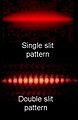
Last time covered how sometimes light behaves like a particle and others like a wave along with how the double-slit experiment was used to demonstrate these properties. For example, if a steady light comprised of numerous individual photons hit a plate with one tiny slit to allow them through, rather than getting a line that matched the slit on the opposing wall it would be spread out in a pattern that was concentrated toward the center and fuzzy around the edges. (See picture below.)

78px-Single_and_double_slit_4

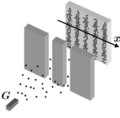
When they used a plate that had two slits a single photon would leave a dot, as expected, but by continuing to release them one at a time they would eventually form an interference pattern, the same as what resulted from a steady light source. It was as if each photon had a mind of its own yet collectively they would arrange themselves in a certain pattern. While exactly where each photon would arrive couldn’t be predicted, the pattern itself could be, based on the wavelength of the light. Thus there was a certain probability that a photon would arrive in a certain place, some more than others, but which exact one would go where was unknown.

120px-2slits
It was apparent they couldn’t predict exactly where a single photon would land but if it was a discrete particle of light then it followed that it would go through one slit or the other. (Remember that the interference pattern resulted because there were two slits so the waves could overlap.) Thus, scientists, the first of whom was Thomas Young (1773-1829), decided to find out which slit of the two choices each photon went through. To do so they polarized the light going through each slit in a different way with the detector on the other side capable of telling the difference. The photon could still theoretically “choose” which slit (or both) it would go through, but they would be able to tell which one by its polarization when it arrived on the detector.

Sneaky. But outsmarting Mother Nature is not an easy task.

Much to their surprise, when they sent one photon at a time toward the slits where it was polarized the interference pattern did not emerge!

Whoa!

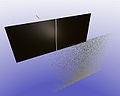
Instead, they got random spots of light which indicated individual particles. Polarizing the light did not destroy its ability to build interference patterns so this didn’t make sense. The results implied that when they set things up so that they’d know whether the photon went through one slit or the other that the individual photons lost their right to choose and behaved like a particle. In other words, the probability wave function had collapsed when the final result would be determined.

120px-2Slits-particles_only
In other words, the photon can change from a wave to a particle when someone is trying to figure out exactly what it’s going to do. When someone is watching, it behaves like a particle that not only goes through one opening or the other but loses its wave properties as well.

Say what?

Back then the expression WTF? didn’t exist yet, but something along those lines was definitely what was going through numerous scientific minds. By all appearances, if someone was watching, i.e. measuring the outcome, then the probability wave collapsed and the photons acted like particles.

Thinking perhaps this was because they were polarizing the photons before they went through one slit or the other, even though they knew that didn’t stop the light from forming an interference pattern, they rigged things up to determine which slit it had gone through afterwards. Much to their surprise they got the same result as before, a rain of itinerant particles, as if each photon had either known in advance or perhaps even went back in time, deciding how to behave.

This introduced the concept of an observer affecting the outcome. Suddenly consciousness was part of the mix, or at least seemed to be since there was no other explanation. Of course physicists who deal exclusively with the physical world were less than enchanted by all this woo-woo stuff. Thus began the philosophical notion of whether or not a tree that fell in the forest made a sound if no one was there to hear it. May I remind you that these are very intelligent people we’re dealing with here and while some of them may not be wrapped to tight as they walk the genius-insanity interface; nonetheless, they are a whole lot smarter than the rest of us.

fallentree

Einstein called this “spooky action at a distance” and didn’t believe it, even though he was the one who theorized that energy and matter were essentially the same as expressed by his famous equation E=mc2. To this day people are still arguing about this aspect of quantum theory with different conclusions. Is it possible that an observer or some form of consciousness can influence physical matter? Do we, indeed, create our own reality?

What do you think?

(Diagrams courtesy of Wikipedia Commons)

Return Match With Marcha Fox!

I totally agree with what John says here about history. Pardon the cliche which writers are supposed to avoid but “Those who fail to learn from history are doomed to repeat it.” I also appreciate the plug at the end. 🙂

spoiler2010's avatarCenter Stage With John Reinhard Dizon

marcha Recently Marcha was kind enough to invite me to participate in a Blog Tour. I gladly obliged, which resulted in the opportunity to not only hawk my new project, Philistia, but allow my fab followers to learn more about one of indie lit’s best and brightest new sci-fi authors!

Here’s Marcha’s questions along with JRD’s answers:

1. What are you working on at the moment?

Philistia is a young adult speculative fiction Christian novel centering on a 21st century reappearance of Samson and Delilah. They find themselves in the desert outside of Bethlehem and get picked up by the police after terror attack warnings have been issued due to hostilities along the Gaza Strip. They escape and become ‘persons of interest’ to Shin Bet (the Israeli Bureau of Investigation) as well as Hamas, who know that Samson’s superhuman strength can be of use in their terror campaign. The couple…

View original post 580 more words

Interview with Elle Klass, Author of the “Baby Girl” Series

messup

Elle Klass is the author of the popular “Baby Girl” series of short stories which chronicle the quest of Cleo, a girl abandoned at a young age, who’s in search of her true identity, literally and figuratively. Her adventures span the globe and take the reader along for a wild ride filled with increasing mystery and intrigue as the story progresses. Elle’s characters are believable and engaging with Cleo’s growing maturity and self-identity slowly emerging with each exciting episode. The third installment, “Baby Girl 3: City by the Bay” is being released for Kindle today, July 15, 2014, with its precursors also on sale so this is your chance to grab all three.

MF: Where did your idea for the Baby Girl series originate?

EK: I was on summer break from work and had an itch to write. The story formulated itself and the characters evolved as I wrote. I get all kinds of ideas in my head for absolutely no reason and write them down. I have tons of rough drafts awaiting revival so they can become full fledged novels.

MF: The Baby Girl series has grown in suspense and complexity with each episode and gathered considerable momentum through its many interesting twists and turns. Has the story evolved as you’ve written it or did you know from the beginning where it was going?

EK: When I first wrote it all I had was a very rough draft that I put on a shelf for several years. I dusted it off last fall and began reworking it. I decided to publish it in short stories form because it seemed more time efficient to break it down. Each segment has grown by 5,000 to 10,000 words from my original draft. Each short has taken on a life of its own as well as my characters. Reworking the draft I knew how the story ended. When I first began the story all I had mentally was a beginning and an end. It was how she got from point A to point B that surprised me.

MF: Besides Cleo/Justine/Shanna i.e., her various pseudonyms, who is your favorite character and why?

EK: Cleo, she is and always will be Cleo even though she hides out and disguises herself. I had the most fun with Cleo-Shanna. In book 3 she finally comes into her own on her own. She realizes she is an adult and her life is hers to direct. She does a lot of growing up and finally finds a place in her life that works for her. She wants the mystery of her birth resolved and plunges forward. In book 3 she also makes friends that she keeps. Until this book the only friend she ever kept was James. She has attachment issues but I guess most of us would if we had been abandoned at a young age and had someone stalking us .

MF: Will Baby Girl 3 complete the story with Cleo finally discovering who she really is or will it be an ongoing series?

EK: In Baby Girl 3 she doesn’t find all the answers. She does fit a lot of the pieces together. The rest of them come together in Baby Girl 4 when she discovers the secrets she’s been searching for. I don’t want to give away too much. The story is ongoing and this November I will be finishing Baby Girl 4 and the sequel to it. The sequel is about half done. What I can say is another mystery blasts her in the face and she has to rescue La Tige from a ghost of her past.

MF: As a teacher of junior high age youth and an author, what advice would you give parents who have a child with an interest or talent for writing?

EK: Let them write, read their work, encourage them. I have students who bring me their stories to read and ask about how to publish a book. I critique their work and have found some very talented youths that I hope pursue their creative writing talents. Junior high students aren’t as autonomous as they like to display. They seek encouragement and support from adults with their interests. I would also recommend checking out the public library. Sometimes they have workshops and writing groups that meet.

MF: What is your favorite part of the creative process?

EK: Free writing! That’s how all my stories start. I have a rough idea in my head that materializes. Once I start writing the words flow, creating more than I expect. Free writing allows the monsters, goblins and frightened little girls to rise to the surface. Equally as entertaining is taking the free write-rough draft and further developing the characters. I love each one even the lowdown- evil ones.

CONNECT WITH ELLE:

Amazon author page- http://www.amazon.com/Elle-Klass/e/B00F2Y48C0/
Goodreads- https://www.goodreads.com/author/dashboard
Blog- https://thetroubledoyster.blogspot.com
Website- https://elleklass.weebly.com
Facebook- https://www.facebook.com/ElleKlass
Twitter handle- @elleklass
Tumblr- http://elleklass.tumblr.com

BOOK LINKS

Baby Girl 1: In the Beginning
http://www.amazon.com/Baby-Girl-Book-1-Beginning-ebook/dp/B00GYP1DXS/

Baby Girl 2: Moonlighting in Paris
http://www.amazon.com/Baby-Girl-Book-Moonlighting-Paris-ebook/dp/B00IX5SSZS/

Baby Girl 3: City by the Bay
http://www.amazon.com/dp/B00LT5VSQU

Pre-release Review of Elle Klass’ “Baby Girl 3: City by the Bay”

Tomorrow, July 15, is the big day for Elle Klass’ latest sequel in the “Baby Girl” series. Here’s my review:

“Baby Girl 3: City by the Bay” continues the saga of Cleo, a girl abandoned as a child and on a quest to discover her true identity. This latest installment of the popular series of novellas finds Cleo, now known as Shanna Nu, in San Francisco where she hopes to uncover more information pertaining to the disappearance of the woman she knew as her mother. Cleo is acutely aware of cryptic letters the woman left behind warning her that her life could be in danger as she nonetheless persists, more determined than ever, to discover who she is. She conveniently obtains a job with a seasoned ex-cop turned private investigator named La Tige where she acquires a variety of new skills as well as access to new information in police files. As she gradually unravels the past the more tangled it becomes as she continues to pick through the various threads and close in on the truth.

This episode is filled with additional mystery, intrigue and adventure as the story and plot deepen. Amid the challenges and sometimes shocking revelations, Cleo is gradually discovering who she is at the core even if her actual identity still eludes her. Readers following this series will enjoy the ride as new dimensions of the story are revealed as well as witnessing Cleo’s evolving maturity. She still may not know her legal identity but she is beginning nonetheless to know exactly who and what she is, a discovery that everyone must encounter sooner or later.

baby 3 cover 2a

What’s Behind the Science in Science Fiction? Part 3: The Mystery of Light

You would think if you shine a light through a barrier with two slits in it that the wall on the other side would show two slices of light. This is not what happens, however, as Thomas Young discovered in the early 1800s. Rather than two distinct lines it created an interference pattern, indicating light behaved like a wave.

Single_slit_and_double_slit2
You can get a better understanding of interference as it relates to wave behavior by dropping a pebble into a puddle and watching how the waves expand in a circle from the center point. Then drop two pebbles at the same time a few inches apart and watch how the waves interact. What results is called constructive and destructive interference as some waves get bigger and others cancel out. This is similar to the interference pattern of light which leaves dark spaces alternating with light bands which create a striped effect.

But as scientists continued messing around with the properties of photons, inconsistencies appeared. In 1887 Heinrich Hertz discovered that light could stimulate electrons on a metallic surface and thus create electrical current but the effect was related to the frequency of the light. In 1905 Albert Einstein explained that this was because light energy was carried in discrete, quantized packets and eventually won the Nobel Prize for it in 1921, which was the beginning of the quantum revolution.

As theorized by Isaac Newton and believed throughout the 1700 – 1800s, this supported the theory that light consisted of particles which were called photons. The particle theory made sense since it had been discovered that a photon absorbed by an atom increased its energy level and when it dropped its energy state then a photon was emitted, showing a release of energy. When photons interact with matter they act like tiny particles.

So what was going on? Was light a particle or a wave? It was in pursuing the answer that quantum theory was further established as scientists continued to study the results of the double-slit experiment. When laser light is passed through two tiny slits it forms what is called a diffraction pattern on the other side, similar to what Thomas Young saw back in the early 1800s and is shown in Figure 2. This behavior supports the idea that light is a wave since particles would not arrange themselves in such a way.

When a single photon is released it behaves like a particle and leaves a single dot of light on the other side. If you continue releasing single photon from the same source and location, however, they eventually form a diffraction pattern. Say what? How could light know how to arrange itself in a pattern? They weren’t interfering with one another when they were released one at a time so how could this occur? (See the figure below that includes 5 views of electron buildup into a diffraction pattern.)
200px-Double-slit_experiment_results_Tanamura_2
This led to the idea of a probability wave meaning that the photons would land somewhere within a given area with some places more likely than others. But this completely blew the idea of prediction out of the water which was the premise of classical physics and presumed if you knew all the conditions involved you could predict the outcome. Suddenly science was having to deal with probabilities, or the likelihood of subatomic particles behaving in a certain way, as opposed to being able to calculate the precise answer when they knew all the parameters.

Ooops! With that revelation, classical, i.e. Newtonian, physics went out the proverbial window. It obviously couldn’t solve any problem and most certainly couldn’t predict future events. This, in turn, eventually influenced the philosophy of the day regarding life and the concept of free will. The implications suggested that while some outcomes were more likely than others, exactly which one it would be was no longer possible to determine.

As if the dual nature of light wasn’t mysterious enough, it soon became even stranger when someone was watching.

(Insert Twilight Zone music here….)

Stay tuned.

(Figures courtesy of Wikipedia.org)

Writing Process Blog Tour

writingprocess

This blog tour originated with Kelly Lewis who stated, “The purpose of this tour is to showcase fellow writers with emphasis around the writing process itself to spread great words, get insights, and to show support in this isolating craft we embark on.”
Kelly Lewis passed the baton to author, Susanne Leist, who in turn passed it on to me in her blog.
http://susanneleist.blogspot.com/2014/06/the-writing-process-blog-tour.html

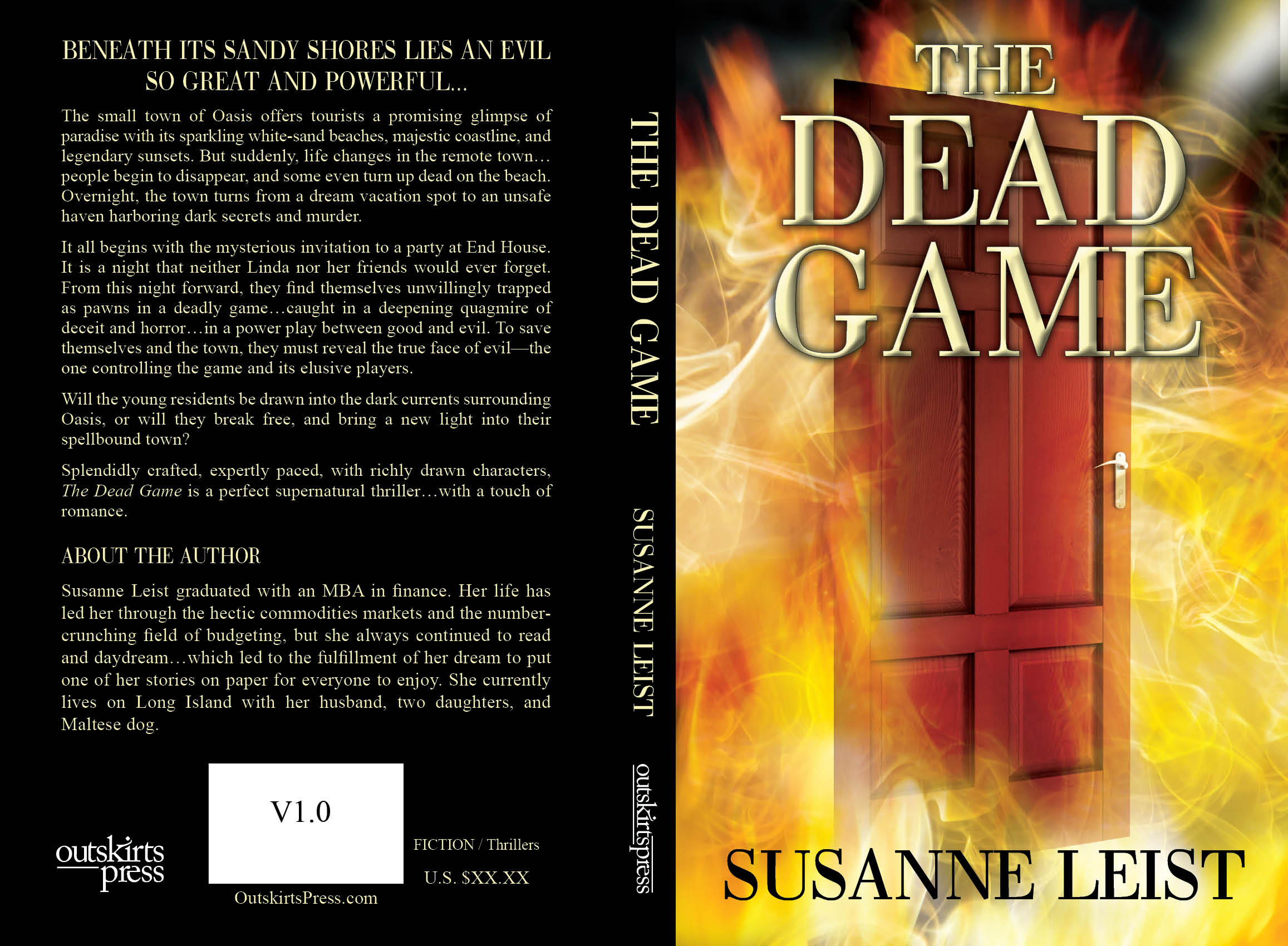
Susanne is the author of the popular thriller “The Dead Game.” If you enjoy scary books check it out here: http://www.amazon.com/Dead-Game-Susanne-Leist-ebook/dp/B00F3IWF70/

Here are the questions and my answers:


1. What am I working on at the moment?

I’m currently working on “Refractions of Frozen Time,” the fourth and final book in the Star Trails Tetralogy science fiction series. I have it drafted but my characters have gotten themselves into such a mess that it’s going to take a while to sort it all out and wrap it up.

2. How does my work differ from others of this genre?

In addition to being science fiction it’s also a family saga. When a family is scattered across the galaxy there is just too much going on in too many places to tell it through a single viewpoint. So at one time or another you get inside everyone’s head. I know it’s breaking the rules but that’s how the story flowed and so far my readers have liked it.

What’s interesting, though, is how everyone seems to relate to a different character and see him or her as the protagonist. While it was originally intended as a young adult series I’ve been told multiple times that it’s suitable for all ages. Another reviewer told me that the “human element raises the bar in this competitive genre” which points out that the setting may be on another planet but it’s the people that matter most, even though the brutal star system their planet is in drives the story.

While much of it is science fiction, I base as much as I can on what is known and pass it on in lay terms. I hope to build an audience of young people interested in science and engineering who will learn something painlessly along the way. I also have a section on my website for parents and educators with hints on how to use the stories as a springboard for discussion on various topics. If I can inspire one person to go into a career in science my work here is done.

3. Why do I write what I do?

I write science fiction because I love science as well as writing fiction so, as we say in physics and math circles, it was “intuitively obvious.” Speculating on the many weird and wonderful theories out there and what the future holds as we gradually get a grip on them and apply them to technology is my idea of fun. What most people don’t realize, though, is I got the physics degree so I could write authentic science fiction, not the other way round.

4. How does my writing process work?

I have an overall view of the story’s premise but once the characters are created most of it comes to me as I write. I’ve never been one who stuck to a chapter outline very closely because the story is sure to deviate based on what the characters do. The story seems to have a life of its own and it feels as if it’s being dictated to me. My characters always take over. I learn more about them all the time like you would someone you meet in real life. Many times they’ve gone off in directions that surprised me or new characters, sometimes important ones, have sprung up out of nowhere. I enjoy writing even more since what comes out usually surprises me.

Of course there are times when I have to do some serious crafting or brainstorming to tie it all together for which I have to give a lot of credit to my muse, Kalliope. I’m an astrologer as well as a writer and a few years ago I discovered that an asteroid named Kalliope is very prominent in my horoscope, which explained a lot.

I tend to do a significant amount of rewriting. My first draft is mostly action and dialog and I have to go back to make sure it includes sufficient imagery and renders appropriate emotion. I use the acronym IDEAS (Imagery, Dialog, Emotion, Action, Suspense) to check on whether I’ve included everything required. I’m one of those authors who never finishes a novel but rather abandons it because I can always find something I can say better or add.

I write a fair amount of nonfiction as well. Once I get an idea it tends to flow so I can produce blogs and articles with ease. I love doing research and have a gift for finding what I’m looking for almost as if I’m being guided by some invisible force. Back before the internet I could walk into a library and just somehow walk down the right aisle and lay my hands on exactly the book I needed. I love writing blogs about science at a level anyone can understand, kind of a “Physics for Dummies” series if you will. You can find them here on WordPress. However, my first love is writing novels and watching the characters evolve.

MY NOMINATED WRITER – John Reinhard Dizon

Now I’d like to hand off the blog baton to Literary Chameleon, John Reinhard Dizon. I conducted an interview with John a while back in which I conferred that title on him which you can find here: (https://marcha2014.wordpress.com/2014/06/11/interview-with-author-extraordinaire-and-literary-chameleon-john-reinhard-dizon/). He writes in numerous diverse genres and handles them all in a masterful way. No matter which genre is your favorite I would be willing to bet dollars to donuts that he’s written something you’ll love. If you enjoy reading a variety yet had to limit yourself to one author, he’s the only one you’d ever need.

In the interview I asked him how he changed his style so easily. Here’s his response:

“I think it’s more a question of adapting rather than changing. My four main ingredients are a dynamic plot, compelling characters, snappy dialogue and a powerful finish. You’ll find that common quality in all my novels. As far as genre goes, I made it a point to explore as many as possible in order to give a future fan base a wide variety of reading material. The way I saw it, there would be something for everybody. At this point in time I’ve been working on sequels, the logic being that it gives readers something to latch onto in following their favorite characters. You know how it goes, if at first you don’t succeed.”

John’s Amazon Author Page: http://www.amazon.com/John-Reinhard-Dizon/e/B00DU9JNUQ/
John’s Facebook Fan Page: https://www.facebook.com/johnreinharddizonUSA
John’s Twitter: https://twitter.com/JohnRDizon
John’s Blog: https://centerstagejrd.wordpress.com/2014/06/03/interview-with-marcha-fox/
My Interview with John: (https://marcha2014.wordpress.com/2014/06/11/interview-with-author-extraordinaire-and-literary-chameleon-john-reinhard-dizon/)
John’s Book Links:
Tiara: http://www.amazon.com/Tiara-10th-Anniversary-John-Dizon-ebook/dp/B00IPS7R64/
The Kingdom: http://www.amazon.com/Kingdom-John-Dizon-ebook/dp/B00L2LLCY4/
Generations: http://www.amazon.com/Generations-John-Reinhard-Dizon-ebook/dp/B00K5DQYSY/
Generations II: http://www.amazon.com/Generations-II-John-Dizon-ebook/dp/B00JG56C2U/
Transplant: http://www.amazon.com/Transplant-John-Reinhard-Dizon-ebook/dp/B00JQRH1J6/
Destroyer: http://www.amazon.com/Destroyer-Abaddon-John-Reinhard-Dizon-ebook/dp/B00FDWB7KC/
Nightcrawler: http://www.amazon.com/Nightcrawler-John-Reinhard-Dizon-ebook/dp/B00I0K9QEI/
Nightcrawler 2: http://www.amazon.com/Nightcrawler-II-Tryzub-John-Dizon-ebook/dp/B00L8653CU/
Wolf Man: http://www.amazon.com/Wolf-Man-John-Reinhard-Dizon-ebook/dp/B00H4HWDAC/
Vampir: http://www.amazon.com/Vampir-John-Dizon-ebook/dp/B00IPPI7FC/
King of the Hoboes: http://www.amazon.com/King-Hoboes-John-Dizon-ebook/dp/B00HXQ4YKQ/
The Break: http://www.amazon.com/Break-John-Dizon-ebook/dp/B00IPPI3ME/
Strange Tales: http://www.amazon.com/Strange-Tales-John-Dizon-ebook/dp/B00JAHX8OO/
Hezbollah: http://www.amazon.com/Hezbollah-John-Dizon-ebook/dp/B00IZMV4D2/
The Fury: http://www.amazon.com/Fury-John-Reinhard-Dizon-ebook/dp/B00FK3UTE4/
The Test: http://www.amazon.com/Test-John-Reinhard-Dizon-ebook/dp/B00IVB9EA2/
Stxeamtown: http://www.amazon.com/Stxeamtown-John-Reinhard-Dizon-ebook/dp/B00GSTZK5W/
The Standard I: http://www.amazon.com/The-Standard-John-Reinhard-Dizon-ebook/dp/B00E1TL5LO/
The Standard II (The Citadel): http://www.amazon.com/Standard-II-Citadel-John-Dizon-ebook/dp/B00KP2B40I/

What’s Behind the Science in Science Fiction? Part Two – Atomic Theory

bohratom

I know you’re anxious to get to the good stuff like other dimensions and time travel, but you need to be patient just a little longer. After all, this blog is about what’s behind the science in science fiction, not the final result. Think of it as similar to those documentaries you see on TV which explain how they do the special effects in your favorite movies. I don’t know about you, but knowing how they do that makes me appreciate the movie even more. If you couldn’t care less, then you’re probably reading the wrong blog and need to just go back to reading sci-fi novels. Those who are left need to just bear with me a little longer as I explain the basics of atomic theory which is more relevant than you may think. Ready? Okay, here we go.

As far back as 400 BC or so early Greek philosophers pondered what constituted matter and decided that it could only be divided down so far, from which atomic theory was born. The term “atom” even originated with their adjective atomos, which means indivisible. Back then the elements were believed to be water, air, earth and fire. Clearly they are all important, particularly to life, but not a one of them is an actual element in the chemical sense.

However, proving it was another story and it wasn’t until the 18th – 19th century that scientists gradually discovered that water was comprised of hydrogen and oxygen; air is mostly nitrogen with hydrogen, oxygen and various others in the mix; earth is made up of too many elements to count; and fire is a process that involves oxygen and thus called oxidation but isn’t an element in and of itself. As they confirmed that certain chemicals could only be broken down so far the Periodic Table of the Elements was born. Periodically more are added (pun intended) though in most cases they are manmade.

periodic_table

By the early 20th century experiments involving electromagnetism and radioactivity revealed that, would the truth be known, the atom was not indivisible after all, but consisted of other particles which were identified as protons, neutrons and electrons. These were suitably dubbed subatomic or elementary particles and scientists conveniently ignored the fact that the etymology of the word “atom” no longer applied, figuring most people didn’t know Greek, anyway.

How these subatomic particles were arranged was a matter of debate that went through numerous speculations. J. J. Thomson’s idea was sometimes referred to the “plum pudding” model where protons and electrons were lumped together in a glob of positively charged fluid. After that, Ernest Rutherford decided that the positive charge as well as most of the mass were concentrated in the center with the electrons surrounding it in some unknown way.

In 1913 Danish physicist, Niels Bohr, proposed his version of the hydrogen atom which remains the mental image many retain today, i.e., a nucleus in the center with electrons revolving around it much as the planets orbit the Sun as shown at the beginning of this blog. Bohr still believed that electrons orbited the nucleus but he placed restrictions on them to certain discrete distances or allowed orbits so that it would agree with what experiments thus far had revealed. At this point they considered the electrons to be itty-bitty particles that orbited the nucleus according to the laws of classical mechanics, in other words like the planets orbit the Sun.

The electrons would change orbits based on either emitting or absorbing a photon, as shown in the animation. This was getting closer, but still had problems.

Nonetheless, the idea of specific orbits was a definite step toward quantum theory and the fact that only specific energy states were allowed. The real problem was thinking of electrons as tiny specks of matter which behaved according to Newton’s Laws pertaining to gravitation. WRONG!

Bohr_atom_animation_2

In 1924 a scientist named Louis de Broglie (pronounced de-broy) proposed that all moving particles could exhibit wave-like behavior. Erwin Schrodinger liked this idea and developed it further, into a probability wave. This theory helped explain behaviors that previous ones couldn’t but still didn’t cover everything. This was ultimately solved by Max Born (no relation to Jason Bourne) who theorized that Schrodinger’s equation represented all possible positions where the electron might possibly be. This conveniently reconciled the two ideas and the wave/particle duality of electrons was born (pun intended).

However, trying to figure out the atom was not taking place in the proverbial vacuum (though admittedly some experiments were). During this same time numerous other scientists were hard at work investigating what interested them most and ultimately led to so many different scientific disciplines. Things were getting too complicated for any one person to have a firm grip on everything anymore.

Light was also under scrutiny since it was apparent that atoms and electromagnetic radiation (a.k.a. light) were related. If you’re scratching your head on where that came from, it derived from having established that atoms emit a photon when they change states, like that cute little animation shows. And in case you’re wondering, yes, even the Sun, our greatest source of energy and light, is no more than a giant glob comprised mostly of hydrogen atoms which bond with each other under pressure to become helium at which time a photon is emitted. Lots of them, true, but that’s the process. Simple.

Most people think of light as what we can see which is conveniently broken down into its various colors by a prism or in some cases a rainstorm that occurs when the Sun is out and thus produces a rainbow. Visible light, however, is but one small portion of what is known as the “Electromagnetic Spectrum.” It also includes various other wavelengths that span a vast variety of wavelengths and energies ranging from radio waves and infrared (heat) on one side to ultraviolet, x-ray and gamma radiation on the other. In the picture you can see the rather small portion of visible light in the middle where it looks like a rainbow.

emspectrum

Albert Einstein theorized that similar to matter, light could also only be broken down so far, the smallest unit of which was ultimately called a photon. He even proved it and received the Nobel Prize for his paper on the photoelectric effect, which stated that a photon could change an atom’s energy state and that principle is used widely today with all those automatic doors you encounter everywhere from the grocery store to Wal*Mart.

Physicists conducted numerous experiments with light which revealed that it, too, had both wave and particle characteristics. Since photons originate with atoms the fact that they share some of the same characteristics shouldn’t be any more surprising than the fact your have your father’s nose or your mother’s smile. True, photons are massless, but electrons aren’t. Nonetheless, they also show wave and particle traits.

This is a good place to ponder Einstein’s famous equation, E=MC2, which states energy is equal to mass times the square of the speed of light. If you rearrange it algebraically you have energy divided by the square of the speed of light is equal to mass, which essentially declares that mass and energy are the same thing.

Now we’re getting into the good stuff. So give that some thought until next time when I introduce you to the true beginnings of weird science which originated with something called the double-slit experiment.

See you then.

© Copyright 2014 by Marcha Fox

All Rights Reserved
Confessions of a Reviewer from Hell – Part Four

As a person who worked in a technical environment for two decades, I have to admit one of my pet peeves is when details relevant to a novel are ignored or inaccurate, particularly when they relate to the protagonist’s or key characters’ livelihoods. If you’re going to place him or her in a particular career or situation such as a police investigation or military setting, then you should know something about their SOPs (Standard Operating Procedures). Otherwise, especially if one of your readers is familiar with such an environment, they’re going to be put off by inaccuracies or glaring errors regarding how that particular field operates. Do you really want someone from one of those professions to pick up your book and laugh themselves silly? Probably not. Not only will you lose a potential fan but may garner a scathing review which will discourage other readers.

Understand that people in most professions including big business, the military, aerospace, law enforcement and most other fields, even including those who labor in fast food establishments, tend to speak their own unique language, often replete with various acronyms. If you want your story to sound authentic then you need to reflect those details in your story. In other words, if you’re going to write a medical thriller then you’d do well to learn some physiology so those gory scenes are accurate and be familiar with emergency room procedures and jargon. In case you haven’t noticed, novels that make it to “Best Seller” status tend to meet these standards of accuracy.

If you’ve followed this blog from the beginning you’re probably getting tired of hearing this, but if you’re going to do something, freakin’ do it right! If nothing else, realize that failing to reflect appropriate details to bring a character, profession or even location to life is a classic example of why authors are continually advised to “Write what you know!” The good news, particularly as far as authenticating a location is concerned, is that as a writer you can vacation in such places of interest and then write off at least part of it as an expense on your income tax. It doesn’t get any better than that. Just be sure to take notes, keep your receipts and not expect immediate book sales to pay off your credit cards from such a jaunt.

If you don’t already know the necessary details through life experience, then you need to do some research. This doesn’t have to be onerous or boring. You can always talk to someone who does that for a living and pick their brain. Most people enjoy talking about what they do and are even flattered that you asked. Use them later as a beta reader to make sure you captured it correctly. You’d be surprised how much more interesting your story becomes when you’ve done your homework. Often new plot twists surface as a result and your finished product will be more convincing and deserving of praise, including by those within or without that particular occupation. If they like it they’ll tell their coworkers and bring more readers and fans your way. You may even inspire someone to go into that line of work as they get a bird’s eye view of what it involves.

The world these days is filled with too much mediocrity. Please don’t contribute to it with your writing. Standards have plunged now that literally anyone who possesses a little computer and internet knowledge (or perhaps sufficient money) can get their novel published in ebook or even printcopy format. No writer today is forced to deal with rejects and a plethora of revisions to get their work published so the incentive to edit and in some cases even run the spellchecker have been lost. Doesn’t anyone own a good dictionary anymore? Okay, okay, I’m one of those weird people who would actually read the dictionary from time to time. I’m not a perfect speller but I can usually tell when a word “looks” wrong and know where to look to find out. My grammar isn’t always correct and one thing I’ve never mastered was punctuation, especially the use of commas. I admit it, I’m far from perfect. But I’m closer than I was 30 years ago.

Please. If you must produce sloppy work, keep it far away from me. If sufficiently provoked by bad writing I can become “The Reviewer from Hell.” Of course that depends on your attitude. Regardless of which stage you’re in as a writer from stark beginner to already published, if you’re a true professional and want to know the truth, then I may be able to either help you move in that direction or validate your efforts as on-track.

That said, before I close what has turned out to be a rather lengthy blog/rant I have one more thing to say: All I’m really trying to do is make this a slightly better world for readers of Indie authors, one sentence at a time.

Namaste.