Unknown's avatar

About Marcha's Two-Cents Worth

I'm a science fiction author of the Star Trails Tetralogy, retired after two decades working at NASA, defected from my physics training to become a professional astrologer, and various other acts of rebellion. More recently, I've teamed with Pete Risingsun in writing "The Curse of Dead Horse Canyon: Cheyenne Spirits" which was released in July 2020 with more to come.

Challenges of Space Exploration: NASA as a Government Bureaucracy

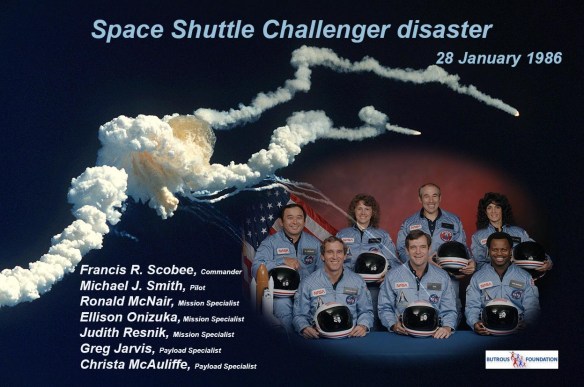
Space Shuttle Challenger disaster

On January 28, 1986, the U.S.A. experienced a tragedy that has since faded into history. If you weren’t yet born at that time, you may not have even heard of it. I remember talking about the space shuttle to a classroom full of junior high students in the late 90s where I was blindsided by a young man who asked whether one had ever blown up. That something indelibly imprinted on my memory could be unknown to someone, even an adolescent, was incredible. Until I realized the simple fact that the kid hadn’t been born yet.

Wow. To me it felt as if it had occurred the day before.

I was a physics major in college with aspirations to work in the aerospace industry. The day we lost the space shuttle, Challenger, for me was a very bad day. Ironically, that’s exactly what NASA calls such an event, a “bad day.” Well, no shit.

Sorry, I usually avoid naughty words in my blogs, but in that context my expansive vocabulary entirely fails me. Somehow nothing defines NASA’s understatement of tragedy as well as an expletive. And much of why I feel that way is because, subsequent to the Challenger accident, I went to work at NASA as a contractor, ultimately winding up in their Safety Division, which meant I was privy to all sorts of dirty little secrets.

When I arrived at Johnson Space Center in Houston in April 1988, the agency was deep into what they referred to as “return to flight”; RTF in NASAspeak, given their propensity for acronyms. RTF comprised the time while they finished investigating the cause and put together design fixes to avoid a similar occurrence in the future, eventually getting back to what NASA did, i.e., send men and women into space. It’s interesting to consider that we didn’t even refer to it as Challenger; it was 51-L, the ill-fated flight’s official designation, which was less emotionally charged than calling it by name.

When I went to work in the Safety Division at Johnson Space Center in 1990, “The Report of the Presidential Commission on the Space Shuttle Challenger Accident” was required reading. This well-written document covered the technical details in a way that even my teen-aged son at the time could understand. I remember him reading it in the backseat of the car during a road trip. That same copy still resides on a shelf in my home office, bristling with numerous sticky notes and highlights marking the parts that struck me the most. But those are but tips of the proverbial iceberg.
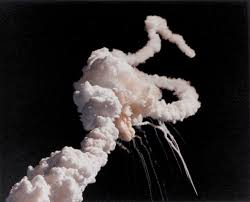
51Lexplosion2As anyone who’s actually familiar with the accident knows, its official cause related to the o-rings in the solid rocket booster which didn’t seal, allowing hot gasses to strike and penetrate the external fuel tank, which resulted in a deadly explosion. A major contributor to o-ring failure was the fact the launch took place when the temperature at Cape Canaveral in Florida was a mere 28 degrees F. This had never before been attempted, Floridian temperatures usually far above that range, even in January. This factor was illustrated dramatically by physicist Richard P. Feynman, a member of the investigation committee, by dropping an o-ring in a glass of ice water to demonstrate how they became brittle and incapable of performing their function at low temperatures.

51Licicles

I lived in Northern Utah at the time of the accident, the manufacturer of the solid rocket boosters (a.k.a. SRBs), Morton Thiokol, located a few dozen miles away. Anyone who lives in such a climate is more than aware of the effects of cold weather. As I recall, the SRBs had never been tested in that temperature range, either.

On the surface, it appears that this tragic accident that claimed the lives of seven astronauts, including teacher Christa McAuliffe, took everyone by surprise. But in reality, as I learned working in Safety for nearly 20 years, it was processes and politics every bit as much as faulty design. They knew; they just ignored it. The true cause was as elusive as missing shuttle pieces still on the bottom of the Atlantic Ocean. [NOTE:–If you’re interested in more sordid details about the Dark Side of NASA, I recommend “Challenger: A Major Malfunction” by Malcolm McConnell or “Prescription for Disaster” by Joseph Trento.]

Anything that can cause a problem, either critical or catastrophic, is documented on a Hazard Report, with o-ring leakage no exception. Hazard Reports (HRs) contain causes along with controls, though some hazards are simply classified as an “accepted risk” if there’s nothing that can be done to prevent them. Space flight is risky and there are some things you simply can’t avoid or control; bird strikes and meteorites come to mind.
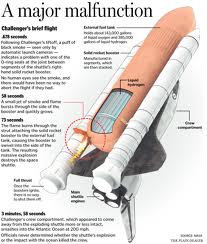
51LMalfunctionO-ring failure was a catastrophic hazard and documented as such. That the design was faulty was likewise known. Engineers had seen leakage on previous flights. Let that sink in for a moment. O-ring failure had happened before. However, earlier instances had not caused an accident. This resulted in a very dangerous and ultimately fatal thought pattern that led them to believe that perhaps it wasn’t as serious as they thought. Previous failures had been investigated, the leakage referred to as “blow-by” and eventually accepted as not a safety issue.

How wrong they were. In reality, they were playing Russian Roulette. Just because they got away with it a few times did not mean it wasn’t a hazard, only that they’d dodged a bullet. A Thiokol engineer named Roger Boisjoly had written a memo before the accident pointing out the seriousness of the problem. It was essentially ignored, most likely for budget and scheduling reasons. Unfortunately, his sordid prophecy of impending disaster was fulfilled almost exactly six months later. Later, to cover their sins, Morton Thiokol and NASA decimated Mr. Boisjoly, typical behavior employed to discredit whistleblowers.

I’d like to point out that for many accidents the public sees Safety as the culprit. Wasn’t it safety’s job to prevent such a horrific occurrence? Yes, it certainly was. And I must say that we did everything possible to assure safety of flight. We were the ones who made sure all risks and hazards were properly controlled and documented. This more refined process, however, was instituted after and because of the Challenger accident. The full rigor of the safety process recommended post 51L by the Presidential Commission was never fully instituted, however. A plethora of subsequent reorgs were supposed to make safety more of a priority, yet somehow eroded, as proven by the Columbia disaster 17 years later. An accident which has a strikingly similar administrative postmortem.

If you remember the movie, “Deep Impact,” you might recall the line where the female member of the crew on that fictitious shuttle flight, charged with protecting our planet from a collision with an approaching asteroid, noted that if they died in service to their country that all they’d probably get was a high school named after them, which is more truth than poetry. So let’s take a moment to remember those seven brave individuals by name who died so needlessly 30 years ago. They represented different genders, races and ethnicities, some professional astronauts, others not.
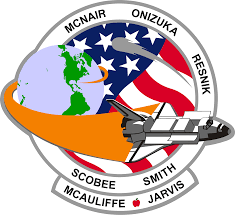
51LPatch

Francis R. (Dick) Scobee (Commander)

Michael John Smith (Pilot)

Ronald Erwin McNair (Mission Specialist)

Ellison S. Onizuka (Mission Specialist)

Judith Arlene Resnik (Mission Specialist)

Christa McAuliffe (Payload Specialist & school teacher, winner of the “Teacher in Space” competition)

Gregory Bruce Jarvis (Payload Specialist & aerospace engineer, bumped to this flight by a U.S. Senator who took Greg’s original spot)

As they say, those who fail to learn from history are doomed to repeat it. And repeat it they did, within four days of being exactly 17 years later on February 1, 2003 when we lost Columbia.

Watch for more on that tragedy on the 13th anniversary of that disaster.

Dates of sun’s entry into each constellation of the Zodiac | EarthSky.org

Excellent article that explains the difference between astronomical and astrological placement of the Sun.

—-

Sun-entry dates to Zodiac constellations in 2016, using boundaries for constellations set by International Astronomical Union in 1930s.

Source: Dates of sun’s entry into each constellation of the Zodiac | EarthSky.org

JUST RELEASED! Vision of the Griffin’s Heart, Andy Smithson, Book 5

Book5cover

I’m delighted to participate in this blog tour for L.R.W. Lee’s latest episode in the Andy Smithson fantasy series for Middle Grade readers!  I had the pleasure of sharing a booth with her at the Austin Book Festival last October and thoroughly enjoyed getting to know this intelligent and fascinating person. Learn more about the fifth book in the series, get to know more about the author and then be sure to grab a copy from the buy links at the end.

Four years ago, Andy Smithson discovered he is the Chosen one to break a 500-yr-old curse plaguing the land of Oomaldee when he unexpectedly and mysteriously found himself there. To do so, he must collect ingredients for a magical potion. Thus far he has gathered the scale of a red dragon, venom from a giant serpent, a unicorn’s horn, and the tail feather of a phoenix. Now he must ask a griffin for one of its talons. There’s just one problem…humans have poached griffin treasure, causing these mythical creatures to attack on sight.

Complicating matters, the evil Abaddon, sovereign of Oomaldee’s northern neighbor, is turning more and more citizens into zolt in his ongoing campaign of terror as he sets in motion the final steps of his plan to conquer the land. Things really start to heat up in book five!

If you loved Harry Potter, you’ll love the Andy Smithson series chalk full of mythical creatures, newly invented animals like zolt, herewolves, and therewolves, a complex plot with evolving characters, and positive themes including responsibility, diligence, dignity, friendship and more.

Purchase Kindle and Paperback

 THE BUZZ

5 Stars! – “A marvelous book in a great series!” – Erik Weibel (Age 14) This Kid Reviews Books Blog

“Readers of this series have come to anticipate a host of challenges, intense battles, and on an epic scale. In Vision of the Griffin’s Heart, you won’t be disappointed. For lovers of fantasy, I consider it a must read.” – Richard Weatherly, Author

“One of the admirable qualities I like about the entire series is seeing Andy’s growth from a self-absorbed kid to a more thoughtful teen as he learns how to deal with the various crises which face him, all the while knowing that the future may hold unpleasant consequences.  The watchword for Vision of the Griffin’s Heart is “courage.” – Wayne Walker, Home School Book Review

THE DEPTH OF THE ANDY SMITHSON SERIES

If you’re an adult looking for a clean series you can sink your teeth into, Andy Smithson is definitely it! In it I develop four layers simultaneously: 1) Andy Smithson in Lakehills, TX 2) Andy in Oomaldee 3) the Afterlife 4) a meaning layer. A few examples to demonstrate the depth…

Symbolism is used extensively (a couple examples):

  • The fog of the curse symbolizes blindness and oppression.
  • The magic key unlocks doors, brings stone statues to life, as well as revives. Put another way, it symbolizes bringing forth, opening up, and revealing (aka taking responsibility).
  • Methuselah is not only a weapon and helper, but also represents justice as it divides good and evil. Consistent with life, justice requires diligence to uphold.

Names are also important in this series (a few examples):

  • Andy means brave or courageous.
  • Alden means helper.
  • Hannah means favor or grace.
  • Imogenia means blameless.

Alchemy used throughout the series (a few examples):

  • Alchemy played a significant role in the development of modern science. Alchemists sought to transformbase metals into the gold or silver and/or develop an elixir of life which would confer youth and longevity and even immortality.
  • In the series, the first instance of alchemy begins with the gold weavers, Max, Oscar, and Henry, spinning straw into gold to manufacture the wealth of the kingdom.
  • The four elementals: air, earth, fire, and water are then seen on Methuselah’s hilt.

 The titles of the books manifest yet another layer of meaning and reveal Imogenia’s evolution.

  • Beginning with Blast of the Dragon’s Fury, Imogenia is furious at what has happened to her and she fuels her emotional hurt.
  • In Venom of the Serpent’s Cunning, Imogenia turns venomous (or spiteful) and cunning in seeking ways to continually punish her brother.
  • Disgrace of the Unicorn’s Honor has Imogenia act in a manner disgraceful to the honor of royalty.
  • In Resurrection of the Phoenix’s Grace we see Imogenia’s grace reborn as she begins to reflect.

In Vision of the Griffin’s Heart, Imogenia realizes she is gripped by hatred and distrust she has harbored for so long. Unlike griffins who choose to trust others, Imogenia cannot yet make that leap when it comes to her brother.

ABOUT THE AUTHOR

lindanewpix

R. W. Lee credits her love of fantasy with her introduction to C. S. Lewis’ Chronicles of Narnia. Later on, she enjoyed the complex world of Middle Earth brought to life by J. R. R. Tolkien in Lord of the Rings and The Hobbit. The multiple dimensions of the worlds mixed with a layer of meaning, captivated her and made her desire to invent Young Adult Fantasy and Epic Fantasy worlds others could get lost in, but also take meaning away from. More recently, L. R. W. Lee has found inspiration from J. K. Rowling and her Harry Potter series as well as Brandon Mull and his best selling Fablehaven, Beyonders and Five Kingdoms series.
R. W. Lee writes to teach her readers principles that can transform their lives – overcoming frustration, impatience, fear and more. She also shows why responsibility, diligence and dignity are the keys to true success in life. She lives in scenic Austin, TX with her husband. Their daughter is a Computer Engineer for Microsoft and their son serves in the Air Force.

Website | Facebook | Twitter | Goodreads | Amazon | Email

L.R.W. LEE INTERVIEW

  1. How did you come up with your main character, Andy Smithson? Did he just pop into your imagination or did you specifically develop him?

Andy is patterned after my son. After our first child who was what I would call compliant and seemed to need little to no correction, our son arrived on the scene. As with most 2nd children, he was polar opposite and provided much fodder for an engaging main character.

  1. How did your experience with building a business help with your writing?

It has been invaluable for I understand that writing is only 50% of the writer’s success equation. Unlike Field of Dreams, with so many good books available today, just launching it, even on a well trafficked platform like Amazon, does not get recognition. Because of my corporate background, from day one I began working to build a platform – Twitter and Facebook primarily and now also Book Nerd Paradise. As well, I understand the importance of the author community, for no author can succeed these days without the support of fellow authors. My background has also helped in understanding the need to optimize my books to rank well on the variety of sites they are listed on. There’s much more, but those are the biggest helps I would say.

  1. Was there any particular book or author whom you feel had the most influence on your work?

I have to say JK Rowling. The imagination she revealed, the strength of her characters, the world building, the depth of plot over multiple books…she definitely shaped how I think about writing.

  1. What do you love the most about writing for young people?

Young people are moldable. My passion for writing is to share with readers principles that from my experience can help them live more peaceful lives. A few of these principles include overcoming fear, frustration and impatience as well as understanding that true success in life is not from riches, fame or power, but rather responsibility, diligence and dignity. If they can finish any of my books closer to understanding these principles, I feel very fulfilled.

  1. Which part of the creative process is your favorite? Least favorite?

Designing the story arc is my favorite part of the creative process for you can take a story anywhere your imagination can go. My least favorite part is editing/revising. Even though I know the narrative gets much stronger as a result, it’s still my least favorite part.

  1. How long does it usually take you to write one of your stories from when you get the idea to when it’s finished?

Usually about 6 months.

  1. I know that most authors love all their characters but which of your many “children” is your favorite (besides Andy) and why?

I have to say Mermin, the kindly old wizard who speaks with a lisp. I love him most after Andy because he’s so warm, humble and approachable. He’s fallible and he knows it, which is why he doesn’t apologize for his mistakes, rather he is comfortable in his own skin.

  1. Do you ever plan to branch out into other genres besides middle grade/young adult fantasy?

Funny you should ask. Yes, I’m actually noodling with a story arc of a YA Sci Fi story.

  1. How do you feel your writing has evolved since your first novel?

I can see how much I’ve changed and improved in showing rather than telling my readers what’s happening. I want them to engage and to show – providing sight, sounds, touch, smell, and taste cues is a big part of that. I was particularly thrilled when my editor came back a full week sooner than expected with this current book because I had improved so much between book three and four. My pocketbook also appreciated that J

OTHER BOOKS IN THE ANDY SMITHSON SERIES:

book1cover

Blast of the Dragon’s Fury (Andy Smithson, Book One) ebook is FREE. Download a copy at Amazon, Smashwords, Kobo, Google, B&N.

Listen to the FREE podcast of Book 1 by L. R. W. Lee on Podiobooks.

Book one is also available in paperback.

book2cover

Venom of the Serpent’s Cunning (Andy Smithson, Book Two) is available in Kindle and Paperback.

Download the professionally recorded audiobook at Amazon

It’s only $1.99 if you download the eBook first…Savings of $16!

book3cover

Disgrace of the Unicorn’s Honor (Andy Smithson, Book Three) is available in Kindle and Paperback.

book4cover

Resurrection of the Phoenix’s Grace (Andy Smithson, Book Four) is available in Kindle and Paperback.

prequelcover

Power of the Heir’s Passion (Andy Smithson, Prequel Novella) ebook is FREE. Pick up a copy at Amazon, Google, B&N, Smashwords. It’s also available in paperback.

Download the professionally recorded audiobook at Amazon

It’s only $1.99 if you download the eBook for $.99 first…Savings of $1!

Challenges of Space Exploration: Gravity Assisted Functions

German_Spacelab_03

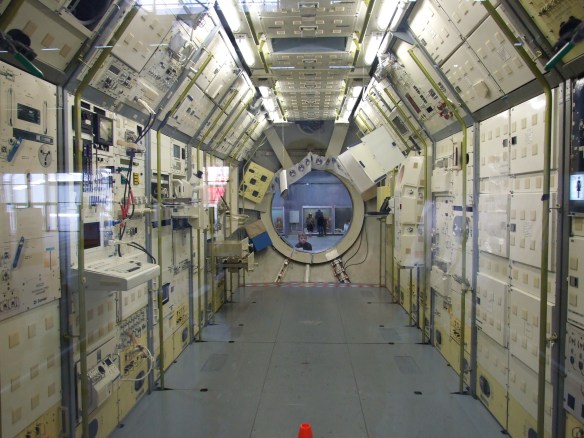
One of my first assignments as a NASA contractor at Johnson Space Center in Houston back in the late 80s was to participate in a vendor survey seeking sources of medical equipment used for life science experiments in Spacelab (mock-up used for training purposed pictured above). If an item was available commercially, it could save a tremendous amount of money versus developing one from scratch and essentially reinventing the wheel.

When I would talk to each sales representative, who was usually rather excited to be talking to someone from NASA, the first thing I would ask would be, “Will this particular item work upside down?”

The ensuing silence never failed to make me smile.  After a sufficiently dramatic pause, I would explain.

Anything used in space needed to function without any assistance from gravity. This could be something as simple as a reagent moving through a tube or some mechanical part that required a nudge from the 9.8 meters/second/second acceleration of gravity.

Since we’ve all grown up on Earth’s gravity field, it’s easy to take it for granted. In fact, I was amazed to encounter situations where aerospace engineers made the mistake of designing something that was gravity dependent! How ironic is that? That’s how pervasive it is, that even someone trained specifically to work in the space industry would forget that important little detail. Along similar lines, when the shuttle would arrive in orbit, any tools left in the cargo bay, or anywhere else, for that matter, would come floating out, sometimes presenting a serious hazard.

Take a look around and think about some of the things you do every day that depend on gravity. Would your food stay on your plate or your drink in the glass? Nope. Could you wash your clothes in your washing machine? Nope. Would water run out of the tap so you could brush your teeth? Not unless it was under pressure and then it probably wouldn’t go where expected. Floating around looks like a lot of fun, but many an astronaut has battled with space sickness as his or her stomach was quite literally upset with food refusing to settle.

While my heroine, Creena, is onboard the escape pod, she encounters similar issues since it didn’t have a gravity simulator. To quote from “Beyond the Hidden Sky:”

“Nonetheless, there were still a few things she’d never get used to. Like the sanicube. She’d never thought of going to the bathroom or taking a shower as gravity assisted functions before, but they were, with equally bizarre solutions.”

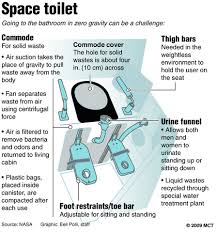
Think about going to the bathroom standing on your head. More than likely, you wouldn’t like the result. Needless to say, toilet facilities in space require innovation to avoid what could otherwise be an extremely unpleasant environment. You can’t pick up a toilet that will work in space at Home Depot, that’s for sure, and developing one was expensive. Even then, it wasn’t ideal. I talked to individuals who were tasked with cleaning up the space shuttle when it returned from a mission who described a rather disgusting mess. Not only would it look as if the astronauts had engaged in numerous food fights, it would smell similar to a port-a-potty as well. Yummy, right?

spacetoiletspecs

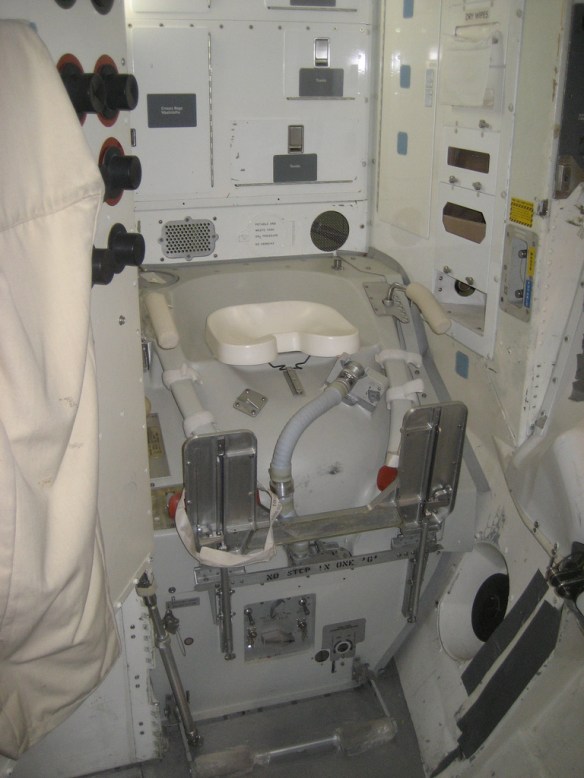
It was quite common when I would go to schools to talk about space exploration that someone would inevitably ask about the space toilet. It certainly didn’t look anything like a normal commode. It employed assistance from vacuum hoses for urination and a general vacuum for defecation. I had a tour of the toilet training facilities with some of my coworkers one time which, of course, we found somewhat amusing. Potty training for astronauts certainly seemed a bit odd, considering all the high-tech training they received.

The funniest part was that the toilet in the training facility actually had a video camera inside it! This had an important purpose, i.e., so trainees could see if they were correctly parked on the seat, which was required to maintain that vacuum effect noted earlier. Failing to do so would result in, well, the possible escape of something you wouldn’t exactly want to encounter floating around, eh?

spacepotty

It didn’t take long for someone to dub it the “butt cam” and we joked about the possibility of someone broadcasting the training session across NASA Select, the private TV network that spanned not only Johnson Space Center but every other NASA facility and accessible in every conference room, lobby and manager’s office. No doubt the “butt cam” was on a closed circuit, but this shows the type of humor we engineers found in the most unlikely places. Yes, it was definitely fun and interesting to work at NASA.

How many “gravity assisted functions” that we Earthlings take for granted can you think of?


Can you tell me the full moon names? | EarthSky.org

Here’s some interesting and fun information about the Full Moon!

For both the Northern and Southern Hemispheres, the full moons have names corresponding to the calendar months or the seasons of the year.

Source: Can you tell me the full moon names? | EarthSky.org

New ideas to help universities attract and empower STEM students

Instilling a love of math, science and engineering in children is an important step toward preparing them for a good job later in life.  My hope as a science fiction author is to contribute to this type of interest and support STEM.

—–

Projections released by the U.S. Department of Education paint a bright future for jobs in the science, technology, engineering and mathematics (STEM) fields. As populations grow, natural resources diminish, disease prevention and treatment become more complex and evolutionary and universal mysteries continue to be explored, STEM will remain critical to expanding human knowledge and solving challenges of today and for the future.

Source: New ideas to help universities attract and empower STEM students

Solid evidence for a 9th planet, say Caltech astronomers | EarthSky.org

This is actually a little bit creepy since various people have said it was out there for years and that it could have an influence on Earth’s various cycles.

If it exists, the 9th planet has 10 times the mass of Earth – orbits 20 times farther from the sun than Neptune – and takes 20,000 years to orbit the sun once.

Source: Solid evidence for a 9th planet, say Caltech astronomers | EarthSky.org

Do You Want to Work for NASA?

EVA-SA

A while back National Geographic featured a blog declaring that NASA was recruiting astronaut candidates. The astronaut corps is obviously an exclusive bunch with strict requirements and grueling competition. Even if you want to join their ranks it’s not going to be easy. At the least, military experience and graduate degrees are usually minimum requirements.

But just because you can’t make muster for the astronaut corps doesn’t mean all is lost. There are literally thousands and thousands of people who work for or support NASA without such demanding qualifications. You can find a list of them here. Having worked at NASA’s Johnson Space Center for over twenty years I can tell you that there is every job imaginable represented in addition to the obvious ones in a technical field. Whether you’re an accountant or public affairs wizard NASA will need people with those skills somewhere in their organization.

If you’re really interested in a NASA career and haven’t checked out their website, then you need to do so. Yesterday. If you haven’t, here are a few highlights.

One thing you need to realize is that NASA is only located in some very specific locations. They have centers in California, Texas, Mississippi, Ohio, Florida and various other places including their headquarters in Washington, DC. Unless you live near one or are willing to relocate, it will be more difficult. There is one caveat I’ll get to later, but if you want to be an actual NASA employee, living in close proximity to one of their centers is required. You can see where these centers are by going here.

If you want to work more directly with the technical side, which comprises 60% of their employees, then you need to have at least a bachelor’s degree in one of the fields noted on their website. Obtaining a position as an intern as part of your education will give you a considerable advantage later for becoming a permanent employee. More information about the various programs available can be found here.

Okay, now I’m going to talk about some things you won’t find on their website.

Getting a job with NASA is not easy. First of all, there are only so many positions available for which there will probably be hundreds if not thousands of applicants. There are three factors that can help you have a slight advantage. One you either have or you don’t with nothing you can do to change it, another may be related to your birth but not necessarily, and the last one you may be able to achieve if you plan early enough as mentioned above.

The first way to get your foot in the door is to be a minority. As a government agency, NASA takes pride in maintaining a high percentage of those in the affirmative action category as an example to industry in general. This is not to say that these folks don’t need to meet the technical requirements of the job at hand. They still need to possess a technical degree and the better their grade point average and/or experience, the better, but these individuals will usually make it to the top of the heap more easily than others. Minority women with a technical degree have an even bigger advantage.

The next potential advantage is to be disabled. Again, this doesn’t mean you don’t need to have the needed qualifications. If you do and you get hired NASA will actually help accommodate your disability. For example, I knew a NASA engineer who was a quadriplegic due to an unfortunate accident when he was a youth. His mind was not affected and he obtained an engineering degree after which he was hired by NASA. He was confined to a wheelchair and clearly had major physical limitations. To compensate, NASA hired an assistant who helped him by entering what he told her on the computer, taking him to meetings, and so forth. In other words, Stephen Hawking could get a job based on his abilities, not refused for his disabilities.

If none of these fit your situation, then it’s going to be a lot more difficult to get onboard, but not impossible. At least not as far as working with NASA’s space program. There are literally thousands of jobs in the aerospace industry, some of which are directly associated with NASA and others that are not. These are mostly available through numerous companies, big and small, that are known as NASA Contractors. In fact, the 21 years I spent at Johnson Space Center were as a contractor employee. There are pros and cons to being a contractor I’ll get into another time, but if you really want to work for NASA it’s a step in the right direction.

After you decide which NASA center you want to work for your next step is to identify which contractors are in that area and start applying. If you don’t want to or can’t move near one, all is not lost. And here’s the caveat I alluded to earlier: There are other options. In order to get their budget passed by Congress each year, NASA requires support throughout the United States. What this boils down to is that there are NASA contractors in just about every state. That way, to protect job interests in their home state, Congressmen will be more inclined to vote favorably for NASA interests. It might be a challenge to find a NASA contractor in your area, but that’s what the Internet is for. If you’re hired by one, depending on the position you hold, you’ll probably get to travel to NASA centers from time to time. You’ll not only get to see some very cool stuff but feel as if you’re part of the program. Perhaps all without moving, at least out of your state.

Like NASA, contractors often have intern programs, especially during the summer. They aren’t always easy to get into, either, but it’s worth a shot. Again, you’ll be competing against a lot of other applicants. And there’s only one way to get around that.

You’ve probably heard the saying “It’s not what you know but who you know.” In other words, if you know someone “on the inside” who can vouch for you, it will give you a much better chance of being considered for a position. In fact, that is why those intern positions are often difficult to obtain, because they’re usually given to the kids whose parents work there first. That may seem unfair depending on your point of view, but it’s the way the world works.

But all is not yet lost.

The next best thing you can do is make personal contact with someone inside your organization of choice. Better yet, lots of them. Trade shows related to aerospace and job fairs at universities are one place you may be able to make such a contact. Always treat such encounters as the equivalent of an interview. It’s critical that the impression you make be favorable as well as memorable. And no, looking like a cast member of “The Big Bang Theory” is not what I mean. Maintain contact with the person afterwards as well, but not to the point of being annoying. Touching base with him or her every few months will be sufficient.

It’s not easy but it can be done. Working with NASA had been my dream since I first watched the Apollo 11 Moon Landing back in 1969, before most of you were born. I didn’t graduate from college until 1987, at the age of 39, yet through determination and the right connections I was able to land a job supporting NASA’s Johnson Space Center in Houston within a year of graduating. I worked my way up through the ranks, eventually managing a cadre of engineers, and finally retired with the satisfaction of knowing I’d gone after something, no matter how elusive, and attained it. There’s no reason you can’t, too.

[Originally published 11/7/2015 at https://medium.com/@marchafox/do-you-want-to-work-for-nasa-f1a64db05292%5D


See all five bright planets simultaneously! | EarthSky.org

Don’t miss this since it doesn’t happen very often. 

—-

All five bright planets will appear together in the morning sky from about January 20 to February 20, 2016. That hasn’t happened since 2005.

Source: See all five bright planets simultaneously! | EarthSky.org

Underwater Robots Help Scientists Understand Great White Sharks

Here’s one for you shark fans.  Pretty cool way to observe these less than friendly creatures.

The “REMUS SharkCam,” an autonomous underwater vehicle (AUV), navigated the waters off Mexico’s Guadalupe Island in November 2013. Outfitted with six high-definition video cameras, the AUV provided Woods Hole Oceanographic Institution engineers and scientists a panoramic view of the clear waters, which are a hotspot for great white shark activity.

Source: Underwater Robots Help Scientists Understand Great White Sharks