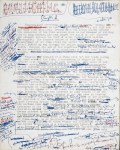

Needless to say, as I learned these lessons in humility, many of which were difficult and ego-deflating, I became quite adept at editing, if I do say so myself. I’ve been an avid bibliophile my entire life, right back to those Little Golden Books my mother read to me, so I have developed a strong concept of character and plot development as it pertains to fiction writing as well.
I didn’t get it all through osmosis, however; I also read books on writing, attended classes which included obtaining an English minor in college, and went to various workshops dealing with writing technique. I point this out not to brag but to show how serious I was about learning how to do things correctly. It’s only when you can admit how little you know that you open yourself up to really learning something. Long before my own books were in print I helped several friends edit their books, two of which eventually got published and earned me a place in their “Acknowledgements” section up front. Seeing my name in print in their work gave me hope that maybe someday I could do the same.
I evolved into “The Reviewer from Hell” thanks to some God-given talent and experience. I was raised with the mantra “If you’re going to do something, then do it right,” as well as its complement, “If you want something done correctly, then do it yourself.” I’m still extremely self-critical but every now and then I’ll read something I wrote, usually far enough in the past that I’d forgotten about it, and realize it’s actually pretty good. At that point I have one of those Han Solo moments when “Sometimes I amaze even myself.”
So, when I read someone else’s work all of this experience comes to bear. If there are spelling errors they jump off the page and hit me between the eyes. Grammatical errors make my ears ring. Plot or character inconsistencies evoke a spoken comment toward the author, often not complimentary and along the lines of “WTF are you thinking?”
I do try to review in context. If something is intended to be an afternoon read at the beach I will not judge it based on standards that would make Hemingway sweat. I realize that all authors don’t obsess on research and accuracy like I do. (You should have picked that up from the fact I got a physics degree to write sci fi.) However, when I encounter something in a novel that just doesn’t ring true it makes me cringe. Kind of like my rant elsewhere in the blog world about the movie “Armageddon” which is entitled “A Roughneck and a Rocket Scientist Went to a Movie.” Do it right or not at all.
But do you know what this is really all about? It’s simpler than you may think. If you only remember one thing from this blog, remember this: A novel should take you to another place, immerse you in another world which may or may not include this planet, and involve you deeply in the lives of its characters. Agree? Good. Now listen up, writers! Bad writing, which includes anything that distracts the reader, breaks that magical spell! Whether it’s misspelled words, typos, incorrect grammar, choppy writing or plot inconsistencies, the reader loses connection with the story.
Thus, if a story makes me both laugh and cry it has an extremely good chance of earning a 5-star review (provided my reaction was motivated by the story and not the author’s lack of technique). Why? Easy. Because I got emotionally involved with the story which meant there were no distractions which meant it was well-written. If I didn’t laugh or cry but enjoyed the story without stumbling over a figurative garbage-strewn path of author carelessness, it may still get 5-stars, especially if it was a thriller or murder mystery which is usually not intended to elicit that kind of response. After that, my ranking goes downhill steadily, depending on how many whiplashes I suffered as I was jerked back into editor mode.
All reviews are subjective and authors can learn something from them all, even if it’s the simple fact that not everyone will love their work. It’s difficult to edit your own writing and another set of eyes can find all sorts of things which can do you a huge favor. In most cases when I find quite a few things that distract me from the story I simply pass on my observations to the author without putting some horrific review out on Amazon or Goodreads. I really don’t want to upset anyone, I want to help make their work better, just as those red pen wielding engineers helped me. I want to raise the bar, especially for Indie writers, so that no reader ever has to suffer through another novel that simply wasn’t ready to be made public.
Capiche?
(To be continued)