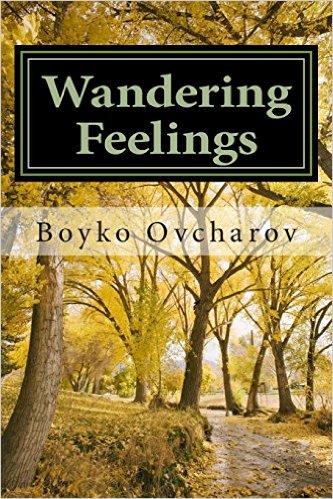
“Wandering Feelings” by Boyko Ovcharov: A Glimpse into the World of Those Driven by Emotion

wanderingfeelingscvr

Much of the prose in this story was poetic and beautifully rendered, such that it did an excellent job of capturing feelings, which can be elusive and difficult to describe with words. The descriptions of various places provide excellent imagery and added to the dreamy, flowing nature of the story. The style is definitely unique and doesn’t conform to formula writing. There is no plot in the usual sense most readers expect and the characters are nameless. In other words, it breaks plenty of rules, yet in its own way, as a chronolog of feelings, it “works.”

As an astrologer, this story struck me as a great example of getting inside the head of someone driven by emotion, such as those born under a Water Sign (Cancer, Scorpio and Pisces). If you’re not a deeply emotional person, you’re likely to see the characters in this book as illogical and possibly even dysfunctional in their inability to dismiss their unloving, materialistic upbringing and get on with their lives. However, for someone ruled by emotion, this is not easily done.

And for those driven by logic, not easily understood.  In fact, this latter group will probably be unable to understand the emotions expressed in this story. They may feel uncomfortable and perhaps even disgusted with the characters, who simply can’t seem to “get over it.” This is something that can cause great divides in relationships when people can’t understand how others are programmed. We’re all egocentric to some degree, especially when we’re younger, and think everyone sees the world as we do, or at least should.

Thus, if you fully relate to this book and become blissfully immersed in its beautiful prose and deeply felt emotions, you’re probably an emotional person yourself. Those who roll their eyes, keep waiting for something to happen worth noting or for the characters to get a grip and quit whining are probably logical by nature.

The richest part of life is often that which is felt. Those who have never fallen deeply in love, felt overwhelming joy or even its antithesis of debilitating emotional pain, are missing something. I believe this book is most important for those who don’t understand how deeply emotions can operate because it introduces them to a world with which they are entirely unfamiliar. Emotions are not always positive, e.g. love, but can be viciously destructive as well. Understanding that brings new insights into human nature, of which no one can ever have too much.

Rather than dismissing or criticizing the book or the characters, learn from it. Yes, there are people out there who are that tied to their emotions. If you’re not one of them, this is an example of what you’re missing, for good or ill.

You can find it on Amazon here.

The Devil’s in the Details

BernkastelStreet

Berncastel, Germany

Embellishing your story with the right details can make the difference between being vivid and memorable versus slipping away like a boring stretch of highway in the rearview mirror. Finding the correct balance is not always easy, however, since there’s no perfect level; it’s not only genre-dependent, but subjective. Some readers expect more while other’s complain about their eyes glazing over. I tried to read a novel a while back that was so loaded with specifics that I felt as if I were there and could map out the entire area.  However, the plot moved so slowly, if at all, I was never able to finish it. Other readers felt differently, however, as it enjoyed several favorable reviews. Nothing is ever simple about writing. Like they say, you can’t please all the people, all the time.

A skilled writer, however, knows when to get down to the nitty gritty details, such as what color blouse the heroine is wearing or what’s on the menu for that romantic dinner at The 21 Club. There’s no greater way to build mood and imagery, but bogging down an action scene, whether physical or emotional, is a definite no-no. Get your reader familiar with the territory beforehand, then fire away.

A sense of place is another important element that can greatly enhance your story. Street names, specific restaurants (whether real or not), historical landmarks and even the weather can take your reader on an excursion to somewhere they’ve never been, adding depth and character to your story. Cities have personalities, too, which can add to the mood if exploited properly.

nyc3

New York City

If your story takes place somewhere you’ve never been, there are various online resources that can provide the information you need. If you can’t afford to hop in your car or on an airplane to see for yourself, you can still obtain vital details. Wikipedia provides historical and demographic information for most cities and localities around the globe. Whether your hero or heroine has lived there his or her entire life or is visiting for the first time, a sprinkling of details will bring it alive for your readers, giving them the bonus of vicariously visiting someplace they may never get to in person. If, perchance, they have been there, you want them to recognize it, which will give you increased credibility.

Writing a chase scene? Google Earth is a fantastic way to roam the streets yourself! If you’re a visual type like I am, you’ll thrive on this blast of input. Research doesn’t have to be dry, boring or expensive. It can be fun as well as informative while providing inspiration and plot twists along the way. Give it a try and see if it takes your scenes to an entirely new level.

(Pictures by the author)

The Best of Times and the Worst of Times

faulknerquote

Forgive me for borrowing the title from Dickens. As you may have guessed, the context, however, is entirely different. I’m talking about publishing.

Truly it’s the best of times for those of us who burned out trying to find a commercial publisher. I remember how excited I was when I found out you could publish your book on Kindle and even more excited when Create Space came along so you could actually hold your book in your hands. Long ago I discovered that, like so many other parts of life, finding an agent, much less a publisher, was quite political. I’m sure you’ve encountered books that were commercially published that sucked worse than a day-old calf. Just the memory of a few I remember is enough to make me shudder. So bringing the DIY world to self-publishing without the thousands of dollars required for a vanity press was like a gift from Heaven.

However, there was definitely a downside. First of all, there’s the competition. In the days when books were only available in, well, bookstores, there was limited shelf space. Thus, most books had a shelf life of about six weeks with a print run of a few thousand copies. Then they were remaindered, i.e. sent back to the publisher, sold to the highest bidder or perhaps the covers ripped off and tossed. Bookstores could only hold so many books and your chance at fame were thus limited.

Now, thanks to e-books as well as print on demand (POD) publishing, books are available ad infinitum, both in time and number. This is a good thing because it gives you all the time in the world to hawk your book. It’s a bad thing, because now there are literally millions of books competing with yours.

Of course when a market is saturated, that also drives down the price. It’s never been easy to make a living as an author and it’s even more difficult now. Readers have come to expect their books to be free, maybe 99c for an author they love. Even if they pay more, especially if it’s someone who prefers print books, selling a print book via Create Space’s “expanded distribution” usually earns you something in the neighborhood of $0.18.

Yeah.

And if the book is used, the author won’t even get that. Bear that in mind the next time you buy one.

As if that’s not bad enough, it costs money to be an author. Having a computer and word processor software is assumed in today’s world. But unless you can do everything yourself, there’s a matter of line editors, content editors, copy editors, book interior designers, and cover designers, perhaps even voice actors. Then there’s the expense of maintaining a website and a presence on social media, which seem to be spawning new platforms like mushrooms after a spring rain. There are book promoters, book fairs, and marketing classes, plus, to maintain your sanity, you may need to hire a personal assistant to keep up with it all. The bad news is that everyone makes money but you. The good news is that it’s a good tax deduction. Just don’t ever make the mistake by referring to it as a hobby with the IRS.

blackboard_writer2So why on Earth do we write? Because we have to. It’s something inside us that needs to come out. It’s that creative spark of self-expression that makes us feel alive. If we can share it with others, all the better. But the fact is, it’s something we’re born with and can’t deny.

Yes, it’s the best of times and the worst of times.There’s a whole lot to bitch about. But when all is said and done, being able to hold your book in your hand is priceless. The only thing better is finding a five-star review.

The Importance of Formatting

26572416_s

Typos, grammar and such are an amazingly common complaint in reviews, something which many indy authors encounter at some point. However, there’s another issue that can get you a bad rapp (or rep, as the case may be) that you may not even be aware of–formatting.

The guidelines for a printed book with an interior that looks professionally done are substantially different than those for an ebook. Considering how there’s a good chance most of your readers are going to opt for the electronic version, it’s in your best interest to make sure that it looks professional as well, not like an afterthought.

I suspect that numerous indy authors, after getting their book set up on Create Space, simply hit that button on the last screen to publish their book in Kindle format. This is all well and good, but don’t trust that automated process to produce an electronic version that looks anything like the printed one. At the very least, check it yourself, especially if your printed version has dropped caps at the beginning of each chapter.

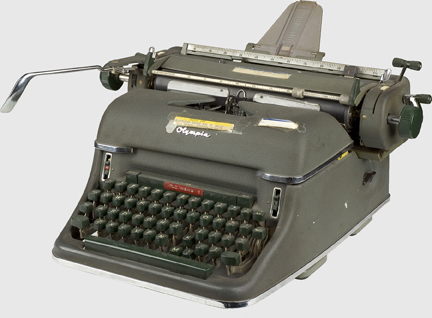
The first thing you need to do is save a second copy of your book to use for the electronic version prior to formatting it for print. Then you can add headers, footers, chapter headings, dropped caps and so forth to the printed version without introducing potential corruption into the electronic version. If you’ve already done the formatting, then obviously when you save that second copy it will be to remove such things. typewriterEither way, it’s a lot easier than the old days, when authors wrote on a device like the one shown to the right. Those of you who haven’t had that experience don’t even want to know what it was like handling simple revisions that changed the pagination. Gives me a panic attack just thinking about it.
If you want to produce a professionally formatted ebook, the best guide for doing so is the Smashwords Style Guide, which you can download for free from their website here.

Even if you don’t use Smashwords’ service (perhaps because you’ve opted into Kindle Unlimited, which requires giving Amazon exclusive rights to sell your work), the instructions will enable you to format a clean version that won’t aggravate readers enough to blast you with a bad review. It takes a little extra work, but it’s worth it.

Writing a book entails a lot of hard work, but that’s just the beginning. If you want it to be well-received by readers, it also needs to provide a comfortable reading experience. It’s not difficult to do and will be worth it. If it’s not something you care to tackle, then check into some of the services that will do so for a reasonable price, such as Fiverr.com.

Showing respect and appreciation to your audience starts with clean copy. Getting yanked out of a story by errors of any type, whether they’re typos, incorrect spelling, punctuation problems or formatting in nature, is not only distracting, but annoying. Some readers are more forgiving than others in overlooking such things, but sure as death and taxes, sooner or later, a reviewer will say so.

After all the time, sweat and blood you’ve put into your story, don’t let its message be diluted or even lost due to careless formatting. Take care of your readers and they’ll take care of you.

It’s that Time Again: The Cosmic Season for Editing and Revising

strasclock

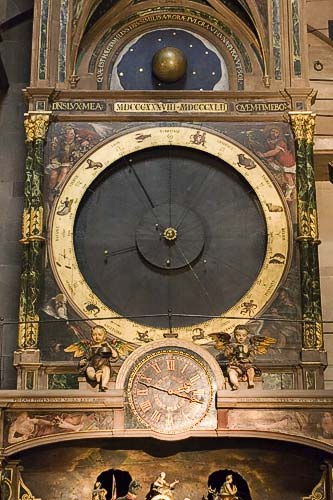
If you’re a writer it would be to your advantage to know a little astrology. Not only can it help you develop your characters as noted in a previous blog but there are actually three times a year when the cosmic climate is particularly conducive to editing and revising. If you don’t believe in astrology, that’s fine, I didn’t used to either. But you might want to give it a try because most writers, myself included, can use all the help we can get. So what exactly is this spell and why is it helpful? Stay tuned, I’m about to tell you.

It starts with the planet Mercury. In mythology Mercury a.k.a. Hermes was the messenger and the only one who could come and go to the Underworld. In astrology he rules communications or all varieties including your thoughts, ideas, writing and paperwork in general. In this day and age he also rules electronic communication devices such as cells phones, computers, television and the internet to name a few, plus anything mechanical, i.e. with moving parts, such as your lawnmower, small appliances, automobile and so forth.

If you’re already familiar with some astrology you’ve probably heard of Mercury Retrograde. While it’s intuitively obvious (or should be) that the planet Mercury does not reverse the direction of its orbit, as a rule three times a years he appears to move backwards in the sky compared to his usual direction. The reason for this is easily explained as similar to when you pass a car on the highway. You’re going faster so it appears the other is moving backwards, even though it’s not. Thus, when the Earth passes Mercury in its orbit you get the same effect.

So what? Hang on, I’m getting to that.

As I write, Mercury is currently in this state which started on 5 January 2016 and will last until 25 January. Astrologically when a planet is retrograde (yes, they all do the backstroke from time to time) it internalizes its energy. During this spell you may notice more computer problems than usual, things may break down more often, traffic is often worse and so forth. Anything ruled by Mercury bogs down during this time. If you buy something ruled by Mercury during a retrograde period it’s likely to be a lemon. Furthermore, anything initiated during Mercury retrograde seldom comes to pass. For example if you interview for a job you’re less likely to get it with one possible caveat, that being if it’s a second interview with the same person. It’s also not a favorable time to sign a contract or lease.

Why? Because during Mercury retrograde it’s a time to rethink, redo, reconsider, revise, refine, repair and so forth. This is a time to slow down, stop, and look over past work, thoughts and decisions. For a writer this is an awesome time for editing and revising. This is when you go back and see your work through different eyes, giving you the ability to make positive changes. It’s not uncommon for writers to dislike this phase because you may feel stuck, your brain may not work as efficiently and your computer may be on strike. Any new endeavors started at this time are likely to bomb out and relate to yet another “re” word, i.e. regret. This is because you’re resisting the cosmic flow. Reviewing, revising and editing your work from time to time is essential if you want to produce professional quality work.

redlines

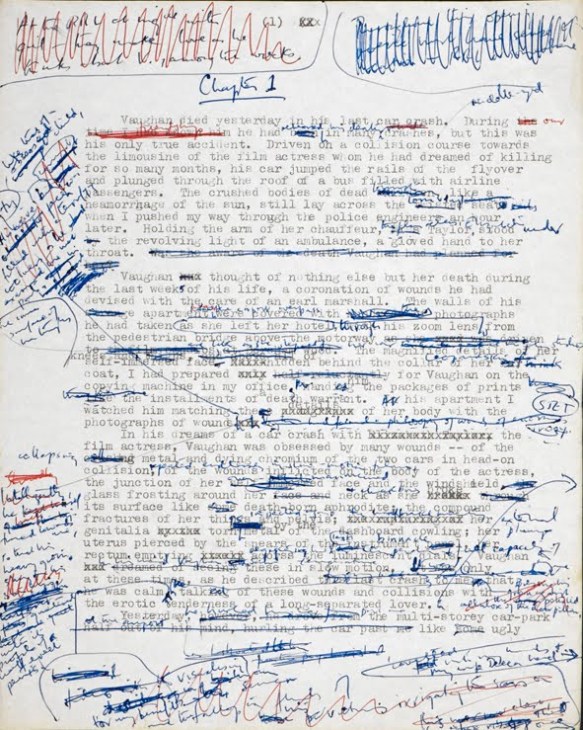
If you’re suffering from writer’s block, this is the ideal time to look over what you have and see if it’s on the right track. You’ll be surprised at how much you’ll be able to improve it, perhaps even make some critical changes you didn’t think of before. Don’t expect to make much progress with new endeavors which are likely to be an exercise in futility. Submitting work at this time is not likely to bring results or, if it does, they’ll be delayed. Rather, use this time to rework and refine.

Will you be out of the woods for new projects come 25 January? Possibly not. Until Mercury gets back to the zodiacal position where he stationed retrograde he’s in his “shadow period” when things are still stalled. This lasts until February 15, at which time once again it will be “all systems go.”

Even if you think that astrology is a bunch of myth and superstition, give this some thought. Observing the world around you and how people behave is part of your job as a writer. See how many events and situations you can find which reflect this internalized energy, the cosmic climate designed to rethink, reconsider and revise. Few of us get it exactly right the first time and the Universe is well aware of our human frailties. Use these spells as they’re intended by the Universe and you’ll find they can become some of your favorite times when you can polish your work to perfection. Use this one to your advantage.

As previously noted, Mercury does this approximately three times each year. Here are the other times he’ll be doing the backstroke. Mark your calendar now!

28 April – 22 May 2016 (Shadow until 8 June 2016)

30 August – 22 September 2016 (Shadow until 8 October 2016)

19 December 2016 – 8 January 2017 (Shadow until 28 January 2017)

If you’d like to learn more about such things you’d probably enjoy my astrology website www.valkyrieastrology.com.  Which reminds me I have some updating to do on the retrograde planets page, perfect for Mercury RX.  Timing is everything.

5 MORE TIPS FOR INDIE WRITERS: Perfecting Your Craft

insultproperly

  1. Avoid adverbs and adjectives whenever possible. For example, rather than saying, He walked slowly say, He strolled or He dragged his feet. Using exactly the right word brings clarity and moves the story along more quickly. Verbs are powerful; use them properly and they strengthen your writing. This contributes to the Show, don’t tell admonition which allows the reader to experience the story as opposed to simply observing it. For example, which of the following is more effective?
    1. “I can’t believe you didn’t tell me that before,” Sally said sadly.
    2. Sally’s eyes filled with tears and her chin quivered with emotion. “I can’t believe you didn’t tell me that before,” she whispered.
  2. Use active voice and subjective case. In other words, say, He threw the ball as opposed to the ball was thrown by him.
  3. Avoid using the same word more than once in a paragraph. This is something my senior lit teacher told us in high school. Of course there are exceptions, but often when you need to repeat a word it’s a signal that you could reword the sentence in a more concise way. For example:
    1. Sharon saw the pantry was empty so she went to the store to get some groceries. When she got to the store she bought bread, eggs, milk and sauerkraut.
    2. Seeing the pantry was empty, Sharon went to the store to buy bread, eggs, milk and sauerkraut.
  4. Flashbacks are often a source of confusion for the writer as well as the reader. The convention is to begin a flashback with past perfect tense, e. We had started that day with the usual cup of coffee. If you want you can use it for the next sentence as well, particularly if it’s going to be a fairly long sequence. Then when the flashback ends, you close it again with past perfect, i.e. I had thought at the time that it was a good idea, but time had shown otherwise. You can also include a simple statement such as He returned to the present….
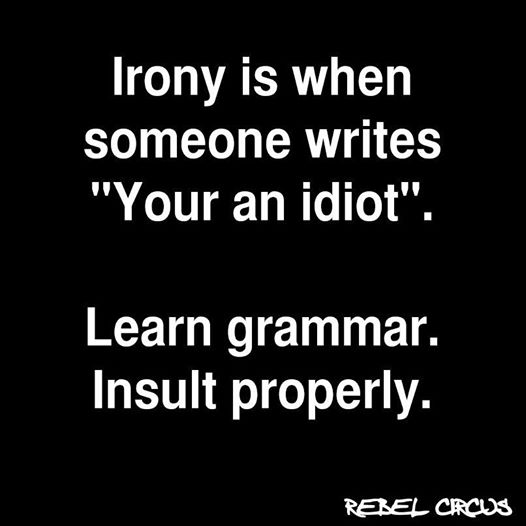
  5. There are numerous words out there that sound the same but have different meanings and are spelled differently which are called homonyms. Examples include here and hear; whole and hole; where and wear; your and you’re; you’ll and yule; there, they’re, and their and a host of others.

In the past few weeks I have seen the word shudder used incorrectly in two different books. The meaning of this word is to shake or vibrate; it is not the word for those planks designed to cover or sometimes decorate windows; that word is shutter like in shut. Another one I’ve seen misused in an otherwise excellent book is the word reign. This word relates to authority, such as “the queen’s reign.” To restrain or limit is the word rein, like the straps used with a bit to control a horse. The most common seem to be your (possessive) and you’re (contraction for you are) and they’re (contraction for they are), there (a place) and their (plural possessive.)

judgeongrammar

Conclusion

Nothing shows your ignorance as a writer faster than getting these different words mixed up. Many readers won’t know the different, I’m sure, but it’s really our responsibility as writers to provide correct usage and set the example for what appears to be an increasingly semi-literate world.

Of course now that we have autocorrect messing with our best intentions sometimes it’s not entirely your fault if they show up. Furthermore, if your keyboarding skills are advanced your fingers may tend to spell incorrectly from time to time. I have that problem where I know (not no) better but when I really get on a roll (not role) they often turn up (not turnip). That said, you’re (not your) going to have to pay attention and do your (not you’re) best to at least know (not no) the difference between them so you can correct them when you see (not sea) them. If you tend to read over your own mistakes then please, by all means, hire a good editor. Readers who know the difference will appreciate it.

6 MORE TIPS FOR INDIE WRITERS: Handling Thoughts and Dialog

raventype

Even though you’ve read dozens or even hundreds of novels, when you sit down to start writing one yourself you’ll occasionally hit a wall and wonder how it’s done. Here are a few common areas related to capturing thoughts and dialog that writers may not find intuitively obvious:

  1. When a character speaks long enough for it to occupy more than one paragraph without any sort of interruption, including he said, the beginning of the statement has a quotation mark but it doesn’t end with one until the speech ends. This shows the reader that it’s the same person continuing to speak. When he’s done, then you close it out with a quotation mark.
  2. A spoken sentence contained within quotes ends with a comma, not a period, provided you’re going to add he or she said at the end; otherwise use a period. If it’s a question you obviously use a question mark but there is no need to capitalize the he or she when you designate who asked. It’s possible that some word processors in their infinite wisdom may capitalize it for you but this is incorrect.
  3. When a character is thinking something it is usually italicized. However, don’t go on and on with pages of italicized text. This is where viewpoint comes into play in the narrative. For example:
    1. Steve can be such an idiot, Jack thought.
    2. Jack shook his head and rolled his eyes, thinking Steve should shut up and quit acting like such an idiot.
  4. Speaking of italics, they also come in handy for emphasis, such as exclamations you want to give a little extra punch. Don’t use them too often, however, or they lose their effect. Same goes for exclamation points! Use them sparingly, please! Even if a conversation is clearly intense you don’t need to end every sentence with one! It really gets annoying to the reader! See what I mean? It’s better to use narrative and detail so the reader is well aware of the mood in the given scene and therefore knows the tone and emphasis the characters would employ in such a conversation. It’s also seldom justifiable to use more than one!!!!!! Capische?
  5. It is a good idea to remind the reader who’s speaking occasionally, even if it’s a soliloquy by the main character unless there is absolutely no one else in the story. If it’s a dialog it applies, also, unless it’s obvious from the context. This can also be done by inserting names into the dialog itself, such as, “Come on, Jerry, it’s time to go.” Conversely, don’t insult the reader’s intelligence by including it too often. Strive for balance.
  6. Don’t over-use the various synonyms for said; use them sparingly and with deliberate intent to help convey the emotional content and avoid adverbs. For example saying “he shouted” is much more effective than “he said loudly.”  The worst thing you can do is distract from the story by trying too hard to be clever and impress the reader, a practice known as overwriting. If it contributes to the mood such as yelled, whispered, grumbled, explained, muttered, etc. then it is probably okay but go easy on the others. Said, stated, replied, commented, acknowledged, agreed, argued, asserted, opined, and numerous others all have a place but don’t feel you have to use them all within a given conversation. Set the mood then let the characters do the rest with what they actually say.

Writing Process Blog Tour

writingprocess

This blog tour originated with Kelly Lewis who stated, “The purpose of this tour is to showcase fellow writers with emphasis around the writing process itself to spread great words, get insights, and to show support in this isolating craft we embark on.”
Kelly Lewis passed the baton to author, Susanne Leist, who in turn passed it on to me in her blog.
http://susanneleist.blogspot.com/2014/06/the-writing-process-blog-tour.html

Susanne is the author of the popular thriller “The Dead Game.” If you enjoy scary books check it out here: http://www.amazon.com/Dead-Game-Susanne-Leist-ebook/dp/B00F3IWF70/

Here are the questions and my answers:


1. What am I working on at the moment?

I’m currently working on “Refractions of Frozen Time,” the fourth and final book in the Star Trails Tetralogy science fiction series. I have it drafted but my characters have gotten themselves into such a mess that it’s going to take a while to sort it all out and wrap it up.

2. How does my work differ from others of this genre?

In addition to being science fiction it’s also a family saga. When a family is scattered across the galaxy there is just too much going on in too many places to tell it through a single viewpoint. So at one time or another you get inside everyone’s head. I know it’s breaking the rules but that’s how the story flowed and so far my readers have liked it.

What’s interesting, though, is how everyone seems to relate to a different character and see him or her as the protagonist. While it was originally intended as a young adult series I’ve been told multiple times that it’s suitable for all ages. Another reviewer told me that the “human element raises the bar in this competitive genre” which points out that the setting may be on another planet but it’s the people that matter most, even though the brutal star system their planet is in drives the story.

While much of it is science fiction, I base as much as I can on what is known and pass it on in lay terms. I hope to build an audience of young people interested in science and engineering who will learn something painlessly along the way. I also have a section on my website for parents and educators with hints on how to use the stories as a springboard for discussion on various topics. If I can inspire one person to go into a career in science my work here is done.

3. Why do I write what I do?

I write science fiction because I love science as well as writing fiction so, as we say in physics and math circles, it was “intuitively obvious.” Speculating on the many weird and wonderful theories out there and what the future holds as we gradually get a grip on them and apply them to technology is my idea of fun. What most people don’t realize, though, is I got the physics degree so I could write authentic science fiction, not the other way round.

4. How does my writing process work?

I have an overall view of the story’s premise but once the characters are created most of it comes to me as I write. I’ve never been one who stuck to a chapter outline very closely because the story is sure to deviate based on what the characters do. The story seems to have a life of its own and it feels as if it’s being dictated to me. My characters always take over. I learn more about them all the time like you would someone you meet in real life. Many times they’ve gone off in directions that surprised me or new characters, sometimes important ones, have sprung up out of nowhere. I enjoy writing even more since what comes out usually surprises me.

Of course there are times when I have to do some serious crafting or brainstorming to tie it all together for which I have to give a lot of credit to my muse, Kalliope. I’m an astrologer as well as a writer and a few years ago I discovered that an asteroid named Kalliope is very prominent in my horoscope, which explained a lot.

I tend to do a significant amount of rewriting. My first draft is mostly action and dialog and I have to go back to make sure it includes sufficient imagery and renders appropriate emotion. I use the acronym IDEAS (Imagery, Dialog, Emotion, Action, Suspense) to check on whether I’ve included everything required. I’m one of those authors who never finishes a novel but rather abandons it because I can always find something I can say better or add.

I write a fair amount of nonfiction as well. Once I get an idea it tends to flow so I can produce blogs and articles with ease. I love doing research and have a gift for finding what I’m looking for almost as if I’m being guided by some invisible force. Back before the internet I could walk into a library and just somehow walk down the right aisle and lay my hands on exactly the book I needed. I love writing blogs about science at a level anyone can understand, kind of a “Physics for Dummies” series if you will. You can find them here on WordPress. However, my first love is writing novels and watching the characters evolve.

MY NOMINATED WRITER – John Reinhard Dizon

Now I’d like to hand off the blog baton to Literary Chameleon, John Reinhard Dizon. I conducted an interview with John a while back in which I conferred that title on him which you can find here: (https://marcha2014.wordpress.com/2014/06/11/interview-with-author-extraordinaire-and-literary-chameleon-john-reinhard-dizon/). He writes in numerous diverse genres and handles them all in a masterful way. No matter which genre is your favorite I would be willing to bet dollars to donuts that he’s written something you’ll love. If you enjoy reading a variety yet had to limit yourself to one author, he’s the only one you’d ever need.

In the interview I asked him how he changed his style so easily. Here’s his response:

“I think it’s more a question of adapting rather than changing. My four main ingredients are a dynamic plot, compelling characters, snappy dialogue and a powerful finish. You’ll find that common quality in all my novels. As far as genre goes, I made it a point to explore as many as possible in order to give a future fan base a wide variety of reading material. The way I saw it, there would be something for everybody. At this point in time I’ve been working on sequels, the logic being that it gives readers something to latch onto in following their favorite characters. You know how it goes, if at first you don’t succeed.”

John’s Amazon Author Page: http://www.amazon.com/John-Reinhard-Dizon/e/B00DU9JNUQ/
John’s Facebook Fan Page: https://www.facebook.com/johnreinharddizonUSA
John’s Twitter: https://twitter.com/JohnRDizon
John’s Blog: https://centerstagejrd.wordpress.com/2014/06/03/interview-with-marcha-fox/
My Interview with John: (https://marcha2014.wordpress.com/2014/06/11/interview-with-author-extraordinaire-and-literary-chameleon-john-reinhard-dizon/)
John’s Book Links:
Tiara: http://www.amazon.com/Tiara-10th-Anniversary-John-Dizon-ebook/dp/B00IPS7R64/
The Kingdom: http://www.amazon.com/Kingdom-John-Dizon-ebook/dp/B00L2LLCY4/
Generations: http://www.amazon.com/Generations-John-Reinhard-Dizon-ebook/dp/B00K5DQYSY/
Generations II: http://www.amazon.com/Generations-II-John-Dizon-ebook/dp/B00JG56C2U/
Transplant: http://www.amazon.com/Transplant-John-Reinhard-Dizon-ebook/dp/B00JQRH1J6/
Destroyer: http://www.amazon.com/Destroyer-Abaddon-John-Reinhard-Dizon-ebook/dp/B00FDWB7KC/
Nightcrawler: http://www.amazon.com/Nightcrawler-John-Reinhard-Dizon-ebook/dp/B00I0K9QEI/
Nightcrawler 2: http://www.amazon.com/Nightcrawler-II-Tryzub-John-Dizon-ebook/dp/B00L8653CU/
Wolf Man: http://www.amazon.com/Wolf-Man-John-Reinhard-Dizon-ebook/dp/B00H4HWDAC/
Vampir: http://www.amazon.com/Vampir-John-Dizon-ebook/dp/B00IPPI7FC/
King of the Hoboes: http://www.amazon.com/King-Hoboes-John-Dizon-ebook/dp/B00HXQ4YKQ/
The Break: http://www.amazon.com/Break-John-Dizon-ebook/dp/B00IPPI3ME/
Strange Tales: http://www.amazon.com/Strange-Tales-John-Dizon-ebook/dp/B00JAHX8OO/
Hezbollah: http://www.amazon.com/Hezbollah-John-Dizon-ebook/dp/B00IZMV4D2/
The Fury: http://www.amazon.com/Fury-John-Reinhard-Dizon-ebook/dp/B00FK3UTE4/
The Test: http://www.amazon.com/Test-John-Reinhard-Dizon-ebook/dp/B00IVB9EA2/
Stxeamtown: http://www.amazon.com/Stxeamtown-John-Reinhard-Dizon-ebook/dp/B00GSTZK5W/
The Standard I: http://www.amazon.com/The-Standard-John-Reinhard-Dizon-ebook/dp/B00E1TL5LO/
The Standard II (The Citadel): http://www.amazon.com/Standard-II-Citadel-John-Dizon-ebook/dp/B00KP2B40I/

Confessions of a Reviewer from Hell – Part Four

As a person who worked in a technical environment for two decades, I have to admit one of my pet peeves is when details relevant to a novel are ignored or inaccurate, particularly when they relate to the protagonist’s or key characters’ livelihoods. If you’re going to place him or her in a particular career or situation such as a police investigation or military setting, then you should know something about their SOPs (Standard Operating Procedures). Otherwise, especially if one of your readers is familiar with such an environment, they’re going to be put off by inaccuracies or glaring errors regarding how that particular field operates. Do you really want someone from one of those professions to pick up your book and laugh themselves silly? Probably not. Not only will you lose a potential fan but may garner a scathing review which will discourage other readers.

Understand that people in most professions including big business, the military, aerospace, law enforcement and most other fields, even including those who labor in fast food establishments, tend to speak their own unique language, often replete with various acronyms. If you want your story to sound authentic then you need to reflect those details in your story. In other words, if you’re going to write a medical thriller then you’d do well to learn some physiology so those gory scenes are accurate and be familiar with emergency room procedures and jargon. In case you haven’t noticed, novels that make it to “Best Seller” status tend to meet these standards of accuracy.

If you’ve followed this blog from the beginning you’re probably getting tired of hearing this, but if you’re going to do something, freakin’ do it right! If nothing else, realize that failing to reflect appropriate details to bring a character, profession or even location to life is a classic example of why authors are continually advised to “Write what you know!” The good news, particularly as far as authenticating a location is concerned, is that as a writer you can vacation in such places of interest and then write off at least part of it as an expense on your income tax. It doesn’t get any better than that. Just be sure to take notes, keep your receipts and not expect immediate book sales to pay off your credit cards from such a jaunt.

If you don’t already know the necessary details through life experience, then you need to do some research. This doesn’t have to be onerous or boring. You can always talk to someone who does that for a living and pick their brain. Most people enjoy talking about what they do and are even flattered that you asked. Use them later as a beta reader to make sure you captured it correctly. You’d be surprised how much more interesting your story becomes when you’ve done your homework. Often new plot twists surface as a result and your finished product will be more convincing and deserving of praise, including by those within or without that particular occupation. If they like it they’ll tell their coworkers and bring more readers and fans your way. You may even inspire someone to go into that line of work as they get a bird’s eye view of what it involves.

The world these days is filled with too much mediocrity. Please don’t contribute to it with your writing. Standards have plunged now that literally anyone who possesses a little computer and internet knowledge (or perhaps sufficient money) can get their novel published in ebook or even printcopy format. No writer today is forced to deal with rejects and a plethora of revisions to get their work published so the incentive to edit and in some cases even run the spellchecker have been lost. Doesn’t anyone own a good dictionary anymore? Okay, okay, I’m one of those weird people who would actually read the dictionary from time to time. I’m not a perfect speller but I can usually tell when a word “looks” wrong and know where to look to find out. My grammar isn’t always correct and one thing I’ve never mastered was punctuation, especially the use of commas. I admit it, I’m far from perfect. But I’m closer than I was 30 years ago.

Please. If you must produce sloppy work, keep it far away from me. If sufficiently provoked by bad writing I can become “The Reviewer from Hell.” Of course that depends on your attitude. Regardless of which stage you’re in as a writer from stark beginner to already published, if you’re a true professional and want to know the truth, then I may be able to either help you move in that direction or validate your efforts as on-track.

That said, before I close what has turned out to be a rather lengthy blog/rant I have one more thing to say: All I’m really trying to do is make this a slightly better world for readers of Indie authors, one sentence at a time.

Namaste.

Confessions of a Reviewer from Hell – Part Three

Needless to say, as I learned these lessons in humility, many of which were difficult and ego-deflating, I became quite adept at editing, if I do say so myself. I’ve been an avid bibliophile my entire life, right back to those Little Golden Books my mother read to me, so I have developed a strong concept of character and plot development as it pertains to fiction writing as well.

I didn’t get it all through osmosis, however; I also read books on writing, attended classes which included obtaining an English minor in college, and went to various workshops dealing with writing technique. I point this out not to brag but to show how serious I was about learning how to do things correctly. It’s only when you can admit how little you know that you open yourself up to really learning something. Long before my own books were in print I helped several friends edit their books, two of which eventually got published and earned me a place in their “Acknowledgements” section up front. Seeing my name in print in their work gave me hope that maybe someday I could do the same.

I evolved into “The Reviewer from Hell” thanks to some God-given talent and experience. I was raised with the mantra “If you’re going to do something, then do it right,” as well as its complement, “If you want something done correctly, then do it yourself.” I’m still extremely self-critical but every now and then I’ll read something I wrote, usually far enough in the past that I’d forgotten about it, and realize it’s actually pretty good. At that point I have one of those Han Solo moments when “Sometimes I amaze even myself.”

So, when I read someone else’s work all of this experience comes to bear. If there are spelling errors they jump off the page and hit me between the eyes. Grammatical errors make my ears ring. Plot or character inconsistencies evoke a spoken comment toward the author, often not complimentary and along the lines of “WTF are you thinking?”

I do try to review in context. If something is intended to be an afternoon read at the beach I will not judge it based on standards that would make Hemingway sweat. I realize that all authors don’t obsess on research and accuracy like I do. (You should have picked that up from the fact I got a physics degree to write sci fi.) However, when I encounter something in a novel that just doesn’t ring true it makes me cringe. Kind of like my rant elsewhere in the blog world about the movie “Armageddon” which is entitled “A Roughneck and a Rocket Scientist Went to a Movie.” Do it right or not at all.

But do you know what this is really all about? It’s simpler than you may think. If you only remember one thing from this blog, remember this: A novel should take you to another place, immerse you in another world which may or may not include this planet, and involve you deeply in the lives of its characters. Agree? Good. Now listen up, writers! Bad writing, which includes anything that distracts the reader, breaks that magical spell! Whether it’s misspelled words, typos, incorrect grammar, choppy writing or plot inconsistencies, the reader loses connection with the story.

Thus, if a story makes me both laugh and cry it has an extremely good chance of earning a 5-star review (provided my reaction was motivated by the story and not the author’s lack of technique). Why? Easy. Because I got emotionally involved with the story which meant there were no distractions which meant it was well-written. If I didn’t laugh or cry but enjoyed the story without stumbling over a figurative garbage-strewn path of author carelessness, it may still get 5-stars, especially if it was a thriller or murder mystery which is usually not intended to elicit that kind of response. After that, my ranking goes downhill steadily, depending on how many whiplashes I suffered as I was jerked back into editor mode.

All reviews are subjective and authors can learn something from them all, even if it’s the simple fact that not everyone will love their work. It’s difficult to edit your own writing and another set of eyes can find all sorts of things which can do you a huge favor. In most cases when I find quite a few things that distract me from the story I simply pass on my observations to the author without putting some horrific review out on Amazon or Goodreads. I really don’t want to upset anyone, I want to help make their work better, just as those red pen wielding engineers helped me. I want to raise the bar, especially for Indie writers, so that no reader ever has to suffer through another novel that simply wasn’t ready to be made public.

Capiche?

(To be continued)