If at First You Don’t Succeed, Bag It and Go With the Flow

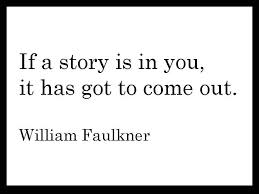
faulknerquote

Now before you get all over me for being negative, pessimistic and various other uncomplimentary adjectives, let me explain. They say there’s nothing you can’t do if you put enough determination behind it. I know this is true or I wouldn’t have made it through college. I even had an escape plan for if I flunked out somewhere along the line, given the sordid reputation of courses like Analytical Mechanics or Electricity and Magnetism, the latter usually referred to formally as E&M and informally as S&M. I was inclined to go with the latter. Miraculously, I made it through, no one more surprised than myself.

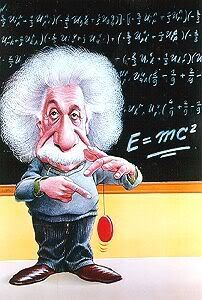
For anyone who thinks I’m some sort of genius, let me set that straight as well. I was a very mediocre student in high school. I cringe when I think of what my grades were. I disliked school tremendously, hated it, actually, and was glad when I got out. I should add, however, that I am ADHD and with a maiden name of Unterreiner, I was typically seated in the back of the room. That explains a lot. Anyway, it was seventeen years before I went back to college. By that time, I might add, I had six kids, all at home. And what did I major in? Here’s a hint:
albert

Physics.

OMG, what was I thinking? But I made it through. Not with the 4.0 GPA I wanted but pretty close, i.e. 3.48 and membership in Sigma Pi Sigma, the physics honor society.

I’m not saying this to brag, simply to illustrate that it can be done. In fact, one of my professors had declared in a general ed astronomy class I took before I was a full-time student that anyone could get a degree in physics if they wanted it badly enough. I seriously thought I would prove him wrong but his opinion prevailed.

So yes, wanting something badly enough usually will do the trick.

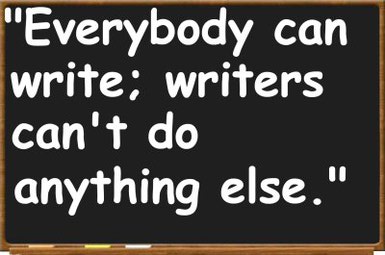
However, there is one thing that I’ve never been able to do and that’s write a short story. I took a creative writing class one time where we were supposed to be writing short stories. I got an A in the class but the professor told me later that nothing I wrote qualified in the technical sense as a short story because they lacked irony. Undaunted, I kept writing and soon discovered there was an even bigger problem. I couldn’t write a short story because it always turned into a novel.

I kid you not.

My unpublished novel, “Phaethon’s Ashes,” started as a short story and became a novel. “Beyond the Hidden Sky” was intended be a novel but it turned into a series.

Star_Trails_3d_version_12714

So now that I’ve completed the four books of The Star Trails Tetralogy I thought I’d write a short story or two, spinoffs from minor characters in the series, to give away. I had a couple ideas and the other day I decided to get one started.

Big mistake.
blackboard_writer2

Short story? Right. I’m already into chapter four and the end is nowhere in sight. But I’m having a blast, back in my creative element which is one of the greatest benefits of writing. Of course starting with a character who’s already developed makes this all the more likely to occur.

So why can’t I write a short story, you ask? One reason is I get into too many details. My characters come alive, take over, and pretty soon they’re driving the train and I’m just trying to keep up. I start with an idea and seldom know where it’s going to end up. For me, that constitutes the most fun, however, in many cases not knowing myself what’s going to happen next.

You would think that if I can’t write anything other than a novel then I should at least be able to crank one out in a few weeks or maybe months. Nope, that’s not me, either. I wish I could and I truly admire those who can, but for me that’s another no-can-do.

As a science fiction author I’m somewhat obsessive about the science being as accurate as possible. Anyone who knows me probably would leave out “somewhat.” That, of course, means research. I only have a Bachelor’s Degree so I’m not that savvy when it comes to the good stuff. Research takes time but it’s part of the fun.

150px-feynman3

I’ve dug through my personal library for relevant material including my hero, Richard Feynman’s “Lectures on Physics”, a couple old college textbooks including Tipler’s “Modern Physics” and Frankl’s “Electromagnetic Theory”, plus I’ve bookmarked a half-dozen related websites as well as articles on Wikipedia. So far I’ve purchased four books online and three DVDs from The Great Courses as background and research material. Of course by the time I get through all that there’ll be even more ideas to incorporate. And no telling how much more will come along in the meantime. Serendipity always directs me to a plethora of relevant references. Whether or not that’s a good thing is hard to say.

The length of this blog is a case in point. I could have simply said “I can’t write a short story because I get carried away and it becomes a novel” and been done with it. That would have been short enough to tweet along with a few hashtags. Did I?

No.

At this point my goal is to at least keep this blog under a thousand words.

raventype

So I give up. I can’t write a short story and have quit trying. From now on I’m going with the flow. Novel flow, that is. In the past I’ve cranked out a first draft in about six weeks but whether that will apply this time is hard to tell. Furthermore, filling in the gaps in the first cut is where I really get into my element. Stay tuned. Once I get it drafted I’ll be looking for beta readers so if you’re interested let me know.


Guilty as Charged: I Had an Ulterior Motive

STTlpostcardVP2 copy

Okay, I admit it. I had an ulterior motive when I wrote the Star Trails Tetralogy. I don’t think it was a bad one, but it was there nonetheless. As I’ve mentioned before, perhaps ad nauseam, I was inspired to pursue a career in a technical field by the science fiction I read as a kid. And that is what I wanted to do with my stories, make science intriguing and interesting enough that my readers would love it as much as I do and want to know more. I mean, seriously. Why else would an otherwise normal person get a degree in physics? At least I thought I was normal. Then again, maybe not.

At any rate, my books have apparently succeeded to some degree. But don’t listen to me, I’m clearly biased and perhaps not to be trusted. Here’s what some of my reviewers have to say:

Marcha Fox has a gift for explaining the science in an interesting and original way. Sci-fi fans who love properly developed cultures backed up by hard and well understood science will devour these stories.

Science theory is a large part of this story and the writer uses many scenes and situations to explore warp drive, time bumps, worm holes, and warp gullies to name a few. When explanation is needed in a book, it usually slows progression of the plot, but the author uses the science as a “key” to unlock the puzzle of the many developing situations in which Creena finds herself. It’s a great book for anyone that wants to learn more about scientific concepts while being thoroughly entertained.

Anyone who loves hard science will lap this book up.

Having taught junior high science for a number of years I think this read would be a fabulous addition to classroom libraries as well as “the hungry for sci-fi lovers” personal bookshelf.

A great book for anyone that wants to learn more about scientific concepts while being thoroughly entertained.

The scientific details added greatly to the story without sounding like something out of a textbook.

I am in awe of the world author Marcha Fox has created. She has populated our galaxy with human colonies and aliens, enriching the story with intricate detail covering solar systems, seasons, geology, politics, anthropological, fauna, eco-commerce, technological, and spiritual beliefs that are unveiled layer upon layer as the story progresses.

[The author] integrates actual science into science fiction, creating worlds, customs, and life forms outside the world we live.

Needless to say I was deeply gratified and appreciative that these wonderful readers picked up on my ulterior motive and didn’t give me a one or two star review because it was too technical and therefore boring. Of course, nerds like myself LOVE the technical side, but that’s besides the point.

So what is the point? The point is that I didn’t stop there. I also put together “The Star Trails Compendium” which includes a glossary of terms, both fictitious and otherwise, as a companion volume to the stories. I include more details about the star system, Cyraria’s weird, lemniscate (figure-8 shaped) orbit, its effects on their horrific, extreme weather, political structure, and a bit more about the bnolar, the planet’s indigenous species. I hope no one is too disappointed that I refrained from including all the calculations I did while developing the star system, mostly because math is so tedious to express via the keyboard.

And here’s the best part: The ebook versions of the Compendium are FREE!  (At least everywhere but Amazon, who’s a bit uncooperative, but might come around eventually given enough complaints. Hint, hint..)

If you’re an educator or perhaps a homeschooler, there’s an even better bonus especially for you. I’ve included suggestions for lesson plans and discussion topics based on the chapters of each book. Thus, any science teachers who have students who need a little bit more could assign my books as extra credit backed up by assignments which are all but laid out for you in the Compendium. Science clubs could likewise utilize them. Knowing how overloaded today’s teachers are, this could provide the needed stimulation for the Advanced Placement students without a lot of extra work on their part.

If you’re wondering how this works, here’s an example using an excerpt from Chapter 3 of “Beyond the Hidden Sky.”

bthsreallydoneit copy

The Escape Pod

Shortly after jettison the acceleration shell loosened its grip and shrunk back into the side of the seat but Creena remained in place, gripping the armrests with white-knuckled hands. She’d always been frustrated with the rapid heartbeat and breathing provoked by anger but that was nothing compared to what she was feeling now. She’d experienced a variety of emotions on Mira III, more than most that went through their ordered lives in a state of unquestioning, unreactive calm.

What she felt now, however, was stronger still, a deep, primal reaction from the core of her being. Seared by adrenaline every cell cried out with an unspeakable fear far deeper than any provoked merely by thought, terror firing her blood like a burning fuse.

Never in her entire life had she been so scared.

Her breathing rasped in her ears, mouth dry with her hands shaking and clammy against the armrests. Gradually her racing mind slowed and her heart stopped pounding though her breathing remained heavier than normal as she concentrated on her surroundings.

Funny, it didn’t even feel like she was moving anymore. But it hadn’t felt like the Aquarius was moving, either. She thought back to her Academy physics class and remembered that was the case when something was moving in a straight line at constant speed. The starfield on the holoscreen likewise seemed still but instinct told her that was simply a matter of scale.

She released the straps, their recoil sloppy and slow. The breathless, airy feeling swelled upward, the sensation similar to a soaring dive in an air cruiser. She gasped clutching her chest and the next thing she knew she was floating haplessly above the shell, like a sphere under electro-magnetic levitation.

She gasped in renewed horror.

Was she dead?

She pinched herself, hard, relieved only slightly when it hurt.

Across the pod lights blinked and flashed while the metal floor offered a dizzying design of concentric rings that still seemed to spring upward in pulsating waves. The illusion aggravated the growing nausea even as the facts fell into place.

The Aquarius hadn’t felt that much different from being confined in an ugly building. Certain areas like the galarium where wall-embedded holoscreens gave every impression that a real world lay beyond epoxy shields even added to the deception. But the pod was designed for survival and lacked the power hungry comforts of a starship.

And a mass generator’s gravity simulation was one of them.

StarTrailsCompendium copy

And here are two of the Compendium Discussion and Lesson Plan Suggestions for Chapter 3:

  1. It doesn’t feel as if the pod is moving. Why?

When something is moving in a straight line at constant speed you can’t tell it’s moving. This relates to Newton’s 1st Law of Motion or the principle of inertia which states than an object will remain in a state of rest or constant velocity unless acted upon by unbalanced forces. Newton’s 2nd Law is best described by the equation Force = mass x acceleration or F=ma.

In other words, the force exerted on an object depends on its mass and how fast it is changing speed or accelerating. Newton’s 3rd Law relates to opposing forces, that whenever a force is applied to something, an equal and opposite force is generated, such as the kickback on a rifle or pushing off the side of a swimming pool.

  1. Why is Creena weightless in the pod?

It doesn’t have a “gravity simulator.” Mass such as that of a planet creates gravity which is proportional to how big it is. Scientists will don’t understand exactly how or why gravity works, but they can predict its strength based on the mass of an object or planet.

* * *

So this should give you some idea of the possibilities. Did I have an ulterior motive for this blog? Of course I did. I want my books to reach the audience for which they were intended! But here’s the good news. You can get “Beyond the Hidden Sky” as an ebook for only $0.99 and the Compendium for FREE! Why don’t you check it out? If you’re a teacher or parent trying to encourage your child to not only enjoy science but perhaps actually pursue it, what do you have to lose? Oh, yeah, there’s one more thing. If your library has ebook lending capability, it can obtain all four volumes of the Star Trails Tetralogy for free through Smashwords.

“Beyond the Hidden Sky” Buy Links

Amazon US: http://www.amazon.com/gp/product/0615658865/ref=as_li_tl?ie=UTF8&camp=1789&creative=9325&creativeASIN=0615658865&linkCode=as2&tag=valkyrastrol-20&linkId=DKGQSU3GYWZM6WH7

Smashwords: https://www.smashwords.com/books/view/509500

Barnes & Noble: http://www.barnesandnoble.com/w/beyond-the-hidden-sky-marcha-a-fox/1112260474

Kobo Link: http://store.kobobooks.com/en-US/ebook/beyond-the-hidden-sky

Apple: https://itunes.apple.com/us/book/beyond-the-hidden-sky/id957915250

Create Space (Print copy): https://www.createspace.com/3911767

“Star Trails Compendium” Links

Smashwords: https://www.smashwords.com/books/view/537630

Kobo: https://store.kobobooks.com/en-US/ebook/star-trails-compendium

Barnes & Noble: http://www.barnesandnoble.com/w/star-trails-compendium-marcha-fox/1121807004

iTunes: https://itunes.apple.com/us/book/star-trails-compendium/id989027687

What’s Behind the Science in Science Fiction Part 5: The Matter – Consciousness Interface

Now we’re getting to the good stuff and I hope you can see why I gave you all that background information leading up to it. In order to fully appreciate something, whether it’s good music or literature, you need a foundation, no matter how rudimentary it may be. And believe me, it was, even though your eyes may have glazed over. My previous posts were a whirlwind tour of physics for dummies but you are now much better informed than most people out there, assuming you read it. Congratulate yourself! I will try to reward your efforts by building on that information so that anyone who skipped it will be entirely lost and need to go back and suffer through it like the rest of you.

Quantum theory was mind-blowing because it introduced the possibility that an observer could influence how light and even matter behaved. This, of course, was only proven on a very small scale, yet the influence was there. Suddenly the world of physics and metaphysics were starting to overlap.

150px-feynman3 150px-feynman-stamp     

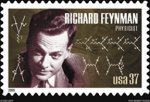
One of my heroes in the physics world is Richard Feinman because he demonstrated an interest in so many things besides physics. I believe he was as brilliant as he was to the point of winning a Nobel Prize was because he was so open-minded and had the courage to see things differently. That is how breakthroughs come about.  I’ll be forever grateful to him for his “Lectures on Physics” which helped tremendously when the textbooks fell short.

heisenequationheisenbergcop

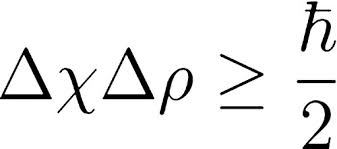
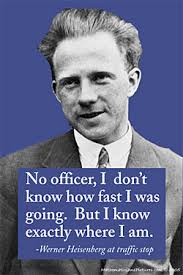
Another great physicist who seemed to grok the concept that there was more to life than one’s own very specific discipline was Werner Heisenberg, also a Nobel Prize winning physicist with an actual phenomena named after him that relates to quantum theory, i.e. the Heisenberg Uncertainty Principle. He stated, “It is probably true quite generally that in the history of human thinking the most fruitful developments frequently take place at those points where two different lines of thought meet. These lines may have their roots in quite different parts of human cultures, in different times or different cultural environments or different religious traditions: hence if they actually meet, that is, if they are at least so much related to each other that a real interaction can take place, then one may hope that new and interesting developments may follow.”

deanw-bookradinbook

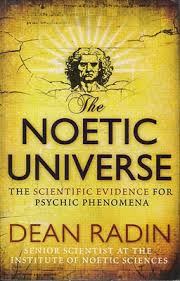
Hello? Ya think that maybe quantum theory would be a good one for collaboration with other disciplines? Scientists need to talk to one another! Here we have physicists scratching their heads over whether consciousness and matter interact while we have psychologists such as Dean Radin researching psi phenomena which may well be the mechanism that causes that interaction between consciousness and matter. Rather than treating these researchers with about the same respect at Dr. Venkman (played by Bill Murray) in Ghostbusters, maybe they should get together over a pitcher of margaritas and see what they come up with.

Quantum entanglement is the term used to describe two particles which become tied up with each other enough, kind of like atomic soulmates, that even when they are separated by long distances, if something happens to change the state of one, the other reacts also. This happens instantaneously, i.e. the communication occurs faster than the speed of light, a barrier that was never supposed to be breached. Psi is also instantaneous. Does this imply that we become entangled with others at the quantum level? This is especially enticing when you think of the stories of identical twins who originated with the same genetic material and are also connected at the psychic level.

Along similar lines is the concept known as NLP or neuro-linguistic programming. It has also been called “the power of positive thinking,” and described in a movie called “The Secret” and promoted by a plethora of motivational speakers who declare that you can create your future by visualizing what you want on an consistent basis such that you will eventually draw that situation to you from the Universe at large. If psi has the power to manipulate matter and create not only matter but circumstances, doesn’t that sound as if it has something to do with quantum theory?

Weird, you bet. But it works. We can, indeed, draw circumstances to us in this manner. Which bring me to favorite quote of mine from science fiction author, Arthur C. Clarke: “Technology sufficiently far advanced is indistinguishable from magic.” What would Isaac Newton think of your smartphone?

However, there was one rather large problem that comes down to one, little three-letter word: EGO.

Scientists tend to have tunnel vision when it comes to their own field of study. I remember hearing once that as a person comes closer to a PhD that their IQ actually goes down. This does not mean that they are losing brain cells from overwork and losing intelligence. The typical IQ test assesses how much a person knows about a broad spectrum of knowledge and as a person narrows their interests down to the level required to pursue a PhD they get in the realm where they know a lot about a little which actually jeopardizes their IQ. This also means that they start blocking out anything that doesn’t relate to their chosen subject. They can become arrogant as they become experts and sabotage their colleagues who are seen as competitors for needed research funding. There is also the status issue. If you’re proven wrong you are probably through. After all that work getting to that pinnacle, the last thing you want is some upstart to push you off.

headstoneraven

Breaching this obstacle is likely to require what has been described as “progress by funerals.” In other words, as the old farts die off and those new upstarts take over, things will move along much faster.

At least until the upstarts scale that pinnacle and replicate the cycle.

(c) Copyright 2014 by Marcha Fox All Rights Reserved

What’s Behind the Science in Science Fiction – Part 4: Light Behaving Badly

117px-Doubleslit3Dspectrum
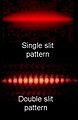
Last time covered how sometimes light behaves like a particle and others like a wave along with how the double-slit experiment was used to demonstrate these properties. For example, if a steady light comprised of numerous individual photons hit a plate with one tiny slit to allow them through, rather than getting a line that matched the slit on the opposing wall it would be spread out in a pattern that was concentrated toward the center and fuzzy around the edges. (See picture below.)

78px-Single_and_double_slit_4

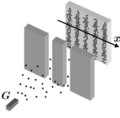
When they used a plate that had two slits a single photon would leave a dot, as expected, but by continuing to release them one at a time they would eventually form an interference pattern, the same as what resulted from a steady light source. It was as if each photon had a mind of its own yet collectively they would arrange themselves in a certain pattern. While exactly where each photon would arrive couldn’t be predicted, the pattern itself could be, based on the wavelength of the light. Thus there was a certain probability that a photon would arrive in a certain place, some more than others, but which exact one would go where was unknown.

120px-2slits
It was apparent they couldn’t predict exactly where a single photon would land but if it was a discrete particle of light then it followed that it would go through one slit or the other. (Remember that the interference pattern resulted because there were two slits so the waves could overlap.) Thus, scientists, the first of whom was Thomas Young (1773-1829), decided to find out which slit of the two choices each photon went through. To do so they polarized the light going through each slit in a different way with the detector on the other side capable of telling the difference. The photon could still theoretically “choose” which slit (or both) it would go through, but they would be able to tell which one by its polarization when it arrived on the detector.

Sneaky. But outsmarting Mother Nature is not an easy task.

Much to their surprise, when they sent one photon at a time toward the slits where it was polarized the interference pattern did not emerge!

Whoa!

Instead, they got random spots of light which indicated individual particles. Polarizing the light did not destroy its ability to build interference patterns so this didn’t make sense. The results implied that when they set things up so that they’d know whether the photon went through one slit or the other that the individual photons lost their right to choose and behaved like a particle. In other words, the probability wave function had collapsed when the final result would be determined.

120px-2Slits-particles_only
In other words, the photon can change from a wave to a particle when someone is trying to figure out exactly what it’s going to do. When someone is watching, it behaves like a particle that not only goes through one opening or the other but loses its wave properties as well.

Say what?

Back then the expression WTF? didn’t exist yet, but something along those lines was definitely what was going through numerous scientific minds. By all appearances, if someone was watching, i.e. measuring the outcome, then the probability wave collapsed and the photons acted like particles.

Thinking perhaps this was because they were polarizing the photons before they went through one slit or the other, even though they knew that didn’t stop the light from forming an interference pattern, they rigged things up to determine which slit it had gone through afterwards. Much to their surprise they got the same result as before, a rain of itinerant particles, as if each photon had either known in advance or perhaps even went back in time, deciding how to behave.

This introduced the concept of an observer affecting the outcome. Suddenly consciousness was part of the mix, or at least seemed to be since there was no other explanation. Of course physicists who deal exclusively with the physical world were less than enchanted by all this woo-woo stuff. Thus began the philosophical notion of whether or not a tree that fell in the forest made a sound if no one was there to hear it. May I remind you that these are very intelligent people we’re dealing with here and while some of them may not be wrapped to tight as they walk the genius-insanity interface; nonetheless, they are a whole lot smarter than the rest of us.

fallentree

Einstein called this “spooky action at a distance” and didn’t believe it, even though he was the one who theorized that energy and matter were essentially the same as expressed by his famous equation E=mc2. To this day people are still arguing about this aspect of quantum theory with different conclusions. Is it possible that an observer or some form of consciousness can influence physical matter? Do we, indeed, create our own reality?

What do you think?

(Diagrams courtesy of Wikipedia Commons)

What’s Behind the Science in Science Fiction? Part 3: The Mystery of Light

You would think if you shine a light through a barrier with two slits in it that the wall on the other side would show two slices of light. This is not what happens, however, as Thomas Young discovered in the early 1800s. Rather than two distinct lines it created an interference pattern, indicating light behaved like a wave.

Single_slit_and_double_slit2
You can get a better understanding of interference as it relates to wave behavior by dropping a pebble into a puddle and watching how the waves expand in a circle from the center point. Then drop two pebbles at the same time a few inches apart and watch how the waves interact. What results is called constructive and destructive interference as some waves get bigger and others cancel out. This is similar to the interference pattern of light which leaves dark spaces alternating with light bands which create a striped effect.

But as scientists continued messing around with the properties of photons, inconsistencies appeared. In 1887 Heinrich Hertz discovered that light could stimulate electrons on a metallic surface and thus create electrical current but the effect was related to the frequency of the light. In 1905 Albert Einstein explained that this was because light energy was carried in discrete, quantized packets and eventually won the Nobel Prize for it in 1921, which was the beginning of the quantum revolution.

As theorized by Isaac Newton and believed throughout the 1700 – 1800s, this supported the theory that light consisted of particles which were called photons. The particle theory made sense since it had been discovered that a photon absorbed by an atom increased its energy level and when it dropped its energy state then a photon was emitted, showing a release of energy. When photons interact with matter they act like tiny particles.

So what was going on? Was light a particle or a wave? It was in pursuing the answer that quantum theory was further established as scientists continued to study the results of the double-slit experiment. When laser light is passed through two tiny slits it forms what is called a diffraction pattern on the other side, similar to what Thomas Young saw back in the early 1800s and is shown in Figure 2. This behavior supports the idea that light is a wave since particles would not arrange themselves in such a way.

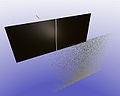
When a single photon is released it behaves like a particle and leaves a single dot of light on the other side. If you continue releasing single photon from the same source and location, however, they eventually form a diffraction pattern. Say what? How could light know how to arrange itself in a pattern? They weren’t interfering with one another when they were released one at a time so how could this occur? (See the figure below that includes 5 views of electron buildup into a diffraction pattern.)
200px-Double-slit_experiment_results_Tanamura_2
This led to the idea of a probability wave meaning that the photons would land somewhere within a given area with some places more likely than others. But this completely blew the idea of prediction out of the water which was the premise of classical physics and presumed if you knew all the conditions involved you could predict the outcome. Suddenly science was having to deal with probabilities, or the likelihood of subatomic particles behaving in a certain way, as opposed to being able to calculate the precise answer when they knew all the parameters.

Ooops! With that revelation, classical, i.e. Newtonian, physics went out the proverbial window. It obviously couldn’t solve any problem and most certainly couldn’t predict future events. This, in turn, eventually influenced the philosophy of the day regarding life and the concept of free will. The implications suggested that while some outcomes were more likely than others, exactly which one it would be was no longer possible to determine.

As if the dual nature of light wasn’t mysterious enough, it soon became even stranger when someone was watching.

(Insert Twilight Zone music here….)

Stay tuned.

(Figures courtesy of Wikipedia.org)

What’s Behind the Science in Science Fiction? Part Two – Atomic Theory

bohratom

I know you’re anxious to get to the good stuff like other dimensions and time travel, but you need to be patient just a little longer. After all, this blog is about what’s behind the science in science fiction, not the final result. Think of it as similar to those documentaries you see on TV which explain how they do the special effects in your favorite movies. I don’t know about you, but knowing how they do that makes me appreciate the movie even more. If you couldn’t care less, then you’re probably reading the wrong blog and need to just go back to reading sci-fi novels. Those who are left need to just bear with me a little longer as I explain the basics of atomic theory which is more relevant than you may think. Ready? Okay, here we go.

As far back as 400 BC or so early Greek philosophers pondered what constituted matter and decided that it could only be divided down so far, from which atomic theory was born. The term “atom” even originated with their adjective atomos, which means indivisible. Back then the elements were believed to be water, air, earth and fire. Clearly they are all important, particularly to life, but not a one of them is an actual element in the chemical sense.

However, proving it was another story and it wasn’t until the 18th – 19th century that scientists gradually discovered that water was comprised of hydrogen and oxygen; air is mostly nitrogen with hydrogen, oxygen and various others in the mix; earth is made up of too many elements to count; and fire is a process that involves oxygen and thus called oxidation but isn’t an element in and of itself. As they confirmed that certain chemicals could only be broken down so far the Periodic Table of the Elements was born. Periodically more are added (pun intended) though in most cases they are manmade.

periodic_table

By the early 20th century experiments involving electromagnetism and radioactivity revealed that, would the truth be known, the atom was not indivisible after all, but consisted of other particles which were identified as protons, neutrons and electrons. These were suitably dubbed subatomic or elementary particles and scientists conveniently ignored the fact that the etymology of the word “atom” no longer applied, figuring most people didn’t know Greek, anyway.

How these subatomic particles were arranged was a matter of debate that went through numerous speculations. J. J. Thomson’s idea was sometimes referred to the “plum pudding” model where protons and electrons were lumped together in a glob of positively charged fluid. After that, Ernest Rutherford decided that the positive charge as well as most of the mass were concentrated in the center with the electrons surrounding it in some unknown way.

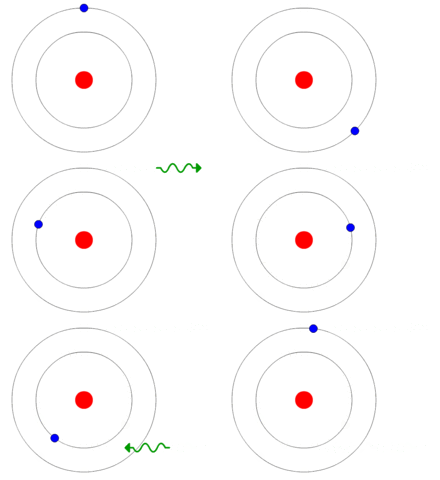
In 1913 Danish physicist, Niels Bohr, proposed his version of the hydrogen atom which remains the mental image many retain today, i.e., a nucleus in the center with electrons revolving around it much as the planets orbit the Sun as shown at the beginning of this blog. Bohr still believed that electrons orbited the nucleus but he placed restrictions on them to certain discrete distances or allowed orbits so that it would agree with what experiments thus far had revealed. At this point they considered the electrons to be itty-bitty particles that orbited the nucleus according to the laws of classical mechanics, in other words like the planets orbit the Sun.

The electrons would change orbits based on either emitting or absorbing a photon, as shown in the animation. This was getting closer, but still had problems.

Nonetheless, the idea of specific orbits was a definite step toward quantum theory and the fact that only specific energy states were allowed. The real problem was thinking of electrons as tiny specks of matter which behaved according to Newton’s Laws pertaining to gravitation. WRONG!

Bohr_atom_animation_2

In 1924 a scientist named Louis de Broglie (pronounced de-broy) proposed that all moving particles could exhibit wave-like behavior. Erwin Schrodinger liked this idea and developed it further, into a probability wave. This theory helped explain behaviors that previous ones couldn’t but still didn’t cover everything. This was ultimately solved by Max Born (no relation to Jason Bourne) who theorized that Schrodinger’s equation represented all possible positions where the electron might possibly be. This conveniently reconciled the two ideas and the wave/particle duality of electrons was born (pun intended).

However, trying to figure out the atom was not taking place in the proverbial vacuum (though admittedly some experiments were). During this same time numerous other scientists were hard at work investigating what interested them most and ultimately led to so many different scientific disciplines. Things were getting too complicated for any one person to have a firm grip on everything anymore.

Light was also under scrutiny since it was apparent that atoms and electromagnetic radiation (a.k.a. light) were related. If you’re scratching your head on where that came from, it derived from having established that atoms emit a photon when they change states, like that cute little animation shows. And in case you’re wondering, yes, even the Sun, our greatest source of energy and light, is no more than a giant glob comprised mostly of hydrogen atoms which bond with each other under pressure to become helium at which time a photon is emitted. Lots of them, true, but that’s the process. Simple.

Most people think of light as what we can see which is conveniently broken down into its various colors by a prism or in some cases a rainstorm that occurs when the Sun is out and thus produces a rainbow. Visible light, however, is but one small portion of what is known as the “Electromagnetic Spectrum.” It also includes various other wavelengths that span a vast variety of wavelengths and energies ranging from radio waves and infrared (heat) on one side to ultraviolet, x-ray and gamma radiation on the other. In the picture you can see the rather small portion of visible light in the middle where it looks like a rainbow.

emspectrum

Albert Einstein theorized that similar to matter, light could also only be broken down so far, the smallest unit of which was ultimately called a photon. He even proved it and received the Nobel Prize for his paper on the photoelectric effect, which stated that a photon could change an atom’s energy state and that principle is used widely today with all those automatic doors you encounter everywhere from the grocery store to Wal*Mart.

Physicists conducted numerous experiments with light which revealed that it, too, had both wave and particle characteristics. Since photons originate with atoms the fact that they share some of the same characteristics shouldn’t be any more surprising than the fact your have your father’s nose or your mother’s smile. True, photons are massless, but electrons aren’t. Nonetheless, they also show wave and particle traits.

This is a good place to ponder Einstein’s famous equation, E=MC2, which states energy is equal to mass times the square of the speed of light. If you rearrange it algebraically you have energy divided by the square of the speed of light is equal to mass, which essentially declares that mass and energy are the same thing.

Now we’re getting into the good stuff. So give that some thought until next time when I introduce you to the true beginnings of weird science which originated with something called the double-slit experiment.

See you then.

© Copyright 2014 by Marcha Fox

All Rights Reserved

What’s Behind the ‘Science’ in Science Fiction? (Part 1)

You don’t have to be a scientist to enjoy science fiction. If you’re lucky, you may learn a few scientific facts painlessly while enjoying a good read, or at least that’s my goal as a science fiction author. But what exactly lies behind stories categorized as science fiction?

Science, of course, but it goes beyond that because it often addresses the impact of technology on society. Science alone is a real snoozer if you don’t combine it with how it affects your life. Unless you happen to be a rocket scientist, however, much of the actual science in science fiction stories often gets lost in the plot. But guess what? Then you’re missing a lot of the fun, too. If you’re someone who thinks that science is really cool stuff, you may want to know more about the actual science behind such things as time travel, teleportation, other dimensions and telepathy. But here’s the bad news. You needed to learn to crawl before you could walk or run and know the alphabet before you could read, so before you can get to the good stuff you need to know the basics.

In the Beginning there was Classical Physics

Originally physics only dealt with, big surprise, physical phenomena. It related to mass, motion and time, things which were apparent in the world around us. Math was used to create formulae to calculate their relationship to one another. Using algebra, if you knew two of the quantities you could figure out the third. A common example is D=vt (Distance equals velocity times elapsed time) which when rearranged become v = D/t. If that sounds vaguely familiar maybe it’s because in a more familiar form, velocity = miles/hour or miles per hour.

Classical physics derived from D=vt. To do so gets into higher math called calculus which is an interesting subject in and of itself. It was invented simultaneously way back in the 17th century by Isaac Newton and Gottfried Liebniz in order to solve more complicated problems such as orbital dynamics. More on that some other time. For now just file away the notion that the world of classical physics mostly involves the movement of objects in your everyday world such as how long it takes to get to work or school, how much momentum a baseball has when hit by a star player or how much energy there is in a garbage truck moving at 65 mph.

For a long time scientists thought that these basic formulae could explain everything in the universe. After all, they do a pretty good job of dealing with everyday life. They also thought that if you took everything down to the most fundamental level you could predict anything that might happen in the future. This was called determinism and in many ways reinforced the concept of fate and denied the idea of free will. This was the philosophy of the day, as noted in the movie “A Knight’s Tale,” where it was pointed out that it was extremely difficult if not impossible to “change your stars.” You were dealt a certain hand in life that you had to play. Period.

As is often the case, however, when an individual or group of like-minded people think they know everything there is to know, they eventually find out otherwise. Indeed, life isn’t that simple and toward the end of the 1800s and early 1900s new discoveries showed that indeed they were flat-out wrong. Not just a little wrong, but really wrong. For starters, the elements definitely did not consist of air, water, earth and fire.

More on that next time when we get into atomic theory. Stay tuned.

© Copyright 2014 by Marcha Fox
All Rights Reserved

What Exactly IS Einstein’s Theory of Relativity?


Image

Is time travel possible? Why can’t we travel faster than the speed of light? Do clocks really run at different speeds depending on how fast you’re moving? Does gravity really warp space and time as well as bend light?

These possibilities have been used in science fiction for decades. H.G. Wells’ classic, “The Time Machine,” was published in 1895, before Einstein’s Special Theory of Relativity was even published in 1905. This goes to show that man’s imagination was exploring the possibility of such things long before it was proven scientifically. In fact, Einstein stated himself that “Imagination is more important than knowledge” and it was his own propensity for what he called “thought experiments” that brought him to the concept of relativity in the first place. Supposedly, he was staring at a gas light one foggy night wondering what it would be like to travel on a light beam and shortly after that the Special Theory of Relativity (STR) was born.

The main point of the STR is that the only thing that’s constant is the speed of light; time is not, space is not. The speed of light, 186,000 miles per hour, is often referred to simply as c. In fact, the term “miles per hour” which you hear every day contains the basis of a physics equation related to time and distance. In other words, if you only know simple algebra you can understand how the distance you travel (length or L) depends on how fast you’re going (velocity or v) and for how much time (t), or L = vt. Simple.

But there’s a catch. That only applies to what is known as an inertial reference frame, or one that is not moving. Now I’m sure you know that the Earth is moving, through space as well as around the Sun, but as far as you’re concerned when you’re riding in a car the Earth is standing still. However, when you get into what are known as relativistic speeds or those closer to the speed of light, that equation changes.

For L = vt, any of those values is considered a variable, meaning it can change. However, the speed of light is constant. Therefore, the only things that can change are the distance (L) or time (t). And that’s where things start to get weird. The scientific terms are length contraction and time dilation. Length contraction means that distances get shorter when traveling near the speed of light and time stretches, meaning that time passes more slowly for someone traveling at the speed of light even though to them clocks would appear to move at the same rate as they do to you.   This is why they say that someone who traveled to a distant planet may only think they’ve been gone for a few years while a century or more will have passed on Earth. Time and distance are both relative and thus the term “relativity.”

As far as a time machine is concerned, going forward in time seems more feasible than going back but that’s not to say it’s impossible. However, the STR really doesn’t postulate going back in time, only that clocks run at different rates. This has been proven at the atomic level by observing atoms that have a known rate of decay (or lifetime) traveling at relativistic speeds where they last longer as measured by Earth clocks.

So why can’t we travel faster than the speed of light? This comes back to the speed of light being a constant. Energy of movement, or what is required to move something, is defined by the mass of the object times its velocity squared, or E = mv2. Starting to sound familiar, like the infamous E=mc2? Here we go again, velocity can’t change so the others must and what this boils down to is that the energy required far exceeds what can be achieved as the mass increases, which also occurs at the speed of light. So, according to Einstein, the reason we can’t travel at the speed of light is because at those speeds the mass of the vehicle will exceed its ability to carry the fuel necessary.

Of course if you’re a UFO fan like myself, you may wonder how they could possibly get here and move erratically like they do. And that brings us to Einstein’s Theory of General Relativity which relates to gravity. Gravity is a force that creates acceleration, or a change in velocity. Drop something and it accelerates to the floor or ground. According to Einstein, the gravity of large objects like the Earth or Sun will also warp space and time. When you see those pictures depicting a blackhole they usually show a funnel-shaped grid, indicating how the force field around it warps space.

Gravity can even change the path of light, which was proven by Sir Arthur Eddington during a solar eclipse on May 29, 1919. When you look up at the sky the stars are in predictable locations, which is why they have been used for navigation, even by the “star tracker” on the Space Shuttle until the advent of the Global Positioning System, a.k.a. GPS. However, during a solar eclipse, there is a massive gravitational object available in the sky (the Sun) that when darkened by the passage of the Moon, allows the stars to be visible during the day. Knowing where the stars should be versus where they appeared showed a difference that proved Einstein’s Theory of General Relativity. This has been proven repeatedly since then by observing distant stars, an effect known as gravitational lensing, which will sometimes even cause an object to appear to exist in two places.

As far as UFOs are concerned, it appears that they utilize extremely high magnetic fields combined with certain radioactive elements to create a gravity field around the craft itself. This, in turn, provides the vehicle with its own gravitational field, essentially creating its own reference frame so that it no longer is subjected to Earth’s gravity and can thus move in ways that defy what our known technologies can currently achieve as far as hovering and drastic changes in direction.

Einstein wanted to discover a Grand Unified Theory that explained how all the forces in the Universe related to one another. He was never able to do that and scientists today continue his quest. The evidence today, however, suggests that they are getting close! Various new theories continue to evolve such as String Theory, which relates to subatomic particles (or those smaller than an atom) and M-Theory which suggests there are multiple universes. Quantum Theory is another fascinating subject that’s been around for a while with significant potential for science fiction such as telepathy. More on that next time.

Marcha Fox is the author of the Star Trails Tetralogy which includes the novels “Beyond the Hidden Sky,” “A Dark of Endless Days,” and “A Psilent Place Below.” The final volume, “Refractions of Frozen Time” was released in March 2015. With a physics degree from Utah State University and over 20 years working at NASA’s Johnson Space Center in Houston, she is never at a loss for something new to incorporate into her stories. Her Facebook Page is https://www.facebook.com/marchafoxauthor and her book website is http://www.startrailssaga.com. Follow her on Twitter @startrailsIV.

A Roughneck and a Rocket Scientist Went to a Movie…

Back in 1998 when the movie “Armageddon” first came out I went to see it with a friend who was in the oil business. I was working at NASA at the time, so we’re talking about a roughneck and a rocket scientist going to a movie, which somehow sounds like the prologue to a bad joke. While it may have been a fairly decent Bruce Willis flick, at least at the time, my friend and I did so much eye-rolling at the inaccuracies in the movie’s script that we hardly saw what was going on. Later when we were home and still ranting about how technically incorrect it was, my teenage daughter just shook her head at us.

“Mom! It’s only a movie!” she said, not understanding what all the fuss was about.

To me as well as my friend the fuss was about doing something correctly. Since we were both in technological fields we knew that was important. Do something wrong in either of our career fields and someone could die. Furthermore, with all the money spent producing movies it was nothing short of lazy to not hire a science and/or engineering consultant to get it right. Around that same time the movie “Deep Impact” came out, a Steven Spielberg movie, and to his credit, the science in that movie was accurate but apparently Robert Duvall didn’t have the drawing power of good ol’ Bruce.

My point, however, remains the same. If you’re going to do something, do it right. Seriously. Or as Yoda so eloquently put it, “Try not, do. Or do not. There is no try.”

I have wanted to be a writer since I was in elementary school. And I wanted to do it right. I wanted to write science fiction and knew that would require not only research but the background necessary to understand the principles and apply them properly. So I went back to school and got a physics degree. I thought I would know a lot more than I did by the time I graduated but I still knew a whole lot more than when I started. So many people say they stupider after going to college than before because they then realize how much there is to know about our amazing world.

After graduation I went to work in the aerospace industry, ultimately winding up at NASA’s Johnson Space Center in Houston, Texas where I worked for over 20 years. And even after that, what I know is relatively little compared to everything that is out there.

Science is loaded with theories that make fantastic plot material. The subject of physics and how it applies to the Universe is often so weird that it actually makes the story more interesting when you tell it like it is. Like they say, truth is stranger than fiction and that certainly applies to science as much as anything. Science fiction is all about taking science to its limits and showing the effects it could have on mankind. There is nothing more exciting than that.

What’s Behind the “Science” in Science Fiction? (Part 1)

You don’t have to be a scientist to enjoy science fiction. If you’re lucky, you may learn a few scientific facts painlessly while enjoying a good read, or at least that’s my goal as a science fiction author. But what exactly lies behind stories categorized as science fiction?

Science, of course, but it goes beyond that because it often addresses the impact of technology on society. Science alone is a real snoozer if you don’t combine it with how it affects your life. Unless you happen to be a rocket scientist, however, much of the actual science in science fiction stories often gets lost in the plot. But guess what? Then you’re missing a lot of the fun, too. If you’re someone who thinks that science is really cool stuff, you may want to know more about the actual science behind such things as time travel, teleportation, other dimensions and telepathy. But here’s the bad news. You needed to learn to crawl before you could walk or run and know the alphabet before you could read, so before you can get to the good stuff you need to know the basics.

In the Beginning there was Classical Physics

Originally physics only dealt with, big surprise, physical phenomena. It related to mass, motion and time, things which were apparent in the world around us. Math was used to create formulae to calculate their relationship to one another. Using algebra, if you knew two of the quantities you could figure out the third. A common example is D=vt (Distance equals velocity times elapsed time) which when rearranged become v = D/t. If that sounds vaguely familiar maybe it’s because in a more familiar form, velocity = miles/hour or miles per hour.

Classical physics derived from D=vt. To do so gets into higher math called calculus which is an interesting subject in and of itself. It was invented simultaneously way back in the 17th century by Isaac Newton and Gottfried Liebniz in order to solve more complicated problems such as orbital dynamics. More on that some other time. For now just file away the notion that the world of classical physics mostly involves the movement of objects in your everyday world such as how long it takes to get to work or school, how much momentum a baseball has when hit by a star player or how much energy there is in a garbage truck moving at 65 mph.

For a long time scientists thought that these basic formulae could explain everything in the universe. After all, they do a pretty good job of dealing with everyday life. They also thought that if you took everything down to the most fundamental level you could predict anything that might happen in the future. This was called determinism and in many ways reinforced the concept of fate and denied the idea of free will. This was the philosophy of the day, as noted in the movie “A Knight’s Tale,” where it was pointed out that it was extremely difficult if not impossible to “change your stars.”  You were dealt a certain hand in life that you had to play.  Period.

As is often the case, however, when an individual or group of like-minded people think they know everything there is to know, they eventually find out otherwise. Indeed, life isn’t that simple and toward the end of the 1800s and early 1900s new discoveries showed that indeed they were flat-out wrong. Not just a little wrong, but really wrong. For starters, the elements definitely did not consist of air, water, earth and fire.

More on that next time when we get into atomic theory. Stay tuned.

© Copyright 2014 by Marcha Fox  All Rights Reserved