
- Rumor has it that your current work is an historical piece that addresses the pre-WW II era. It seems as if this time period is often eclipsed by WWII such that most of us are mostly unaware of the events leading up to it. Does your novel fill in some of the blanks?
What the novel does is try to help readers understand the mindset. Just as Millennials have great-grandparents who remember WWII, teens in the pre-WWII era had great-grandparents who saw the Civil War. Radio was like the Internet back then, it was a phenomenon. There’s an episode in the novel that reflects how people thought we were being invaded by aliens when The War of the Worlds was broadcast. People were extremely vulnerable to propaganda, which is how the dictators took over most of Eurasia. Governments played on that, and it is remarkable how easily people gave up their civil liberties in exchange for having their leaders tell them everything was all right.
- Historical fiction is typically populated by a mix of fictitious characters intermingled with historical figures. Are your characters purely fictitious or based on actual people?
It’s a mix, which is something I try to do as much as possible. I use the actual people to help readers understand the historical figures, while creating characters to help bring them into perspective. Chess Power is based on someone I know. He lived through the Pendergast Era, and I turned him into an FBI agent trying to earn a paycheck while serving his country. Alvin Karpis is my favorite gangster, and I thought I could do more to bring him to life in this novel than writing a biography about him. Some of the protagonists are entirely tongue-in-cheek, like Cat the Bounty Hunter. Alternately, J. Edgar Hoover and Heinrich Himmler are who they are, they create their own stereotype that no one can change.
- Historical fiction has a sub-genre, speculative history, which examines what could have happened had past events played out in a different way, for example, if Hitler had won WWII. Is there anything of that nature in Triad?
Not really. In my opinion, authors who do that are dead in the water. You’re asking for too much of a suspension of disbelief. What this novel is doing is asking, suppose we got from Point A to Point B by taking this route? All roads lead to Rome, but some take paths you wouldn’t imagine. In this novel, we have gangsters helping thwart assassins trying to murder some of our great leaders. In reality, Lucky Luciano made a deal with the Government to put Mafia associates at the waterfront in NYC on alert to catch Nazi saboteurs. After the war, the US Army recruited hundreds of Nazi war criminals to help win the Cold War. Many say the ends justify the means, and this novel calls that into question.
One thing I’d like to point out is that most publishers and agents loathe postmodernist literature. It breaks all of their traditional industry rules. It takes your head out of The Box and tosses it into the street. It took over eighteen months for me to find an indie publisher for The Bat, one of my first works which was also a postmodernist novel. It is unique among art forms in that it brings the reader out of the audience and sits him alongside the author. Anyone who’s read Slaughterhouse Five by Kurt Vonnegut can relate. You realize you’re being jerked around, and you ask, what’s this guy doing? Where is he going with this? It’s actually a classical concept, the deus ex machina, but postmodernists like myself take it places you’ve never seen before.
- What particular event or situation inherent to that historical period, if any, inspired you to set a novel at that time?
Again, it was all about Karpis. I find it amazing that he is the least known of all the 1930s gangsters, though by far the most successful. He is probably the only man in history to have personally known Al Capone, Bonnie and Clyde, and Charles Manson. He was a criminal genius, though surrounded by Ozark hillbillies whose IQs ranged in the eighties. This is what provides us the angle where his partners suspect his mind is controlled by either the Government or aliens. It also supports the storyline that technology is changing the world faster than people can absorb it, and Karpis becomes their lifeline in helping them cope. He is also the only one smart enough to figure out what the Nazis are up to.
- Writing an historical novel involves a significant amount of research. Do you have any particular method for gathering the information you need?
German society and culture has also been another area of expertise for me. I try to write about subjects I know a lot about. People have no idea how closely America is tied with Germany. If not for a few votes, our national language would have been German. People in Texas can tell you how many cities and towns have German names. It was an act of God that Roosevelt and Hitler dragged us into WWII. After the war, we helped rebuild Germany into the economic power it is today. Hitler envisioned a world ruled by the Third Reich and the USA. When the Germans declared war against us, it was an ultimate betrayal. I think the novel takes a lot of that into account.
- Do you generally travel or vacation at locations used as settings for your novels, use past experience, or simply research them from home? Has a particular location ever inspired a novel in and of itself?
Living in Kansas City really helped me channel the Gangster Era of the Thirties. I’m a short driving distance from Union Station where the Kansas City Massacre occurred. UMKC is a short distance from the neighborhoods where the Karpis-Barker Gang used to recruit their gang members. Alvin Karpis had a luxury apartment at the Plaza where I hang out all the time. It’s not much different from my life in South Brooklyn where I grew up. My parents knew lots of associates from the Colombo Mob, which is where I got the background for my crime novel, The Break. I clearly remember Crazy Joe Gallo, who took on Joseph Colombo in a war that changed the face of the New York Mafia. It’s safe to say that I’ve a lifetime of experiences that inspires lots of these novels.
- When you mention the “Five Families in NYC” do they include Rockefeller, Carnegie, and J. P. Morgan or are they purely fictitious?
I love it! That’s the five Mafia families who controlled the underworld of the 20th century. There was the Gambino Family, the Genovese Family, the Colombo Family, the Bonanno Family and the Lucchese Family. In the timeframe of the novel, Albert “the Mad Hatter” Anastasia was the boss of his family after killing the Don, Vincent Mangano. Anastasia was then murdered by Carlo Gambino, whose son-in-law and heir Paul Castellano was knocked off by John Gotti. The FBI’s annihilation of the Gotti Mob heralded the demise of the New York Mafia. That makes your question perfectly logical. There’s almost nothing left of the Mafia in comparison to what it was in the last century. Top guys who get elected Godfather are thinking, “Oh, please, not me!” They usually wind up doing life in Federal penitentiaries.
- They say that those who fail to learn from history are doomed to repeat it. Is there something to be learned from this period of history that’s relevant to today?
It’s all about civil rights, and how governments manipulate them to ensure their power and authority. When you deny criminals their rights, it then becomes a question of how you define a criminal. The FBI shredded the Constitution to win the War or Crime in the Thirties. They next used their authority to eradicate enemies of the State, much like the Nazis and the Communists did. It wasn’t until the McCarthy Era did we realize we had gone too far. Islam caused us to repeat history with the Patriot Act after 9/11. There are always those who will feel that law enforcement keeps us safe, while others will feel that they will be taken next.
- The intermingling of the FBI, mafia, politics and “Big Money” typically result in considerable corruption. Do you think things of that nature have gotten better or worse since the pre-WWII era?
Power corrupts, and absolute power corrupts absolutely. The Great Depression nearly destroyed the middle class, which is what spawned the Gangster Era of the Thirties. We’ve been seeing the steady erosion of the middle class since the end of the 20th century, and it’s resulted in the War on Drugs and our current Gangsta Culture. Desperate people turn to crime as a last resort, and when governments crack down and rich people refuse to share the wealth, history will repeat itself again and again.
- I sounds as if this novel has a plethora of subplots as well as something for everyone, e. history, intrigue, conspiracy, a touch or romance and perhaps a touch of the occult which broadens its appeal to just about every reader. Such broad appeal is often the stuff of New York Times Best Sellers. Do you think this might be the one?
Hitting the best-seller list is like hitting lightning in a bottle. The odds are phenomenal, but it happens. I personally think pigeons will be shitting on my statue in cities across America long after I’m dead. If there’s any justice in the world, maybe this’ll be The One. There’s also great unknowns like Elle Klass, Pamela Winn, Chris Birdy, Susanne Leist and Marcha Fox who also deserve their day in the sun. We’re all starving indie authors who are writing great novels and just waiting for our day to come.
http://www.amazon.com/dp/1500878642
SYNOPSIS
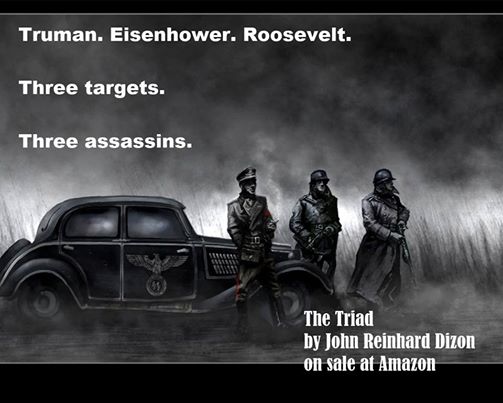
The Triad is a postmodernist historical fiction novel centering on the pre-WWII United States of America and its difficulties in maintaining its neutrality in a world on the brink of war. Amidst rumors of a conspiracy by the Axis powers to diminish America’s capacity to engage in hostilities, the FBI is called into action. Special Agent Chess Power is empowered by Deputy Director Melvin Purvis to put together a plan to thwart the efforts of a mysterious team known as the Triad. Powers heads out to Alcatraz Island and enlists the aid of criminal genius Alvin Karpis in return for his parole. Karpis agrees on condition that his partners, Fred and Doc Barker, and Harry Campbell are included in the deal. Power agrees, and the game of cat-and-mouse soon begins.
It is announced that Karpis and his gang escape during transport to a military base for medical observation, and the criminals are considered fugitives though the FBI dragnet is non-existent. Karpis returns to one of his main hideouts in Kansas City where he reestablishes contact with his Mafia connections. During that time he learns of activity by the Triad in the Missouri area and immediately begins working on leads provided by both the FBI and the Mafia. He discovers a plot to assassinate Vice President Harry Truman, and moves in to thwart the Triad near Truman’s home in Independence.
Karpis’ FBI and Mafia informants next lead him to Philadelphia where the Triad agents have been sighted. During this time, one of Karpis’ gun molls, Carole Robbins, finds out where the gang is hiding out and rejoins her long-lost lover. She provides a romantic comedy angle to the action-packed story as the laser-focused Karpis is repeatedly distracted by her antics. She also becomes his weak spot as the Triad learns of her existence and seeks to use her against Karpis. Yet the lovely girl is not without her own devices, and she remains one step ahead of the Triad as they fail to abduct her time and again.
In Philadelphia, both the FBI and the Mob learn of the Triad’s plan to murder Army General Dwight Eisenhower as he and his wife are looking at property in the Gettysburg area of York County. Once again Karpis is able to use his criminal genius to determine the Triad’s course of action and uncover their sniper nest near the hallowed battlefield area.
In the climactic episode, Karpis learns of the Triad relocating to the New York City area in time for a Presidential speech by Franklin D. Roosevelt scheduled at Madison Square Garden. Unknown to Karpis, one of the Triad members is connected to the Sicilian Mafia, and they have made arrangements with the Five Families in NYC to coordinate the assassination. The Karpis-Barker Gang manage to save the day in stopping the Triad and bringing the killers to justice.
The postmodernist techniques are evident with the use of non-linear narrative, metafictional technique, elliptical structure and classical irony. Of particular note are the dream sequences in which Karpis seems to be transported through time to modern-day Harlem where the gang’s bank robbery is pre-empted by a botched attempt by a street posse. Upon waking, he finds himself in the ‘dream house’ on the Plaza in Kansas City where he begins to suspect Freddie Barker of being a spectre. There is also a sequence where J. Edgar Hoover meets with Heinrich Himmler at an INTERPOL convention where they discuss objectives in destroying world Communism and eliminating crime in the USA and Germany. These are but a couple of scenes that may define this work as a postmodern classic.
This is a rollicking action/adventure tale with plenty of thrills, chills and tension-breaking comedic episodes that make The Triad a barn-burner that readers will long remember.
John’s Amazon Author Page: http://www.amazon.com/John-Reinhard-Dizon/e/B00DU9JNUQ/
John’s Facebook Fan Page: https://www.facebook.com/johnreinharddizonUSA
John’s Twitter: https://twitter.com/JohnRDizon
John’s Blog: https://centerstagejrd.wordpress.com/
OTHER TITLES
Tiara: http://www.amazon.com/Tiara-10th-Anniversary-John-Dizon-ebook/dp/B00IPS7R64/
The Kingdom: http://www.amazon.com/Kingdom-John-Dizon-ebook/dp/B00L2LLCY4/
Generations: http://www.amazon.com/Generations-John-Reinhard-Dizon-ebook/dp/B00K5DQYSY/
Generations II: http://www.amazon.com/Generations-II-John-Dizon-ebook/dp/B00JG56C2U/
Transplant: http://www.amazon.com/Transplant-John-Reinhard-Dizon-ebook/dp/B00JQRH1J6/
Destroyer: http://www.amazon.com/Destroyer-Abaddon-John-Reinhard-Dizon-ebook/dp/B00FDWB7KC/
Nightcrawler: http://www.amazon.com/Nightcrawler-John-Reinhard-Dizon-ebook/dp/B00I0K9QEI/
Nightcrawler 2: http://www.amazon.com/Nightcrawler-II-Tryzub-John-Dizon-ebook/dp/B00L8653CU/
Wolf Man: http://www.amazon.com/Wolf-Man-John-Reinhard-Dizon-ebook/dp/B00H4HWDAC/
Vampir: http://www.amazon.com/Vampir-John-Dizon-ebook/dp/B00IPPI7FC/
King of the Hoboes: http://www.amazon.com/King-Hoboes-John-Dizon-ebook/dp/B00HXQ4YKQ/
The Break: http://www.amazon.com/Break-John-Dizon-ebook/dp/B00IPPI3ME/
Strange Tales: http://www.amazon.com/Strange-Tales-John-Dizon-ebook/dp/B00JAHX8OO/
Hezbollah: http://www.amazon.com/Hezbollah-John-Dizon-ebook/dp/B00IZMV4D2/
The Fury: http://www.amazon.com/Fury-John-Reinhard-Dizon-ebook/dp/B00FK3UTE4/
The Test: http://www.amazon.com/Test-John-Reinhard-Dizon-ebook/dp/B00IVB9EA2/
Stxeamtown: http://www.amazon.com/Stxeamtown-John-Reinhard-Dizon-ebook/dp/B00GSTZK5W/
The Standard I: http://www.amazon.com/The-Standard-John-Reinhard-Dizon-ebook/dp/B00E1TL5LO/
The Standard II (The Citadel): http://www.amazon.com/Standard-II-Citadel-John-Dizon-ebook/dp/B00KP2B40I/
 Marcha's Two-Cents Worth