Here’s a great article that explains Venus’ retrograde cycle and the source of the pentagram.
—
A word about the
Here’s a great article that explains Venus’ retrograde cycle and the source of the pentagram.
—
A word about the

Berncastel, Germany
Embellishing your story with the right details can make the difference between being vivid and memorable versus slipping away like a boring stretch of highway in the rearview mirror. Finding the correct balance is not always easy, however, since there’s no perfect level; it’s not only genre-dependent, but subjective. Some readers expect more while other’s complain about their eyes glazing over. I tried to read a novel a while back that was so loaded with specifics that I felt as if I were there and could map out the entire area. However, the plot moved so slowly, if at all, I was never able to finish it. Other readers felt differently, however, as it enjoyed several favorable reviews. Nothing is ever simple about writing. Like they say, you can’t please all the people, all the time.
A skilled writer, however, knows when to get down to the nitty gritty details, such as what color blouse the heroine is wearing or what’s on the menu for that romantic dinner at The 21 Club. There’s no greater way to build mood and imagery, but bogging down an action scene, whether physical or emotional, is a definite no-no. Get your reader familiar with the territory beforehand, then fire away.
A sense of place is another important element that can greatly enhance your story. Street names, specific restaurants (whether real or not), historical landmarks and even the weather can take your reader on an excursion to somewhere they’ve never been, adding depth and character to your story. Cities have personalities, too, which can add to the mood if exploited properly.

New York City
If your story takes place somewhere you’ve never been, there are various online resources that can provide the information you need. If you can’t afford to hop in your car or on an airplane to see for yourself, you can still obtain vital details. Wikipedia provides historical and demographic information for most cities and localities around the globe. Whether your hero or heroine has lived there his or her entire life or is visiting for the first time, a sprinkling of details will bring it alive for your readers, giving them the bonus of vicariously visiting someplace they may never get to in person. If, perchance, they have been there, you want them to recognize it, which will give you increased credibility.
Writing a chase scene? Google Earth is a fantastic way to roam the streets yourself! If you’re a visual type like I am, you’ll thrive on this blast of input. Research doesn’t have to be dry, boring or expensive. It can be fun as well as informative while providing inspiration and plot twists along the way. Give it a try and see if it takes your scenes to an entirely new level.
(Pictures by the author)
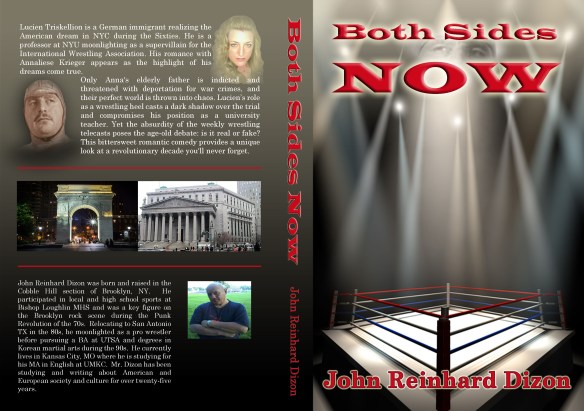
This unique story entirely sucked me in. It has so much substance I scarcely know where to begin. The characters are incredibly real, not only the protagonist, but the supporting ones as well. It feels like real life because there are so many others involved with their own agendas. In this sense, it reads more like a biography as opposed to a novel. The plot is likewise incredibly complex and convincing while it skillfully portrays a slice of history representative of the 60s era.
Lucien Triskellion obtains his PhD in Germany and accepts a teaching job at New York University teaching German. Lucien is a big guy who was a champion amateur wrestler during his college years. It doesn’t take long for someone to notice the fact he can press 500 pounds and lure him into the professional wrestling circuit. If you’re not a wrestling fan, don’t let this stop you from reading this book. I, personally, couldn’t care less about this pseudo-sport, yet I enjoyed this story tremendously because it went so far beyond that. Wrestling comprises numerous settings, but the story was so character-driven that it was comparable to meeting someone really interesting and listening to their life’s story. For example, the dichotomy of Lucien’s life as a university professor versus that of a pro-wrestler, in which he was cast as a bad guy, is gripping in and of itself. If you’re a wrestling fan, then you’ll undoubtedly love it even more as it brings the human element alive with the conflict behind the scenes.
Of course with a young, hot protagonist like Lucien, there’s going to be a romantic angle. This involves Anneliese Krieger, another German immigrant, who lives with her father. As if Lucien doesn’t already have enough going on in his life, Anneliese’s father is falsely accused of Nazi war crimes incident to WWII which results in a gripping trial which is loaded with additional suspense.
The details of all elements of this novel are so vivid and convincing it was easy to get lost in it and forget that it wasn’t real. The author has the masterful ability to include just the right amount of detail to build strong imagery, clear sense of place, as well as character appearance and development. Whether it’s an address in New York City, a famous restaurant, Madison Square Garden, or legal terminology or courtroom protocol, you feel as if you’re there. Needless to say, this book would make an incredible movie.
They say an author should write what he knows, and clearly Dizon knows wrestling, which shows in how he immerses the reader in this crazy world. He’s footnoted some of the unusual terminology and slang, which helps if you’re unfamiliar with it. The business and politics of this sport are explored and exposed as well as the various complications this adds to Lucien’s life and even reflect on the trial of Anneliese’s father. While some of the detail regarding the players in the wrestling business was somewhat overwhelming, possibly a bit overdone, it nonetheless added to the story’s amazing credibility.
I don’t often find myself in a position where I’ll actually miss the characters of a book, but I felt as if Lucien and Anneliese were personal friends by the time it ended. If you enjoy a meaty novel with a different setting, strong, well-developed characters, and a breathless ride through the 60s, you’ll thoroughly enjoy this book. I absolutely give it 5-stars.
You can pick up a copy on Amazon here.
Forgive me for borrowing the title from Dickens. As you may have guessed, the context, however, is entirely different. I’m talking about publishing.
Truly it’s the best of times for those of us who burned out trying to find a commercial publisher. I remember how excited I was when I found out you could publish your book on Kindle and even more excited when Create Space came along so you could actually hold your book in your hands. Long ago I discovered that, like so many other parts of life, finding an agent, much less a publisher, was quite political. I’m sure you’ve encountered books that were commercially published that sucked worse than a day-old calf. Just the memory of a few I remember is enough to make me shudder. So bringing the DIY world to self-publishing without the thousands of dollars required for a vanity press was like a gift from Heaven.
However, there was definitely a downside. First of all, there’s the competition. In the days when books were only available in, well, bookstores, there was limited shelf space. Thus, most books had a shelf life of about six weeks with a print run of a few thousand copies. Then they were remaindered, i.e. sent back to the publisher, sold to the highest bidder or perhaps the covers ripped off and tossed. Bookstores could only hold so many books and your chance at fame were thus limited.
Now, thanks to e-books as well as print on demand (POD) publishing, books are available ad infinitum, both in time and number. This is a good thing because it gives you all the time in the world to hawk your book. It’s a bad thing, because now there are literally millions of books competing with yours.
Of course when a market is saturated, that also drives down the price. It’s never been easy to make a living as an author and it’s even more difficult now. Readers have come to expect their books to be free, maybe 99c for an author they love. Even if they pay more, especially if it’s someone who prefers print books, selling a print book via Create Space’s “expanded distribution” usually earns you something in the neighborhood of $0.18.
Yeah.
And if the book is used, the author won’t even get that. Bear that in mind the next time you buy one.
As if that’s not bad enough, it costs money to be an author. Having a computer and word processor software is assumed in today’s world. But unless you can do everything yourself, there’s a matter of line editors, content editors, copy editors, book interior designers, and cover designers, perhaps even voice actors. Then there’s the expense of maintaining a website and a presence on social media, which seem to be spawning new platforms like mushrooms after a spring rain. There are book promoters, book fairs, and marketing classes, plus, to maintain your sanity, you may need to hire a personal assistant to keep up with it all. The bad news is that everyone makes money but you. The good news is that it’s a good tax deduction. Just don’t ever make the mistake by referring to it as a hobby with the IRS.
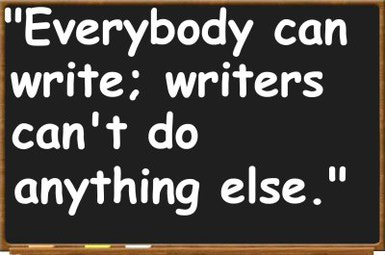 So why on Earth do we write? Because we have to. It’s something inside us that needs to come out. It’s that creative spark of self-expression that makes us feel alive. If we can share it with others, all the better. But the fact is, it’s something we’re born with and can’t deny.
Yes, it’s the best of times and the worst of times.There’s a whole lot to bitch about. But when all is said and done, being able to hold your book in your hand is priceless. The only thing better is finding a five-star review.
Now that our means of detection have improved, we’re discovering more and more of these “close encounters.” Sooner or later, another one is going to hit. In an astrological sense, they often bring some interesting effects as well. A few years ago we had a close encounter with one and that day a horrific F-5 tornado struck Oklahoma that killed some professional stormchasers. You can find the blog I did on it on my website here.
—
The asteroid – discovered June 4 – is about 20 feet wide and will pass within about 100,000 miles (153,000 km) this afternoon according to clocks in North America.
Source: Asteroid 2016 LT1 sweeps close June 7 | EarthSky.org
Astrologically, Pluto represents transformations, death & regeneration, intense experiences, things you suppress, things that need to be exposed and/or eliminated and shared resources. The convection process described in this article is a great analogy for his function of renewal in our lives.
—
Computer simulations show that the heart-shaped Sputnik Planum region on Pluto is covered with icy, churning, convective
Typos, grammar and such are an amazingly common complaint in reviews, something which many indy authors encounter at some point. However, there’s another issue that can get you a bad rapp (or rep, as the case may be) that you may not even be aware of–formatting.
The guidelines for a printed book with an interior that looks professionally done are substantially different than those for an ebook. Considering how there’s a good chance most of your readers are going to opt for the electronic version, it’s in your best interest to make sure that it looks professional as well, not like an afterthought.
I suspect that numerous indy authors, after getting their book set up on Create Space, simply hit that button on the last screen to publish their book in Kindle format. This is all well and good, but don’t trust that automated process to produce an electronic version that looks anything like the printed one. At the very least, check it yourself, especially if your printed version has dropped caps at the beginning of each chapter.
The first thing you need to do is save a second copy of your book to use for the electronic version prior to formatting it for print. Then you can add headers, footers, chapter headings, dropped caps and so forth to the printed version without introducing potential corruption into the electronic version. If you’ve already done the formatting, then obviously when you save that second copy it will be to remove such things. 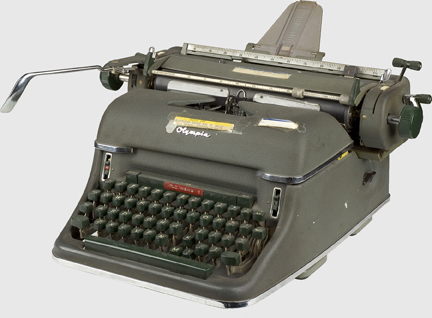 Either way, it’s a lot easier than the old days, when authors wrote on a device like the one shown to the right. Those of you who haven’t had that experience don’t even want to know what it was like handling simple revisions that changed the pagination. Gives me a panic attack just thinking about it.
If you want to produce a professionally formatted ebook, the best guide for doing so is the Smashwords Style Guide, which you can download for free from their website here.
Even if you don’t use Smashwords’ service (perhaps because you’ve opted into Kindle Unlimited, which requires giving Amazon exclusive rights to sell your work), the instructions will enable you to format a clean version that won’t aggravate readers enough to blast you with a bad review. It takes a little extra work, but it’s worth it.
Writing a book entails a lot of hard work, but that’s just the beginning. If you want it to be well-received by readers, it also needs to provide a comfortable reading experience. It’s not difficult to do and will be worth it. If it’s not something you care to tackle, then check into some of the services that will do so for a reasonable price, such as Fiverr.com.
Showing respect and appreciation to your audience starts with clean copy. Getting yanked out of a story by errors of any type, whether they’re typos, incorrect spelling, punctuation problems or formatting in nature, is not only distracting, but annoying. Some readers are more forgiving than others in overlooking such things, but sure as death and taxes, sooner or later, a reviewer will say so.
After all the time, sweat and blood you’ve put into your story, don’t let its message be diluted or even lost due to careless formatting. Take care of your readers and they’ll take care of you.

Lake Buchanan in Central Texas looks like the Mississippi River the past few days due to the excessive inflow resulting from the torrential rains we’ve been getting the past few days. Yesterday’s lake report indicated over 22,000 cubic feet per second were pouring in. The Highland Lakes dams, managed by the LCRA (Lower Colorado River Authority), are operating 24/7 to control the flow the best they can, but there’s still too much water headed downstream for some areas and flooding is inevitable.
A few years ago this area was in a drought of record and the lake was at around 32% capacity at the worst of it. The buoy in the picture above was high and dry with the lake still hundreds of yards beyond it, as you can see below.
The picture below was taken in 2011 from the edge of the water looking back; the houses you see are supposed to be on the waterfront. In contrast, the picture above was taken from next to the two story structure just left of center, showing how far the lake has finally come up.
Droughts do, indeed, end and usually with a flood. That has certainly been the case here.

Now that our drought is over we’re seeing various species return including fireflies!
—
Next time you see a firefly, keep in mind that its flickering isn’t just a wonder of the night. It’s also a unique, and sometimes deadly, language of love.
I can really relate to this since the lake I live by was down to 32% during the worst of the Texas drought a few years ago. Fortunately, now it’s nearly full again. The sad truth is that droughts always end with a flood. Hopefully they’ll be prepared when it finally hits.
—
Lake Mead – largest U.S. reservoir, as measured by water capacity – has reached a record low. Space images from 2016 and 1984 show its highs and lows.
 Marcha's Two-Cents Worth