Today’s Writing Tip

alphabets-copy

I’m sure you’ve heard of Murphy’s Law, i.e. “Whatever can go wrong, will go wrong.”  Anyone who hasn’t experienced this truism at some point in their life isn’t living on this planet. However, as an author, have you ever thought of it as a great plot enhancer?

When you’re plotting action, you may be inclined to move things right along without any complications. Not only is this often unrealistic, but can actually be boring. Suspense is a major factor in good fiction and how your hero or heroine is going to get out of their current scrape is what keeps your reader turning the pages.

Thus, if things are moving along  bit too well, figure out all the things that could go wrong. Throw some obstacles in the way and make your protagonist’s goal harder to attain.
Today’s Writing Tip

blank copy

I don’t know about you, but I skip around a lot when I’m writing. In other words, I don’t start out with chapter 1 and continue on straight through until I type “The End.” This is for numerous reasons. One is that I write using multiple viewpoints and sometimes it’s easier to follow that person through several chapters. Another is that I tend to write in layers. I don’t conceive a story in its detail all at once, but go back as other things come to me, whether it’s tweaking dialog or improving a description.

Needless to say, this can get tedious. I’m currently dealing with a 141K word WIP and jumping around to find the right place can be a real nuisance. One way to get around this is by bookmarking certain scenes or chapters so I can get there more quickly. I always seem to be short on time, so every trick that saves a few moments helps.

One thing to remember, however, is you need to remove them before submitting it for ebook or print format. The coding can really honk up the final version, plus the bookmarks may not be in places that make sense to anyone but you, anyway.

Today’s Writing Tip

blogging-copy

Who’s your muse? In other words, what inspires you? Is it a walk in the woods? Another author? An inspirational phrase? A ceramic statue? It’s good to have something to turn when you need guidance or ideas.

I don’t know about you, but often my best ideas come when I’m away from the computer. It may be driving along my quiet country road, vacuuming, mowing the yard, or washing dishes. Evening watching TV often brings inspiration, depending on what you watch. I spend a lot of time on The History Channel and their programming often dovetails nicely with my work.

The most important thing is to know what feeds your muse. Feed it regularly whichever diet it prefers and you’ll never be short on great ideas.

My official muse is Kalliope, muse of epic poetry. I did not necessarily adopt her, but it’s more the other way around. Astrologically, she has a very prominent place in my horoscope, which explains a lot about why I’ve been writing since I was old enough to hold a pencil.

Today’s Writing Tip

e-mail- copy

I’m declaring today “Internet Appreciation Day.” Those of us who have been writing for a while truly appreciate how easy it is to conduct a lot of research without leaving home. Finding out the details that make your novel come alive are usually no farther away than Google.

I can’t help but reflect from time to time on the “old days” when research meant going to the local public or university library. Magazines were helpful for location research, but now we have Google Earth to say nothing of the wealth of information on the internet.

As you’re probably already aware, I’m a detail freak. I don’t want some future reader to get in my face about some stupid mistake I made in one of my stories. I have so many bookmarks in my browser it’s ridiculous and I actually donate to Wikipedia on a monthly basis, because I don’t know what I’d do without them.

Getting it correct these days is easier than ever. I, for one, truly appreciate writers who care enough about their work to do the research and get it right. There’s no excuse to make foolish mistakes anymore when a Google search is only a few keystrokes away.

Take a few moments today and think about what the author’s world was like in the old days. Then pay your next ISP bill with a smile.

Today’s Writing Tip

laptop-4 copy

With tax time coming up, at least the USA’s infamous April 15, remember to keep track of all your writing expenses for your tax return. Research, subscriptions, social media, online services, promotional expenses, contest fees, club memberships, etc. are all tax deductible as business expense.

Whatever you do, don’t ever call your efforts a hobby if you’re seriously trying to make money as an author. I’m not a tax expert, but so I’ve heard. Even if it takes you years to turn a profit, as long as you can back it up that your intent is to be profitable with receipts and so forth, you should be okay.

One trick of business owners is to always do a little promotion on vacation so they can write off trip expenses. Thus, book research fits this category. Even if it doesn’t fit your  WIP or current list of future titles, take notes to file away for later use.

Today’s Writing Tip

home-office-3 copy

Newsletters are one of the best ways to connect with your readers and fans directly. There’s no panacea in marketing, but this is one way that comes highly recommended. One way to add interest to them is to include games and contests. This helps retain subscribers, if they enjoy what you send out. If it’s a fun and interesting read, they’re more likely to open it and think of you in a positive way.

Sales pitches eventually fall on deaf ears. Even if you write newsletters worthy of a Pulitzer Prize, you’re unlikely to have a 100% open rate, at least if your subscriber list includes more people than your mother and Aunt Bessie. One author newsletter comes to mind that goes directly to my spam folder without even touching my inbox. All it ever includes is a big, glaring, full-color picture of the cover of her one and only book, followed by all the reasons you should read it.

Ho-hum, I don’t think so.

Study the newsletters you like to receive and actually enjoy reading for content ideas. Keep hawking your book to a minimum. Connecting at a personal level with your fans is your best bet.

Today’s Writing Tip

technology-3 copy

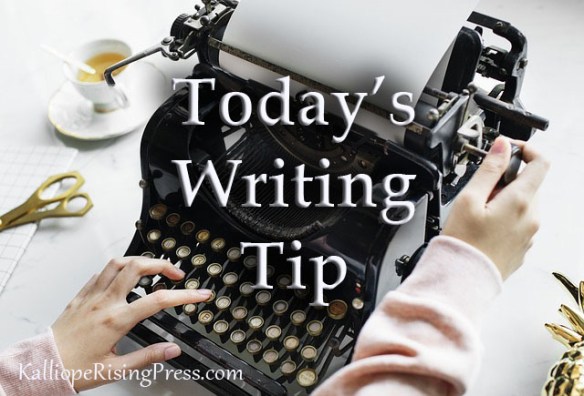
Have you ever written a book on a typewriter? I wrote my first novel on a typewriter that looked quite a bit like the one shown above. Yes, a MANUAL typewriter! I later graduated to an electric, then couldn’t get a computer fast enough when they came out. A double 9 1/4″ disk drive, 64K Sanyo. I shudder when I remember Word Star, yet it was SUCH an improvement over a typewriter.

Then there was the matter of going to a store that had a photocopier to send it to potential publishers. Printers helped a lot with that, then even that went away with electronic/online submissions.

We’ve come a long way, baby!

If you started writing when the dinosaurs roamed the earth like I did, you know what I mean. Word processors make writing much easier. Revisions were the worst, especially when you had to retype and then renumber pages. Believe me, many never got done, simply because it was such a huge hassle when your story was on actual paper.

Take a moment today to remember, or, if you’re not that old, imagine what it would be like. Then, the next time you have writer’s block and are frustrated and unhappy, you’ll have something to be thankful for.


Today’s Writing Tip

laptop-2 copy

What time of year is your story taking place? Besides using the weather to create vivid scenes, you can add another dimension using holidays. They add depth to our lives; likewise they can enhance your characters. How does he or she feel about it? Happy? Sad? Nuisance? You don’t have to dwell on it, but it’s another way to build character.

It also lends a sense of time, possibly even place. For example, you could have what would otherwise be a somewhat boring (but necessary) conversation take place at some sort of holiday celebration to add color and interest. This brings to mind an episode of The Big Bang Theory where Raj was going to break-up with his girlfriend right before Valentine’s Day.

Adding them also adds another touch of realism to your story since holidays are a part of life. The reader may not miss them if you don’t include them, but mentioning them adds a touch of real life. Birthdays are another one that can add some color and a sense of reality.

Today’s Writing Tip

laptop-3 copy

Most authors hate writing book blurbs. I’m definitely one of them. How can you condense hundreds of pages with multiple characters and a complex plot into a few paragraphs? This can be absolutely mind-boggling. And as if that’s not bad enough, there are some promotional sites where you only have 100 characters! Are you kidding me???

One place I’ve found it helpful to start is with your story’s theme. Do you even know what it is? If not, you should. This is what gives it meaning. This is the message you want to deliver to your reader, their “take away”, if you will. If necessary, start with your genre. If you don’t even know that, then you’re really in trouble. And believe me, been there, done that, got the t-shirt!

The most basic ingredients are your main character, what s/he wants, what’s in the way, and will s/he get it? Once you have that, you can fill in a few background and/or setting details and you should be close.

One thing to avoid is spoilers, of course. You want your reader to want to find out how things work out. Sometimes you can plant a teaser by finishing the blurb with a question. Give it a try. Feel free to comment below on any tricks you may have for one of the hardest things author have to tackle.

Today’s Writing Tip

nobody-copy

Have you ever written a scene, then had an idea later that improved it? Some little detail that made it come to life? These are what refine your work from good to great. Thank heaven computers make revisions a breeze.

I do this all the time. I’m one of those people who’s apparently a slow thinker because I always think of the clever thing to say a day or two after the opportunity presents itself. Yeah, I know, Duh! But I’m not quick and witty spontaneously. So it’s not surprising when I’ll get some of my best ideas after I’ve written a scene, whether it is mostly descriptive or dialog. Much of this also relates to really knowing and understanding your characters and what they might say.

This is where you need to keep a writer’s notebook handy, because you never know when one of these clever mini-revisions will come to mind. I’ve lost several when I didn’t have the opportunity to write it down at the time, then it had entirely evaporated by the time I was back at the computer.