
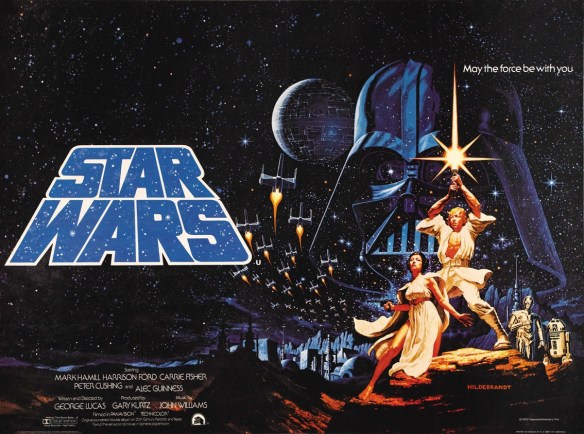
I don’t know if it was the Force, but something definitely awakened this past week when I FINALLY went to see the latest Star Wars episode, “The Force Awakens.” I’ve been a Star Wars fan since seeing the very first one back in May of 1977. I find it incredibly amusing that George Lucas was worried that it would be a flop and kept a low profile for its release, fearing humiliation if it did. Right. A flop that has spanned four generations, at least in my family.
I saw this latest one with my 42 year old daughter, who was three years old when the first one came out. Way back then, I was 29. Now she could take her three year old grandson to see it. That does something to me on so many levels that I’m not sure I can even describe it.
First of all, on an intellectual level, I marvel at anything that maintains its popularity for that long. Of course if you like old movies, you can find them, whether it’s on Netflix, the cheap video bin at Walmart or Turner Classic Movies. But few single titles can sustain that kind of audience. The only one I can think of that might even begin to compete would be “Gone With the Wind” which my mother saw when it was released in the 30s, then I enjoyed and subsequently my children. But it comes and goes, waning and waxing in popularity, whereas Star Wars has NEVER being invisible. In 39 years. Give that some thought.
I’ve always wanted to be a novelist, but I seriously wonder if I’d be writing science fiction if it weren’t for Star Wars. My initial idea for “Beyond the Hidden Sky” came from the opening scenes of that first flick, where R2D2 and C3PO blast off in an escape pod. The first step toward any story is “What if?” and for me that comprised “What if a rebellious teen-aged girl moving from one planet to another with her family got blasted off accidentally in an escape pod?” The result of that premise launched my Star Trails Tetralogy of four novels and a companion volume which number over 1500 pages. I know other authors similarly inspired.
I really enjoyed this latest episode, which was reminiscent in style and energy to the original trilogy. I really liked the new characters, at least the good guys, particularly Rey and Finn. My all-time favorite from the series was “The Empire Strikes Back” and, quite honestly, I wasn’t quite as enchanted by the more recent three. “The Phantom Menace” put me to sleep, actually, and the two after that were so-so, in my opinion. But this latest one resonated, right from the blasting of that iconic theme introducing the now-classic opening crawl. Instantaneously, I was back in 1977.
My eyes tend to water in places like the grocery store and Walmart, plus it’s allergy season here in Central Texas, so it may have only been that effect, which had me wiping my eyes from that point on. I’ve mentioned in a previous blog (see “RIP Columbia: Picking up the Pieces”) how memories are stored in both your head and heart with those that reside in the latter coming back full-force, replete with a physical reaction, when stimulated. Clearly, that’s where my memory of Star Wars resides.
That feeling of being taken back in time, coupled with lightspeed flashes of all that has transpired in my life since 1977, had a profound effect.
Not to digress, though I tend to do that a lot, but I remember reading about a study several years ago where they investigated the effects, if any, on rest home residents when they were exposed to music that was popular when they were young. Interestingly enough, the oldsters figuratively got younger! They acted younger and the physiological indicators such as blood pressure and such improved as well. It’s like when all those old feelings come back, your body responds and reverts to that place in space and time.
Time certainly is an illusion, something I may understand slightly better that some folks since I have a physics degree. I’ve had a tremendous amount of fun playing with such possibilities in my novels. But here on planet Earth, so far we haven’t conquered time. I may have been 29 when Star Wars was first released, but now I’m a great-grandmother. Believe me, I don’t feel that old, and I certainly didn’t feel that old watching Episode VII earlier this week.
At least I didn’t until Han and Leia came on screen. Seeing them OLD reminded me that I, too, was OLD! How could that be? I was jolted back to the present and that rush of nostalgia slammed through me like decelerating from lightspeed. I tend to be pretty hard on myself, expecting to look and have the energy I did when I was say, well, to be reasonable here, even 50. After all, I don’t feel that old inside my head. But I am. I look it, no matter how much I try to deny it, and my body feels it, particularly my right knee which functions similar to an odometer.
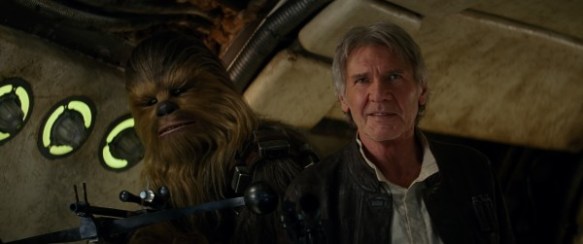
Yes, something happened when I saw Han and Leia in all their 60s glory. Time marches on and waits for no one.
Will this movie have a similarly profound effect on me like the first one? Maybe. It’s made me acutely aware that time is not standing still. If there’s anything I want to do before I die, then I’d better figure out what that is and get to it. I’ve already been reminded of that a few times recently when contemporaries of mine have passed on, which is starting to happen with increasing frequency. It’s time to forget about the things I didn’t do in the past 39 years and concentrate on what I want (or could) to accomplish in the years I have left.
They say that your life flashes before your mind’s eye when you die. Perhaps compressing 39 years into a nanosecond was a freebie from the Universe, reminding me that time, indeed, does not stand still. I remember a similar feeling the first time I heard “Sunrise, Sunset”, that sentimental song from “Fiddler on the Roof,” back when my children were still young. Now they’re all grown and even their children are grown or will be soon. It’s incomprehensible that I have a grandson in the U.S. Marines with two others married and having children of their own.
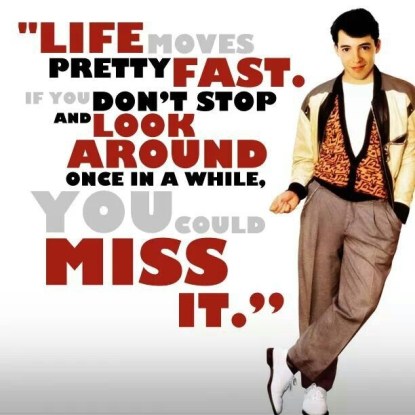 Perhaps Ferris Bueller said it best when he declared “Time moves pretty fast. If you don’t stop and look around once in a while, you could miss it.” That was in 1986, a mere 30 years ago. Matthew Broderick is no spring chicken these days, either.
OMG, where has all that time gone?
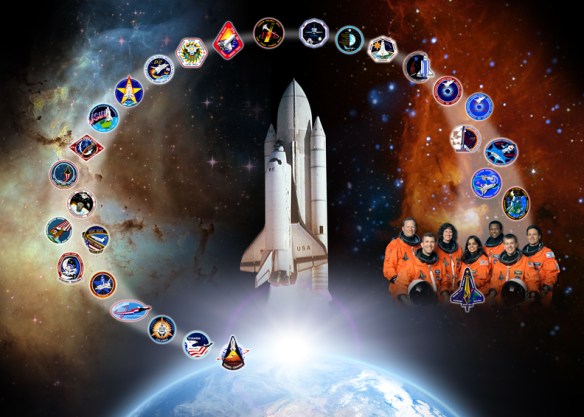 It was Saturday and I was home in the midst of a cleaning frenzy. Since it was my grandson’s tenth birthday, my plans for the day included joining family members to celebrate that occasion. I was wearing ratty workout clothes, planning to get on my stair-stepper after I finished vacuuming. Periodically, I’d pause to look out my north-facing French doors that led to my patio to check for Columbia’s plasma trail, which was supposed to be visible from where I lived in Houston. I’d seen entry emissions from previous shuttle flights which were truly spectacular, contrails on steroids, that split the sky and sparkled in the Sun.
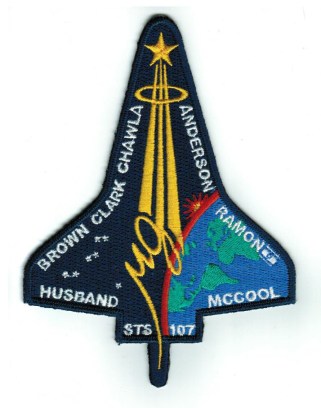
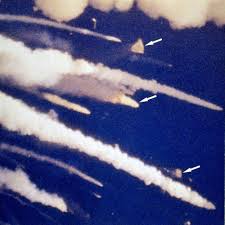 I managed the Payload Safety Section at NASA’s Johnson Space Center. Our responsibilities included making sure that anything that flew onboard the shuttle didn’t present a safety hazard, mostly through the institution of various controls. Whatever had caused the accident, we were reasonably sure that it wasn’t one of our payloads. It was a Spacehab flight, a module secured in the cargo bay that was a habitable area where astronauts conducted entire suites of life science experiments. That meant there were no satellites onboard with potentially dangerous inertial upper stages, a.k.a. booster rockets to take them to their proper orbit, which could have possibly been the problem.
 Not everyone came in, some simply called in to make sure they weren’t needed, but I’ll always remember those who did. These were the ones whose hearts were in their jobs and dedicated to their place in the space program. It wasn’t just a job, it was their life. I was a contractor as were the engineers who worked for me, but there were a few who were actual NASA civil service employees who reported to a NASA lead, to whom I also reported. This particular individual, who professed to be an expert on NASA history and lived only a few miles away, didn’t bother to come in that day. He was home painting a room inside his house, which he apparently deemed more important. I called him several times, reporting our actions, appalled at his flippant attitude as well as his absence. How could someone who was supposedly a history aficionado stay away on such an occasion? I wonder how he feels about that decision today.
 One of the chemicals used to create the foam insulation had recently been banned by the EPA. While NASA could have applied for a waiver, they wanted to be compliant, which is certainly honorable enough. However, they couldn’t find a substitute that resulted in the same integrity of the material. Thus, the new formula resulted in losing chunks of foam. This substance was light, yet needed to be extremely durable. While you may wonder how being hit by something even lighter than the memory foam most of us now enjoy in one form or another, when it was going at launch ascent speeds of approximately 500 mph, the impact was considerable and enough to damage the wing’s composite structure.
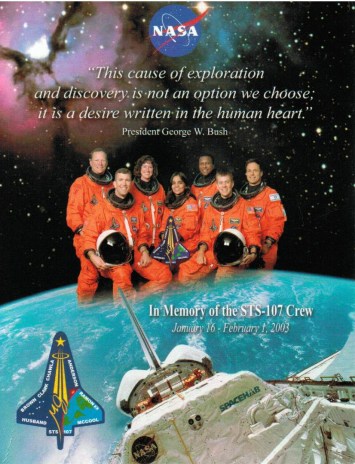 WTF? We were appalled. I suppose he wanted to show optimism and faith in NASA’s ability to recover. But for those of us at NASA, who were already stressed enough trying to fix the shuttle program and maintain the International Space Station (ISS), which was now totally dependent on our Russian and European partners for transportation, this was the last thing we needed. Then, of course, years later came an administration change and Moon/Mars was zapped, much as Reagan’s Space Station Freedom was initially cancelled by Bill Clinton, only to be resurrected some years later as the ISS. Some things never change. Most of us remember John F. Kennedy’s declaration to go to the Moon. Clearly subsequent presidents wanted a similar legacy. At this point, Reagan’s is the Challenger and Bush’s, Columbia. No wonder Reagan wanted Space Station Freedom and Bush wanted Mars!
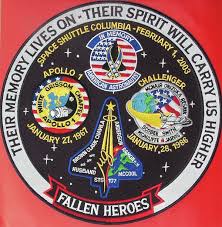 There are no easy answers. A plethora of international political implications exist for space exploration, many of which relate to countries and individuals we can’t even trust to share our neighborhoods, much less our planet or low earth orbit. Space weapons have an incredible advantage with tremendous destructive capability. This implies government involvement coupled with diplomacy are indeed necessary. Budgets and safety will inevitably clash. “Rocket science” technology based on propulsion remains quite primitive, something that’s been around for thousands of years. Whether or not you believe in UFOs, there simply has to be a better way. Seriously. Yet, on the other hand, Earth herself is vulnerable to attack from a rogue asteroid or comet. Space weapons could offer protection from cosmic annihilation as well as threats from our fellow humans.
 Marcha's Two-Cents Worth