WATCH “RWISA” WRITE Showcase Tour – Day 3

RWISA TOUR (1)

laurie-finkelstein

Laurie Finkelstein

Bulletproof Vest

By Laurie Finkelstein

The bulk, padding, and steel plates weigh me down. The protection of a bulletproof vest is necessary. No matter the weather, I wear the cloak. The weight is a burden, but I trek on because wrapped is the only way to navigate my journey. The jacket protects my heart from being blown to crimson shards of death.

A direct hit is avoided for days and nights, lulling me into calm and complacency. “All will work out fine,” I tell myself. The truth tells a story I want to change. All my will and might does not make an impact to stop the bombardment.

Experience and time separates me from tragedy. At any moment, the bullets strike. Inside or out. My house cannot provide security, nor can a million people surrounding me. With nowhere to hide, I am a target. Shelter and safety are nonexistent.

Discharges are held back while luck and grace harbor me. The slugs will come, however, in a piercing barrage without warning, and will pummel me.

Knocked to the ground, I am immobilized and rendered helpless. My breathing is halted. My movements are stopped, and I understand what assaulted me.

The shockwave subsides, and in small increments, I am able to take in air. Incapacitated, I continue to lie until I am rescued by the rational thinking buried under an avalanche of pain, doubt, and fear. My thoughts check my vitals to make sure I am in the here and now. “Stay in the moment,” I tell myself. “I can manage this. I will persevere.”

“Rise,” I command. The mass of the garb constricts my movement, but I stand, analyze what must be done, and begin to act. The warrior in me comes out. Battles will be fought. My impervious attire gets me through another crisis, and its weight comforts me. Without the guise, I am unable to prevail against the onslaughts, which pop out of the dark corners of another day.

Yes, my vest is cumbersome, but without my swathe I will not withstand the painful projectiles. Clips are filled, ready to punch and knock me down, disabling me should I forget for a moment to cloak myself within my protective armor.

My bullets are not made of lead, surrounded by a dense metal. The projectiles do not come from terrorists intent on decimating me. The ammo does not come from a police state or a dictator’s command. A barrel is not involved.

My bullets are made of depression, anxiety, and obsessive-compulsive disorder. Composed of irrational thoughts, insipid ideations, and ignorant rationalizations, they are crushing invisible forces. The capacity to shatter my resolve and render me dysfunctional invades me.

My unsociable enemy is treatable, but never disappears. My therapists validate my experiences of being trapped, resentful, guilty, shameful, ill-equipped, grief-stricken, lost, uncertain, and disabled. My growth in therapy helps me accept the challenge with compassion and empathy in my heart.

Throughout my lifetime three stages will haunt me.

Stage one is the onslaught of rounds. The crisis mode. The shock and pain.

Stage two is being slammed down, breath taken away. Sabotaged. Terms and feelings of the emergency are acknowledged.

Stage three is advocacy for myself. Stand. Breathe. Make decisions. Tools in hand to counteract the depression and anxiety and OCD. Utilize appropriate response and care.

Encouraged by others, I enroll in Toastmasters. Time for me to improve my public speaking and thinking on my feet. Professional and compelling ways of expressing my views is a talent I want to possess. Persuasive interactions are in reach. My computer with Google as my guide, I find the Toastmasters website. The rules and guidelines answer many of my questions. Ready to take on the challenge, I enter my credit card information and become a member. A direct thrust knocks me down.

At first, I don’t understand what attacks me. My heartbeat begins speeding up. My gasps for air speed up. My head spins with dizziness. The mighty effects of terror hammer me to the ground. Despair sinks me deeper into the attack.

Stage one. The thought of standing before people enunciating in a clear voice avoiding “ums” and “ahs” strikes with negative force. In a semi-frozen state of fear and regret, I struggle to make sense of my attacker. Groups of Toastmasters are warm, safe environments to learn public speaking and leadership skills. “Warm and safe,” I remind myself. Still my heart beats faster and my breath diminishes by the second. A ghost of recognition appears before me. Panic is familiar.

Stage two. My history tells me to take an extra Klonopin. Scared to death is not an option. Upon reaching my medicine cabinet with weak, wobble-producing legs, I discover my pill case empty. In my next move, I check the bottle. Empty. My heart beats faster and my limbs go numb. Sweat trickles down my forehead. My last attempt before I collapse in a heap of despair, I call my pharmacist. My trembling voice separated from my body explains my attack and lack of pills. “How fast can you fill the prescription?” my quivering voice speaks out. “Is ten minutes okay?” the pharmacy technician asks.

Stage three. My inner voice tells me to be brave. Think of a serene place. My happy place. Take deep soothing breaths. My toolbox is ransacked for more options until I come to grips with the present. The dispensary is too far to hike, so I must drive to pick up my pills. Cranked engine. Foot on pedal. Brake released. My self-talk takes me on a wild ride to the drug store. My trembling legs walk me to the back of the aisles. The friendly face of the tech reassures me. The credit card transaction is signed with a jellylike hand, completing the purchase.

Back in my car, I down the remedy with tepid water from an old bottle sitting in my trash. My panting is steadier, my heart pounding a little less. Within thirty minutes, I am relaxed, able to pursue my day. Ready to reassess my decision to become a Toastmaster. The choice is sound and important.

My bulletproof vest is worn as a badge of honor and survival. Without my garb, I would be a prisoner in my house, hiding in bed. Sick to my stomach. Useless.

The stigma of mental illness must be broken. My vest is worn with pride. I am a survivor. I am the voice of one in every five Americans experiencing the assailant. I am not alone.

~~~

Thank you for supporting this member along the WATCH RWISA WRITE Showcase Tour today!  We ask that if you have enjoyed this member’s writing, to please visit their Author Page on the RWISA site, where you can find more of their writing, along with their contact and social media links, if they’ve turned you into a fan.  WE ask that you also check out their books in the RWISA or RRBC catalogs.  Thanks, again for your support and we hope that you will follow each member along this amazing tour of talent!  Don’t forget to click the link below to learn more about this author:

Laurie Finkelstein’s RWISA Author Page

WATCH “RWISA” WRITE Showcase Tour – Day 2

RWISA TOUR (1)

Karen Ingalls

Karen Ingalls

A FISHY DAY

It was one of those wonderful August days when the sun was high and warm in the sky. The big cumulus clouds slowly drifted by, creating designs that filled Jim’s imagination, who at nine years could see all kinds of amazing sights. He had been playing with his model airplane in his aunt and uncle’s yard, where he spent the summers on their ranch in San Diego, California. Staying with Uncle Leon and Aunt Helen was always a special time of adventure, fun and farm work.

“Jim, do you want to go to the pasture with me? We’ll check the water trough for the cattle,” Uncle Leon asked, at the same time he took his handkerchief and wiped some perspiration from his tan brow.

“Oh, yes,” Jim responded with great excitement. He ran to the front porch and put his treasured airplane on the table next to where Aunt Helen sat in her rocking chair.

Uncle Leon walked over to the Allis-Chalmers tractor and stretched his long, thin legs up and over onto the metal seat. “All right, Jim, you can come on up now.” Jim awkwardly managed to climb up and grab hold of his uncle’s hand, who swung him onto his lap. With the turn of the key the tractor began to vibrate and the engine roared. Shifting the gears into forward, Leon yelled, “Here we go!”

The pasture was a favorite place for Jim with its rolling hills, oak trees, and green grass. It was always a peaceful place where a boy could run until he was out of breath, and then fall onto the grass and let the wind gently blow over his panting body. Many were the times that Jim would spend his days, just climbing in the oak trees pretending he was hiding from some enemy, or shooting squirrels with his imaginary rifle.

He and his uncle drove through the pasture until they came to a large trough sitting by a water pump on the top of a knoll. The cattle were grazing some distance away, but their occasional moos could be heard.

Uncle Leon helped Jim off the tractor and then sauntered up to the trough. “Not much water left so we best get this filled up.”

Jim was leaning over the trough where the top of it just reached his chest. “What can I do? I want to help.”

“Well, now, how about you pump the water in once I get it primed,” replied Uncle Leon with his usual smiling face. He was happy that Jim wanted to help, but he also knew that pumping water would be a big job for such a young lad. Once he had the water flowing with each downward motion of the pump handle, he instructed, “Okay, young feller, it is your turn now.”

Jim eagerly grabbed the handle and standing on his tiptoes, pushed it down, smiling happily when the water gushed into the trough. He repeated the pumping for as long as he could, but all too quickly his arms and shoulders began to ache. Jim did not want to admit that he was getting tired, but his uncle knew and said, “How about if I do it for a while?”

Once the water neared the top, Jim leaned over cupping some water into his hands. “This is the best tasting water I’ve ever had,” Jim thought to himself. He slurped several handfuls into his dry mouth.

Looking over at his nephew, Leon asked with a twinkle in his eye, “Did you see that fish drop into the water from this here pump?”

“What fish?”

“Why, that fish that came right out of the pump into the trough. I thought sure you would have seen him while you were drinking the water.”

“No, sir. I didn’t see any fish.” Jim wiped his mouth with his shirt sleeve and earnestly looked in the water.

“Well, he must still be in there.” Uncle Leon leaned over the trough looking for the mysterious fish. “Now isn’t that something. I can’t see him anywhere.” He peeked a look at his nephew, who now had eyes as big as saucers. “I wonder if you accidentally swallowed that poor little fish while you were drinking all that water.”

Jim stepped back from the trough and began to rub his stomach. “I don’t think so, sir.” The minutes passed and Uncle Leon continued to wonder out loud what happened to the fish. Jim began to imagine that the fish was swimming in his stomach. “I don’t feel so good,” Jim said as he stretched down on the cool grass.

Seeing that his nephew was fearful and feeling sick, Uncle Leon laid down next to him and pointed up towards the clouds. “Jim, look at that cloud up there. See the little one next to the big puffy cloud?”

He waited until Jim nodded his head and said, “I think so.”

“It kind of looks like a fish, doesn’t it? I wonder if that is the fish that was in the trough.”

Jim looked at his uncle, then up at the clouds, and then back at his uncle who was smiling from ear to ear. Uncle Leon laughed and began to tickle Jim’s stomach. “Or, is that fish still here? Where is that fish?”

Jim laughed and joked right back while he patted his uncle’s stomach. “No, I think that fish is right here!”

Soon they both stopped laughing and just looked at one another. “I hope I don’t tease you too much,” Uncle Leon said.

“Oh no, Sir.” Jim looked at his uncle and went on to say, “I like to tease my younger brothers. Mother is always telling me not to do it too much. She doesn’t want them to cry.”

“Well, I would never want to make you cry.” Uncle Leon put his big hand on Jim’s head. “Do you know why?” Jim slowly shook his head back and forth not wanting his uncle to remove his hand. “I love you too much to ever make you cry for any reason.”

With tears in his eyes, Jim whispered, “I love you, too.”

They spent the rest of the afternoon enjoying the sun, the warm breeze, and just being next to one another in the grass, watching the clouds drift by. It was a special day that Jim always remembered with a smile.

~~~

Thank you for supporting this member along the WATCH RWISA WRITE Showcase Tour today!  We ask that if you have enjoyed this member’s writing, to please visit their Author Page on the RWISA site, where you can find more of their writing, along with their contact and social media links, if they’ve turned you into a fan.  WE ask that you also check out their books in the RWISA or RRBC catalogs.  Thanks, again for your support and we hope that you will follow each member along this amazing tour of talent!  Don’t forget to click the link below to learn more about this author:
Karen Ingall’s RWISA Author Page

WATCH “RWISA” WRITE Showcase Tour – Day 1

RWISA TOUR (1)

calleiro

Words

By Yvette M Calleiro

The written word and I

Are cherished friends,

Embracing each other’s thoughts and emotions

Like kindred spirits,

Dancing on clouds.

Bosom buddies who gossip and giggle

And gasp at all the same moments.

She and I are equals,

More than that, really.

We are two parts of a whole,

Complementing and complimenting the other,

Perfect beings.

The spoken word and I

Skirt around each other’s social circles.

We stumble around awkward pauses,

Unable to pull the perfect word or phrase

From our filing cabinet of knowledge.

Ease and grace flee without a moment’s notice.

She is more skilled than I.

She whispers her intricately woven ideas into my mind,

But her delicate strength is no match for

The hills of anxiety and the mountains of insecurity

That obstruct her path to freedom.

Before her words can reach my tongue,

They unravel into shreds of confusion,

Left unspoken.

If only the written word and the spoken word

Could meet…

They would live in perfect harmony.

But alas…

It is not meant to be,

Neither willing to leave her domain,

Each content to dance alone,

And I…

I am stuck in the middle,

Pulled in both directions,

Reveling in the comfort of the written word,

Needing the spoken word to survive.

But still I dream

Of the day when my words will intermingle

And a new love affair can be born.

Thank you for supporting this member along the WATCH RWISA WRITE Showcase Tour today!  We ask that if you have enjoyed this member’s writing, to please visit their Author Page on the RWISA site, where you can find more of their writing, along with their contact and social media links, if they’ve turned you into a fan.  WE ask that you also check out their books in the RWISA or RRBC catalogs.  Thanks, again for your support and we hope that you will follow each member along this amazing tour of talent!  Don’t forget to click the link below to learn more about this author:
 Yvette M. Calleiro’s RWISA Author Page


A Cool New Way for Authors to Package Their Books

STTTDPA51-USB copy

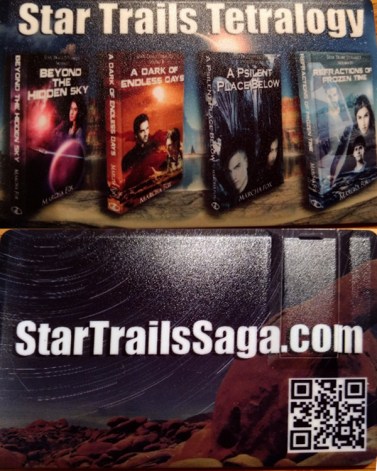
What you’re looking at are photos of the latest and greatest way to share your books! As an author I think this is the coolest thing I’ve seen in a long time. Its actual size and dimensions are the same as a credit card, but the awesome part is that it contains a USB drive loaded with my Star Trails Box Set and latest novel, “The Terra Debacle: Prisoners at Area 51”.

These work great for book signing parties, especially for those who prefer an ebook, as well as for giveaways, drawings, and anything else you can think of.  They have a variety of styles, but I thought this particular one was best suited to show my books on one side and have the website and QR Code on the other. Just think how much easier it is to haul a box of these around versus print copies!

I got mine from https://www.usbmemorydirect.com. Check it out!

Is your inner Einstein looking for some brain candy?

paradox

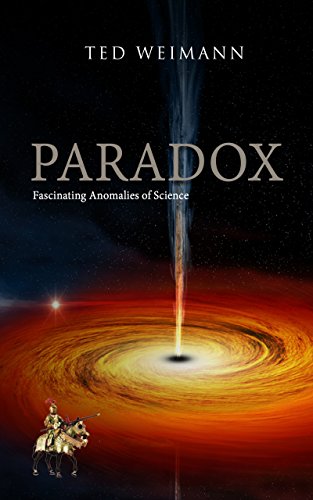
This deliciously meaty and heavily researched book should be on everyone’s shelf. Of course, I’m prejudiced as a scientist myself. I thrive on nonfiction books like this, because they clear the dust from those remote corners of my brain, many of which haven’t been used in a long, long time.  In many ways, the content reminds me of the popular physics books Isaac Azimov wrote years ago, which I thrived upon, prior to actually obtaining a physics degree myself.

Probably what I liked most is its focus on the numerous paradoxes that exist in just about every field of study. The author includes sections on medicine, neurology, and psychology; astronomy, cosmology, and physics; and geosciences and math. He points out through a host of examples that there is still so much we don’t understand and thus so much to learn and explore. On the other hand, research is often subjective and highly biased, conducted to prove a point that financially benefits someone or, more likely, a corporation or industry.

So can you trust research results? Maybe, maybe not, making scientific findings paradoxes in and of themselves.  Science should represent facts, but does it? If someone you don’t trust tells you one thing, scientific data notwithstanding, do you automatically assume the opposite to be true? Do you trust everything the pharmaceutical industry tells you? The tobacco industry? Monsanto? The government? How many times has USDA’s official “food pyramid” changed? How many drugs or food additives have been declared “safe” by the FDA only to be proven otherwise at a later date? is it a paradox we can’t believe so much of what we’re told in the name of science?

You’ve probably heard the quote “Lies, damn lies, and statistics”. The section on mathematical manipulation was particularly fascinating, especially pointing out a statistical flaw (or method, depending on whom you ask) known as HARKing, “hypothesizing after the results are known.” Sometimes, remarkable discoveries are found that way; but, on the other hand, it can be used deceptively.

Weimann notes how correlations are often implicated as causes, when there’s no solid evidence to substantiate it. Along similar lines, in some cases, I would have liked to have seen a specific source as opposed to the massive bibliography at the end. While I understand that footnoting every fact would have been a Herculean task, I definitely raised a eyebrow from time to time wondering, and would have appreciated more substantiation. Ironically, the author himself points out how so much of published scientific findings are suspect, yet other times presents them as gospel. I find this somewhat ironic, perhaps a subtle play on the title, perceivable only at the subconscious level, or maybe it’s the author’s way of messing with us.

What can we believe these days? Sometimes, it’s hard to tell. In some ways, the entire book is a paradox, where facts are provided on one hand, yet the overall theme is that contradictions lie all around us. It’s as if it the book’s underlying message is something like, “This is all the cool stuff science is discovering these days, but don’t believe everything you hear.”

Maybe you need to be a scientist to see the humor in that. We nerds do tend to have a weird sense of humor, a trait that’s occasionally, but not always, captured on the popular TV show, “The Big Bang Theory.” It’s a matter of laughing with versus at someone and, more often than not, the humor in that show is directed at mocking those who are different. Personally, as a physics major myself, I find it marginally offensive, and if I were of certain political persuasions, I’d be out there protesting and demanding it be removed from the airwaves. Not that scientists can’t laugh at themselves. They just do it at a level the average person doesn’t grok.

Digression aside, Paradox contains a wealth of science, much of it unknown or cutting edge; the beauty of it lies in pointing out–sometimes clearly, sometimes, not–the various contradictions afoot. A favorite saying among physicists and mathematicians is that something is “intuitively obvious.” That tends to show our arrogant side, since so much isn’t, such as his expose of the number one in the math section.

One human behavior paradox I particularly enjoyed in Weimann’s book was in the section that addresses psychology. As humans, we want choices, even demand them, but too many options are overwhelming and tend to result in a person not selecting any of them. I know I’ve experienced this in the grocery store, where there is so much to choose from (especially in the ice cream cooler) that walking away and thus doing without is a far simpler decision, and probably healthier. Another example would be the plethora of political ideologies (some of which are idiotologies) where people scream for freedom to express their own views, then want the entire world to conform to their beliefs, a primary reason why democracies fail.

Some sections are more controversial than others, including the age of the Earth, as well as whether global warming is attributable to a natural climate cycle, which the Earth has endured for millennia, or being contributed to by fossil fuels. I must say, that section tended to convince me of the latter, though I previously leaned toward natural cycles. I found the section fascinating that addresses how our brains have evolved and actually become smaller. The author states that scientific evidence indicates that once daily environmental threats are removed by a “civilized” society, brains shrink, while disease increases. Apparently, “Survival of the fittest” conditions refine a species to top efficiency, whereas survival for everyone, including the drones, downgrades the species, generally. Who woulda thunk it?

The contradictions paradoxes represent keep us honest and humble. They remind us that all may not be as it seems, that our sense of reason may be flawed, implying we’re not as smart as we’d like to think we are. What we believe is impossible is limited only by our knowledge of natural law. Perhaps the only individuals from centuries past who wouldn’t be surprised by what we’ve achieved would be Nostradamus and other visionaries who were considered crazy in their own time.

While this book serves as brain candy if you’re a scientist, you don’t have to have a physics degree to appreciate or understand this information. Rest assured, it’s presented for a lay audience, but won’t be palatable for everyone. For those who find science boring, it’ll serve best as bedtime reading for insomniacs.

On the other hand, this is a must read if you’re a science aficionado or entirely immersed in it by degree or profession. Stretch your synapses to fields outside your own! If you love science, yet aren’t formally educated in its tenets, Paradox is a wonderful primer that will keep you informed of some of the most interesting subjects under investigation today. If you’re surrounded by scientists or engineers, but aren’t one yourself, yet want to participate in conversations at work or social gatherings and show you’re smarter than they think you are, this handy volume will provide a wealth of the latest information on what’s going on out there in the world of research, both in the cosmos and on planet Earth.

Those heading for college to obtain a technical degree can benefit greatly as well. If you’re not sure which field you want to go into, you may find something that grabs you. Furthermore, this material will help grease the skids, so to speak, introducing concepts that will make them easier to understand later. Our brains require synaptic connections to work properly, and if a concept is entirely new, it’s harder to grasp than one with some level of familiarity where a niche has already been prepared in your grey matter, if you will. Anyone home schooling their kids will also find this an excellent resource. If you’re a science fiction author, you definitely need this book, not only to keep your writing credible, but to likewise trigger a wealth of new ideas.

As you can tell, if nothing else, this book made me think and possibly stimulated my neurons a bit too much. All that aside, even if you’re not interested yourself, pick up a copy of this five-star book and give it to your favorite nerd. They’ll be forever grateful.

You can pick up your copy on Amazon here.

“Gone: Catastrophe in Paradise” by O.J. Modjeska

gonecatastrophe

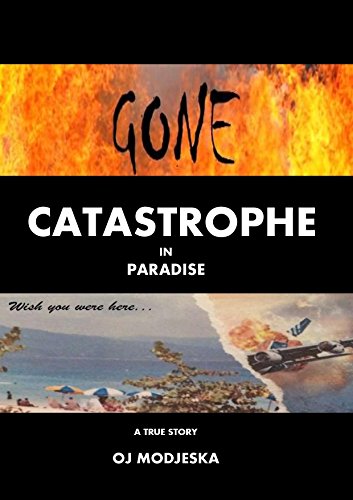
This book reminds me of the movie, “Titanic” in that you know from the start it’s not going to end well, yet up until that horrible moment, there’s nail-biting suspense as you wish that, somehow, it isn’t true and never happened. And like the Titanic, this incident is also horrifyingly true.

I blew through this gripping, yet heart rending book in a single day. I can’t name a single novel at which I’ve shed more tears. It recounts in incredible detail what went on behind the scenes of the catastrophic plane crash that occurred March 27, 1977 on Tenerife, one of the Canary Islands, when two jumbo jet Boeing 747s collided on the ground, killing 583 people.  I remember that accident well and how horrified I was that something so terrible could happen. I’d never even heard of Tenerife until that time, and unfortunately, every time I’ve heard it since, this tragedy is the first thing that comes to mind.

The author takes you, step by step, through all the events that led up to it, again showing that every disaster has multiple causes, an unfortunate chain that could have been broken at any number of points, yet never was, resulting in the unthinkable. Incredibly, it started way before that, with the placement of the airport at a horrible location where banks of fog were known to roll in from the adjacent mountains. Folklore has it that the “X” on the map was originally to indicate the place NOT to place the airport, yet later that rationale was lost, Murphy’s Law prevailed, and that was exactly where it was placed. How ironic and how human.

Having worked at NASA for over 20 years, including during the time immediately following the Challenger accident as well as when Columbia broke up over Texas skies in 2003, I’d already seen that pattern. It’s never one, single thing, one single mistake, that causes a major disaster, but an unfortunate chain that is seemingly cursed by fate.

It made my blood boil that it actually started with a terrorist attack on Las Palmas, another airport in the Canary Islands. While I’m sure there’s a special place in hell for the insidious individual perpetuating that scourge, it’s horrible the damage and loss of life their barbaric beliefs have caused. In this case, their actions of detonating a bomb in the Las Palmas terminal forced numerous aircraft to be rerouted to Los Rodeos, an airport far too small to accommodate such an influx of unexpected flights, especially wide-body, jumbo jets like the Boeing 747.

Truly, this situation was an accident waiting to happen from the start as two tower controllers near the end of their shift attempted to manage the unexpected situation with antiquated equipment; they didn’t even have ground radar. These critical circumstances were further exacerbated by cultural issues and the quirks of human nature, always a factor in such a tragedy, yet so often far from deliberate. Someone makes a bad decision, never dreaming in their worst nightmare what the result will be. And the coup de grace was the fog.

I’m not sure it would constitute a spoiler to say more, given the unfortunate end result is well known and documented. To say I enjoyed the book is a bit of a misnomer, given it was far from pleasant, yet a very emotional experience, which to me is the hallmark of an outstanding book.  This one is skillfully written and represents meticulously detailed research, which provides a three or even four dimensional view of the happenings of that day.

I’m probably not the “average reader” since I worked in shuttle and payload safety at NASA, I where I personally participated in accident investigations, had classes in such, and was involved in the post-mortem of the Columbia accident. I’ve read NTSB reports of other airline accidents with interest and had the privilege of attending Aerospace Medical Association Conferences a few times where such things were discussed, including TWA Flight 800, which went down in flames July 17, 1996 after taking off from JFK airport in New York.  Some pretty interesting theories exist related to that one, too, which were not included in the official accident report.

The author did a spectacular job of leaving no stone unturned, reporting the situations, circumstances, and results in an objective, yet thoughtful manner, demonstrating once again that accidents don’t just “happen,” at least not of this scope.

The message, of course, for us all, is to recognize that nothing in life is guaranteed. There’s no telling when what appears to be a benign decision might be the fatal link that takes a normal day into the realm of tragedy. For the human factors involved alone, this book deserves attention, especially for those who work in any industry that has the potential for a similar disaster.

I particularly appreciated mention at the end of various individuals reporting paranormal and ghostly apparitions appearing from time to time on the runway. This is the case of various locations where horrific loss of life has occurred. As a professional astrologer, upon finishing the book, I immediately cast the event chart for the accident and could see that there were definitely very sordid aspects in play at the time, all of which reflected much of what was included in the book.

Whether or not you believe in astrology, disaster charts tend to include details that fall into the category “you can’t make this stuff up.” For example, for this disaster it showed fog and unclear communications, power trips, rebellion against authority and regulations to one’s own self-undoing, death and separation from loved ones, and a tremendous amount of activity in the 8th house of death, including the asteroid Icarus, namesake of the mythological individual who tried to fly but went down in flames, on the cusp of the 8th house. It shows the compassionate action of those on the ground, and even that Tenerife would ultimately bear the stigma of being remembered for this horrific event. No, you can’t make this stuff up.

Read this book. It’s outstanding, albeit heartbreaking. And never take anything for granted again. I give this nonfiction thriller 5 stars for content, even though there were a few grammatical issues here and there. The research more than compensates.

You can pick up your copy on Amazon here.

FREE Science Fiction for Everyone

Less than a week and this deal ends! Also, besides the gift card, two winners will win an extra 17 books, one of which is my latest, “The Terra Debacle: Prisoners at Area 51” which has been gathering great reviews! Don’t miss out!

authorssmith's avatar

From now until the end of July, choose from over a dozen science fiction books to download for FREE! These are all types of science fiction, not just aliens and robots. Treasure, my middle grade book about a future where gardening is illegal, is among the books.

You will also be entered to win an additional free book, and a $10 gift card! What are you waiting for? Check it out now!

Limitless-Worlds-share

S. Smith is the author of the awesome and award-winning middle grade/YA series, Seed Savers. Visit her Facebook and Pinterest pages. Follow her on TwitterSign up for the newsletter!

View original post

Don’t miss “The Great American Eclipse” 21 August 2017

eclipse08212017

Path of Totality for August 21, 2017 Eclipse

A special event is coming up August 21, the scope of which hasn’t occurred for 99 years! If you had grandparents at that time in Portland, Oregon; Denver, Colorado; Oklahoma City, Oklahoma; or Orlando, Florida, to name a few, they would have most likely seen it, or at least heard about it.

As you’ve probably figured out, I’m talking about the Great American Eclipse, so called because it crosses the entire USA from Oregon to South Carolina, and is only visible in the Continental USA. Last time we had one that stretched from “sea to shining sea” was June 8, 1918. That one started in Washington State and struck a diagonal path across the US, clear down to Florida and slightly beyond.  When I gave this talk at my Toastmasters meeting recently, one of the members recalled her mother, who lived in Oklahoma, seeing it, and being amused when the chickens were confused and went to roost when it got dark.

Eclipse 101

Total solar eclipses are relatively rare. First of all, they only occur with a New Moon. Why? Because that’s when the Moon is between Earth and the Sun, allowing its shadow under the right conditions to reach the ground. But we have a New Moon every month! Why don’t we have a solar eclipse every month?

Easy–it’s a matter of alignment. Remember, both the Sun and Moon are moving! More correctly, the Earth is rotating, making the Sun appear to move across the sky in a path called the ecliptic, which changes as far as its elevation above the horizon is concerned, based on the seasons, which are caused by the Earth’s axial tilt. The ecliptic is highest for the summer solstice. This maximizes the Sun’s path and explains why the days are longer. The opposite is true in winter. So, the Sun is not only “moving” across the sky, but changing it’s elevation above the horizon. I knew someone once who loved to describe unpredictable people by saying that for them “The Sun always comes up in a different place.” Ironically, this is true. If you’ve never noticed, it’s never too late to start.

The Moon orbits the Earth, but where its orbit crosses the ecliptic is not static, but moves a few degrees each month. Thus, the Moon’s location is also constantly changing, though it does so in a predictable manner. For an eclipse to happen, both the Sun and Moon need to be in the location where their paths cross, placing the Moon exactly between Earth and the Sun, casting its shadow on the ground directly below. You can see how predicting when and where eclipses will occur is not a simple matter. Nonetheless, the antikythera device was able to predict eclipses and so were the Mayans, because as their precise calendar indicates, they understood solar and lunar cycles.

You may be surprised to find out that there are two solar eclipses every year, but they’ll be visible in different locations. With two-thirds of the Earth’s surface oceans, many occur there and go unnoticed, save for physicists dedicated to solar research, especially those trying to determine why the Sun’s corona is several millions of degrees, while its surface, known as the photosphere, is a mere 10,000 degrees Fahrenheit. A total eclipse is the only time when the magnificent corona is visible. Researchers suspect the corona’s temperature is related to the Sun’s magnetic field, but they’re still trying to figure out why.

Types of Eclipses

Not all eclipses are total. There are also partial and annular. Partial is when the Sun and Moon don’t line up exactly, so only a portion of the Sun is obscured. In this case, a total eclipse is not seen anywhere. However, note that a partial eclipse is also what those located outside the narrow band of totality will see on August 21, again because the alignment is not perfect.

annulareclipse

Annular Eclipse

An annular eclipse occurs when the Moon is farther away from the Earth and therefore smaller, such that it doesn’t entirely cover the Sun. Then, instead of the magnificent corona visible during a Total Eclipse, you see a ring. In some of these less than ideal cases, the Moon’s shadow doesn’t even reach the Earth.

Eclipse Path of Totality

To see the upcoming event as a total eclipse, you’ll have to be somewhere along the red stripe shown on the map. The location where totality will be longest (2 minutes 41.6 seconds) is in the vicinity of Carbondale, Illinois. Oddly enough, another total eclipse in 2024 also crosses that location.  It’s very unusual for this to happen; often centuries pass before a total eclipse is visible again from the same place.

2US-eclipses2017-2024

Paths of 2017 and 2024 Eclipses. “X marks the spot” over Carbondale, Illinois.

Unfortunately, the eclipse will not be total where I live, here in Texas. Rather, it will be a partial eclipse that covers 65-70% of the Sun. It will start here around 11:35 am, be at its maximum around 1:10 pm, and end around 2:40 pm. However, space cadet that I am, I’ll be traveling somewhere that it’s total.

Safe Viewing Tips

To safely view the eclipse, you need to protect your eyes with special glasses or some other sort of filter. Ordinarily sunglasses are insufficient, so don’t even think about using them alone if you value your eyes. A pinhole camera will show it, too, or look at the shadows of leaves beneath a tree to see thousands of tiny Sun crescents.

You can get special ISO Certified glasses, but hurry since they’re selling out fast. Sources are listed below. Note that glasses suitable for you to watch the eclipse are NOT sufficient if you’re using a camera or telescope! In that case you need a solar filter for the lens!  Solar filters are available for most regular cameras. If you value your cell phone, don’t plan on taking pictures of the eclipse with it because it’ll burn it up. Remember starting a fire with a magnifying glass when you were a kid? Same idea. Another option to special eclipse glasses is #14 welder’s glass, which could also work to protect your cell phone.

The only time it’s safe to look at a solar eclipse without eye protection (for you or your camera) is during totality, i.e. when the Sun is entirely covered by the Moon. That is preceded by a final glint from the Sun they call the “Diamond Ring”, which also occurs as the eclipse ends, but that flare could be enough to zap your camera or cell phone, so bear that in mind. Totality doesn’t last long, usually between 1 – 2 minutes. Nonetheless, you should enjoy it with your natural eyes while it lasts to enjoy it’s full impact and beauty.

Many people go throughout their lives without ever witnessing a total eclipse. I’ve seen partials, but never a total, so I’m flying to Utah to visit my daughter and her family, then we’ll drive into Idaho to the band of totality. I’m sure it will be a get-together we’ll never forget. It’ll be worth watching, even from here in Texas. If nothing else, you can see firsthand why the ancients were frightened when it appeared something was consuming their life-giving Sun.

Another Eclipse is coming!

If you live somewhere outside the band of totality and can’t travel to see the total eclipse this time, then you can look forward to the one in 2024, when there will be another one.  (You can see the path as the second band that forms the “X” in the map above.) For me, here in Central Texas, it will be right on our doorstep! In fact, the center of the path of totality goes right over Lake Buchanan, northwest of Austin, meaning I’ll be able to watch it from my front yard! Come April 2024, there will be a lot of people around here praying for clear weather.

eclipse2024Texas

RESOURCES

Eclipse Information

www.greatamericaneclipse.com

www.earthsky.org

http://eclipse.gsfc.nasa.gov/eclipse.html

http://www.valkyrieastrology.com/Makeover/Planets/Eclipses.htm (my astrology website)

Eye Protection

www.rainbowsymphonystore.com (bulk orders)

https://www.teachersource.com/product/1892/nyeglasses

https://www.space.com/36941-solar-eclipse-eye-protection-guide.html

https://www.eclipseglasses.com/products/

https://weldingsupply.com/

Photo Tips

http://www.eclipse2017.org/2017/photographing.HTM

http://www.whas11.com/news/experts-warn-not-to-use-cell-phone-camera-for-2017-solar-eclipse/457560482


The Terra Debacle, Marcha Fox

This great review for “The Terra Debacle” just in! Thanks so much to the “redheaded book lover” for such a comprehensive review!

Enough FREE SCI-FI BOOKS to get you through a hot summer!

Limitless-Worlds-July-10-37-banner-2017

If you love science fiction and are looking for some great reads from multiple authors, you’re going to love this! Here’s your chance to download a wide variety of sci-fi novels for FREE, plus get a chance to win even more along with a $10 gift card!

The first book in my Star Trails Tetralogy, “Beyond the Hidden Sky,” is included in the cache, so don’t miss out! Grab yours on My Book Cave today!  Stay cool and happy reading!