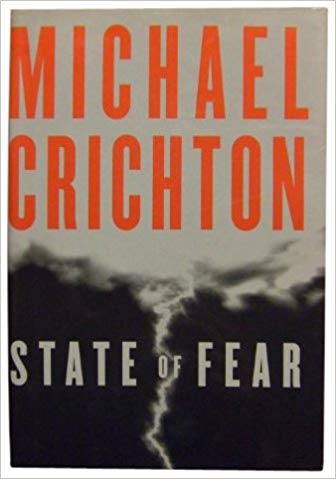
“State of Fear” by Michael Crichton

StateofFear

I always enjoy a good Michael Crichton book. While this one wasn’t my favorite, considering some of his other titles such as Jurassic Park or Timeline, it was nonetheless excellent. This hardback had been sitting on my shelf for literally years; given the book’s copyright is 2004, no telling how many. I live in a house that was once my family’s vacation home, so I have no idea who may have left it here. One day recently, its dust-covered binding caught my eye from its position on the bottom shelf and I decided to read it.

It’s rather amazing how the story and premise really haven’t gone out of date in fifteen years. Essentially, it’s an exposé of the science (or lack thereof) of global warming. We’re still obviously hearing about this today. It has changed names a few times, now currently referred to as “climate change”, but it’s one and the same. Clearly, Crichton was expressing strong, well-substantiated opinions regarding how science and politics are a very bad combination, which he presents in the form of a gripping, conspiracy techno-thriller.

One thing that really irritates me as a reader is when an author doesn’t do his or her homework as far as research is concerned. When I encounter scientific inaccuracies in a story they are a major turnoff. They throw me out of the story immediately and scream “amateur” on the part of the author, who clearly didn’t respect his readers enough to do the research. No one can ever accuse Crichton of this faux pas. This book took three years to research and, believe it or not, has twenty pages worth of bibliographic material as well as footnotes to scientific journals throughout that are real. I’m afraid that few readers appreciate that as much as I do, which is a shame.

Even though this book has been around for a decade and a half, it’s still worth reading. I suspect that little has changed scientifically. It should be read with an open mind, considering all sides. Crichton’s opinions regarding the volatile mix of science and politics are definitely worth noting; nothing has changed there, either. I, for one, have grown weary of everything being about money and corporate profits.

I want to point out that I am not “Red” or “Blue” in a political sense, but rather some shade of purple; there are elements of both platforms with which I agree. I don’t believe in blatant handouts at the expense of hardworking people, but I also believe in treating Mother Earth and all her creatures with respect. I also believe people’s health and well-being are more important than greedy corporate giants who place whomever they want in political office with their campaign contributions to assure maximum profits.

I love a novel that not only entertains, but informs and educates the reader, something Crichton did in spades. I am so sorry he is no longer with us, turning out these well-written, well-researched page-turners. I suppose in some ways this story is overshadowed by the issues it exposes, making some conversations a bit pedantic. However, 20 pages of bibliography deserves considerable respect. This is a very thought-provoking story that highlights an issue that is as relevant today as it was in 2004. Whichever side of the argument you may espouse, you should read it. The bibliographic material–count it, 20 pages worth–speaks for itself.
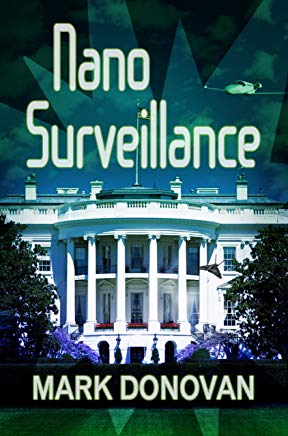
Nano Surveillance by Mark Donovan

nanosurveillance

This story was well-developed as far as the conspiracy thriller plot and technology were concerned. The author clearly knows his stuff about a variety of topics including flying and surveillance technology where the details enhanced the story’s credibility and imagery. While this expands into the realm of science fiction (at least for now) it was believable, which is required of good fiction–even fantasy needs to be believable to work.

The political intrigue was right out of the headlines and well developed as well, but leans heavily toward the conservative, so bear that in mind, too. In other words, if you lean to the left you probably won’t like it, period. The plot is loaded with suspense, kept moving, and would make an excellent action movie.

However, there were a few things that kept it from being great, primarily the desperate need for editing. The story demonstrated imagination and knowledge of technology,  but strong writing skills are necessary to engage the reader. I found the lack of flow made it awkward, even  painful to read. While, to the author’s credit, there were only one or two typos, there was far too much reliance on prepositional phrases. There were also numerous instances of homonym misuse and incorrect punctuation, particularly in the dialog. When the style (or lack thereof) throws the reader out of the story on a regular basis, it’s distracting as well as disappointing.

I want to stress there was nothing grammatically “wrong” with the writing. It simply didn’t employ the complex sentence structure that demonstrates strong writing skills. If it had, this thriller could have been a five-star read; as it stands, I’d give it three stars. In other words, by investing in editorial help or some advanced writing classes, this author could produce an outstanding story, perhaps even a best seller.

Tequila Rose Virginity Blues by Wendy Jayne

TequilaRoseVB

If you’re a regular here at my blog you’ve probably noticed my lack of book reviews for quite a while now. This is because I’ve been writing a novel with most of my reading research which has occupied my time and brain. However, it’s time for me to take care of a backlog of reviews, which you’ll see over the next few days.

This particular one is a short story that I finished in less than an hour. It was a total hoot that had the best descriptions of a hangover I’ve ever read. It practically gave me a headache, LOL. Not only is it an entertaining story of someone who had a few too many and can’t remember what happened, it’s also an outstanding study in the effective use of similes. Thus, if you read my Writer’s Tips, saw the one on similes, and need some help understanding what they are, then by all means read this cute story. Along with general outstanding writing, this author has similes down to a science.

Set in a small town in New Zealand, the pictures of this quaint place the author included in the back were a nice bonus. In fact, you might want to look at them before you read the story to further enhance the imagery. This is a great beach read or when you need a light, humorous dose of one woman’s experience with too much booze and meeting the mystery man of her dreams.

You can pick up a copy on Amazon here. If you have Kindle Unlimited, read for free.

Today’s Writing Tip

alphabets-copy

Read a variety of books and genres, those written by those more skilled than yourself as well as those less skilled. You can learn something from both. Sometimes the glaring errors of most amateur writers call attention to some silly thing you do yourself, but have been blind to. It also allows you to see how far you’ve progressed. To paraphrase a favorite quote, “No book is ever wasted. You can always serve as a bad example.”

However, it’s important to read well-written stories as well. A steady diet of poorly written stories may help you identify pitfalls so you can eliminate them, but that alone won’t make you a better writer. If anything, it will make you a frustrated reader. Nothing takes the joy out of a good story faster than when it’s poorly written.

Believe it or not, you can pick up a certain amount of writing skill by osmosis, simply by repeatedly exposing your brain and subconscious to strong writing. However, a well-written story that flows well sucks you in, but you probably would have a hard time explaining why it worked. It’s a lot easier to see something that doesn’t work when you trip over it. But you’d be surprised how you can assimilate those skills.

As with so many things, variety is the spice of life.

Today’s Writing Tip

technology-copy

The usual convention is to start your story with the main character. That way,  your reader immediately knows who the story is about. Prologues are the only exception. If something occurs before the main story begins that involves another person, often a prologue functions well to present that information.

Sometimes another character comes along who is so strong, that he or she takes over the story. It’s okay to have several strong characters in a story, but who does it really belong to? This is not always easily answered. Sometimes two characters come together who have separate story arcs. I don’t have all the answers to that situation and am dealing with just that in my current WIP.

However, if someone else clearly takes over, leaving your original main character/protagonist in the dust, then it’s time to reconsider who your protagonist really is. If it changes dramatically, you may have to go back to Chapter One and introduce that person first.

Main characters in complex stories with well-developed plots are not always that easy to identify. How often has your favorite character in a book been someone other than the protagonist? Side and back stories are always an option with these folks as well.

Today’s Writing Tip

technology-3 copy

I know I nag a lot about what the author’s job entails. If you’re fortunate enough to have a conventional publisher who provides a cadre of competent editors, then you may have the luxury of simply putting your story down for them to clean up, much as your mother may have done your laundry or cleaned up your room when you were a child.

However, if you’re an independent author, you need to be aware that proper grammar, word usage, punctuation, and so forth is YOUR JOB. Even if you hire an editor, unless you understand there are several types of editors, your work may not be at its best when it goes to press.

One thing that occurs frequently is misuse of homonyms. These are words that sound the same, yet have entirely different meanings. You can find a great list of common offenders as well as words that are often confused on Grammarly here.

Some of my pet peeves are shutter (those louvered, wooden panels you see on windows) versus shudder, which is to shake or tremble; Hanger (what you put your clothes on in the closet) versus hangar, (a building for aircraft storage); their (possessive pronouns for they) versus there (place) versus they’re (contraction for they are); lead (a type of metal or the graphite in a pencil) versus led (past of the verb to lead); whose (possessive pronoun) versus who’s (contraction for who is).

Check out the list on Grammarly. If those terms aren’t firmly implanted in your brain, bookmark the page for future reference.

Today’s Writing Tip

paper-copy

Flashbacks can be tricky and confusing to a new writer. How to construct them is really quite simple. You introduce flashbacks with past perfect tense, then revert to simple past for duration.

For example, “She’d always known they were an item when their eyes had first met.” After that, you would go to simple past, i.e.: “She remembered that first time clearly, as it stood out so dramatically….” Continue is simple past for the duration of the flashback.

Then, when it’s over and you come back to the present story action, use past perfect again. For example, “That moment would always mean a lot as it had signaled from the start that it would be a special relationship.”

Today’s Writing Tip

paper-2 copy

Use active voice as much as possible. If you don’t know what that means, “The boy threw the ball” is active voice.  “The ball was thrown by the boy” is passive voice. Who is performing the action versus what or who is receiving the action?

Not that active voice also eliminates a preposition. The sentence is more clear and there are less unnecessary words. Tighter writing is better writing.

Today’s Writing Tip

nobody-copy

Another skill that separates the pros from the amateurs is comma usage. Personally, I don’t know all the specific grammar rules that apply. There are also a multitude of usage opinions. I actually had an English professor in a university level grammar class tell us they were optional! If he were still alive, I would write him a strongly worded letter regarding why he was all wet.

Granted, there are some who could be called “comma fanatics.” For example, there’s a lot of controversy over what is known as the “Oxford comma.” Most people seem to understand that the elements in a series need to be separated by one. However, whether or not to place one directly before the “and” that precedes the final item is less clear. Most readers can deal with that situation one way or another.

However, with complex sentences, commas help keep the statements from running together. Think of your dinner plate, how most people prefer to keep the meat, potatoes, vegetables, and anything else separated, as opposed to being all slopped together. Commas do this for long sentences, keeping the thoughts separated and more coherent.

Another classic example of how commas change meaning is “Let’s eat Grandma” versus “Let’s eat, Grandma.”

Without knowing all the rules, one way to tell intuitively where a comma belongs is to read your final edit aloud. Where a pause is necessary for clarity is usually a good place for one.

Today’s Writing Tip

notes-copy

Redundancy is another thing that can slow a story down. One part of speech that helps avoid repetition of a character’s name is the pronoun. You don’t need to keep repeating the character’s name. This is where he, she, it, and they as well as possessive pronouns like his, hers, its, and their come into play.

If a paragraph only involves one person, by all means, don’t keep repeating his or her name. If there are two people involved of different genders, then he and she will work fine. If there are two people of the same gender, then it’s more complicated. If it’s not clear, then it is sometimes justifiable to repeat names.

I read an absolutely dreadfully written story a few years ago where the protagonist was alone, no one else within miles, yet the author repeated his name with nearly every sentence, paragraph after paragraph. It was tedious to the point of being offensive, as if the reader wasn’t intelligent enough to figure out who was doing what.