
Welcome to the WATCH “#RWISA” WRITE Showcase Tour! #RRBC #RRBCWRW

Blog Tour Banners

Welcome to our tour! Each day this month I’ll feature a writing sample from some of the incredible authors who are members of this elite writing group. To learn more about them and their work, follow the link at the bottom of the page. Today’s featured author is Bernard Foong.

bernard-foong

Stop Worrying

“Worry does not empty tomorrow of its sorrow. It empties today of its strength.

 –Corrie Ten Boom

Simpson’s-in-the-Strand, London, England

I was delighted to see Uncle James after several months of absence. The evening before my mother’s arrival in London, I had a heart-to-heart talk with my English guardian. He had kindly invited Andy and me to sup with him at one of London’s oldest English establishments – Simpson’s-in-the-Strand.

“What is worrying you, boy?” Uncle James pressed. “You know you can ask or tell me anything. I promised your mother that I’ll do my best to assist you, while you are in my care.”

Touched by his kindheartedness, I muttered, “I know my mother is in London to whisk me away from Andy. She’d gotten wind that I am having a homosexual affair with a boy. Is that true?”

My guardian gave a hearty laugh. “That is indeed true, and it was I, who told her about Andy. Most importantly she is here to see her darling son and to meet his mannerly beau.”

“If she intends to get to know Andy Why is she bolting me, with her female entourage to Europe for two weeks?” I questioned.

“She misses her son and wants to spend time with you,” my guardian answered on my mother’s behalf.

“Knowing my relatives, they’re likely to convince her that my homosexuality is a sin,” I countered.

James acknowledged. “Although that is true, you should evince to them that you have come into your own and you have the right to love whom you choose. Young, positive actions will always speak louder than words.

 “Your mother is a worldly and a well-traveled woman. She understands you more than anybody else, besides Andy.”

“It’s hard not to worry,” I opined.

Andy, who had thus far remained quiet, expressed, “My dearest, the answer lies in your beliefs in the negative and the positive about worrying. On the negative side, you may believe that your worrying is going to spiral out of control, which will drive you crazy, and may damage your health.

“On the flip-side, you may believe that your worrying will help you to avoid bad things; like preparing you for the worst and then coming up with solutions. In my opinion, your worrying shows you’re a caring and conscientious person.”

Uncle James denoted, “Andy is in part correct. Negative beliefs or worrying about worrying add to your anxiety.

“But, positive beliefs about worrying can at times be damaging. It’s tough to break the worry habit if you believe that your worrying protects you. To stop worrying, you must give up your belief that worrying serves a positive purpose. Once you realize that worrying is the problem and not the solution, you can regain control of your worried mind.”

He paused before he rejoined, “Young, you can train your brain to stay calm and look at life from a more positive perspective.

“Let me cite you an example: daily, I have tough decisions to make as the CFO of The Hong Kong and Shanghai Banking Corporation, and it is not easy to be productive if I allow worries and anxiety to dominate my thoughts….”

My Valet asked before my uncle could finish. “What techniques do you use to rectify that, sir?”

James responded smilingly, “It doesn’t work to tell myself to stop worrying; at least not for long even if I can distract myself for a moment. I can’t banish those anxious thoughts for good. Trying to do that often makes these thoughts stronger and more persistent. 

“Thought stopping often backfires because it forces me to pay extra attention to that very thought I want to avoid, thereby making it seem even more important. However, that doesn’t mean there’s nothing I can do to control worry. This is where the strategy of postponement of worrying comes in. Rather than trying to stop or get rid of the anxious thought, I give myself permission to have it, but I put off dwelling on it until later.”

He took a breather before he resumed, “Postponing worrying is effective because it breaks the habit of dwelling on worries when I’ve other more pressing matters to attend to, yet there’s no struggle to suppress the thought or judge it. I simply save it for later. As I develop the ability to postpone my anxious thoughts, I realize that I have control over them.”

Andy inquired curiously, “How do you stop thoughts of worry from reemergence by deferment?”

The CFO answered, “There are three steps I take to accomplish this goal. 

“First, I create a ‘worry period.’ I choose a set time and place for worrying. For me, it is from 6:00 to 6:30 PM so that it is early enough for me to not be anxious before dinner and bedtime. During my worry period, I allow myself to worry about whatever is on my mind, while the rest of the day, is a worry-free zone.

“If an anxious thought comes into my head during the day, I make a brief note of it and then continue about my day. I remind myself that I will have time to think about it later. Therefore, there isn’t any need to worry about it for now.

“Lastly, I go over my worry list during the appointed worry period. If the thoughts I had written continue to bother me, I allow myself to worry about them. But only for the time I’ve set aside for my worry period. If those worry thoughts don’t seem important anymore, I cut short my worry period to enjoy the rest of my evening.”

My Valet exclaimed, “What a brilliant way to deal with worry and anxiety.”

James gave an acceding nod and added, “You see, worrisome thoughts and problem-solving are two very different things. Problem-solving involves evaluating a situation, before coming up with concrete steps to deal with it, and before putting the desired plan into action. 

“Worrying, on the other hand, rarely leads to solutions. No matter how much time I spend dwelling on the worst-case scenarios, I am no more prepared to deal with them should the actual event happen.”

I queried, “How then, do you distinguish between solvable and unsolvable worries?”

“Young, It is much easier than you think. If a worry pops into my head, I start by asking myself if the problem is something I can actually solve. I ask myself these questions: 

Is the problem something I am currently facing, or an imaginary what-if? If the problem is an imaginary what-if, how likely is it to happen? Is my concern realistic? Can I do something about the problem to prepare for it, or is it out of my control?”

He sipped his wine and continued, “Productive, solvable worries are those I can take action on right away. For example: if I’m worried about my bills, I could call my creditors to see about flexible payment options. 

“Now, unproductive, unsolvable worries are those for which there is no corresponding action. Like: What if I get cancer someday? Or what if my kid gets into an accident?

“If the worry is solvable, I start brainstorming by making a list of all the possible solutions I can think of. What I try not to do, is get hung up on finding the perfect solution. I focus on the things I can change, rather than dwell on the circumstances or realities beyond my control. After I’ve evaluated my options, I draw out a plan of action. Once I have a plan, I can start to do something about the problem. This way I feel less worried.”

My lover questioned, “How do you deal with unsolvable worries or a worry I cannot solve?”

“Andy, you’re not a chronic worrier, but if you are, it is vital for you to tune into your emotions. In the majority of cases, worrying helps a person avoid unpleasant emotions. Worrying keeps one in one’s head – like thinking about how to solve problems rather than allowing him or herself to feel the underlying emotions. Yet, one cannot worry one’s emotions away. While a person is worrying, his/her feelings are temporarily suppressed. As soon as the worrying stops, the feelings bounce back. Then, the person start worrying about his/her feelings, like: ‘What’s wrong with me? I should not feel this way!’” James paused when our waiter fill our wine glasses.

When he departed, my uncle resumed, “It may appear alarming to embrace one’s emotions because of a person’s negative belief system. For example, I may believe that I should always be rational and be in control and that my feelings should make sense. Or I shouldn’t feel certain emotions, such as fear or anger.

“The truth is that emotions, like life, are complex. They don’t always make sense and are not always pleasant. But as long as I can accept my feelings as part of being human, I will be able to experience them without being overwhelmed, and I can learn how to use these emotions to my advantage.”

I remarked, “Uncle, it is difficult to accept uncertainties when I don’t know the outcome.”

“That is indeed true. The inability to tolerate uncertainty plays a huge role in anxiety and worry. Chronic worriers cannot stand doubt or unpredictability. They need to know with a hundred percent certainty what is going to happen. Worrying is seen as a way to predict what the future holds, to prevent unpleasant surprises, and to control the outcome. The problem is, it doesn’t work.

“By thinking about all the things that could go wrong doesn’t make life any more predictable. You may feel safer when you’re worrying, but it’s just an illusion. Focusing on worst-case scenarios won’t keep bad things from happening. It will only keep you from enjoying the good things you have in the present. My dear boy, if you want to stop worrying, start by tackling your need for certainty and immediate answers,” my surrogate dad counseled.

“Worrying is usually focused on the future, on what might happen and what you’ll do about it. The centuries-old practice of mindfulness can help you break free of your worries and redirect your focus back to the present. This strategy is based on observation and release, in contrast to the previous techniques I mentioned; that of challenging your anxious thoughts or postponing them to a worry period. Merging these two strategies together will help you to identify the roots of the problems and will assist you to be in touch with your emotions.

“By not ignoring, resisting, or controlling them, and through acknowledgment and observation of the anxious thoughts and feelings, one then views the worrisome thoughts without immediate reactions or judgments, from an outsider’s perspective.” 

 “My dear fellas, let go of your worries. When you don’t control your anxious thoughts, they will pass; like clouds moving across the sky. Stay focus on the present, pay attention to your ever-changing emotions, and always bring your attention back to the present,” my surrogate dad reassured as our English roasts arrived for us to dig in.


Thank you for supporting this member along the WATCH “RWISA” WRITE Showcase Tour today!  We ask that if you have enjoyed this member’s writing, please visit their Author Page on the RWISA site, where you can find more of their writing, along with their contact and social media links, if they’ve turned you into a fan.

We ask that you also check out their books in the RWISA or RRBC catalogs.  Thanks, again for your support and we hope that you will follow each member along this amazing tour of talent!  Don’t forget to click the link below to learn more about this author:

Bernard Foong’s RWISA Author Page


How would you like to become a RWISA Member so that you’re able to receive this same awesome FREE support? Simply click HERE to make application!

 

Welcome to the WATCH “#RWISA” WRITE Showcase Tour! #RRBC #RRBCWRW

Blog Tour Banners

Welcome to our tour! Each day this month I’ll feature a writing sample from some of the incredible authors who are members of this elite writing group. To learn more about them and their work, follow the link at the bottom of the page. Today’s featured author is Rhani D’Chai.

rhani-dchae

THE WEEK MY FATHER DIED

by Rhani D’Chai

I was at work when my mother called to tell me that dad had been rushed to the hospital the night before, suffering from excruciating pain in his abdomen.

Dad had been diagnosed with prostate cancer about fifteen years earlier and it had spread to other parts of his body, but he had been doing fairly well so there was no reason to anticipate something like this.

Mom told me that dad had spent quite a bit of time at the hospital while they ran numerous tests to discover the cause of his pain. Long story short, his kidneys were failing and there was nothing that could be done. He was sent home with a hospice nurse, so that he could be with his family in comfortable surroundings when the end came.

We rented a hospital bed and put it next to the front window so that he could see outside into the yard. We kept instrumental hymns playing on the stereo and moved mom’s chair closer to the bed so that she could be nearer to him.

And that’s when things started to get a little crazy.

James, my seeing eye son, was living with mom and dad at the time, and my sister, who I was living with at the time, drove out with me every day.  Gail, my other sister, also came out daily, as did her husband, her four children and their collection of young ones.

Gail’s grandkids were all under ten and did not really understand the severity of the situation. They knew that Papa was going home to see Jesus, but that was about as far as it went. Gail’s family had never lived close to mom and dad, so their kids only saw my parents three or four times a year. None of them had a close relationship with dad, so the thought of losing him did not rate overly high on their radar.

For five days, the kids ran through the house, slamming the doors and yelling to each other. Even when they were sent outside, the noise was loud enough to be heard everywhere in the house. Their respective parents would occasionally tell them to tone it down, but they were kids and that’s what kids do.

At one point, one of my nephews-in-law decided to commemorate the occasion by putting it on film. He videotaped everyone going to my father’s side and saying goodbye. Maybe it was the stress of the situation, but I didn’t like what he was doing. My father’s death was not a photo-op, and I resented anything that made it seem that way.

I remember being called into the living room and told to say something to dad. I had already spoken to him several times, telling him that I loved him and assuring him that mom would be taken care of. Having my niece’s husband dictate to me where to stand and how long to talk so that he could get it on film, was infuriating.

As six families moved through the house each day, my mother spent most of her time sitting with dad, reading the Bible to him and making the most of the time that remained. She loved having her family close, but as the days passed, I could see that the noise and constant disruption was getting to her. I did speak to my nieces individually on several occasions, asking if they could please keep the kids quiet, at least in the house. They always said they would, and I know that they meant it at the time, but it never happened. The noise, the chasing from room to room, and the constant interruptions into my parents’ private space, continued. I could see that it was upsetting my mother, and I finally decided to put my foot down.

I took my mom and Gail into the bedroom and asked mom what she wanted or needed. She thought about it for a long moment and then said, very simply, that she wanted to answer the phone. Either Gail or one of her daughters had been taking the phone calls and making a list of the callers. Mom wanted to speak to those people, most of them from her church, and was upset that she was not being allowed to do so. And she wanted the volume around her to be turned down to a much less disruptive level.

Gail said that she would take care of it, and she did. Within hours, her grandkids had been taken by their fathers to another location. I didn’t know where they went, and I didn’t much care. They were gone, the house was quiet, and that was all that mattered to me.

Later in the day, James, my other sister Sharon and I, took mom to Cold Stone for some ice cream. Dad was fairly unresponsive by then, so she felt that it was okay to take a little break.

We were gone for about an hour, and by the time we got back, everyone else was back as well. But at least mom had a few hours of uninterrupted time with dad, and I’m so grateful that the girls understood and were willing to do what was needed to give her that.

My father passed that night, surrounded by family and carried home on the sound of our voices singing his favorite hymns. Standing in a semi-circle around the bed, we held hands as we sang, while my brother-in-law, a minister, laid his hands on my father’s head and prayed him home.

As cancer deaths go, my father’s was fairly quick. He had been fully functional up until the night he went to the emergency room, enjoying his life without much discomfort. He avoided the long hospital stays and horrific pain that are so often a part of that kind of death. My aunt Gloria died of lung cancer when I was eighteen or so. I went to see her in the hospital, and I remember a shrunken figure in the bed, hooked up to monitors and numerous IV lines. Her time of dying took several long and torturous weeks, and I will always be thankful that my father was spared a similar end. I would have hated to have my last memory of this strong and vital man, be that of a wasted shadow of the man that he had always been.

I thank the Lord that it didn’t go that way.


Thank you for supporting this member along the WATCH “RWISA” WRITE Showcase Tour today!  We ask that if you have enjoyed this member’s writing, please visit their Author Page on the RWISA site, where you can find more of their writing, along with their contact and social media links, if they’ve turned you into a fan.

We ask that you also check out their books in the RWISA or RRBC catalogs.  Thanks, again for your support and we hope that you will follow each member along this amazing tour of talent!  Don’t forget to click the link below to learn more about this author:

Rhani D’Chai’s RWISA Author Page


 How would you like to become a RWISA Member so that you’re able to receive this same awesome FREE support? Simply click HERE to make application!

Today’s Writing Tip

write-2 copy

Make it easier for potential readers to find your book by making sure its BISAC code is correct. There are several which include numerous sub-categories as well. They’re not always easy to search since they’re often not in any discernible order.

BISAC stands for “Book Industry Standards and Communications” which are subject headings developed by the Book Industry Study Group (BISG).  To quote from Wikipedia, “BISG has been involved with technological advances such as bar codes and electronic business communications formats. It developed BISAC (Book Industry Subject and Category) Subject Headings, which are a mainstay in the industry and required for participation in many databases.”

These categories have numbers followed by tiers of description that look something like this:

FIC027130 Fiction / Romance / Science Fiction

FIC028000 Fiction: Science Fiction – General

CGN004190 Comics & Graphic Novels: Manga – Science Fiction

If you’ve listed your story with a distributor or sales site, you’ve most likely been asked for its BISAC. The question is whether or not you selected the correct one? With hundreds to choose from, it’s possible you didn’t bother to scrutinize the listing carefully enough to find the best fit for your work. I have found, much to my frustration, that when they’re listed as a pull-down menu, such as on sites like Google Play, ironically they don’t appear to be in any order! Thus, the temptation is to pick the first one that sounds even remotely like you story. It doesn’t really matter, does it?  Wrong!

Considering that there are millions of books out there, it doesn’t take a rocket scientist to figure out there needs to be a way to classify and organize them. Librarians have been doing this for years through Library of Congress designations and/or the Dewey Decimal System for non-fiction. However, if the BISAC Subject Headings are “making inroads into library classification” as suggested by Wikipedia, then it’s important that you recognize what they are and why they’re important.

Still wondering why should you care? Here’s why: Because if you’re an author, the proper classification of your story can make the difference of whether or not your readers find it.

There are hundreds of categories for fiction alone. You can find a complete listing of codes on the BISG website. Note that this organization has been around since the 1970s and is located in the heart of the traditional publishing industry in New York City. This is an organization you should take seriously.

Being an Indie author means having to learn how to navigate the particulars of the publishing industry, often with less than even a crash course. BISAC subject headings are one aspect of it that’s a mystery to most Indies, yet could have a direct bearing on your sales. For example, if a book store or library wants to purchase a specific genre based on patron requests, if your books fits like the proverbial glove, won’t you want them to find it?

I rest my case.

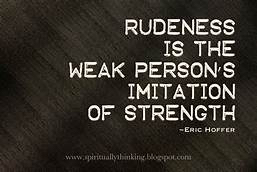
Rudeness is in the Mind of the Beholder

rudeness

While in principle, I agree with this meme, I also think it’s too general to be accepted without a huge caveat. And I mean HUGE. Like on the scale of the Grand Canyon. Rudeness is so subjective that in many respects it defies description. For example, what constitutes rude to someone in Atlanta may be business-as-usual for someone in Brooklyn. Certain ethnic groups likewise have vastly different standards of behavior. What’s offensive to someone from England will be entirely different than a native of Italy.

Okay, before I go any further, please note that I’m talking about the subjective interpretation of rudeness. I’m not talking about when a person is confrontational. That’s an entirely different situation, which fits the above meme much better, but the words don’t flow quite as nicely. Maybe part of the problem is so many people don’t know the difference.

There have been numerous references to individuals referred to as “snowflakes” lately, a term I didn’t fully understand until I happened upon its definition: Someone who is easily hurt or offended. Aha! Makes perfect sense–someone whose ego is so fragile that they figuratively “melt” when they encounter something contrary to their personal paradigm.

I was raised that it was foolish to take offense when none was intended. In other words, sometimes you won’t like something a person says, perhaps because they’re a bit too outspoken or raised with a different standard of what equates to “rude” behavior.  Remember Dorothy on “The Golden Girls?” Her behavior could certainly be considered “rude”.

However, if it was not intended as a slam, insult, or challenge, then it seems foolish to get your panties in a wad. Some people are programmed that way, aren’t even aware of it, and seldom mean it as perceived. Or maybe they meant it at the time, but overreaction on your part can result in a rift that never closes. By the next day the offending party may have already forgotten about it while you’re just getting started nursing a grudge. It takes two, remember?

While rudeness is indeed in the mind of the beholder, it’s important to consider whether that judgment is correct. A person’s reaction is also in their court. There are those who are so easily hurt or offended that you cannot relax around them, but tiptoe on eggshells so as not to ruffle their precious feathers. Such people go off in a huff if you offend them, yet you may not even know why. So who’s at fault? Whose responsibility is it? Who’s the bigger person, or in the case of the meme, the stronger person? The one who was “rude” or the one who didn’t react?

The world has enough whiners and martyrs out there who apparently never learned in elementary school that “Sticks and bones may break my bones, but names will never hurt me”. Even if a person IS being overtly rude, how you react is your responsibility. In that case, why give them the satisfaction of reacting? Who’s the stronger person then?

To be fair, just as some are programmed to be outspoken or lack a tact filter, some are programmed to be more sensitive. To those individuals author Karen Ingalls presents an excellent suggestion in her book “Outshine”, which chronicles her bout with ovarian cancer. She writes, “What we say may not always come out the way we intended. It creates an opportunity for the receiver to bring comfort to an awkward or embarrassing time with smiling and laughing rather than with defensiveness or anger. Sometimes what seems like an insult is actually a compliment that just came out the wrong way.”

Furthermore, many instances of being offended and/or suffering from hurt feelings can be avoided by giving the alleged offender the benefit of the doubt. Jumping to conclusions will often create problems that could have been avoided.

Rather than judging everyone out there and expecting them to conform to your rules, it  pays to assess your own response. Take responsibility for the one and only individual in the known universe whom you can control–yourself. If you need some additional help, I suggest listening to this 1994 classic from the Eagles. Several years ago when I was a manager at NASA, my group had a sing-a-long with these lyrics at one of our staff meetings. Try memorizing the melody, then hum it the next time someone gets your goat.

It’s the classic answer to being too easily offended: Get over it.

Today’s Writing Tip

technology-copy

Perfect people are boring, the same with those that are too predictable and have their lives entirely together. You don’t want your readers to get bored reading about your character, so they need to have some issues. Even if they’re a very strong person, then they need to have a challenge before him or her that tests that strength.

However, don’t make your characters such a piece of work that they’re off-putting to readers. I have read books where the character, or at least one of them, was so dysfunctional that I was rolling my eyes and wanted to slap this person upside the head. I came very close to not reading any further, except I usually give a book about three chapters before I ditch it.

Interesting characters and plots are essential and character growth through the story is essential, but remember, if your reader doesn’t like or can’t relate to him or her at all, they may quit reading.

Today’s Writing Tip

technology-3 copy

How many award winning books have you read? These are great reference points for what constitutes not only a good read, but excellent writing. Don’t just read them for enjoyment, study them for what makes them special.

When a book wins an award or is a finalist, the author is given a seal or medallion that recognizes their status, which they place on their book cover. Thus, you can tell by looking at the cover if it’s been given an award. Another way to find them is to go to the websites for the organizations that provide awards. If you don’t know where to find them, here are a few, though there are numerous others: ReadersFavorite.com; BookExcellenceAwards.com; NewAppleAwards.com.

If you think your book is top notch, enter one of these and get a professional opinion. However, bear in mind that as with all reviews, there’s a level of subjectivity. I know one author who got blasted by one of these and awarded the top award for the same book by another. Nonetheless, it does provide a baseline.

Today’s Writing Tip

paper-copy

Mercury retrograde is a great time for editing and bad time for starting a new project.  While this prognostication is astrological in origin, it’s often a time when skeptics start to recognize there may be something to it. Astronomically, it means that the planet Mercury is moving backwards in the sky. Of course this isn’t true, only by appearance, similar to when you’re passing another car on the freeway and it appears that the other car is moving backwards when you are actually moving away from it.

Astrologically, since Mercury rules communications of all kinds as well as anything that moves, this is not when your brain, electronics, or anything mechanical is functioning properly. Computer, automobile, and appliance problems are common at this time as well as communication problems at the people level. This is a time to go back and review, revise, reconsider, and reassess while starting something new is likely to not go anywhere ever or, at best, be delayed.

This usually happens three times each year. The next one will be from November 17 – December 6, 2018, but to be safe, avoid new projects from October 29 – December 25. Put this time to good use by editing and revising as opposed to new copy.

Today’s Writing Tip

paper-2 copy

Many authors will tell you, including myself, that book blurbs are harder to write than the book itself! After creating numerous characters, devising a complex plot, and describing the time and place over hundreds of pages, distilling this down into a few sentences is no easy task.

Some great advice from author Nicholas Rossis that he passed along in a recent writers conference stated that the main elements to include are your main character, what s/he wants, what’s in the way, and the consequences of failure. Whatever you do, don’t include any spoilers or too many extraneous details. You want the reader’s curiosity to be aroused enough for them to want to read the story.

Today’s Writing Tip

nobody-copy

Do you fully understand what it means to show versus tell? Your reader should experience the story through the eyes of your characters, up close and personal, not as an observer from afar.

When you tell a story, there is little to no reader engagement at the emotional level. They may be able to sympathize with the character or relate story action to their own experience, but they do not feel as if they’re part of the story or that they really know the characters.

Showing involves rendering the same feeling in your reader as your character is experiencing, whether it’s love, joy, fear, sadness, grief, anger, etc. You are not going to be able to do this with a single word or sentence. If you ever find yourself using the word “feel” in any of its conjugations, stop right there. For example, saying, “He felt angry” simply doesn’t do it. However, if you describe how he really felt, such as his heart rate increasing, hands shaking, mind racing, tension in his muscles, or thinking that he might explode, then you’re showing.