A Vivid Backstory for Bible Lovers

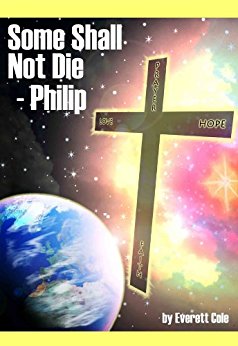
someshallnotdiecvr

Some Shall Not Die — Philip

by Everett Cole

This story is an excellent example of well-executed Christian fiction.  The characters are well-developed, the research is outstanding, and it’s not preachy. Clearly, the main character, Philip, is passionate about sharing the Gospel of Jesus Christ, but he does it in a natural, compelling manner. If you’re a Christian, you’ll find your faith strengthened by Philip’s quoting of Biblical verses and intrigued by how much of this story is historical truth and how much is fiction, as the two are blended beautifully.

As stated in the introduction, the premise is based upon a statement made by Jesus Christ and recorded in the Bible that promised that some of his disciples wouldn’t taste of death until Jesus returned. The story recounts the mission of Philip, one assumed to be one of these chosen few, and starts when he’s in Britannia, i.e. today’s United Kingdom, as his companion, Barnabas, dies. Following that event, he’s summoned to a meeting with the other disciples so he leaves to return to mainland Europe. He winds up in a small village in Northern Italy and become involved with the various citizens of a town called Martigny.

If you’ve ever wondered what it was like for these early Christian missionaries, this story will take you there. It’s a great history (and geography) lesson with regard to travel at that time as well as the Roman Empire’s influence. Threats early Christians faced, not only from the Romans, but the Druids as well as hoards of barbarians, who resented the Roman invasion of their land, are clearly explained. Living conditions of the time are well-represented, as well as the simple nature of the majority of people, who were mostly illiterate. This enjoyable story takes you on a fascinating journey and provides a powerful glimpse of what it was like to be one of the early Christians. While fictitious, it nonetheless will provide fascinating context to your comprehension of the New Testament. For that, I highly recommend it, especially since it’s suitable for family reading time if you or your children’s eyes glaze over when reading the actual scriptures.

As a Christian myself, but also a professional astrologer, I wasn’t surprised when the primary antagonist was an astrologer and mystic. Of course there have always been charlatans, but I can’t resist mentioning that if it weren’t for the Magi’s knowledge of astrology, they never would have found Jesus or recognized his significance. The Bible tells us to expect signs in the heavens (as well as in the Earth beneath), the recognition of which in the majority of cases will require a knowledge of astrology. What better way to keep people in the dark than to forbid such knowledge? Furthermore, all the Bible says against astrologers is that they’re not as powerful as prophets and are not intended to replace them.

To set the record straight, it was actually the Roman Empire who did all it could to keep astrology out of the hands of those who weren’t in the highest echelons of society; they wanted to control the common people and what they knew. Individuals are never encouraged by emperors and/or dictators (or even popes) to think for themselves.  Given the heavy influence on Christianity by the Romans, it’s no wonder that this false tradition has persisted in Christianity to this day.

I have found astrology to be so elegantly detailed and precise that it could have no origin other than from God, who created the stars and planets in the first place. Thus, how could their message not be from Him? A knowledge of astrology was required of those considered learned for centuries, but ironically fell out of favor during the Enlightenment, when most things spiritual in nature were dismissed as either nonexistent or of the devil when they couldn’t be proven with hard data.

The Sefer Yetzirah, the book of the Letters of Abraham, contains a wealth of information related to Jewish mysticism and Kabbalistic traditions. Astrology is mentioned in great detail. along with the statement that Abraham was the greatest astrologer of all time. It seems to me that’s a pretty high recommendation. Like so many other gifts given to man by our Creator, its use has been misunderstood and maligned to keep us from recognizing signs in the heavens and the many insights it can provide into our personal lives.

You can pick up your copy on Amazon here.
A Touching Autobiographical Account of One Woman’s Journey

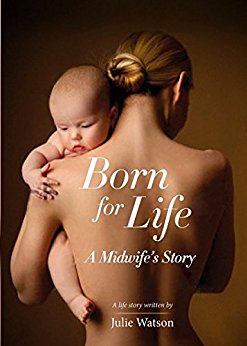
borntolifecvr

Born for Life: A Midwife’s Story

by Julie Watson

This book is the autobiographical account of a woman who was involved in childbirth much of her life. It took me a while to figure out where it was taking place, which I knew wasn’t the USA, but wasn’t sure where until it was stated eventually that it was New Zealand. That explained some of the terminology which was unfamiliar, but nonetheless, I could relate to this book on many levels.

First of all, as the mother of six children, I’ve been through the birth process personally enough times to understand much of what was recounted for numerous birth experiences. I suppose one I had that wasn’t mentioned was a posterior presentation. I was also surprised that women in labor whose membranes had ruptured were allowed in a bath, something that was a major no-no here in the USA. Other than that, most was familiar, other than names of different medications.

You really got to know the author through her experiences, some of which were heartrending, which of course life can be at times, especially with something as intense and life-changing as childbirth. She started out at the tender age of 16 as a nurse’s aide, then eventually later in life went to nursing school and certified as a midwife, which she’d dreamed of doing her entire life. I could relate to that as well, having returned to college when I was 35 to pursue a physics degree and my childhood dream, then eventually starting my career at 41 years old working for NASA.

This book also made me realize that a person doesn’t have to be famous to present an interesting story. I thoroughly enjoyed it throughout, eventually feeling as if I knew the author as a friend. I have thought of writing up some of my experiences, but wondered if anyone would care since I’m not famous. This story, however, demonstrated the value of stories of ordinary people who have done something remarkable. Anyone who feels as if they’re too old to pursue their dreams needs to read books like this, which will remind them not to give up. However, be warned, this one has a whole bunch of somewhat graphic descriptions of the birth process, which may not be everyone’s cup of tea for entertainment. Nonetheless, I enjoyed it tremendously.

You can pick up your copy on Amazon here.

What do Wacky Sci-Fi, the LSAT, and MCAT have in Common?

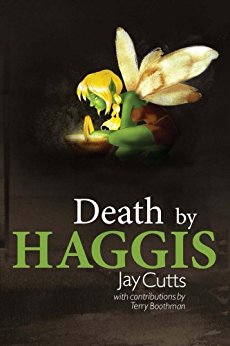
I certainly never would have thought avant garde science fiction and entrance test preparation manuals for law or medical school would have anything in common–until I came across author, Jay Cutts. Our “meeting” was in a somewhat notorious manner, in that he gave one of my books a rather scathing review, replete with a grammar lesson about the use of periods. However, after my initial tantrum, I had to admit he was correct, so subsequently edited the book accordingly, sent him the revised copy, and he generously improved the book’s rating. It was during this correspondence that I discovered that, in addition to being a grammar Nazi, he was a fellow author as well as a professional editor.  After sampling his brand of humor in his novels on his website, I wanted to know more about him, so asked him for an interview. Indeed, he is as diverse and unconventional as I suspected. To wit:

MF: I find it fascinating that your writing spans such diverse writing skills, i.e., editing study guides for the LSAT and MCAT versus the wacky humor of Death by Haggis and Annie Gomez and the Gigantic Foot of Doom. Conveying facts and editing are left brain activities while fiction falls more on the right. Which talent were you aware of first? Does one come more easily than the other?

JC: Yes, it’s true that I’ve edited and/or written thousands of pages of science and logic! Actually, it feels to me that real creativity requires both some “organizing” skills and some “wild fantasy” skills. The trick is to keep my imagination from going crazy when I’m writing non-fiction stuff. My publisher has to make sure I haven’t included bizarre aliens in my test prep materials. In the LSAT book I did include a logic dialogue between my dog (Baxter) and the neighbor’s dog (Beardsley). I finally confessed to my editor but she said not to worry. All authors do that. Of course, the dialogue was pure fiction because Baxter NEVER talks to Beardsley, stuck-up little mutt that he is.

MF: I can see that. And cats are even worse. Tell us about your educational background. Where did you go to school, what did you major in when you were in college, etc. If you were to go back to school now, what would you study?

JC: I went to the University of Michigan, where I tried to major in (in chronological order) chemistry and/or cooking, psychology, anthropology, and linguistics. I eventually managed to complete the linguistics degree. Many  years later I got a masters in special education.

If I were to go back to school now, I would be anxious for summer vacation to come! I have always loved summer vacation more than anything.

If I had to take classes, they would be in dance and jazz piano.

MF: I can relate. Summer was always my favorite, too. Who are your favorite authors? Whose work do you enjoy most and why? Did any one in particular influence you more than the others?

JC: Terry Pratchett is my favorite. He has a wonderful sense of humor, a great imagination and really captures the human condition. I’ve never read anyone else with his combination of qualities. I also like Kage Baker, Jasper Fforde, Connie Willis, and Douglas Adams. I once read a Terry Pratchett novel in Slovak. It’s amazing how well he writes in Slovak!!

MF: I’m impressed that you can read Slovak! What’s the most unusual job you’ve ever had? What did you learn from it? Has it affected your writing in any way?

JC: I once cleaned houses. It affected my writing in that my hands were too sore to write!

MF: Harsh detergents can do that. Tell us about the concept behind your books. How did you get the idea for them? Do they have a hidden message?

JC: Death by Haggis had a very interesting genesis (as explained in its intro.) I have an old friend, Terry Boothman, who is a great writer with a wonderful sense of humor. We often email back and forth a dozen or more times  a day with riddles and jokes.

At one point I suggested to him that he send me the first line for a novel and that I would write back. Continuing in that way I figured we could complete the book in a couple weeks. He did send me a wacky first line and I responded.

I found that every time I tried to develop a plot, he instinctively destroyed whatever I had started. That made for an amazing challenge. Eventually he dropped out of the project and let me finish it myself. The basic plot and characters of the story, however, were set in those early exchanges that were random and chaotic.

I wrote Annie Gomez and the Gigantic Foot of Doom because one of my Barron’s (test prep publisher) contacts said they were now publishing YA fiction. I asked him if he had a particular request for a type of story that he thought could sell. He said I could just write whatever I wanted.

A year later I sent him the result, which he said was very nice but they don’t really publish sci fi. Oops.

In any case the character of Annie was inspired in part by my granddaughter and I hope some day she will read it!

MF: For what it’s worth, I gave a copy of it to my granddaughter for Christmas and I hope she’ll read it, too! Maybe even give you a review, since she’s an aspiring author herself so should appreciate the concept of reviews! What is your life like outside of writing?  Is there anything you would like us to know about yourself and your books?

JC: When I’m not writing, I sometimes take a three minute break for a sponge bath and to open a random can of, hopefully, food from the kitchen.

Just kidding.

I like to dance (especially with my sweetie), play the accordion and piano, garden, travel, study strange languages, go to meditation retreats and roller skate with my granddaughter.

MF: My paternal grandfather was a linguist, but he had the ill-grace to die before I was born. Supposedly, he spoke nine languages. You’re a brave soul to roller skate, which I gave up in 9th grade after breaking my tailbone. Who (living or dead) would you like to invite for dinner? What would you like to know about him or her?

JC: I would invite the living. It’s hard to know what to cook for the dead. They are so picky. And I hate it when the food dribbles out of their mouths like that. Yuck.

MF: There’s that logic side of yours coming out again. Switching to the creative, is there any particular song you’d pick to go with your books?

JC: House of the Rising Sun. Three drunk guys once paid me $20 to play it on the accordion on the streets of Tempe, Arizona. I have a feeling that the next day, they wondered what happened to all their money.

deathbyhaggisNo but seriously folks, I did produce a trailer for Death by Haggis and it has some cool detective-y music. It’s on youtube here. If the book is ever made into a movie, it could have some eery Scottish music in it. And of course some Greek music when the hero arrives in the Aegean.

I’ve never thought about music for Annie Gomez and the Gigantic Foot of Doom. It’s about teens so I suppose it would have to have some godawful rap music in it. Just sayin’.

MF: Will there be a sequel to Annie Gomez and the Giant Foot of Doom or Death by Haggis? If so, do you have anything you’d like to tell us about it or a target day for its release?

JC: I don’t have plans for sequels for either. I’m waiting for all you fans to beg me desperately to write more.  In the meantime I’ve been very much enjoying writing short stories. I’ve poured my heart and funny bone (assuming one can pour a funny bone) out into them.

I’m thinking of publishing a collection of short stories woven together by an overall story, possibly based on a Time Lizard, who may just happen to have appeared – though not identified as such – as a character in Annie Gomez.

MF: Some of these characters who just appear are among the best. Anything else you’d like to tell your existing and potential readers and fans?

JC: Eat a nectarine. Half a peach, half a plum. It’s a hell of a fruit. And never run for a bus. Just stroll, jaunty jolly. (Shamelessly quoted from Mel Brooks’ 2000 year old man.)

Other than that, if you like humor in your sci fi/fantasy and admire writers like Terry Pratchett and Douglas Adams, please do browse through my website at cuttsbooks.wordpress.com

I also send free short stories monthly to my Twitter followers. I’m at @jaycuttsbooks.

Thanks for allowing me to do an interview. I enjoy being in touch with readers and writers!

MF: Thank you, Jay, for sharing your wit! I hope my blog readers check out your books, which can be found on Amazon by following these links:

Annie Gomez and the Gigantic Foot of Doom

Death by Haggis

What Awaits Us on the “Other Side?”

legendwalkingdeadcvr

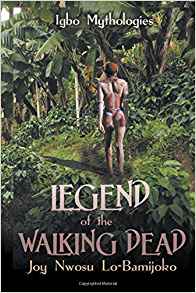
Review of “The Legend of the Walking Dead” by Joy Nwosu Lo-Bamijoko

First of all, if you think this story relates to the popular television series, “The Walking Dead”, it doesn’t. Secondly, if you think this book is a dry account from an anthropologist’s point of view, it’s not that, either. Rather, it’s what best described as a dramatization or fictionalized account of what the Igbo culture in Nigeria believe happens to a person after death, an account of what goes on in the spirit world, if you will.

When Gloria’s son, Osondu, disappears, she goes looking for him. She finds him, but at a price. They are both dead and in the world of spirits where an entirely different culture, hierarchy of authority, and set of rules apply.

As the story unfolds, the reader joins them in a fascinating journey where “the walking dead” are not zombies, but simply those who have died, yet mingle with the living. Some may not realize they’re dead, others may refuse to leave the world of the living, others, who discover and follow the rules, get established in their new environment, progress, and are given assignments. This is not a simple world where departed spirits hang out on clouds playing harps.

The author has definitely researched the subject and conveying it in story form makes it come alive, no pun intended. There are times when it rambles a bit and there certainly isn’t any discernible plot, given it’s more like a stream of consciousness journey of discovery.

I was fascinated by the similarity to various religious beliefs as well as the work of renowned psychologist, Michael Newton, author of “Journey of Souls” and “Destiny of Souls.”  These two books contain accounts of some of his clients, whom he has regressed back to their sojourn in the Spirit World via hypnosis.

If you’re curious about reincarnation and what goes on in the world of the dead, I can highly recommend Newton’s books as well as Joy’s, all of which convey the message that things on the other side are structured and in most cases, far better than what mortals have to deal with. It’s no wonder we come into this world crying.

You can pick up your copy of “The Legend of the Walking Dead” on Amazon here.

Three Cheers & Five Stars for Scott Skipper’s “Alien Affairs” Trilogy

I read the first book in this series, “Alien Affairs”, a few years ago and always intended to read the others, but had a TBR list that precluded it at the time.  When a health issue drove me toward reading something that would make me laugh (laughter is the best medicine after all, right?), I reread “Alien Affairs”, then immediately dove into the sequels. I was not disappointed.

As a fan of dry, dark humor, not only did this one make me laugh, it was also a great, highly suspenseful story with a complex plot of its own with some new engaging characters. With the human race left sterile by the attack depicted in book one, now the characters need to figure out how to reverse the effects. Coupled with that, however, is a wave of terrorist attacks, which rather than simply using explosives to kill people, disperse the deadly ebola virus instead. Thus, the chase is on, the team trying to second guess the terrorists with regard to where they’ll strike next while also trying to develop the antivirus to say nothing of trying to live their personal lives in the midst of chaos.

Alien technology recorded in an ereader that main character, Carrie Player, obtained in book one, contains the information they need to beat the virus, which they hope to employ to reverse the sterility situation as well, since it’s caused by a virus. Nothing is simple, though, because the aliens are still hanging around committing random abductions to make sure their extermination plan has succeeded. If they discover their mission to wipe us out humanely by attrition has failed, they’ll simply kill off everyone real-time with their gravity wave weapons, though we’re on the trail to developing them as well, thanks to the same ereader.

Anyone who has left-leaning political views would probably find this book outrageously offensive.  I found it refreshing and satisfying, the characters’ goals such that could undoubtedly improve upon the current world situation. There’s no sugar coating of what’s going on or where we’re heading, if someone doesn’t take drastic steps soon. While I appreciate the symbolism vampires and zombies represent in numerous dystopia novels, this cautionary tale doesn’t pull any punches with regard to where the greatest threat really lies. These stories are not trivialized satire; they are well-written, masterfully constructed, brilliant looks at how our way of life is crumbling before our eyes. Read it and weep.

If you haven’t read “Alien Affairs” this book would still make sense since the author did an outstanding job of recapping major events that tie into this one. However, I recommend starting with book one since it sets the stage by going all the way back to the Roswell UFO crash back in 1947. If you’re a UFO or conspiracy aficionado, you’re bound to thoroughly enjoy these well-written, fast-moving stories populated with vivid, often snarky characters you’re sure to cheer on in their quest to save the world from annihilation.

Pick up your copy of Book 2 on Amazon here.

Moving on to Book 3, “Alien Child”, the third and final book in the “Alien Affairs” series, this one is slightly different since it’s written through the viewpoint of Terrie Deshler, who is Carrie Player’s child (born in the end of book two as the result of an alien encounter in book one) who has 2% alien DNA.  Now a teenager, she’s brilliant, snarky, sexy, and telepathic, her black eyes the only visible evidence of her alien heritage. This is enough for her to be viewed as an abomination, so she and her mother become the target of government supported terrorist attacks. Thus, they are forced to live in a walled compound surrounded by heavily armed security details.

Having found an anti-virus which can reverse the sterility imposed upon the world in book one, it is being selectively dispersed only to graduates of Georgia Turnbull’s elite Academy, their goal to repopulate the earth with educated, hard-working, morally solid individuals. Controversial, yes, but what intelligent person hasn’t entertained the thought that there are some people on this planet who simply shouldn’t be allowed to reproduce? Yet, there is the matter of who should make such a radical decision? It’s even more complicated, however, because if the aliens discover their plan to destroy the entire human race has failed, they’ll employ more violent means to do so and be done with it.

Like the other books in this series, this one is loaded with political incorrectness. However, anyone who thinks we’ve made strides forward in the past several years is either blind or can’t be playing with a full deck. It’s thought-provoking to consider who the real enemy is: The aliens who want to destroy the human race because they don’t want our propensity for violence unleashed on the entire galaxy? Or the terrorists and their sympathizers in the government itself, who are clearly on the path to destroying civilization as we know it?

Yet, when push comes to shove, the aliens turn out to be Carrie and Terrie’s allies, providing some very satisfying, high-five moments, though the problem remains regarding the alien’s refusal to accept a failed mission due to the sterility issue. There are certainly plenty of other loose ends that the author could continue to develop, should he so choose to continue the series.

I blew through this book in a single day, wondering how it would end, which certainly held some interesting twists and surprises.  Dark, satirical humor and suspense aside, this thought-provoking series addresses numerous sobering issues. Clearly we live in a world that has chosen a path that can’t possibly end well without intervention. It wasn’t too difficult to see both the alien point of view as well as that of the Turnbull Academy with regard to human behavior. As a side note, if you’ve read any of Dr. Steven M. Greer’s books on the UFO phenomenon, you may recognize that there are various elements of this tale that could be more truth than poetry. We can always hope.

Pick up your copy of “Alien Child” on Amazon here.

Join RRBC’s Book Trailer Block Party!

videotourdec2017

Whether you’re looking for your next great read or ideas for clever, effective book trailer videos, you’ll enjoy this great “Block Party”! One video is featured each day, so it will only take you a few minutes to take a break and feed your creativity! Here’s the link.

The Block Party has been running for a few days, so be sure to go back and watch the three that are already out there, then bookmark the page to go back each day for the entire month. Be sure to “Like” each one on YouTube and leave a comment so you’ll have a chance at winning each day’s giveaway!  Enjoy!

Calling All Bibliophiles!

2017 WC&BE Badges

Whether you’re an avid reader, an aspiring writer, or published author, there’s something for you at RRBC’s Writers’ Conference and Book Expo. It’s open now and will be online until October 30.

Come meet dozens of outstanding authors, many of which are award winners, learn about their often amazing backgrounds, and explore their many books. Most of us are sponsoring a giveaway and all you have to do to enter is leave a comment on our author page! Be sure to stop by my Author Page for a chance to win an 8 gigabyte USB card preloaded with the Star Trails Tetralogy, including my latest release, “The Terra Debacle.”

Don’t miss the raffle, which has some spectacular prizes. For only $5, you get a chance at a virtual gift basket worth approximately $100 in gift cards! You can sign up here.

While you’re there, be sure to check out my Astrological Services page to discover how astrology can be a writer’s best friend, whether it’s timing a book release or rounding out a character.

Hope to see you there!

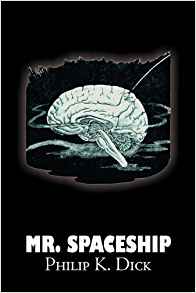
“Mr. Spaceship” is Mediocre Except for Context

MrSpaceship

This little known short story by Philip K. Dick, one of the all-time great classic science fiction authors popular from the 50s to 70s, is an interesting read for its historical value, if nothing else. If someone wrote it today, I suspect it would receive little acclaim or attention. It’s actual publication date I don’t know, since its copyright is expired and now in the public domain, but I would guess the 50s. One reviewer on Amazon summed it up beautifully by stating it “reads as if in black and white Rod Serling mode.” The detail is indeed sketchy and in the context of today’s technology, beyond lean, the theme now a worn-out cliche. However, it presents interesting brain fodder at the philosophical level.

The basic premise is that a human brain is used as the control mechanism for a spaceship. Of course the brain goes rogue with its new “body,” i.e. the spacecraft. In a way, this is the antithesis of artificial intelligence, and apparently his pet philosophical question with regard to what actually constitutes consciousness and reality. At what point, if ever, does an augmented human lose its humanity and at what point does artificial intelligence attain status as a living being? Clearly this has a lot of relevance today as both scenarios move toward reality.

What makes this more interesting to me is the fact that Dick is the author of “Do Androids Dream of Electric Sheep?” from which the 1982 movie, “Blade Runner” came, with a new one, albeit a sequel, just released. He also wrote “Minority Report”, “Total Recall”, and various others, so he did put out some outstanding work.

Reading about him on Wikpedia gives me the impression this guy wasn’t wrapped too tight. He had a drug problem most of his life and various other issues. Perhaps he was a genius, which isn’t an easy cross to bear, and would explain the otherworldly, dystopian essence of his work, which reflected his unique view of life.

This short story is worth reading for its historical value, but certainly not his best work, which didn’t even earn mention in Wikipedia. A novel of his won the John W. Campbell Memorial Award for Best Science Fiction Novel, showing he did put out some excellent, thought-provoking work. Clearly this really isn’t one of them. It has value, however, in the context of his other achievements, the Cold War climate during which it was written, and the many questions he posed, which have still not been answered, even as our technology brings us to the threshold of urgently needing to know.

You can pick up your copy on Amazon here. It’s free for Kindle and very reasonable for a print copy, if you’re so inclined.

The “Purrfect” Read for International Feral Cat Day

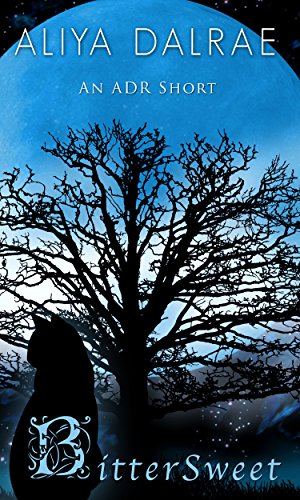
bittersweet

Malcolm Gatta’s touching backstory transported me to a fantasy world I’ve not visited in a long time. I lean more toward science fiction and thrillers, not being that much of a vampire or zombie fan, which seem to dominate the fantasy genre of late. But as a cat lover and someone who has often envied my housecats’ idyllic existence, the idea of a cat shifter was intriguing, so I couldn’t resist checking it out. It’s the prequel to a trilogy which I have not yet read, but will probably add it to my reading list after experiencing this beautifully written, albeit heartrending tale of loss and renewed hope.

My only criticism is that I felt the sprinkling of expletives was unnecessary. There were probably only three in the entire story, but they were biggies, didn’t add to the story or characters, and such that I would hesitate to gift this story to my grandchildren. It’s not that I’m personally offended by such language myself. After all, my father was in the Navy and I worked at NASA over 20 years around engineers and such, plus have to admit I drop a few myself from time to time. There’s no question that some situations are best expressed through an expletive. Furthermore, sad but true, coarse language is now a part of today’s popular culture like never before, a possible symptom of what the world has become. However, there are still some who wish to avoid it and/or don’t want to condone much less encourage it. There are also creative ways to include such words in a story without actual use.

I feel crossing the PG barrier can cut off readers from an author’s fan list, which most can ill-afford. It’s apparently still enough of an issue that on sites where books are rated such as MyBookCave, inappropriate language is pointed out along with content related to sex and violence. I didn’t mean to go off on a total rant about it because this story really was outstanding, but it would have been even better to me without the bombs which seemed out of place with the smooth, even poetic, narrative as a whole.

You can pick up a copy on Amazon here.

34959857 - two enamored cats

Global Cat Day


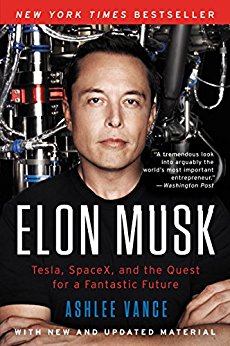
5 Stars for “Elon Musk: Tesla, Space-X, and the Quest for a Fantastic Future” by Ashlee Vance

elonmuskcover

I’ve been fascinated by Musk for quite a while. I even entertained thoughts he might be some sort of space alien hybrid, helping us develop new technologies. I wondered where this guy came from and where he got all that money. I wondered why his new technologies, which are a threat to industries which have been known to resort to rather nasty tactics to suppress such competition, seemed to have no power to do so in his case. This book certainly answered all my questions and then some. I had no idea he was one of those dot-com millionaires, starting with his connection with PayPal. Explaining where his money came from certainly clarified quite a lot. His personality explained the rest.

As someone who worked as a NASA contractor for over twenty years, I can especially appreciate what he has done with Space-X. While some accuse him, and rightfully so, of being a obsessive workaholic and expecting the same from his employees, you have to admit that his system of finding the best and brightest and luring them to work for him works. Musk doesn’t suffer fools. You disagree with him or goof up and you’re gone. In today’s world of tolerance and dumbing down the general population via our pathetic education system, this certainly goes against the grain. But it gets things done.

I saw so much mediocrity at NASA it was pathetic. But it was only part of the problem as far as technological advances were concerned. I remember seeing an invoice one time for small a metal plate with a part number on it costing thousands of dollars. I mean, really. How ridiculous is that? But that’s how government contracting works. Musk, on the other hand, emphasized efficiency. It was his money, so he pushed for keeping costs down. Rather than buy from a manufacturer on the other side of the world, he would develop the needed facilities and make it himself. He demanded perfection and refused to give up.

One philosophy I always liked and employed as a manager myself was “If you’re not part of the solution, you’re part of the problem.” Clearly he had the same attitude. His employees knew better than to simply complain about something being an obstacle. They needed to contribute to a solution or get slam-dunked.

There was so much about his management style that I admired. In most cases in today’s world, his tactics will either get you sued for harassment and/or fired. Which explains a lot. But if you want something considered impossible done correctly, that’s what it takes. The results of Musk’s methods speak for themselves.  He does what he says he’ll do and is a force to be reckoned with. He’s not been suppressed by existing industries since he has the money to proceed on his own, unlike most inventors who depend on selling their patents. In that case, they’re typically bought up by competitors, their ideas left to rot somewhere in a file cabinet to assure the status quo.

Along those lines, Tesla is another awesome success story, a venture that was more than once on the brink of failure. But Musk persevered, his vision and intentions a testimony to those who promote such tactics for manifesting what you want. I loved the part where Tesla acquired a former GM plant in Fremont, California (not too far from where I lived many years ago) virtually for free. Tesla is driving conventional car makers crazy. The cars are kicking butt in all areas from safety to speed to virtually “free” fuel as he builds recharging stations.  He’s out to change the world and making steady progress doing so, specifically in previously troubled industries collapsing under their own weight.

His personal life was certainly interesting as well. Did you realize he has 5 boys, i.e. a set of twins and a set of triplets from his first wife, Justine? Or that as a child he was bullied, in some cases brutally enough to land him in the hospital. His photographic memory has served him well, his intelligence and scientific understanding off the scale. If someone tells him something can’t be done, he usually fires them and does it himself. I find that inspiring, not obnoxious.

The author did a great job of providing a glimpse of what this guy is like, not only as a slave-driving manager, but as a person. I admire much of what he stands for and stands up for.  I loved the author’s candid writing style, often imbued with humor that had me laughing out loud. I don’t doubt that I will eventually read this book again. It’s inspirational to see what one determined man can accomplish when he sets his mind to what needs to be done, then commandeers the help and talent he needs to get there, leaving naysayers in the dust. His self-imposed mission is to save the world from itself and so far it looks as if he might do just that. It won’t surprise me one bit if he’s the one who gets us to Mars. If you have any doubts, then you should read this book. It made a believer out of me and restored my faith in old-fashioned hard work and ingenuity, which has somehow gotten lost in our crazy world.

This book convinced me, more than ever, that it’s people like Musk who should be considered heroes in today’s world. Not obnoxious sports figures, crooked politicians, and those who want to be taken care of at others’ expense. It’s time that we return a strong work ethic and intelligence to the status it deserves for making this a better world.

You can pick up a copy on Amazon here. I recommend it highly. I will warn you that it contains a multitude of f-bombs. If you want to share this awesome story with your kids, which I also recommend, there’s a cleaned up version you can get here.