Unknown's avatar

About Marcha's Two-Cents Worth

I'm a science fiction author of the Star Trails Tetralogy, retired after two decades working at NASA, defected from my physics training to become a professional astrologer, and various other acts of rebellion. More recently, I've teamed with Pete Risingsun in writing "The Curse of Dead Horse Canyon: Cheyenne Spirits" which was released in July 2020 with more to come.

Day 7 of the 1/2-Acre Challenge

IMG_0028

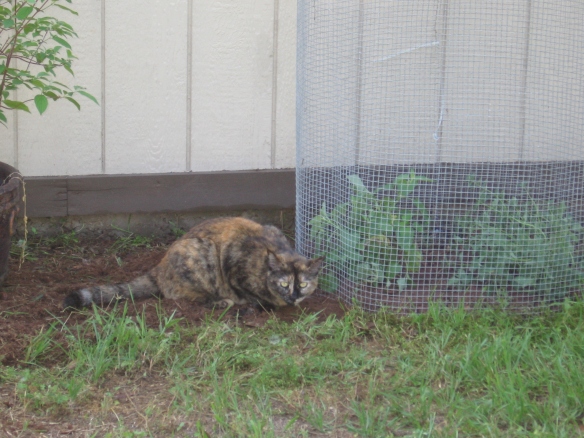
I’m happy to report that so far for an entire week I have spent at least two hours a day working in my yard. The progress so far is not that dramatic, but I hope the cumulative effect will be. Yesterday I went to Home Depot and picked up some plants, one of which is pictured above on the far right.  Can you guess what it is?  Gizmo, my feral cat, provides a hint with her disgruntled expression.

Right, it’s cat mint and the plant closest to her is catnip. If I didn’t have the protection around it, by tomorrow it would be gone with numerous very happy cats lazing around the yard in an inebriated state. Gizmo, of course, does not agree with my decision, much as children protest when their parents ration Easter or Halloween candy.

Don’t worry, she’ll get her share, as will my indoor cats, who are regular “nipheads”, a term coined by fellow blogger, Jeanne Foguth, in her series, “The Sea Purr-tector Files”, which stars my favorite feline 007, Xander de Hunter. If you’re a cat fancier looking for a fun read, check out volume one here on Amazon! You can start the series for free with the prequel, “Latitudes and Cattitudes.”

Tomorrow I’ll continue my quest and provide another update when I do something interesting enough to report.


Blog Tour: Annie Douglass Lima’s Latest YA Adventure Tale

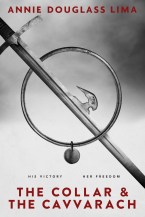
I’m excited to be part of Annie Douglass Lima’s blog tour to announce her latest young adult action and adventure novel, The Gladiator and the Guard, is now available for purchase! This is the second book in the Krillonian Chronicles, sequel to The Collar and the Cavvarach.

The Collar and the CavvarachFirst Things First: a Little Information about Book 1: 

Bensin, a teenage slave and martial artist, is desperate to see his little sister freed. But only victory in the Krillonian Empire’s most prestigious tournament will allow him to secretly arrange for Ellie’s escape. Dangerous people are closing in on her, however, and Bensin is running out of time.  With his one hope fading quickly away, how can Bensin save Ellie from a life of slavery and abuse?

What is the Collar for, and What is a Cavvarach?

The story is set in a world very much like our own, with just a few major differences.  One is that slavery is legal there.  Slaves must wear metal collars that lock around their neck, making their enslaved status obvious to everyone.  Any slave attempting to escape faces the dilemma of how and where to illegally get their collar removed (a crime punishable by enslavement for the remover).

Another difference is the popularity of a martial art called cavvara shil.  It is fought with a cavvarach (rhymes with “have a rack”), a weapon similar to a sword but with a steel hook protruding from partway down its top edge.  Competitors can strike at each other with their feet as well as with the blades.  You win in one of two ways: disarming your opponent (hooking or knocking their cavvarach out of their hands) or pinning their shoulders to the mat for five seconds.

Click here to order The Collar and the Cavvarach from Amazon for $2.99 a discounted price of just 99 cents through May 30th!

And now, The Gladiator and the Guard, with another awesome cover by the talented Jack Lin!

The Gladiator and the Guard

Bensin, a teenage slave and martial artist, is just one victory away from freedom. But after he is accused of a crime he didn’t commit, he is condemned to the violent life and early death of a gladiator. While his loved ones seek desperately for a way to rescue him, Bensin struggles to stay alive and forge an identity in an environment designed to strip it from him. When he infuriates the authorities with his choices, he knows he is running out of time. Can he stand against the cruelty of the arena system and seize his freedom before that system crushes him?

EXCERPT:

“Hey, it’s the new guy,” someone said, and heads turned. “What’s your number?”

“My number? Oh, um, I think they said I’d be Fifty-Eight.” A tasty-looking bowl of chicken and potatoes came within reach, but someone else picked it up, scooped some onto his own plate, and then passed it away down the table before Bensin could get any.

“So, you beat Ninety-Nine,” a Skeyvian gladiator across from him commented, his dark skin laced with pale jagged scars. “Soon as he gets out of the clinic, you better watch out. He’ll be out for blood.” He set down the vegetables he had just served himself, and Bensin picked up the dish, but the guy next to him plucked it out of his hands and sent it in the other direction.

“I didn’t actually mean to hurt him,” Bensin began, looking around for another dish of food. He was interrupted by derisive laughter from everyone within earshot.

“Fifty-Eight didn’t mean to hurt him! Ha! What kind of gladiator are you, kid?”

Bensin couldn’t think of an appropriate response. “Hey, could somebody pass me the chicken?”

“Dude, you better start meaning to hurt people if you want to make it here,” the burly Tarnestran beside him advised. “You can’t manage that, Gile will plan a blaze of glory for you sooner rather than later.”

Bensin wasn’t sure what the man was talking about, and his stomach was still rumbling. Everyone around him was eating now, but the serving dishes had all been passed down to the other end of the table.

“Gile won’t have to plan a blaze of glory for this one,” another gladiator predicted. “At this rate, he’s gonna starve to death first.”

* * *

Click here to order The Gladiator and the Guard in Kindle format from Amazon for $2.99 a discounted price of just 99 cents through May 30th!

 Click here to order The Gladiator and the Guard from Smashwords (for Nook or in other digital formats) for $2.99 a discounted price of just 99 cents through May 30th!

About the Author

Annie Douglass LimaAnnie Douglass Lima spent most of her childhood in Kenya and later graduated from Biola University in Southern California. She and her husband Floyd currently live in Taiwan, where she teaches fifth grade at Morrison Academy. She has been writing poetry, short stories, and novels since her childhood, and to date has published twelve books (two YA action and adventure novels, four fantasies, a puppet script, and five anthologies of her students’ poetry). Besides writing, her hobbies include reading (especially fantasy and science fiction), scrapbooking, and international travel.

(See my previous interview with Annie here.)

Connect with the Author Online:

Email: AnnieDouglassLima@gmail.com

Blog: http://anniedouglasslima.blogspot.com

Facebook: https://www.facebook.com/AnnieDouglassLimaAuthor

Twitter: https://twitter.com/princeofalasia

Goodreads: http://bit.ly/ADLimaOnGoodreads

Amazon Author Page: http://bit.ly/AnnieDouglassLimaOnAmazon

Smashwords: https://www.smashwords.com/profile/view/AnnieDouglassLima

LinkedIn: http://bit.ly/ADLimaOnLinkedIn

Google Plus: http://bit.ly/ADLimaOnGooglePlus

Now, enter to win an Amazon gift card or a free digital copy of The Collar and the Cavvarach!

 a Rafflecopter giveaway


Keeping up with Technology — Barely

cropped-brain-fingerprint-300x296

It blew me away today when I discovered this article on Futurism.com about brainprints. The reason is that in my last science fiction novel, “Refractions of Frozen Time,” I had the bad guys collecting what I called mindprints, which were a unique identifier. So here we go again, science fiction has become science fact.

What’s a sci-fi author to do?

It gets harder and harder to come up with futuristic technology. Since I started my novels several years ago I had to do various “upgrades” for them to keep up. I had internet, the equivalent of Craig’s List, and electronic currency in my novels long before they were reality.

About the only thing I have in my novels, short of faster-than-light (FTL) space travel, that I 15442253_sTHOUGHT was still science fiction is the c-com device my hero uses for any number of functions. C-com stands for “cerebral companion” and was like a smart phone on steroids driven by psi-waves, a.k.a. telepathy.  But EVEN AS I WAS WRITING THIS BLOG, an email came in from Futurism that stated you can now send text messages via your brainwaves! You can find the article here.

Holy cow…

What’s a sci-fi author to do????

Please, buy my books quick, before they jump genres into historical novels!  The box set of the entire series is currently on sale for only $3.99.

STTlpostcardVP2 copy


Moon, Mars, Saturn, Antares on April 25 | EarthSky.org

Here’s what’s waiting for you in the sky tonight.

Moon is still moving past 2 planets and a bright star, Antares in the constellation Scorpius. Learn why this constellation is never in the sky with Orion.

Source: Moon, Mars, Saturn, Antares on April 25 | EarthSky.org

Eating an Elephant One Bite at a Time

yard

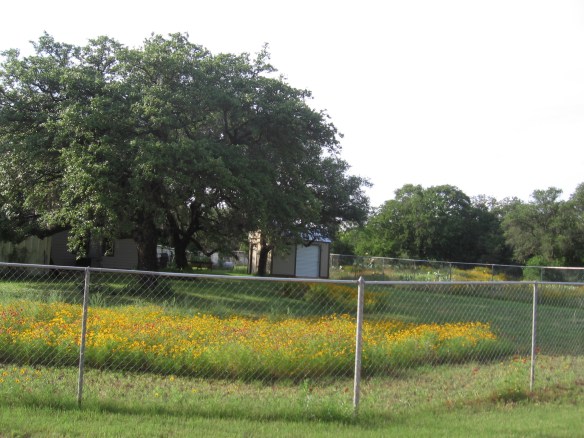
I live in a rural area on a half acre that I’m trying to tame. I must say that during the nasty drought that Texas experienced that past seven-plus years it was a lot easier to sit in my air-conditioned house and go outside as little as possible, like to the mailbox and back. Period.  Now that the drought appears to be over, everything is green again and our lake is back up where it should be, I’ve decided it’s time to make my place look the way I’ve always dreamed it could on the outside.

Usually I get totally overwhelmed looking at it, but have finally adopted a common sense approach of taking it on one thing at a time, about an hour a day. It usually takes me three separate days to mow the yard with a walk-behind mower, so today I finished what I started Friday. I cut back the cactus by my front door that was taking over the porch, and have a list of manageable chores on my list for the coming days, like cutting down several volunteer hackberry trees and saving the irises from that unruly cactus.

So often when a task is utterly overwhelming, it’s easy to ignore or dismiss it entirely. How many things are you putting off because you don’t know where to start? Here’s the secret: Just start.  The satisfaction feeds your resolve and before you know it you’ve gained enough momentum to keep at it. I just hope I can get enough done before serious heat sets in, but until then I’ll tackle taming my little patch of land one bite at a time.

Chartreux | Breed History, Information and Pictures – Pet360 Pet Parenting Simplified

This cat has a fascinating history!

Well muscled and energetic, the Chartreux makes for a fun feline to have around the house.

Source: Chartreux | Breed History, Information and Pictures – Pet360 Pet Parenting Simplified

Mars is getting bright! Here’s why | EarthSky.org

Mars stationed retrograde on April 17 so will now appear to move “backwards” through the sky.

We’ll pass between Mars and the sun about a month from now, on May 22. Watch Mars brighten dramatically between now and then!

Source: Mars is getting bright! Here’s why | EarthSky.org

Was Houston Flood the Fault of the Stars?

Video of Houston Flood

If you’re a fan of The Old Farmer’s Almanac, you’re most likely aware that it contains weather predictions as well as advice regarding when to plant, harvest, and numerous other activities. Most likely anyone who’s drawn from its wisdom hasn’t questioned its source or wondered what it was. If that’s a burning question you’ve had for most your life, then I have good news for you because I’m about to tell you where that advice comes from.

Ready? Are you sitting down? Okay. It’s astrological.

Whether or not you believe in astrology makes no difference. It works and doesn’t much care whether people recognize it or not and neither do I.

As an example of how it works for weather, I couldn’t resist doing another extreme weather blog regarding the astrological influences in effect at the time, in this case, the massive flooding event in Houston, Texas. This blog, like numerous others involving astrology, is in the category best known as “You can’t make this stuff up” or “What are the odds?”

As a professional astrologer I tend to speak in astrologese, which of course makes no sense to anyone unfamiliar with its terminology. I will do my best here to explain things in lay terms which will of necessity include a few brief, albeit essential, astrology lessons.

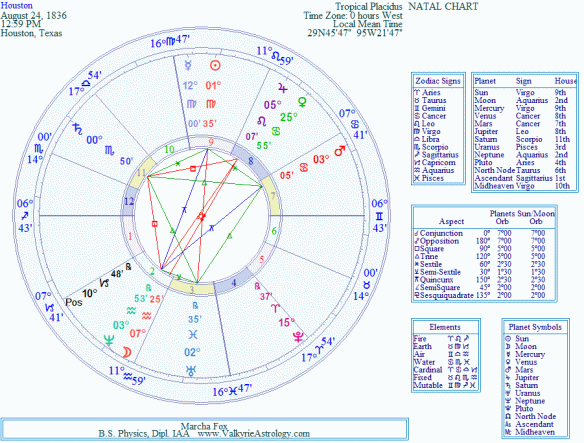
First of all, what you see below is the “birth chart” of Houston, Texas. Since it is a major city, detailed information about it’s founding is available in the historical record. In reality, the worst part of this recent flood was centered slightly northwest of the city in a city called Katy, but an actual date much less time of its incorporation or naming (which occurred when they applied for a post office in 1896) were unavailable. Houston felt the effects too, so thus, we’ll look at Houston.

houstonnatal

Planets, signs and houses (of which there are twelve as you can see from the numbers around the smaller inside circle) each represent a variety of things. Planets and signs have their own distinctive energies while houses indicate different categories relative to life.

If you look at the city’s horoscope, which represents the location of the Sun, Moon and planets at that moment in time, you can see a variety of different lines in the center. These indicate relationships known as aspects between the Sun, Moon and planets. In general, the red ones are stressful, the green ones favorable, and the blue ones somewhat unstable, except when two of them come together, like they do here, with a green line connecting them at the base.

This aspect pattern is known as a yod or “finger of god” and typically has a fated flavor to it. From time to time, as the actual location of the planets in our solar system form other aspects to these natal planets, events are triggered. Seriously. The yod is comprised of Houston’s Virgo Sun, Cancer Mars and Aquarius Neptune, which is represented by a glyph that looks a lot like Neptune’s famous trident. Neptune is in a position in the yod known as its eye, which is where the Sun’s energy (Sun being indicative of personality) and Mars’ energy (symbolic of activity) are directed.

If you know a little about mythology, you know that Neptune is the God of the Deep. In astrology, he rules anything related to liquids among other things. Houston’s nickname is “The Bayou City.” The Houston Ship Channel is a major influence on its economy. Oil, another biggie for Houston, is also ruled by Neptune. Being not too far from the Gulf of Mexico, Houston is often troubled by hurricanes, such as Ike in 2008.

So we have Neptune very prominently placed in Houston’s horoscope and it’s easy to see its influence has been a big one on this city as expressed by the yod, which basically states that the city’s personality and activity is going to relate a lot to Neptunian matters such as water and oil.

Get the idea?

Coincidence? Maybe. Let’s see what else is going on.

Neptune is also related by aspect to some other planets as well. Note the red triangle, an aspect pattern known as a T-square. These are stressful. The other planets involved are Saturn, which represents structures, responsibility and tradition, and Jupiter, which tends to exaggerate and inflate matters. Saturn is in the 11th house which includes groups and organizations and Jupiter is in the 8th house, which includes matters that are intense, transformational or involve shared resources. It also includes death and is usually involved for severe weather events. For Houston, this house is particularly sensitive to the Moon.

Thus, this T-square can easily be related to major storms and floods that damage structures of both a physical and societal variety with extreme impact on the infrastructure as well as the potential for loss of life.

The green lines that look like a big triangle is what is called a Grand Water Trine. I swear I’m not making this up. That is because the three planets involved are in Water Signs which include Cancer, Scorpio and Pisces. The smaller green triangle on top of the big one, which makes the entire configuration look like a kite, ties the Sun into the Grand Trine. While this configuration is often favorable, all it really means is that the planets all communicate their energy well, so if that energy isn’t good, then the influence isn’t, either.

The glyph at the bottom of the Grand Trine, which looks like an old-style television antenna, represents Uranus. This is appropriate since Uranus is associated with technology. He is also related to surprises, unexpected events, upsets, rebellion, explosions, freedom and so forth. Uranus, in turn, is connected back to Neptune by an aspect that tends to denote friction. The implication is for numerous unexpected and disruptive events related to water. The main point here is that so many planets are connected such that when one is affected it will reverberate throughout making things a bigger deal than if they weren’t tied together.

If you’re wondering what the planet labeled “Pos” represents (probably not what you think), that’s the asteroid named Poseidon, also associated with water. We’ll get to him in a moment.

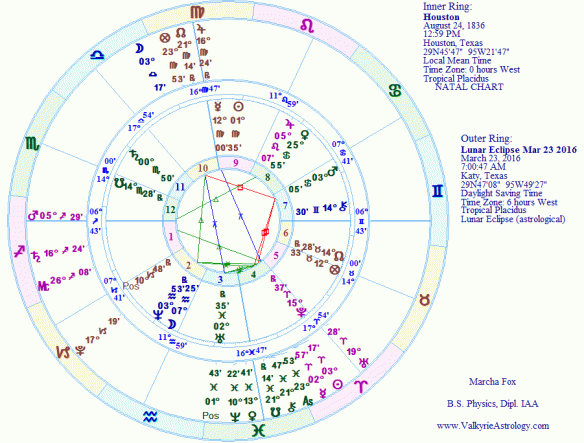
There are certain cosmic events that tend to have tremendous impact astrologically. One of those is eclipses, which are even recognized by stock market gurus as influential. Look it up some time. In March there were two eclipses, one a solar eclipse and the other lunar. The location of the Sun and Moon for the lunar eclipse was in a zodiacal degree that slammed Houston’s Neptune creating an astrological tsunami.

houeclipsebiwheel

Neptune was aspected by the Moon and the Sun, both of which were in houses that typically indicate important events, which in this case include a lot of public attention and the property and residents of the city itself. Uranus, master of the unexpected and upsets, was involved as well. Part of the “You can’t make this stuff up” department, and why I love the asteroids in astrology, is that Poseidon’s current position is irritating Uranus PLUS opposite Houston’s Sun, kind of an “in your face” kind of aspect, to say the least.

Jupiter’s current location is at the top of the chart, which indicates major attention from the public, in this case worldwide.

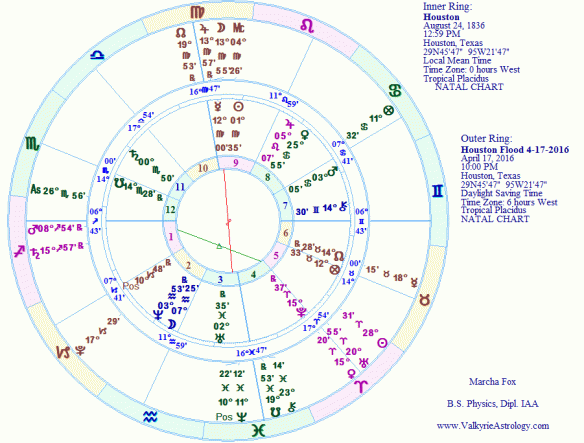
You’ll note that the eclipse was March 23 while the flood didn’t occur until April 17, but eclipses set events in motion with their effects strong enough to last for months. The night the rain began that started this debacle, a few things had changed in the planetary configurations which were far from helpful.

houfloodbiwheel

This looks like a relatively quiet chart until you look a little closer. Out in space, Jupiter and the Moon were aligned and parked on Houston’s Mercury, which is all about news and movement. Neptune’s cosmic position was opposing them, making it a key player. The Moon is always important, but as noted earlier,it’s particularly influential for Houston’s ominous 8th house of death and such. So first there’s a lunar eclipse, now the Moon is stirring things up some more.

Holy guacamole! On top of all that, the asteroid, Poseidon, is in a different zodiacal sign but in the same degree as the natal chart, increasing his energy, plus he was cozied up to Neptune, so both mythological gods of the deep were in cahoots, too. Saturn, which relates to structure, as noted earlier, and Pluto, god of the underworld, were also combined in a malefic blast, though Venus did provide some intervention, enough to keep this from being a lot worse than it already was, such as the fact most of the rain came down overnight when less people were out, though Houston is definitely another city that never sleeps.

There are various other indicators in these charts that tie in even more of Neptune’s soggy influences as well as several others that I won’t go into, because I think I’ve made my point and there’s a good chance you didn’t even make it this far and if you did, your eyes have long since glazed over and you’ve set this aside for bedtime reading.

So be it. Once again, at least as far as I’m concerned, astrology has not failed me, if nowhere else in the domain of “What are the odds?” Poseidon, if nothing else, is the coup de grace, much as the asteroid, Marathon, was for the Boston Marathon bombing several years ago, where he was in a key location of the event chart.

You can’t make this stuff up.

Use Orion’s Belt to find Mercury | EarthSky.org

Here are some hints on how to find Mercury in the sky tonight, weather permitting, of course. By the looks of things, here in Central Texas that ain’t gonna happen.  Mercury at maximum elongation also means that he will be stationing retrograde, too, a time those familiar with astrology tend to dislike. More on that later this month.

Mercury’s greatest eastern elongation – its greatest distance from the sunset – is today. But how can you tell which object you’re seeing is Mercury?

Source: Use Orion’s Belt to find Mercury | EarthSky.org

The Astrolabe: Ancient Analog Computer with 1K Apps

1280px-Planispherical_astrolabe_mg_7100

Figure 1. Planispherical astrolabe. Marocco, 16th century. Engraved brass. On display at Paris naval Museum.

Whether you’re an astronomer, astrologer or steampunk fan, you’re bound to fall in love with this ancient analog computer.  Even better, you can make one for yourself by downloading the directions from the Resources section below.

The astrolabe is an ingenius device used for nearly two thousands years, from the time of Hipparchus (c. 190 – 120 BCE) until the turn of the 17th century.  It’s typically a disc constructed from wood or brass, about 10 – 20 centimeters in diameter, and a few millimeters thick.  In 1391, medieval writer and poet, Geoffrey Chaucer, wrote a treatise on the subject for his son, describing how to build one as well as its use.  Astrolabes had over a thousand uses, including timekeeping, navigation, surveying, solving equations, and so forth.  Mastering them all required an entire university level course.

While at first appearance an astrolabe is intimidating, breaking it down into its components, combined with the information contained on each one, brings a strong sense of familiarity if you’re an astronomer.  Appreciation for the knowledge ancient civilizations acquired of the stars and their relationship to the Earth quickly follows at the thought of designing, much less crafting, such a clever precision instrument.

The main components of a planetspheric astrolabe are the mater, climate plate or tympan, and rete, which all function together, demonstrating how Earth’s place in the cosmos provides the ultimate reference frame.

Astrolabe (Front)
scan-astrolabe-front copy

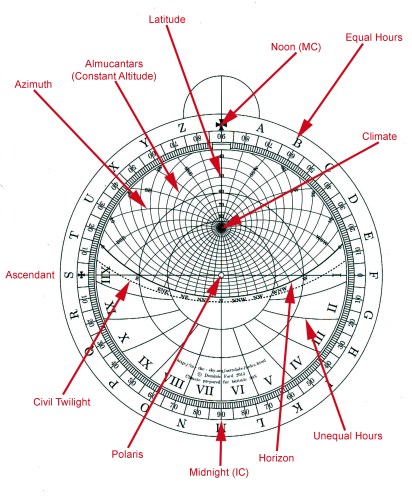
Figure 2. Astrolabe Front: The Mater

The front of the astrolabe, called the mater, (which means mother and is sometimes referred to as such) looks mind-boggling, until you break it down into its components.

Starting from the outside, you see most of the letters of the alphabet around the circumference.  These represent the twenty-four hours of the day, more specifically, the equal hours system, which is what we use now, i.e. each hour is 60 minutes long.  However, at one time, there were twelve hours of daylight and twelve hours of darkness.  Needless to say, unless you live on the equator, the days and nights are NOT of equal length except at the equinoxes.  Thus, the unequal hours system meant that the duration of hours were adjusted, according to the time of year.  The astrolabe thus accounted for them as well, as shown by the designated lines in Figure 1.

The numbers just inside the letters represent degrees from the horizon, where’s it’s zero, to a maximum of 90 degrees at the zenith (Noon) or nadir (Midnight).

The horizon is represented by an oblique line. Unlike most of the maps we see these days, East is on the left, West on the right, North at the top, South at the bottom. ( If you’re familiar with astrology, you should not be surprised that these are the same as a horoscope with the ascendant on the left, Midheaven (Noon) on the top, descendant on the right and Imum Coeli (Midnight) on the bottom.) Just below the horizon is a dotted one, which is somewhat difficult to see at this scale, but represents the period known as Civil Twilight, or the time in the morning or evening when the Sun isn’t above the horzon, yet there’s a certain level of light.

So, to recap, so far we have 24 hours around the outer edge, perpendicular lines representing the cardinal directions, and an arc indicating the horizon.

Due North, represented so conveniently by Polaris, a.k.a. the North Star, is located dead-center.  Its position in the sky varies with latitude, indicated numerically on the vertical line extending upward from the climate’s center.

The climate, sometimes referred to as the tympan, comprises the section that looks like a spider web with a center just North of Polaris, which represents the zenith, or portion of sky directly overhead. The curved lines mark azimuth readings, while the concentric rings are lines of constant altitude or almucantars. These vary with latitude, like the view of the night sky, so astrolabes used in multiple locations required suitable climate plates, which fit into this area. Note the degree markings along the edge of the azimuth lines, which you’ll use later.

A rotating ruler with degree markings which represent declination, the altitude above the celestial equator, is attached to the center of the mater. It’s also used as a convenient pointer in the process of telling time, as explained further below. [NOTE:–The concentric rings, which are unlabeled in Figure 1, are duplicated on the rete and therefore explained in that section as well as defined in Figure 3.]

Astrolabe (Back)
Astrolabe-Back-Labels copy

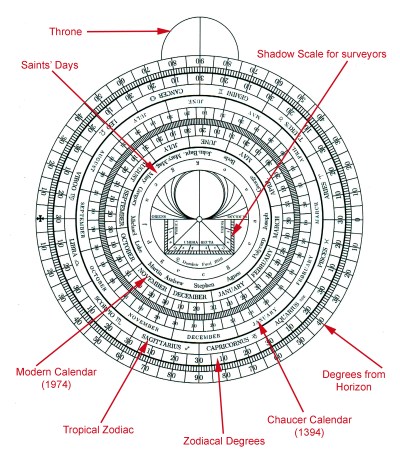
Figure 3. Astrolabe Back: Calendars and Shadow Scale.

The back of the astrolabe is equally daunting at first sight, until you break it down. However, it’s this complexity that allowed this ancient instrument to provide so many functions. For example, the box labeled “Shadow Scale for surveyors” gives a hint of one of its many uses.

The top, called the throne, was used to hang the instrument or hold it in the proper position.

The outer ring has degrees from the horizon, like the front, with zero on the horizontal axis and 90 degrees on the vertical. Just inside the degrees are another ring of numbers, this time corresponding to the degrees of the tropical zodiac signs named in the next ring.

There are two calendars represented, one from Geoffrey Chaucer’s time (1394), which is included since Chaucer wrote a popular treatise on the astrolabe for his son, a copy of which you can find online. The modern calendar, closer in toward the center, is based on 1974, but this is close enough since it takes centuries for precession to change enough to worry about.

Near the center, several Saints’ Days are noted.

Thus, there’s a lot of information, but most of it’s familiar. Another pointing device called the alidade is placed on the back, which is similar to the ruler on the front except it has either pinholes or notches used to sight in the altitude of the chosen star or landmark, if being used for surveying.

The Rete
scan-astrolabe-rete-Labels copy

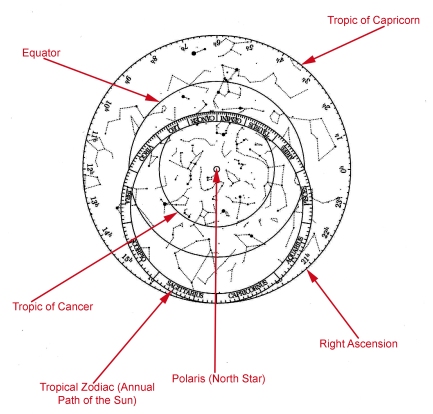
Figure 4. The Rete

The rete comprises the main component of a planisphere, i.e., a stereographic projection of the celestial sphere on a flat surface. Polaris is at the center with several constellations included with the brighter stars emphasized.

The outer ring represents the Tropic of Capricorn, the one in the center, the Equator, and the innermost ring, the Tropic of Cancer. The hours of Right Ascension are shown along the circumference as well.

A diagram of the annual path of the Sun, a.k.a. ecliptic, is offset from the center and includes markings for the signs and degrees of the tropical zodiac.

For a homemade astrolabe, the rete is printed on a sheet of clear transparency which allows the stars to be superimposed on the mater. Obviously, in ancient times, that wasn’t available, their solution not only innovative but artistic as well. The rete, like most of the other components, would be constructed of brass, but numerous areas cut away so you could see the mater underneath.

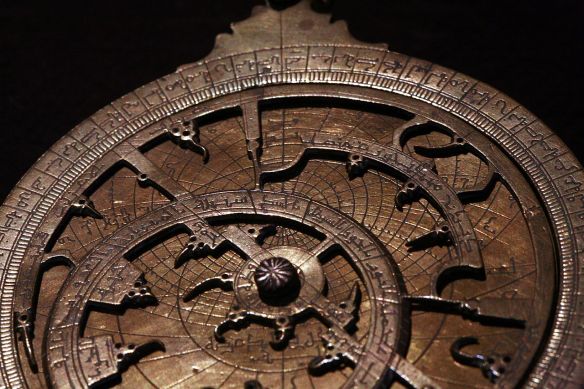
Most astrolabes were carefully crafted precision instruments which were much larger than the homemade version, allowing for a more accurate position determination, but nonetheless, a relatively accurate reading is possible with a homemade version, a source of which is included in the resource listing.  The ancient Turkish astrolabe in Figure 5 shows the mater and rete on the front and calendar and alidade on the back.  Note the incredible artistry and workmanship of this 17th Century device.

Planetary Position

To determine the position of a planet, use its relationship to the Fixed Stars on the rete.  By rotating the rete so that the position of the planet is on the horizontal axis, i.e., zero degrees, then following that line to the tropical zodiac on the ecliptic circle, to determine its position. The ruler provides its declination.

Telling Time

This process is relatively simple and shows the genius of using Earth’s position combined with celestial alignments to determine the time of day.

  1. First, using the back of the astrolabe, find the current date and note the corresponding zodiacal degree of the Sun.
  2. Next, select a specific star visible in the night sky that’s represented on the rete.
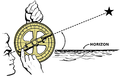
  3. Using the back of the astrolabe, align the device’s horizon line with the visible horizon and use the alidade to measure its altitude. (Warning: This could be the most
    120px-Astrolabe_(PSF)

    Figure 6. Sighting in the altitude with the alidade.

    difficult part of the process. Furthermore, in many cases the visible horizon is not the actual horizon due to elevation, buildings, trees, mountains, and so forth. If nothing else, consider that the Moon appears to be, on average, a half-degree across, or approximately the width of your thumb, which you can use to approximate the altitude.)

  4. Identify the star on the front of the astrolabe (rete).
  5. Move the rete so the altitude you measured of the star matches the azimuth scale behind it.
  6. Align the rule on the rete with the zodiacal position for the Sun for that day.
  7. The rule will point to the time represented on the outer rim of the mater, indicated by a letter. (Don’t forget to adjust for Daylight Savings Time.)

If you know any two of the variables (date, time, rete star position), you can always solve for the third.

Conclusion

The innovative talents of the ancients who invented this device provide a new appreciation for their knowledge of the heavens, Earth, and their celestial relationships.

Even more astounding, and perhaps even a progenitor or technological cousin of the astrolabe, is the antikythera mechanism, an invention attributed by researchers to Aristotle.  It included the positions of the Moon and planets using a complex system of gears and pins that compensated for their elliptical orbits, plus had the ability to predict when eclipses would occur.  Researchers believe it was lost when General Marcellus sacked Syracuse, then surfaced later via the Byzantine Empire (500 A.D.) where it was most likely the inspiration for Persian astrologers to reinvent the astrolabe, then bring it to Spain in the 13th century via the Moors.

During the 14th century Renaissance, sophisticated gear trains came back to drive astronomical clocks found in various European cities such as Strasbourg, France and Prague, Czech Republic.  The sophistication of these devices demonstrates the knowledge of celestial mechanics and engineering possessed by past civilizations, tangible testimonials to man’s ingenuity, long before such calculations became the domain of application programmers creating smartphone apps.

Resources

Directions for Making an Astrolabe

https://in-the-sky.org/astrolabe/index.php

Some Places to Buy Astrolabes

http://leelehman.com/wp/index.php/2015/11/02/brass-astronomical-and-astrological-instruments/

http://www.chronos-manufaktur.de/

Video on How to Use an Astrolabe

http://www.ted.com/talks/tom_wujec_demos_the_13th_century_astrolabe

Additional Information

http://www.chronos-manufaktur.de/en/astrolabes_principle.htm (Includes the TED video plus additional resource information)

References

Wikipedia: https://en.wikipedia.org/wiki/Astrolabe

“Building a Model Astrolabe” by Dominic Ford, Journal of the British Astronomical Association, 122, 1, 2012, https://in-the-sky.org/astrolabe/index.php

“Western Astrolabes” by Roderick and Marjorie Webster, Copyright 1998, Adler Planetarium & Astronomy Museum, 1300 South lake Shore Drive, Chicago, Illinois 60605

Picture Credits

Figure 1: Creative Commons Attribution Share Alike License, By Rama – Own work, CC BY-SA 2.0 fr, https://commons.wikimedia.org/w/index.php?curid=7294462

Figures 2 – 4:  (c) Dominic Ford, 2013, https://in-the-sky.org/astrolabe/index.php

Figures 5a & b: Creative Commons Attribution Share Alike License, By Pom² – Own work, CC BY-SA 3.0, https://commons.wikimedia.org/w/index.php?curid=4039477. Description: Astrolabe planisférique Mère et tympan : Turquie ottomane, 1098 H / 1686-1687 Araignée: maghreb, vers 1850 Laiton à décor gravé et incisé D. 10,2cm Paris, musée de l’Institut du monde arabe, AI 86-45 Legs Destombes

Figure 6: Wikimedia Commons, Public Domain, https://commons.wikimedia.org/wiki/Astrolabe

Copyright (c) 2016 by Marcha Fox, All Rights Reserved