Unknown's avatar

About Marcha's Two-Cents Worth

I'm a science fiction author of the Star Trails Tetralogy, retired after two decades working at NASA, defected from my physics training to become a professional astrologer, and various other acts of rebellion. More recently, I've teamed with Pete Risingsun in writing "The Curse of Dead Horse Canyon: Cheyenne Spirits" which was released in July 2020 with all three books in the trilogy now complete. Check them out at https://dead-horse-canyon.com.

Too Much of a Good Thing

IMG_0001

Lake Buchanan in Central Texas looks like the Mississippi River the past few days due to the excessive inflow resulting from the torrential rains we’ve been getting the past few days. Yesterday’s lake report indicated over 22,000 cubic feet per second were pouring in. The Highland Lakes dams, managed by the LCRA (Lower Colorado River Authority), are operating 24/7 to control the flow the best they can, but there’s still too much water headed downstream for some areas and flooding is inevitable.

A few years ago this area was in a drought of record and the lake was at around 32% capacity at the worst of it. The buoy in the picture above was high and dry with the lake still hundreds of yards beyond it, as you can see below.

The picture below was taken in 2011 from the edge of the water looking back; the houses you see are supposed to be on the waterfront. In contrast, the picture above was taken from next to the two story structure just left of center, showing how far the lake has finally come up.

Droughts do, indeed, end and usually with a flood. That has certainly been the case here.

20111006_001


Why do fireflies light up? | EarthSky.org

Now that our drought is over we’re seeing various species return including fireflies!

—

Next time you see a firefly, keep in mind that its flickering isn’t just a wonder of the night. It’s also a unique, and sometimes deadly, language of love.

Source: Why do fireflies light up? | EarthSky.org

Lake Mead reaches a record low | EarthSky.org

I can really relate to this since the lake I live by was down to 32% during the worst of the Texas drought a few years ago. Fortunately, now it’s nearly full again. The sad truth is that droughts always end with a flood. Hopefully they’ll be prepared when it finally hits.

—

Lake Mead – largest U.S. reservoir, as measured by water capacity – has reached a record low. Space images from 2016 and 1984 show its highs and lows.

Source: Lake Mead reaches a record low | EarthSky.org

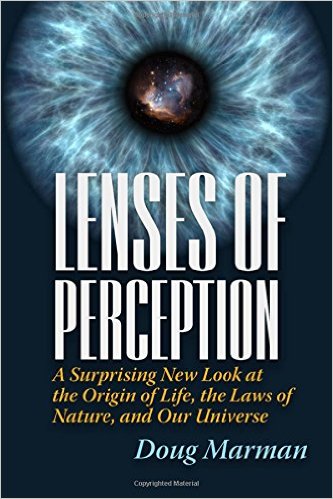
“Lenses of Perception” by Doug Marman: An Interesting Summer Read for Science Aficionados

lensesofperceptioncover

Let me start out by saying that this book has 359 references that comprise eleven pages of endnotes. If you’re not impressed by that, then this is probably not the book for you. However, if you love science and appreciate revolutionary ideas supported by considerable research that relate to an enigma no one, including Einstein, Feynman or Hawking, has been able to solve, then you would probably enjoy this book.

As a physicist and science fiction writer myself, I was fascinated by the book’s precepts. When I really get into such a tome, I become a librarian’s worst nightmare: highlighting key passages, scribbling notes in the margin and, heaven forbid, dog-earing pages. For what it’s worth, my copy sports 46 pages in that condition as well as more marginal notes and highlights than I care to count.

The premise of this fascinating book has been touched on ever since the double-slit experiment suggested some mysterious interaction existed between consciousness and physical matter. Rather than argue this, the author makes an a priori assumption that such a relationship exists. That in and of itself is not particularly remarkable, since it has been the stance of various other authors for decades. Marman, however, does not stop there. It’s not simply a matter of human consciousness influencing subatomic particles. He systematically builds a credible case for the tiniest subatomic particles possessing consciousness as well.

The author is an engineer and inventor who holds various patents and is thus experienced on the technical side, but is not a PhD physicist. This is a good thing. Stepping beyond the bounds of conventional science tends to be a career-limiting experience. Some have referred to scientific progression as occurring only via funerals, e.g., German physicist, Max Planck, who stated, “A new scientific truth does not triumph by convincing its opponents and making them see the light, but rather because its opponents eventually die, and a new generation grows up that is familiar with it.”

Marman’s theory is imaginative to the point of resembling one of Einstein’s thought experiments. While he doesn’t do the math, it goes beyond philosophizing, conjecture or excursions of fantasy. As indicated in the first sentence of this review, this book is well documented. The author states his theory then backs it up with existing scientific research.

The concept that there’s a link between quantum mechanics and consciousness has been argued by many. “The Tao of Physics”, published in 1976 by Fritjof Capra, took on this challenge, opening with Werner Heisenberg’s statement, “It is probably true quite generally that in the history of human thinking the most fruitful developments frequently take place at those points where two different lines of thought meet.  These lines may have their roots in quite different parts of human culture, in different times or different cultural environments or different religious traditions: hence if they actually meet, that is, if they are at least so much related to each other that a real interaction can take place, then one may hope that new and interesting developments may follow.”

In this case, Marman has synthesized his theory using particle physics, biology, evolution, psychology and various other disciplines. Typically, research in any of these areas is conducted strictly within the bounds of that discipline’s accepted facts, limiting the conclusions. Allowing these areas to overlap brings new possibilities as they’re viewed with, as the title suggests, new “lenses of perception.”

This typically creates an uproar from those violated by the unwelcome intrusion into their supposed domain. I’m reminded of the Alvarez Theory from back in the 80s, when it was first proposed that an asteroid collision caused the extinction of the dinosaurs. The paleontologists protested, claiming they’d died off from diseases incident to migration. Then NASA found the crater in the Gulf of Mexico, forcing paleontologists to accept it, like it or not. Professional jealousy is especially fierce when someone outside a specific field of study figures something out the oldtimers have been battling for years. Is this the case with Marman’s work? Time, as always, will tell.

The bulk of his ideas are expressed using analogies. Analogies are effective teaching tools employed by the world’s greatest teachers and philosophers. Using something a student understands as a basis, the concept can be expanded to facilitate comprehension of something new. The author leverages this approach by employing grammatical principles of first, second and third person viewpoints. For example, first person is “I”; second person brings in a relationship with another person, “you”; and third person adds others at a slightly less personal level, “they.” There are concepts individuals grasp which are expanded upon when shared with another, then ultimately coalesce when a group shares a link that binds several beings together.

A subatomic particle is assumed to have a level of consciousness which is defined as first person. It’s aware of itself and its existence. Stepping it up to the second person involves quantum entanglement, a phenomenon that’s been demonstrated, but not fully understood. In a nutshell:

  • Two subatomic particles interact and become linked through an unknown process.
  • When you measure one particle it instantaneously determines what behavior to expect in the other particle.
  • Quantum state of partner particle will be identical.
  • Whatever you impose on one partner particle the other will do the opposite.
  • Theoretically, they can be separated by billions of light years but when you dictate spin of one it will instantaneously affect the other.

If you’ve ever had a psychic connection with someone, you should understand this concept. Research by various scientists, including Dean Radin, PhD, who specializes in psychic phenomena, has indicated that these connections are instantaneous, defying the speed of light as the supposed limit of information transfer.

Getting into the third person, he discusses the relationships between groups that can be related to molecular bonding and steps into the life sciences speaking of “all for one” bonds, where certain entities will self-sacrifice for the good or even the life of the system. A plethora of explanations, examples and extrapolations build from these concepts, backed up by various references.

Marman concludes the book with an addendum that tackles the five unsolved problems of physics as they relate to his theory. I must admit that at this point I got a little lost. I only have a bachelor’s degree in physics, which was insufficient to fully grasp all the implications of some of his conclusions. By this point my brain was fried, anyway, due to the vast array of information provided on so many different levels. There was so much to absorb that it took me far longer than usual to finish reading. At times it was laborious, even painful. Perhaps if you have a PhD in physics you could blow through this book in a few days, but that was definitely not the case for me. With so many topics under discussion to establish their relationship, brevity is difficult to achieve.

This book provides interesting fodder to those with an open mind who are seeking new ideas and insights to the mystery presented by quantum mechanics. It’s unconventional, potentially groundbreaking, and defies many existing speculations. It proposes a paradigm shift to discover answers, which have so far been elusive. Just because a theory is popular doesn’t mean it’s correct. Many fade quietly into the past, unannounced. Even Einstein wasn’t correct all the time. What’s popular one year could be debunked the next. If it’s wrong, it will simply fade away, save any tidbits hanging on in old, out-dated textbooks.

Conversely, as German philosopher, Arthur Schopenhauer suggested, “All truth passes through three stages. First it is ridiculed.  Second it is violently opposed. Third it is accepted as self evident.”

The author explores history, philosophy, physics (of course), biology and various other subjects. If you’re into metaphysics, there are connections there as well. Expect to see a few things differently than you did before. If you’re a science aficionado like myself, it would make an interesting summer read. Take your time. Digest each new idea on its own merits. The title says it all. Be prepared to see the world through an entirely different lens than you did before.

You can pick up your copy on Amazon here.

[I was provided a copy of this book in exchange for a fair and unbiased review.]

* * *

For those of you who love this topic as much as I do, here are some of my favorite quotes related to physics, consciousness and the unknown:

“One is unlikely to discover what one is certain cannot possibly exist…. Whatever the field of inquiry, attempting to access a phenomenon with a methodology that is based on the firm underlying assumption that the phenomenon does not exist has proved itself to be a singularly inadequate strategy, at once self-fulfilling and self-limiting.”

–Richard Tarnas in “Cosmos & Psyche” (p. 108)

“Probing inside the atom and investigating its structure, science transcended the limits of our sensory imagination.  From this point on, it could no longer rely with absolute certainty of logic and common sense…Like the mystics, physicists were now dealing with a non-sensory experience of reality…”

–Fritjof Capra in “The Tao of Physics”

“Physics tends to be dictated by fad and fashion. There are the gurus who dictate the direction in which new ideas grow.”

–Michael Duff, Physicist (University of Michigan)

Some scientists (Stephen Hawking and the late Carl Sagan come to mind) insist that a “theory of everything” is just around the corner, and then we’ll essentially know it all—any day now.  It hasn’t happened and it won’t happen.  The reason is not for lack of effort or intelligence.  It’s that the very underlying worldview is flawed…We have ignored a critical component of the cosmos, shunted it out of the way because we didn’t know what to do with it.  This component is consciousness.

Robert Lanza, M.D. in “Biocentricism” (pp 8 – 9)

“You ask whether parapsychology lies within the bounds of physical law.  My feeling is that to some extent it does, but physical law itself may have to be redefined.  It may be that some effects in parapsychology are ordered-state effects of a kind not yet encompassed by physical theory.”

–Brian Josephson, Physicist, Nobel Laureate

“Space and time exist only as constructs of the mind, as tools of perception.  Experiments in which the observer influences the outcome are easily explainable by the inter-relatedness of consciousness and the physical universe.”

–Robert Lanza, M.D. in “Biocentrism” (p. 159)

“…psi may require an explicit bridge between the physical and the psychological worlds. This is why an adequate theory of psi will be … cross-disciplinary…”

–Dean Radin, PhD

“In psychology, physiology, and medicine, wherever a debate between the mystics and the scientifics has been once for all decided, it is the mystics who have usually proved to be right about the facts, while the scientifics had the better of it in respect to the theories.”

— William James in “The Roots of Consciousness: Science, Evaluating Psi Research”

Earth goes between sun and Saturn tonight | EarthSky.org

Great views these days of Saturn, Mars and Jupiter. If you have clear skies be sure to check them out!

—

June 2-3, 2016 is the night of Saturn’s opposition. This world is now opposite the sun in Earth’s sky. How to see Saturn and enjoy it as its best!

Source: Earth goes between sun and Saturn tonight | EarthSky.org

June 2016 guide to the 5 bright planets | EarthSky.org

You can see three planets this month. By the end of summer there will be five visible in the night sky.

—

Three planets – Jupiter, Mars and Saturn – light up the evening sky all month long. Mercury is east before sunrise. Great month for planet-watching!

Source: June 2016 guide to the 5 bright planets | EarthSky.org

How do hurricanes get their names? | EarthSky.org

For those of you who may be wondering how they come up with names for hurricanes and tropical storms.

—

The Atlantic hurricane season starts June 1. Here are the hurricane names for the 2016 season.

Source: How do hurricanes get their names? | EarthSky.org

Mars closest to Earth on May 30 | EarthSky.org

This is a great time to take a look at Mars in the night sky! If you can find the constellation, Scorpio, which is one of the easiest to spot, Mars is just above it.

—

We passed between Mars and the sun 8 days ago, on May 22. Yet Mars is closest on May 30, 2016. Why?

Source: Mars closest to Earth on May 30 | EarthSky.org

Interview with Author/Historian, Augustine Kobayashi

OLYMPUS DIGITAL CAMERA

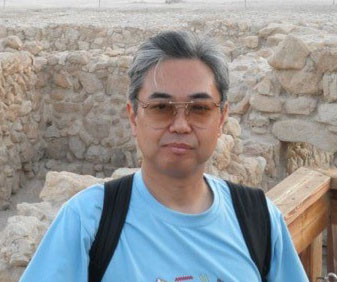
Augustine Kobayashi

What better way to commemorate Memorial Day than with a history lesson?

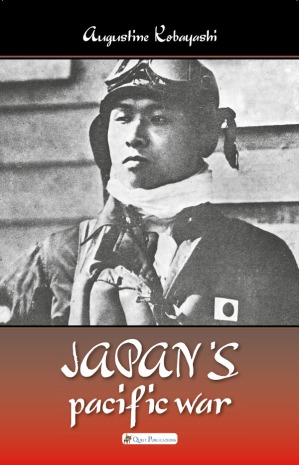
Tokyo-born Augustine Kobayashi, author of “Japan’s Pacific War”, earned postgraduate degrees in modern international history and Byzantine history at Leeds and London Universities in the U.K. In the following interview he shares insights that convinced me that what’s needed in politics today is more attention to historians and less to lawyers, businessmen and career politicians. Historians possess a perspective that could work through differences in a diplomatic fashion while never forgetting the fact that future generations will be affected by those decisions. Most of what we see today are those seeking only to expand their own wealth and power. The few who know anything about history only use it to further their own agenda, not improve the human condition.

MF: What motivated you to research and subsequently write your book, “Japan’s Pacific War”?

AK: I had been writing some historical articles for Historical Quest ezine, and I got some responses from readers for my article explaining how Japan’s war in China in the 1930s and the Pacific War were linked. Many reacted saying that they had no idea how the Sino-Japanese War (1937-1945) directly led to WW2 in Asia. I felt that we have a knowledge gap in this area of 20th century history, and thought that I could make some contributions to fill it. As for the American side of the story, there are many excellent books out there, so I decided to tell Japan’s story, from a Japanese perspective. When I was a student back in Leeds University, UK, I did research on Anglo-American relations in the 1920s, including some naval strategic discussions, such as how Japan’s stance in the world stage might affect international politics. In a way, this current book of mine is the fruition of my past historical studies.

MF: What surprised you the most regarding Japan’s decision to attack Pearl Harbor? Do you think they were realistic in their expectations of the outcome?japan_for web

AK: In hindsight, Japan’s decision to attack Pearl Harbor is incredible, but, having gone through Japanese history of the 1930s, I have found that it is not really so surprising. Given the pre-WW2 American isolationism and Eurocentric tendency of the USG(overnment), giving strategic and diplomatic priorities to the solving of European situation, if they didn’t think that the USA would react by mobilizing the whole economy for war to crush Japan no matter what, it is understandable that they miscalculated this way. This is the time before TV or the Internet. People were not well informed and the Japanese public knew nothing about the outside world. The Japanese military basically thought that the US would be too busy fighting Germany or even be defeated and all they had to do was to immobilize the US Fleet a while, pick off Western colonies in the Western Pacific one by one and hold out until the European war was settled in favour of the Berlin-Tokyo Axis. If Germany had won, these expectations would have been deemed as quite realistic. Ironically, they attacked Pearl Harbor just when Germany tasted her first defeat in front of Moscow.

MF: As a student of Byzantine history, what is the most important lesson you believe it holds for those of us living in modern times?

AK: Things change. The secret of longevity of the Byzantine Empire was its ability to reinvent itself every now and then after crises. So much so that, even though it’s real designation should be the ‘Roman’ Empire, modern historians, who are so fond of the Classical image of Imperial Rome, feel uncomfortable with the designation ‘Rome’ and use ‘Byzantine’ instead for the empire after the 4th or 5th centuries. But this is precisely the point: it changed its shape and cultural characteristics so much to cope with the changing political, economical and military environment surrounding the empire, after several centuries, it was almost unrecognizable. So, the lessons for us are: be flexible and accept changes. Rely on your ingenuity rather than muscle power.

MF: A common saying is “Those who fail to learn from history are doomed to repeat it.” What is your favorite example of a culture or country failing to learn from previous civilizations?

AK: There are so many, it is difficult to single out a favourite one. As I live in Japan now, I’m concerned with China at the moment, as she seems to be in danger of repeating Japan’s mistakes in the 1930s and the 1940s. Given that China was the chief victim of Japan’s aggression in those decades, it would be so ironic. Hope the Chinese are capable of learning from others’ mistakes.

MF: The world today has a lot of problems. Based on your studies, what do you think is the most important thing world leaders should do to avoid another World War?

AK: Do not let others fear you too much. A cornered beast tends to lash out, which was the case for Japan in 1941; and I suspect that that is what is happening with the Islamic militants right now. The Byzantine Empire fought a devastating war with its rival, the Persian Empire in the 7th century, which in turn led to the Islamic Arab conquests. The Persians started this war as they were so worried over the reviving power of the Byzantine Empire (in 476AD, they had gleefully been watching the fall of the West; but now alarmed by the Byzantine reconquests of North Africa and Italy in the 6th century).

Christianity as soft power of Rome, its spread among small countries and ethnic groups geographically surrounding Persia frightened her leaders. Persia attacked Rome when internal power struggle at the capital Constantinople momentarily paralyzed the Byzantine war machine as a heaven-sent and only opportunity to strike. In modern times, in WW1, both Germany and England were motivated by the need to weaken their rivals before they became too strong. Japan’s war in China in the 1930s was partly due to a resurgent China and thus Japan’s fear of losing their top dog status in Asia. As for solutions to this problem of power imbalance, I don’t really know. Probably we have to find out by working patiently through diplomatic effort.

guscropMF: What are you finding in your current research into Syriac Christianity and its spread into Persia that relates to modern tensions between Christians and Muslims?

AK: Persia’s state religion was Zoroastrianism at the time, but Christianity was gaining ground. It seems that Jesus’ saying that he came to fulfill old religion applied to Persia also! When you realise that Judaism had also been strongly influenced by Persia, which released Jews in captivity and allowed them to return to Jerusalem, you can see that Jews, Christians and Zoroastrians were not that very different. And Persia can be a very tolerant place for different religions.

But inevitably, religion and politics cannot be separated completely; conflicting socio-economic and political forces often clashed along religious lines, causing internal instability and external wars. As in my answer to question No.5, as Rome’s power grew, Christianity was seen as a threat by the Persians. At this stage, Roman Christianity became a political religion, which forced a political response from Rome’s rival(s). I think that today’s problems we have with Christians and Muslims are fundamentally the same: they are not really in conflict in terms of religion, but, whenever communal tensions arise and political conflict develops, they unfurl their respective banners and try to protect themselves by rallying around them. Some hotheaded young men often employ rhetoric of religious mission etc., but they do not really represent what should be the majority view.

MF: Do you think it will ever be possible for those two religions, which actually have similar roots, to make peace with one another?

AK: The answer should be yes. Different religious communities usually live in peace side by side most of the time anyway. It is a time of political tensions when religious communities are pitted against one another. The Coptic Egyptian Christians, for example, had lived in a relative calm for nearly 2,000 years until very recently. They should be able to go back to that, normal state. In Syria, sadly, the Christians appear to be being exterminated or displaced permanently, but, once a politically stable Syria could be achieved, Christians and Muslims should be able to live side by side again. But so long as political forces exploiting religious differences remain too strong, it might be a while before that could happen.

Pick up your electronic copy of “Japan’s Pacific War” on Amazon here.

Paperback: https://www.createspace.com/6222626

Read more about Augustine: http://www.quest-publications.com/authors/kobayashi/

Goodreads: https://www.goodreads.com/author/show/15168533.Augustine_Kobayashi

Facebook: https://www.facebook.com/augustine.kobayashi

Publisher’s Book Link: http://www.quest-publications.com/books/japans-pacific-war/

Half-Acre Challenge Update: Encroachment

rockgarden05212016

My lot is on the corner, which has a few advantages. For example, I have a back gate that works well for the propane truck or when I want to unload something directly into my shed. If I ever wanted to build another house or sell it as a building lot, there’s no problem with road access. It also makes my little piece of Texas look bigger, though sometimes that can be intimidating.

Not so advantageous is having a dirt road skirt half your lot’s perimeter. That means dust kicked up by every passing vehicle, particularly garbage trucks and all those massive pickups that are so popular here in Texas. Furthermore, they all tend to cut the corner, such that over the years the encroachment resulted in the corner of my lot actually being in the middle of what has now become the road. Obviously, the beneficiaries are my neighbors, across the street, where the road’s supposed to be.

Most of this happened before I owned the place, but when I saw the land survey I decided that was crazy and it wasn’t going to continue on my watch. First step was a chainlink fence. No, we didn’t take it all the way to the middle of the road, but we definitely pushed it out there enough to send a message.

To top it off, my favorite contractor gathered some rocks, which are plentiful in this area, so I could build a rock garden, but it wasn’t until this spring that I finally got around to doing so. Until a week or so ago, the rocks were overgrown with weeds. Not anymore! I’m happy to report that 500 lbs of dirt and a fair amount of sweat later, that my message to encroachers is complete. It’s populated with a desperado sage, golden sword yucca and mountain laurel, all of which will grow to be 5 – 10 feet tall, can tolerate winter temperatures down in the teens as well as summer heat and droughts. And a few vincas for color, of course.  My rational in using native plants was that once they’re established they’ll do fine on their own so I don’t have to drag a hundred foot hose down there to water them.

Of course building a rock garden can easily be associated with another situation, when people encroach upon your personal space. In that case, the solution is much the same. Building a stone wall and setting boundaries are your best bet, but it doesn’t have to be ugly. Sometimes it may have to be, but in most cases setting the boundaries, albeit doing so with a smile and kind but assertive words, will cause less resistance. I shudder to think what my neighbors would have done had I placed my fence, much less my little rock garden, out in the middle of the road, even though my lot reaches that far legally. The main point is to defend your right to privacy and what is yours.

Remember, what you allow will continue.