Unknown's avatar

About Marcha's Two-Cents Worth

I'm a science fiction author of the Star Trails Tetralogy, retired after two decades working at NASA, defected from my physics training to become a professional astrologer, and various other acts of rebellion. More recently, I've teamed with Pete Risingsun in writing "The Curse of Dead Horse Canyon: Cheyenne Spirits" which was released in July 2020 with more to come.

Meet Award Winning Historical Novelist, Ronald E. Yates!! (2nd RRBC “TREAT” Reads Blog Hop Day #1) #RRBC #RRBCTreatReads

“Greetings!  Welcome to the 2nd RRBC “TREAT” Reads Blog Hop!  These members of RRBC have penned and published some really great reads and we’d like to honor and showcase their talent.  Oddly, all of the listed Winners are RWISA members!  Way to go RWISA!

We ask that you pick up a copy of the title listed, and after reading it, leave a review.  There will be other books on tour for the next few days, so please visit the “HOP’S” main page to follow along.

Also, for every comment that you leave along this tour, including on the “HOP’S” main page, your name will be entered into a drawing for a gift card to be awarded at the end of the tour!”


Ron at Southcoast WineryThe first author on this blog hop is one of my favorites, Ronald Yates. As a former journalist and foreign correspondent, he does impeccable research and creates unforgettable characters. I’ve interviewed Ron on a previous blog which you can find here. Ron’s Billy Battles trilogy is outstanding. The book featured below is the second in the series, “The Improbable Journeys of Billy Battles.” I was amazed how much I learned about history. You can read my review here. Follow Ron on Twitter @jhawker69.

THE IMPROBABLE JOURNEYS OF BILLY BATTLES

Book Blurb: The year is 1894 and Billy is aboard the S S China sailing to the inscrutable Far billybattlescoverEast. Trouble is not far behind. He has met a mysterious and possibly dangerous German Baroness. He has locked horns with malevolent agents of the German government and battled ferocious Chinese and Malay pirates in the South China Sea.
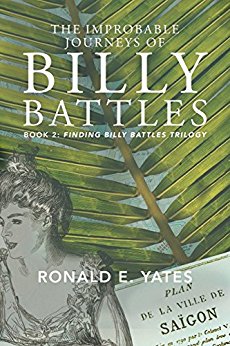
Later, he is embroiled in the bloody anti-French insurgency in Indochina–which quite possibly makes him the first American combatant in a country that eventually will become Vietnam. Then, in the Philippines, he is thrust into the Spanish-American War and the brutal anti-American insurgency that follows. But Billy’s troubles are only beginning.

As the 19th century ends and the 20th century begins, he finds himself entangled with political opportunists, spies, revolutionaries, and an assortment of vindictive and dubious characters of both sexes. How will Billy handle those people and the challenges they present? The answers are just ahead.

You can pick up your copy on Amazon.

Are you an author who would like to network and support other authors for your mutual benefit? Then check out Rave Reviews Book Club!

#RRBC #RRBCTreatReads


Today’s Writing Tip

blank copy

Make it a habit to “people watch” when you’re in places like the grocery store, the mall, waiting in the doctor’s or dentist’s office, or Walmart. When you see someone who catches your eye, think of how you would describe that person if s/he were in one of your stories. (Try not to stare, it could get you in trouble.)

As they say, truth is stranger than fiction, and you can often see characters far beyond anything you could imagine, unless you’re deep into fantasy writing and this sort of thing comes naturally. Even then, it can fuel your already-fertile imagination. This is also one way to put your time to good use while doing routine errands that can sometimes feel like a nuisance when you’d rather be writing.

Today’s Writing Tip

alphabets-copy

Do you know the difference between a red herring & a plot hole? Red herrings, usually used in mysteries, distract suspicion from the true villain and point toward other possible culprits. These can also be used in similar situations to keep your readers guessing.

A plot hole is something implied that you never brought to closure. While you may plan on doing so in a sequel, it’s best to nonetheless mention it in some way so your readers don’t think you forgot and it slipped through the cracks.

Today’s Writing Tip

laptop-3 copy

If possible, include keywords that describe your story in the title. This will help it appear in more searches. If you have a great title that doesn’t include them, you can always cheat a little and add a subtitle.

Make sure the categories you can include in various places are accurate as well. The more accurately you can place your book in one of them, the more likely it will show up there as well. The BISAC  codes are especially important since they are what librarians and other book professionals depend upon. You can find a complete listing here. You can sign up for free to get more information.

Today’s Writing Tip

technology-copy

Perfect people are boring, the same with those that are too predictable and have their lives entirely together. You don’t want your readers to get bored reading about your character, so they need to have some issues. Even if they’re a very strong person, then they need to have a challenge before him or her that tests that strength.

However, don’t make your characters such a piece of work that they’re off-putting to readers. I have read books where the character, or at least one of them, was so dysfunctional that I was rolling my eyes and wanted to slap this person upside the head. I came very close to not reading any further, except I usually give a book about three chapters before I ditch it.

Interesting characters and plots are essential and character growth through the story is essential, but remember, if your reader doesn’t like or can’t relate to him or her at all, they may quit reading.

Today’s Writing Tip

technology-3 copy

How many award winning books have you read? These are great reference points for what constitutes not only a good read, but excellent writing. Don’t just read them for enjoyment, study them for what makes them special.

When a book wins an award or is a finalist, the author is given a seal or medallion that recognizes their status, which they place on their book cover. Thus, you can tell by looking at the cover if it’s been given an award. Another way to find them is to go to the websites for the organizations that provide awards. If you don’t know where to find them, here are a few, though there are numerous others: ReadersFavorite.com; BookExcellenceAwards.com; NewAppleAwards.com.

If you think your book is top notch, enter one of these and get a professional opinion. However, bear in mind that as with all reviews, there’s a level of subjectivity. I know one author who got blasted by one of these and awarded the top award for the same book by another. Nonetheless, it does provide a baseline.

Today’s Writing Tip

paper-copy

Mercury retrograde is a great time for editing and bad time for starting a new project.  While this prognostication is astrological in origin, it’s often a time when skeptics start to recognize there may be something to it. Astronomically, it means that the planet Mercury is moving backwards in the sky. Of course this isn’t true, only by appearance, similar to when you’re passing another car on the freeway and it appears that the other car is moving backwards when you are actually moving away from it.

Astrologically, since Mercury rules communications of all kinds as well as anything that moves, this is not when your brain, electronics, or anything mechanical is functioning properly. Computer, automobile, and appliance problems are common at this time as well as communication problems at the people level. This is a time to go back and review, revise, reconsider, and reassess while starting something new is likely to not go anywhere ever or, at best, be delayed.

This usually happens three times each year. The next one will be from November 17 – December 6, 2018, but to be safe, avoid new projects from October 29 – December 25. Put this time to good use by editing and revising as opposed to new copy.

Today’s Writing Tip

paper-2 copy

Many authors will tell you, including myself, that book blurbs are harder to write than the book itself! After creating numerous characters, devising a complex plot, and describing the time and place over hundreds of pages, distilling this down into a few sentences is no easy task.

Some great advice from author Nicholas Rossis that he passed along in a recent writers conference stated that the main elements to include are your main character, what s/he wants, what’s in the way, and the consequences of failure. Whatever you do, don’t include any spoilers or too many extraneous details. You want the reader’s curiosity to be aroused enough for them to want to read the story.

Today’s Writing Tip

nobody-copy

Do you fully understand what it means to show versus tell? Your reader should experience the story through the eyes of your characters, up close and personal, not as an observer from afar.

When you tell a story, there is little to no reader engagement at the emotional level. They may be able to sympathize with the character or relate story action to their own experience, but they do not feel as if they’re part of the story or that they really know the characters.

Showing involves rendering the same feeling in your reader as your character is experiencing, whether it’s love, joy, fear, sadness, grief, anger, etc. You are not going to be able to do this with a single word or sentence. If you ever find yourself using the word “feel” in any of its conjugations, stop right there. For example, saying, “He felt angry” simply doesn’t do it. However, if you describe how he really felt, such as his heart rate increasing, hands shaking, mind racing, tension in his muscles, or thinking that he might explode, then you’re showing.