
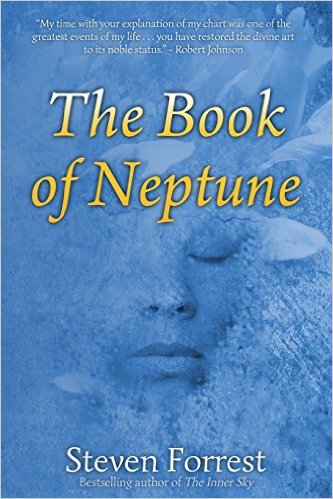
[NOTE:–To get the most out of this book requires at least a rudimentary knowledge of astrology. This need not be extensive, but should include knowing Neptune’s sign and house position in your natal chart, any aspects between Neptune and the other planets as well as where he currently resides in sign and house placement by transit. A transit, for those of you unfamiliar with the term, refers to the current zodiacal location of a planet or other cosmic entity, including any aspects it forms to a planet in your natal or some other astrological chart, of which there are too many to get into here. You can obtain this information for free from astro.com. Once you have that, you’re all set to apply the information Forrest has provided in this outstanding book. If you’d like to learn astrology’s basics, I recommend my own book, “Whobeda’s Guide to Basic Astrology”, which contains what I would have liked to have found when I was first learning about this ancient discipline.]
Even though I’m a professional astrologer myself, I’d been struggling with a Neptune transit for three years as this bad boy aspected first my ascendant, then Mars, then my Moon. Neptune’s influences are often elusive while contributing to a foggy, lazy, dreamy, ungrounded feeling. This was entirely foreign to me, though I must say it has certainly lent me a tremendous dose of understanding for those who are programmed that way.
As someone with a Capricorn Sun, Virgo ascendant, and Gemini Moon, everything about it was contrary to my basic cosmic imprint. For those of you out there who are fellow astrologers, I’ll point out that my progressed Sun has been in Pisces for over a decade, which has been uncomfortable as well, but these Neptune transits have been like weathering a tsunami in a leaky boat whereas before it was simply a matter of being afloat in a swimming pool on an air mattress.
Needless to say, I was very uncomfortable with it, and some of my fellow astrologer friends, who are more familiar with these energies, tried to help, but the main thing they accomplished was only to convince me I wasn’t losing my mind. Which reminds me, delusions and numerous forms of insanity are in Neptune’s domain along with drugs, alcohol and all forms of escapism. Fortunately, one of those peers, who is also a close friend, was aware of this book, told me about it and I immediately bought a copy. It’s a considerable understatement to say that I’m glad that I did.
Prior to Neptune swamping me with other-worldly, space cadet ditziness, I’d been an organized, disciplined, responsible, hardworking person. Now I couldn’t stay focused to the point that if I hadn’t realized it was Neptune, I would have been deeply concerned that I was developing Alzheimer’s. I kid you not. As the cosmic surfactant, Neptune tends to dissolve what he touches, and I believe that includes your brain. Not surprisingly, the god of the deep is associated with loss, disappearances, deception, psychic phenomena and abilities, spiritual experiences such as enlightenment and so forth.
To sum it up, Neptune left me in a state best described by WTF? I advise my clients that there’s always a positive side to any transit, no matter how grueling, but I was having serious difficulty finding anything about this one that was useful. The usual approach with a transit is to identify it, then direct that energy to something productive, yet I had never been less productive, more confused and generally feeling as if I were adrift in the ocean with no land in sight. I had never felt so lost.
Then I was fortunate enough to get a copy of Forrest’s book and I must say that he nailed it. He starts out by explaining Neptune’s realm, on the edge of the solar system, beyond which lie Pluto, Eris and possibly other planets or minor planets, the domain of comets and then interstellar space. It’s an area filled with mystery and the unknown, so it’s no wonder it’s unfamiliar to someone who’s practical, logical and responsible by nature.
In describing Neptune’s effect when connected with the other planets, Forrest provides both the “Light Side” and the “Dark Side.” This is tremendously helpful because sometimes with Neptune it’s not easy to tell which is which. For the twelve houses, he provides snapshots which include an overview, significant quote and a sentence or two regarding “Leaking Energy” as a preface to several pages of in-depth explanation. This is particularly helpful if you’re desperate, as I was, so you can grab the highlights before diving into the book as a whole. He discusses loss, often experienced during a Neptune transit, as well as navigating those murky waters in a positive way. He talks about synchronicity, which is typically ramped up during this time, both of a favorable and less favorable nature. His section on how the zodiac sign Neptune resided in influenced the music for different eras is fascinating, as is his journey through history, recounting key events that occurred when Neptune was previously in his home sign of Pisces, as he is now.
As an astrologer, Forrest’s books have provided me with a much deeper understanding of Neptune’s influence than I had before. It helped me understand numerous things which have occurred during this period and provided excellent ideas for dealing with them and channeling that energy that will contribute to my personal evolution in a positive way. I feel as if he has thrown me a life-jacket when I needed it most, the fact this book came into my hands at this time an example of the synchronicity he describes. It also makes sense that in the past few months I’ve become involved with a local astronomy group that conducts star parties every month where I’ve had the opportunity to look into Neptune’s realm, now understanding why this experience has felt so profound. Somehow gazing out into space helped me feel more grounded. Now I understand why.
If you feel as if you’ve lost your footing, are sinking in quicksand or adrift on a large body of water with no land in sight, there’s a good chance that Neptune is involved. If that’s the case, I can’t recommend this book highly enough. The price is a far cry less than a psychologist, especially one who doesn’t augment his or her practice with astrology. It has not only provided me with the answers I was looking for, but made me a better astrologer who can be more helpful to any of my clients going through Neptune’s often dark and mysterious waters.
You can pick up a copy of Steven Forrest’s “The Book of Neptune” on Amazon here.
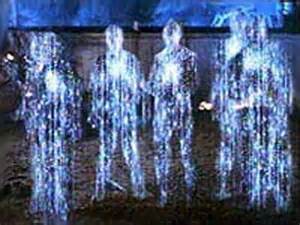
 To quote a conversation from my sci-fi novel,
 Some researchers indicated a new physics, which combined human consciousness with quantum and spacetime physics, was required to fully explain PK phenomena, a concept with which I heartily agree. After all, early quantum physics experiments such as the double slit experiment indicated the affect of an observer from the git-go, but of course “rational” scientists have made every possible effort to explain this away.
 Looking at things from the astrological side, weird, woo-woo phenomena like P-Teleportation resides largely within the domain of the planet, Neptune. Steven Forrest is renowned worldwide as astrologer who has recently released a book entitled, “The Book of Neptune.” Forrest explains that currently Neptune is in the sign of its astrological dignity, i.e. Pisces, in which Neptune’s energy is not only particularly strong but has historically delivered a huge shift in spiritual paradigms. Forrest explains:
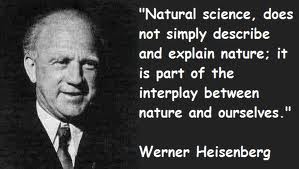 This brings to mind forward thinkers like Fritjof Capra, author of The Tao of Physics, published initially clear back in 1976. This book definitely served as a prelude to a melding of science and mysticism. He begins this fascinating work with one of my all-time favorite quotes from Werner Heisenberg, which states, “It is probably true quite generally that in the history of human thinking the most fruitful developments frequently take place at those points where two different lines of thought meet. These lines may have their roots in quite different times or different cultural environments or different religious traditions: hence if they actually meet, that is, if they are at least so much related to each other that a real interaction can take place, then one may hope that new and interesting developments may follow.”
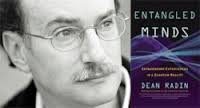 Perhaps Neptune’s subtle influences will facilitate the removal of the stigma associated with metaphysical phenomena sufficiently to allow such collaboration. I suspect researchers such as
  Xander de Hunter fans will be delighted to know that their favorite undercover cat is at it again in this exciting and vividly rendered adventure tale (or tail, as the case may be). If you’ve already read “Purranoia” (and you should, to fully appreciate this sequel) you’ll know that there were many unanswered questions at the end. Furthermore, Xander picked up a lovable sidekick, appropriately named Mischief. Her rebellious and inquisitive yet highly intelligent nature adds another important member to Catamondo. She continually rubs Xander’s fur the wrong way, especially her weird love of water sports, making the Sea Purrtector wonder if choosing to mentor her was really a good idea or not. The tension between these two adds conflict and more suspense, further enriching the story and plot.




 Marcha's Two-Cents Worth