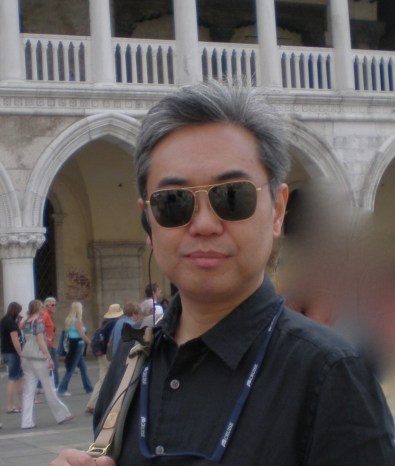
Augustine Kobayashi
What better way to commemorate Memorial Day than with a history lesson?
Tokyo-born Augustine Kobayashi, author of “Japan’s Pacific War”, earned postgraduate degrees in modern international history and Byzantine history at Leeds and London Universities in the U.K. In the following interview he shares insights that convinced me that what’s needed in politics today is more attention to historians and less to lawyers, businessmen and career politicians. Historians possess a perspective that could work through differences in a diplomatic fashion while never forgetting the fact that future generations will be affected by those decisions. Most of what we see today are those seeking only to expand their own wealth and power. The few who know anything about history only use it to further their own agenda, not improve the human condition.
MF: What motivated you to research and subsequently write your book, “Japan’s Pacific War”?
AK: I had been writing some historical articles for Historical Quest ezine, and I got some responses from readers for my article explaining how Japan’s war in China in the 1930s and the Pacific War were linked. Many reacted saying that they had no idea how the Sino-Japanese War (1937-1945) directly led to WW2 in Asia. I felt that we have a knowledge gap in this area of 20th century history, and thought that I could make some contributions to fill it. As for the American side of the story, there are many excellent books out there, so I decided to tell Japan’s story, from a Japanese perspective. When I was a student back in Leeds University, UK, I did research on Anglo-American relations in the 1920s, including some naval strategic discussions, such as how Japan’s stance in the world stage might affect international politics. In a way, this current book of mine is the fruition of my past historical studies.
MF: What surprised you the most regarding Japan’s decision to attack Pearl Harbor? Do you think they were realistic in their expectations of the outcome?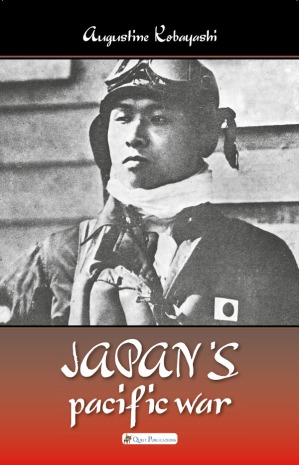
AK: In hindsight, Japan’s decision to attack Pearl Harbor is incredible, but, having gone through Japanese history of the 1930s, I have found that it is not really so surprising. Given the pre-WW2 American isolationism and Eurocentric tendency of the USG(overnment), giving strategic and diplomatic priorities to the solving of European situation, if they didn’t think that the USA would react by mobilizing the whole economy for war to crush Japan no matter what, it is understandable that they miscalculated this way. This is the time before TV or the Internet. People were not well informed and the Japanese public knew nothing about the outside world. The Japanese military basically thought that the US would be too busy fighting Germany or even be defeated and all they had to do was to immobilize the US Fleet a while, pick off Western colonies in the Western Pacific one by one and hold out until the European war was settled in favour of the Berlin-Tokyo Axis. If Germany had won, these expectations would have been deemed as quite realistic. Ironically, they attacked Pearl Harbor just when Germany tasted her first defeat in front of Moscow.
MF: As a student of Byzantine history, what is the most important lesson you believe it holds for those of us living in modern times?
AK: Things change. The secret of longevity of the Byzantine Empire was its ability to reinvent itself every now and then after crises. So much so that, even though it’s real designation should be the ‘Roman’ Empire, modern historians, who are so fond of the Classical image of Imperial Rome, feel uncomfortable with the designation ‘Rome’ and use ‘Byzantine’ instead for the empire after the 4th or 5th centuries. But this is precisely the point: it changed its shape and cultural characteristics so much to cope with the changing political, economical and military environment surrounding the empire, after several centuries, it was almost unrecognizable. So, the lessons for us are: be flexible and accept changes. Rely on your ingenuity rather than muscle power.
MF: A common saying is “Those who fail to learn from history are doomed to repeat it.” What is your favorite example of a culture or country failing to learn from previous civilizations?
AK: There are so many, it is difficult to single out a favourite one. As I live in Japan now, I’m concerned with China at the moment, as she seems to be in danger of repeating Japan’s mistakes in the 1930s and the 1940s. Given that China was the chief victim of Japan’s aggression in those decades, it would be so ironic. Hope the Chinese are capable of learning from others’ mistakes.
MF: The world today has a lot of problems. Based on your studies, what do you think is the most important thing world leaders should do to avoid another World War?
AK: Do not let others fear you too much. A cornered beast tends to lash out, which was the case for Japan in 1941; and I suspect that that is what is happening with the Islamic militants right now. The Byzantine Empire fought a devastating war with its rival, the Persian Empire in the 7th century, which in turn led to the Islamic Arab conquests. The Persians started this war as they were so worried over the reviving power of the Byzantine Empire (in 476AD, they had gleefully been watching the fall of the West; but now alarmed by the Byzantine reconquests of North Africa and Italy in the 6th century).
Christianity as soft power of Rome, its spread among small countries and ethnic groups geographically surrounding Persia frightened her leaders. Persia attacked Rome when internal power struggle at the capital Constantinople momentarily paralyzed the Byzantine war machine as a heaven-sent and only opportunity to strike. In modern times, in WW1, both Germany and England were motivated by the need to weaken their rivals before they became too strong. Japan’s war in China in the 1930s was partly due to a resurgent China and thus Japan’s fear of losing their top dog status in Asia. As for solutions to this problem of power imbalance, I don’t really know. Probably we have to find out by working patiently through diplomatic effort.
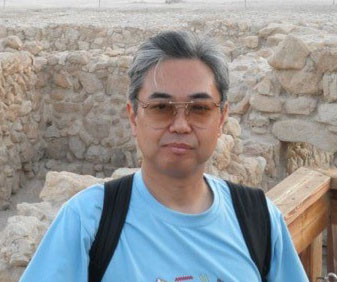 MF: What are you finding in your current research into Syriac Christianity and its spread into Persia that relates to modern tensions between Christians and Muslims?
AK: Persia’s state religion was Zoroastrianism at the time, but Christianity was gaining ground. It seems that Jesus’ saying that he came to fulfill old religion applied to Persia also! When you realise that Judaism had also been strongly influenced by Persia, which released Jews in captivity and allowed them to return to Jerusalem, you can see that Jews, Christians and Zoroastrians were not that very different. And Persia can be a very tolerant place for different religions.
But inevitably, religion and politics cannot be separated completely; conflicting socio-economic and political forces often clashed along religious lines, causing internal instability and external wars. As in my answer to question No.5, as Rome’s power grew, Christianity was seen as a threat by the Persians. At this stage, Roman Christianity became a political religion, which forced a political response from Rome’s rival(s). I think that today’s problems we have with Christians and Muslims are fundamentally the same: they are not really in conflict in terms of religion, but, whenever communal tensions arise and political conflict develops, they unfurl their respective banners and try to protect themselves by rallying around them. Some hotheaded young men often employ rhetoric of religious mission etc., but they do not really represent what should be the majority view.
MF: Do you think it will ever be possible for those two religions, which actually have similar roots, to make peace with one another?
AK: The answer should be yes. Different religious communities usually live in peace side by side most of the time anyway. It is a time of political tensions when religious communities are pitted against one another. The Coptic Egyptian Christians, for example, had lived in a relative calm for nearly 2,000 years until very recently. They should be able to go back to that, normal state. In Syria, sadly, the Christians appear to be being exterminated or displaced permanently, but, once a politically stable Syria could be achieved, Christians and Muslims should be able to live side by side again. But so long as political forces exploiting religious differences remain too strong, it might be a while before that could happen.
Pick up your electronic copy of “Japan’s Pacific War” on Amazon here.
Paperback: https://www.createspace.com/6222626
Read more about Augustine: http://www.quest-publications.com/authors/kobayashi/
Goodreads: https://www.goodreads.com/author/show/15168533.Augustine_Kobayashi
Facebook: https://www.facebook.com/augustine.kobayashi
Publisher’s Book Link: http://www.quest-publications.com/books/japans-pacific-war/
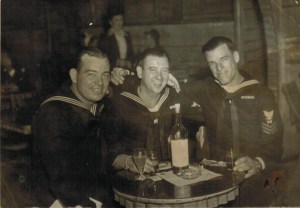 Oakland, California on February 8, 1944.
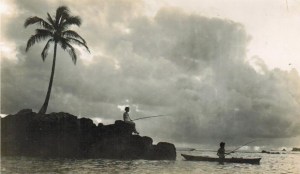 impacted by the war with Japan. Islands populated by those embracing a primitive life style who probably had no comprehension of why their peaceful lives were suddenly disrupted by the U.S. military. The little boy with the pig, the children with the old woman holding a baby, all tell a story.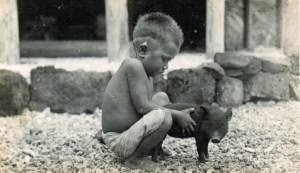
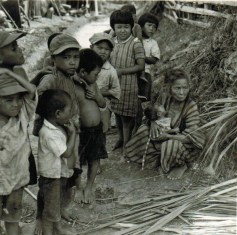 My father came home from the war alive and in one piece, which was more than thousands could say. I don’t know which island the cemetery below happens to be but it, too, tells a story. How anonymous all those white crosses seem, yet each represents a son, husband and/or father who never made it home.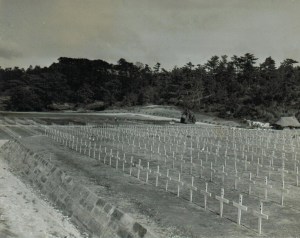
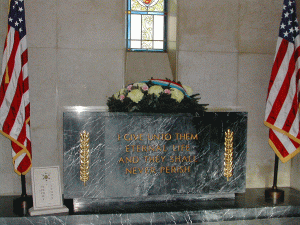
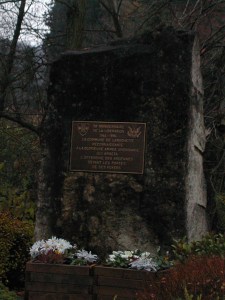
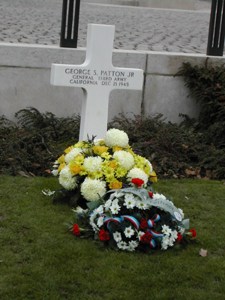 It was touching to see how much the Europeans appreciated our service. Every year on Veteran’s Day the government of Luxembourg honors General George S. Patton by placing flowers on his grave. There were several monuments of thanks erected to the U.S. Military as well, such as the one shown below, also in Luxembourg.
 WWII, nothing about Korea, even as we were stepping into the Vietnam conflict. No wonder everyone thought history was boring. It had no relevance to our lives. No wonder Baby Boomers rebelled.
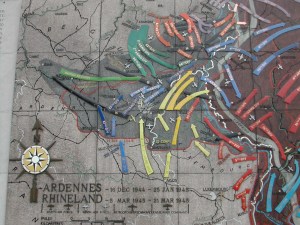 world needs to be imposed on others. In some cases resources or land plays a part, another symptom of greed that demonstrates a total lack of regard or respect for others. People will obviously fight for what they believe in or if someone else wants to take something away that they value. No one wants to be forced to believe something with which they don’t agree. And I must admit that though I like to consider myself a pacifist, if
 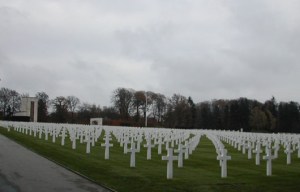 someone suggested eliminating all those who want to take away my freedom, property or anything else, I’d be cheering them on. Like Bill Pullman said so eloquently in the movie Independence Day, “Nuke the bastards!” I believe we should live and let live, but ironically that only applies to those who share that belief. So I suppose I’m not that much different than anyone else.
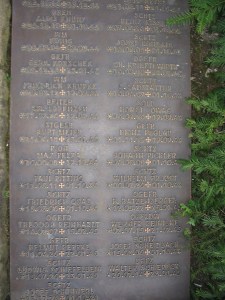 and destruction. On that Veterans’ Day in 2004 that I spent in Europe we also visited German cemeteries.
  Hitler’s obsession didn’t only kill those he murdered in concentration camps. Untold numbers of his own people also died. Soldiers fighting for what they were forced to believe in or die as well. Were they any less victims of a tyrant?
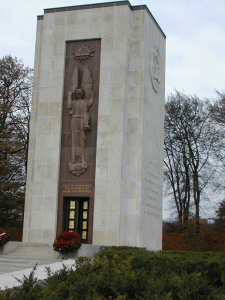 I suppose my generation’s war was Vietnam. There have been several since, mostly in the Middle East. While both World Wars focused on political ideologies, too many since have born shades of President Dwight D. Eisenhower’s warning regarding the military-industrial complex. Wars are expensive which means they’re profitable to certain industries. Bullets, rifles, uniforms, airplanes, tanks and so forth cost money. Big money, which benefits those who have no regard for their fellow citizens, particularly the upcoming generation who are inducted into the military and sacrificed on the altar of greed. Fighting to defend one’s freedom is one thing; getting involved in a foreign war to make money for a chosen few is quite another.
 Marcha's Two-Cents Worth