
I Placed a $30 ad on Facebook. Then my PayPal balance started to disappear.

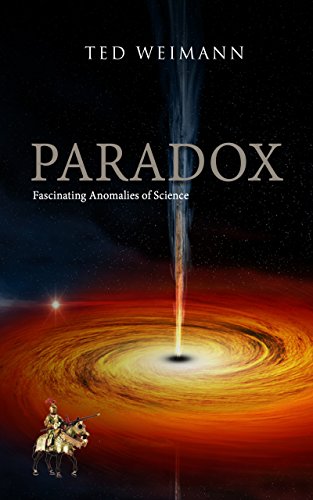
This is what my ad looked like.

I’m usually pretty good at catching phishing schemes. The dead-giveaway? Usually a gmail address. But be warned, professional scammers are experts at social engineering. They know how to push you buttons. I’m sharing this to maybe prevent some other person from a similar experience, which was far from pleasant.

I have never had much luck with advertising but decided to give Facebook a try to gather order for the pre-release of my Curse of Dead Horse Canyon Trilogy ebook. I created a post (shown above) and submitted it with a campaign limit of $30. The post was accepted and their AI even created a couple other texts for it so it wouldn’t be repetitive. So far so good.

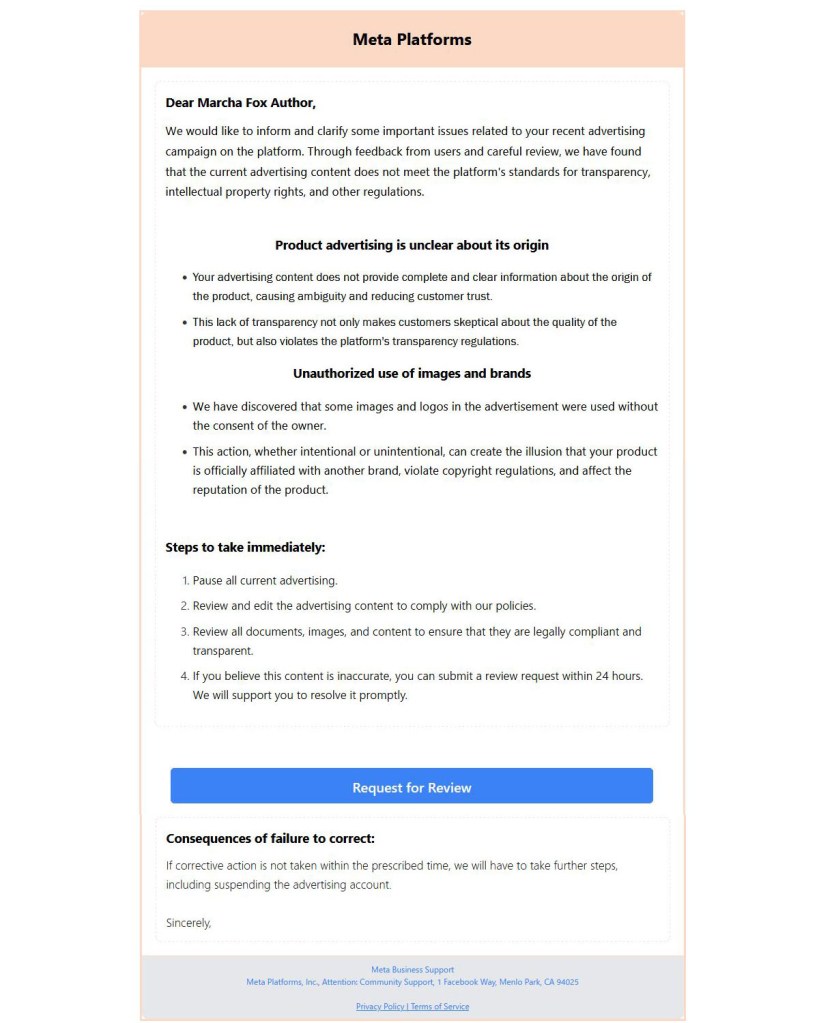
It no sooner went live and I get an email, supposedly from Meta, telling me my post violated their community standards with a bunch of nonsense about copyright violation and all sorts of other stuff you see below. My first reaction was anger followed quickly by frustration.
Why did they accept the ad, then reject it? Why didn’t they say something first?

Meanwhile, I set out to correct it and clicked the email’s “Request for Review” button.

What followed was a form where I had to fill in all my Facebook information, i.e. preferred emails, date of birth, and of course, my password, along with why there was nothing wrong with my post.

Big mistake!

When I went to my Facebook account to check on the ad, it was running and everything looked fine.
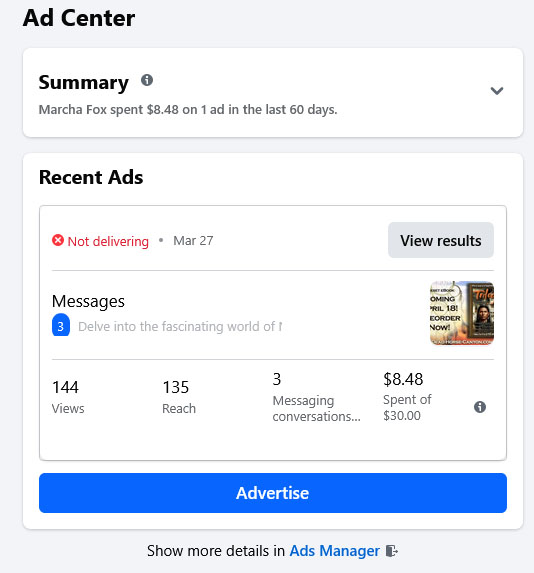
(It shows as not delivering because this screenshot was taken after I realized what was going on and cancelled my credit card)

What was going on?

About then I realized what happened. I looked back at that email and saw it came from a gmail address. After slapping myself upside the head, I set out to do what I could to preclude what was sure to follow.

In other words, with access to my Facebook business account they could easily find my credit card information.

I cancelled the credit card, which of course also cancelled my ad for nonpayment. Not wanting to do that, I added my PayPal to pay one of the invoices that was around $30 and looked legitimate, though a bunch of other charges were starting to accumulate that I didn’t understand. I figured if I paid one it would at least turn the ad back on.

A few had hit my Discover Card, too. When Discover texted me whether the first charge was okay, I responded it was, since I hadn’t yet figured out what was going on, much less expected additional charges.

Being rattled already, combined with the complexity of the Facebook/Meta business site, it was impossible to figure out what was happening or find the right menu to do anything about it.

I did discover some unknown Muhlenberg Life Company in my business profile with a bunch of obviously fake names and emails that I was unable to delete.
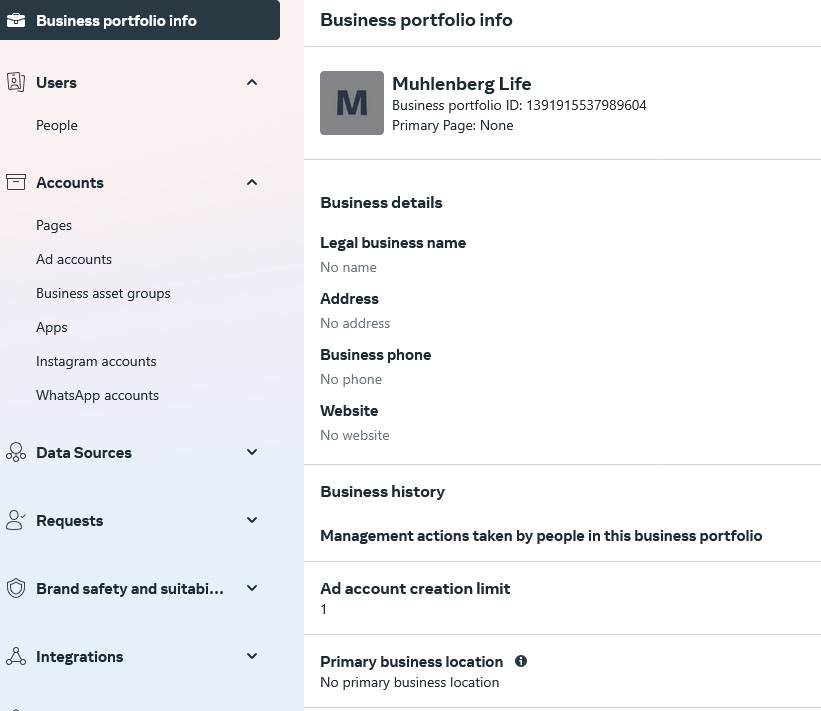
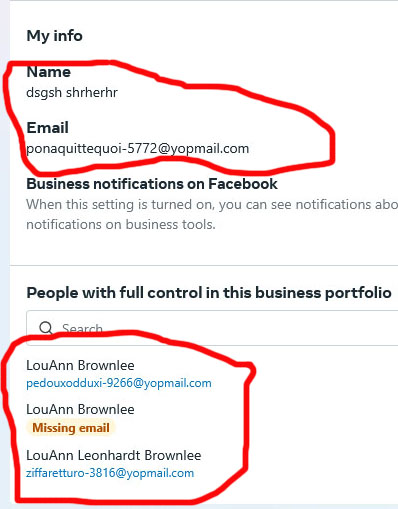
Then I realized Meta was charging my PayPal account–charge after charge after charge–the balance dropping to zero before my very eyes!

OMG!

I took what was left and sent it to my son-in-law to keep them from getting it all. Then I really panicked when I realized my bank account was also on PayPal as backup! Holy crap! When Pay Pal went to zero they’d start in on my bank balance! Then I really panicked, but was able to delete my bank from PayPal before that happened, thank heavens, and my Discover card on there was already cancelled.

Meanwhile, further digging on the Meta site indicated another ad on my account I didn’t place and couldn’t open, but had a daily spending limit of $5,000!

Meanwhile, I was getting more messages through Facebook and Instagram with the same bogus message with minor variations indicating they were from other people! By then I’d figured it out and fired back a rather nasty reply.

So consider yourself warned that a multitude of low life out there is on to this scheme!

The fact that Meta has no means of contacting an actual person or even a chatbot, my only choice was to send a frantic message to Meta about the situation. Then I went about changing passwords to just about everything.

nd by the way, that was done on Facebook very early on, but somehow these sleazeballs still had access to my account, which was apparent when I saw a transaction log of when they changed the spending limit. My daughter pointed out that I may have had to check an option to “log out of all devices” after I changed the password, but I didn’t see that option on my desktop computer, but it must have allowed them to remain logged in or perhaps in long enough to see the new password.

Several hours later I got a message from Meta. They’d investigated, found my account had been compromised (duh) and refunded all the bogus charges.

Whew!

However, this did nothing for the years it felt like were stolen from my life from the stress or the fact I still have to deal with getting a new Discover card, changing the number for all the utility companies and other services that go to that card, and probably doing the same with PayPal, though if I’m lucky, the regular charges may come through okay. As long as it’s not Meta!

I snarled when I saw PayPal took a fee from when I sent the remaining balance to my son-in-law. I don’t know about you, but if a digital currency will help us exchange funds without these ridiculous fees all over the place, I’m in.

I’m grateful this turned out to be no worse than an afternoon spent in a state of sheer panic. Too many are not so lucky. I do have fraud protection through my Discover Card, but if they’d gotten to my bank account I don’t know just how much that would have covered since I’m sure the coverage has a limit.

I still wonder what that other ad might have been and what they gained from it, if anything. When they discovered my Discover Card was no longer accessible was it simply retaliation?

Lessons learned:

1. Never advertise on Facebook. Period. Maybe it works for some, but unless you have thousands upon thousands of followers or already a best selling author it’s not likely to be effective. Looking at the statistics on there for when they were posting like crazy was pretty telling. Two responses with over 900 impressions?

C’mon!

I should have known because it has never done me any good in the past, making me guilty of violating Einstein’s statement, “Insanity is doing the same thing over and over and expecting different results.”

2. If you use PayPal, rethink those backup payment sources! After they wipe out the balance, charges will go to your credit card or, heaven forbid, your bank! Don’t be naive to how easy it would be to empty it out once they get access.

3. Pay attention to the authenticity of any email, no matter what the circumstances. AI has made it not only possible but way too easy for scammers to make them look legitimate.

They got me with the phishing email because it was timed perfectly. I reacted exactly as planned, wanting to rectify the situation and handing over everything they wanted. These scumbags are professional thieves. They’re tech-savvy and know how to dupe people. Every time I get a phishing email I report it to reportphishing@apwg.org. I have no idea whether they do anything about it, but it may at least get it listed as a scam somewhere.

4. Don’t leave credit card information on social media sites where someone can access it if they hack that account. I have two-factor authentication and do not know how they managed to get in with just my password, but somehow they managed it. If perchance you do run ads, I recommend entering the information when its needed versus leaving it out there.

5. Pay attention to those mass “Data Breaches” that happen all the time with major corporations. Changing your passwords when that happens is a nuisance but highly advised because you don’t always know exactly what they got. Once they have one password, there’s no telling how many other things they may get to. We tend to be too trusting and casual putting that information out there.

6. Be sure to protect your credit cards, even when they’re in your wallet. Shields that look like another credit card can prevent the RFID chip from being read remotely, even by someone you pass on the street. There are wallets available as well with that protection built in.

7. When your credit card company messages you about a charge, give it serious thought before responding. If nothing else, they’re acutely aware of frauds and are likely to know something you don’t.

8. If you ever have to change your Facebook password, be sure to log out from all devices first.


I shared this harrowing experience in the hope it may help someone out there avoid such a debacle. I’m usually smarter than this, but they suckered me in. Just like the rogue movers who scammed me two years ago when I moved from Texas to New York. (You can find my blog about that here.) Do yourself a big favor and learn from my mistakes. If everyone was smart enough not to fall for their tricks and it wasn’t profitable, they’d go away. We must do our best as individuals to make that happen given the sorry state of the world these days.

On a side note, switching to my persona as a professional astrologer, the worst of this has developed during the astrological transit of Neptune through Pisces, which has placed the planet under a deceptive fog beginning April 2011 through August of that year. Then he went retrograde and backed into Aquarius until February 2012 when he returned to Pisces. Gratefully, this is about to end when Neptune goes into Aries today (March 31, 2025).

Yay!

Be warned, however, that Neptune will return to Pisces for a short jaunt from October 23 until January 27, 2026, then eventually return to Aries which will last until May 23, 2028, when he goes into Taurus.

Historically, Neptune went into Pisces the last time February 17, 1848. Needless to say, as an outer planet of our solar system, it moves very slowly. Retrograde motion kept him in Pisces until April 12, 1861, when he first dipped into Aries–the very day the Civil war began on April 12, 1861. He went back into Pisces for awhile after that due to retrograde motion, returning to Aries for the long haul on February 14, 1862.

What will this ingress bring? As the Neptunian fog of deception dissipates and people rebel against what they’ve been subjected to, will another Civil War follow?

Time will tell.

Meanwhile, learn from my mistakes.

“The Curse of Dead Horse Canyon” A cross-cultural epic saga begins . . .

front-hi-res-rgb-tiny

Government corruption ignites a 19th century Cheyenne curse….

In 1879 a drunken hoard of silver miners raided a Cheyenne village while the tribe’s warriors hunted buffalo. A small band of young braves, not yet old enough to join the hunt, escaped and rode for help. Their efforts failed when they were discovered by the raiders, who ran them over a cliff along with all the tribe’s horses that had been left behind.

When the warriors returned and found the devastation, the tribe’s medicine man, Black Cloud, placed a curse on the site.

A century and a half later, a scandalous Top Secret project is under construction in the same Colorado wilderness. Bryan Reynolds discovers that its roots lie in the same greed, corruption, and exploitation of the Earth that precipitated the curse. But before he can expose what he’s found, he’s killed in a suspicious accident that his wife, Sara, miraculously survives. Her memory of where they were or what they’d discovered, however, is gone.

Neither Sara nor Bryan’s life-long Cheyenne friend, Charlie Littlewolf, will rest until they find out what Bryan discovered that resulted in his death.

Charlie is acutely aware that the only way to solve the mystery is through connecting with the grandfather spirits. To do so he must return to his roots and the teachings of his medicine man grandfather, Eaglefeathers. His journey back to the Cheyenne way includes ancient rituals and ceremonies that guide him and Sara to the answers they seek.

As a descendant of Black Cloud, his destiny is deeply embedded in the fulfillment of the original curse, which was triggered by the scandalous government project Bryan discovered and his subsequent death. Charlie’s quest has only just begun.


toolateortooearly copy


It took me far longer to write this story than I ever imagined. Believe it or not, my original intent was to write a cozy mystery which I planned to finish in a few weeks. Once I got into it, however, and started doing some research (my fatal flaw as a write), it morphed into a not-so-cozy murder mystery with a sharp conspiratorial edge. It took nearly two years from when it was conceived to releasing volume 1 of a trilogy.

Part of the delay was when I decided I needed a Native American to give my work a sanity check. I didn’t want it to be inaccurate or offensive. I did a lot of research, but recognized that is often insufficient. Through a rather serendipitous chain of events I found Pete Risingsun, a Cheyenne who lives on the Northern Cheyenne reservation in Montana. It didn’t take long for Pete to connect with the story to such a degree that he became the story’s coauthor. The Cheyenne portions of this story are accurate. You can read Pete’s biography as well as mine on the book’s website here.

A government conspiracy lies at the core, though this first volume concentrates on Sara and Charlie discovering what Bryan knew that got him killed. It’s character driven like my other novels with them riding a freight train of research that captured me in their iron grip. Every time I turned around I discovered something else that fit the story and situation too closely to ignore.

Modern man’s colonialism coupled with a blatant disregard for the environment conflicts with Native American philosophies of animism and the necessity to honor the Earth. These ideologies have clashed for centuries. Informed individuals already know about the downside of fracking. Past pollution caused by 19th century mining and the EPA Superfunds charged with cleaning them up, however, are not as well-known.  Put them together and there’s a subplot just waiting to hatch.

Various paranormal and supernatural elements including detailed descriptions of Cheyenne rituals and ceremonies are included. You’ll learn about the sacred red pipe, ceremonial fasting, and the sweat lodge. The Cheyenne’s name for the Great Spirit is Maheo, who is referred to throughout. There are numerous other-worldly situations included. While the story is fictitious, these depictions are authentic.

Modern technology plays a significant role in juxtaposition to traditional Native American elements. Astronomy and the ancient art and science of western astrology play roles as well in helping Sara and Charlie find the answers they need.

These complexities are what expanded this story into a trilogy. Charlie’s journey back to his roots and the consequences Sara pays for fulfilling Bryan’s dying request play out in the next two volumes. They are already drafted and awaiting collaboration with Pete and then the usual rounds of editing. Native American history is touched upon, but will be covered in greater detail in subsequent volumes.

I hope you’ll join me in this incredible journey and enjoy it as much as I have putting it together with the assistance of my awesome coauthor.

Pick up an electronic copy on Amazon or Google Play until July 31, 2020 for only 99c!

More vendors are on the way. The print version will be out in about a month. COVID19 has slowed down the conventional indie publishing process to glacial speed, but it is on the way.

Check out the series website for more information about the sequels and an excerpt from this one.

The saga has barely begun….

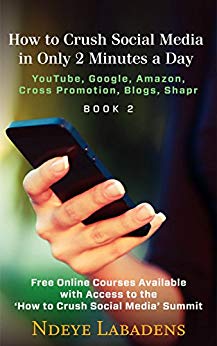
“How to Crush Social Media in 2-Minutes a Day” –Yeah, right.

howtocrushsocialmediccvr

I generously gave this book two stars when I reviewed it on Amazon, only because the author does demonstrate knowledge of the subject. While she has numerous good ideas in this book, I did not find any advice on how to “crush social media in only 2 minutes a day.” While the advice given for the different social media apps is probably sound, it would take considerable effort and, in many cases, a steep learning curve to implement.

Face it, there is no way to do as the title promises unless you hand it all over to a promoter or admin assistant.  Being able to deal with your social media promo nightmare in a few minutes a day is nothing more than a pipe dream unless you dump it on someone else. MAYBE if you spent six months or a year, laboriously implementing all her ideas and putting them on auto-pilot, if even possible, you could make progress. But the way I understand time in the real world, that is a far cry from two-minutes a day.

Thus, I find the title entirely deceptive because it does not deliver on the hope that drove me to read it. Okay, believing such a thing was even possible showed incredible naivety on my part, right up there with people who expect to solve their financial owes by winning the lotto. But that is only part of why I was so irritated. On top of being a big fat lie, it appears that the author is not a native English speaker. The grammar is atrocious and often makes it even more difficult to understand what is being said. Intensive editing by someone more familiar with the language is definitely called for.

Looking at the ranking of this book on Amazon, clearly this author does know how to play the social media game. For example, including this book in the “finite mathematics” category is ridiculous. I suppose if nothing else, it’s an example of the low standards people maintain these days for honesty and proper delivery on a promise. The lesson here is the way to get a best-selling book on a hot topic is to promise something everyone wants but can’t have, then not even bother to polish the prose. Then you categorize it in obscure, remote niches where it can obtain a high rank. Nice.

Then there’s the matter if this book were made into an audio book as it’s written–it would be hilarious.

If the first book in this series is anything like this one, I have no idea how it got so many 4 and 5 star reviews, other than to say those people either didn’t read it, were semi-illiterate, or were friends of the author.

I will admit, the advice is sound. However, good luck putting it all in place. I suspect this book is part of the author’s MBA and does show research and knowledge. It would probably work if you got through it all. But to me, I find the title so irritating along with its contrived rankings that I consider it an example of an indie snake oil salesman. It does demonstrate, however, that you can sell anything if you know how to promote it. The inherent dishonesty, however, as you can probably tell, really pisses me off.

If you feel inclined to wade through the fractured English, you can find a copy on Amazon here.

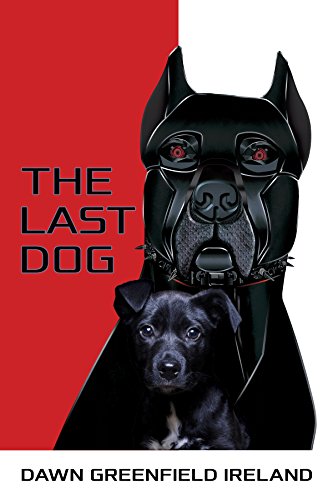
“The Last Dog” is Sci-fi at it’s Best, Especially if You’re an Animal Lover!

lastdogcvr

5stars

The Last Dog

by Dawn Greenfield Ireland

This story is not only original, but science fiction at its absolute best. While the story is suitable for young adults, it has enough substance to satisfy even a hardcore science fiction fan like myself. Animal lovers will especially love it, since one of the main characters is a dog.

The story is set in the 2080s in a dystopian setting. The author provides background in the prologue, which explains how different events in the 21st century, of both a political and natural disaster variety transformed the United States. It was a story in itself, which was not only tremendously interesting and entertaining, but showed how much thought and creativity the author has invested to develop this outstanding story.

Probably the most important technological angle is the development of the Dot, invented by one of the main characters, Bill Maxwell, which enables dogs to talk. The human birth rate has been greatly compromised, so few are able to have children. Thus, having dog and cat “children” is the norm. Anyone who’s ever had a beloved pet knows they are like our children. Then add the ability to have them talk to you and you can imagine how amazing that would be.

However, another disaster comes along, which kills millions of people as well as nearly all the dog and cat children, except a puppy named Abby, who belongs to Bill and Teresa Maxwell. However, Abby is taken by the government under the pretense of trying to find any other canine survivors and cloning or otherwise finding a way to re-establish the canine population. Meanwhile, a robotic dog has also been created, which is endowed with artificial intelligence. One of these in particular, named Rex, is another major character who is entirely endearing.

While all of this probably sounds pretty far-fetched, the author has done a fantastic job of creating a futuristic world where it all comes off as believable. Furthermore, if you’re an animal lover, chances are you already talk to your pets and can imagine them talking back. The gist of the story relates to if and how the Maxwell’s and Abby will ever be reunited. I absolutely loved it and know that I will someday read it again, which is the highest recommendation I can ever give a book because my TBR is so long, it’s a rare book indeed that I indulge in more than once.

If you’re a science fiction fan you’ll love the technologies and if you’re a dog or cat lover, you’ll love the pet angle. I highly recommend this heart-warming and original story from one of my favorite authors.

Pick up your copy on Amazon here.


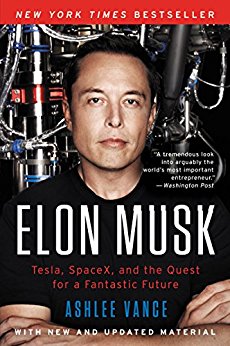
5 Stars for “Elon Musk: Tesla, Space-X, and the Quest for a Fantastic Future” by Ashlee Vance

elonmuskcover

I’ve been fascinated by Musk for quite a while. I even entertained thoughts he might be some sort of space alien hybrid, helping us develop new technologies. I wondered where this guy came from and where he got all that money. I wondered why his new technologies, which are a threat to industries which have been known to resort to rather nasty tactics to suppress such competition, seemed to have no power to do so in his case. This book certainly answered all my questions and then some. I had no idea he was one of those dot-com millionaires, starting with his connection with PayPal. Explaining where his money came from certainly clarified quite a lot. His personality explained the rest.

As someone who worked as a NASA contractor for over twenty years, I can especially appreciate what he has done with Space-X. While some accuse him, and rightfully so, of being a obsessive workaholic and expecting the same from his employees, you have to admit that his system of finding the best and brightest and luring them to work for him works. Musk doesn’t suffer fools. You disagree with him or goof up and you’re gone. In today’s world of tolerance and dumbing down the general population via our pathetic education system, this certainly goes against the grain. But it gets things done.

I saw so much mediocrity at NASA it was pathetic. But it was only part of the problem as far as technological advances were concerned. I remember seeing an invoice one time for small a metal plate with a part number on it costing thousands of dollars. I mean, really. How ridiculous is that? But that’s how government contracting works. Musk, on the other hand, emphasized efficiency. It was his money, so he pushed for keeping costs down. Rather than buy from a manufacturer on the other side of the world, he would develop the needed facilities and make it himself. He demanded perfection and refused to give up.

One philosophy I always liked and employed as a manager myself was “If you’re not part of the solution, you’re part of the problem.” Clearly he had the same attitude. His employees knew better than to simply complain about something being an obstacle. They needed to contribute to a solution or get slam-dunked.

There was so much about his management style that I admired. In most cases in today’s world, his tactics will either get you sued for harassment and/or fired. Which explains a lot. But if you want something considered impossible done correctly, that’s what it takes. The results of Musk’s methods speak for themselves.  He does what he says he’ll do and is a force to be reckoned with. He’s not been suppressed by existing industries since he has the money to proceed on his own, unlike most inventors who depend on selling their patents. In that case, they’re typically bought up by competitors, their ideas left to rot somewhere in a file cabinet to assure the status quo.

Along those lines, Tesla is another awesome success story, a venture that was more than once on the brink of failure. But Musk persevered, his vision and intentions a testimony to those who promote such tactics for manifesting what you want. I loved the part where Tesla acquired a former GM plant in Fremont, California (not too far from where I lived many years ago) virtually for free. Tesla is driving conventional car makers crazy. The cars are kicking butt in all areas from safety to speed to virtually “free” fuel as he builds recharging stations.  He’s out to change the world and making steady progress doing so, specifically in previously troubled industries collapsing under their own weight.

His personal life was certainly interesting as well. Did you realize he has 5 boys, i.e. a set of twins and a set of triplets from his first wife, Justine? Or that as a child he was bullied, in some cases brutally enough to land him in the hospital. His photographic memory has served him well, his intelligence and scientific understanding off the scale. If someone tells him something can’t be done, he usually fires them and does it himself. I find that inspiring, not obnoxious.

The author did a great job of providing a glimpse of what this guy is like, not only as a slave-driving manager, but as a person. I admire much of what he stands for and stands up for.  I loved the author’s candid writing style, often imbued with humor that had me laughing out loud. I don’t doubt that I will eventually read this book again. It’s inspirational to see what one determined man can accomplish when he sets his mind to what needs to be done, then commandeers the help and talent he needs to get there, leaving naysayers in the dust. His self-imposed mission is to save the world from itself and so far it looks as if he might do just that. It won’t surprise me one bit if he’s the one who gets us to Mars. If you have any doubts, then you should read this book. It made a believer out of me and restored my faith in old-fashioned hard work and ingenuity, which has somehow gotten lost in our crazy world.

This book convinced me, more than ever, that it’s people like Musk who should be considered heroes in today’s world. Not obnoxious sports figures, crooked politicians, and those who want to be taken care of at others’ expense. It’s time that we return a strong work ethic and intelligence to the status it deserves for making this a better world.

You can pick up a copy on Amazon here. I recommend it highly. I will warn you that it contains a multitude of f-bombs. If you want to share this awesome story with your kids, which I also recommend, there’s a cleaned up version you can get here.

A Cool New Way for Authors to Package Their Books

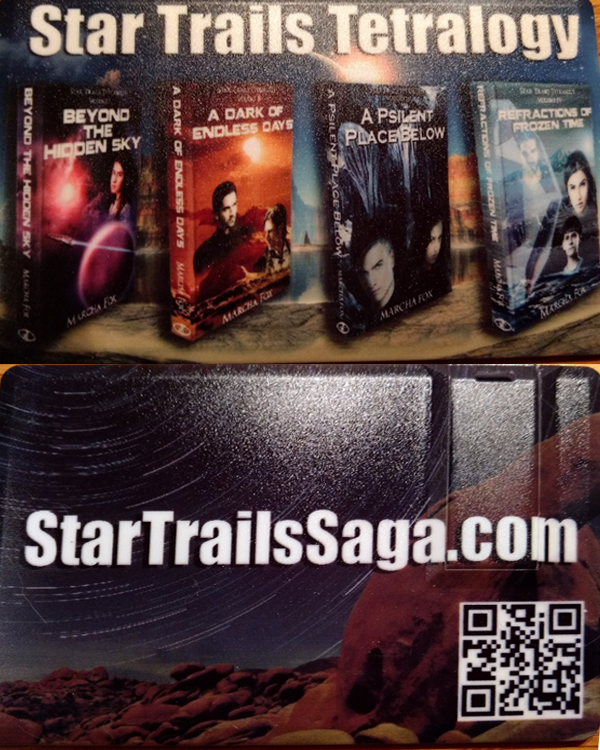
STTTDPA51-USB copy

What you’re looking at are photos of the latest and greatest way to share your books! As an author I think this is the coolest thing I’ve seen in a long time. Its actual size and dimensions are the same as a credit card, but the awesome part is that it contains a USB drive loaded with my Star Trails Box Set and latest novel, “The Terra Debacle: Prisoners at Area 51”.

These work great for book signing parties, especially for those who prefer an ebook, as well as for giveaways, drawings, and anything else you can think of.  They have a variety of styles, but I thought this particular one was best suited to show my books on one side and have the website and QR Code on the other. Just think how much easier it is to haul a box of these around versus print copies!

I got mine from https://www.usbmemorydirect.com. Check it out!

Is your inner Einstein looking for some brain candy?

paradox

This deliciously meaty and heavily researched book should be on everyone’s shelf. Of course, I’m prejudiced as a scientist myself. I thrive on nonfiction books like this, because they clear the dust from those remote corners of my brain, many of which haven’t been used in a long, long time.  In many ways, the content reminds me of the popular physics books Isaac Azimov wrote years ago, which I thrived upon, prior to actually obtaining a physics degree myself.

Probably what I liked most is its focus on the numerous paradoxes that exist in just about every field of study. The author includes sections on medicine, neurology, and psychology; astronomy, cosmology, and physics; and geosciences and math. He points out through a host of examples that there is still so much we don’t understand and thus so much to learn and explore. On the other hand, research is often subjective and highly biased, conducted to prove a point that financially benefits someone or, more likely, a corporation or industry.

So can you trust research results? Maybe, maybe not, making scientific findings paradoxes in and of themselves.  Science should represent facts, but does it? If someone you don’t trust tells you one thing, scientific data notwithstanding, do you automatically assume the opposite to be true? Do you trust everything the pharmaceutical industry tells you? The tobacco industry? Monsanto? The government? How many times has USDA’s official “food pyramid” changed? How many drugs or food additives have been declared “safe” by the FDA only to be proven otherwise at a later date? is it a paradox we can’t believe so much of what we’re told in the name of science?

You’ve probably heard the quote “Lies, damn lies, and statistics”. The section on mathematical manipulation was particularly fascinating, especially pointing out a statistical flaw (or method, depending on whom you ask) known as HARKing, “hypothesizing after the results are known.” Sometimes, remarkable discoveries are found that way; but, on the other hand, it can be used deceptively.

Weimann notes how correlations are often implicated as causes, when there’s no solid evidence to substantiate it. Along similar lines, in some cases, I would have liked to have seen a specific source as opposed to the massive bibliography at the end. While I understand that footnoting every fact would have been a Herculean task, I definitely raised a eyebrow from time to time wondering, and would have appreciated more substantiation. Ironically, the author himself points out how so much of published scientific findings are suspect, yet other times presents them as gospel. I find this somewhat ironic, perhaps a subtle play on the title, perceivable only at the subconscious level, or maybe it’s the author’s way of messing with us.

What can we believe these days? Sometimes, it’s hard to tell. In some ways, the entire book is a paradox, where facts are provided on one hand, yet the overall theme is that contradictions lie all around us. It’s as if it the book’s underlying message is something like, “This is all the cool stuff science is discovering these days, but don’t believe everything you hear.”

Maybe you need to be a scientist to see the humor in that. We nerds do tend to have a weird sense of humor, a trait that’s occasionally, but not always, captured on the popular TV show, “The Big Bang Theory.” It’s a matter of laughing with versus at someone and, more often than not, the humor in that show is directed at mocking those who are different. Personally, as a physics major myself, I find it marginally offensive, and if I were of certain political persuasions, I’d be out there protesting and demanding it be removed from the airwaves. Not that scientists can’t laugh at themselves. They just do it at a level the average person doesn’t grok.

Digression aside, Paradox contains a wealth of science, much of it unknown or cutting edge; the beauty of it lies in pointing out–sometimes clearly, sometimes, not–the various contradictions afoot. A favorite saying among physicists and mathematicians is that something is “intuitively obvious.” That tends to show our arrogant side, since so much isn’t, such as his expose of the number one in the math section.

One human behavior paradox I particularly enjoyed in Weimann’s book was in the section that addresses psychology. As humans, we want choices, even demand them, but too many options are overwhelming and tend to result in a person not selecting any of them. I know I’ve experienced this in the grocery store, where there is so much to choose from (especially in the ice cream cooler) that walking away and thus doing without is a far simpler decision, and probably healthier. Another example would be the plethora of political ideologies (some of which are idiotologies) where people scream for freedom to express their own views, then want the entire world to conform to their beliefs, a primary reason why democracies fail.

Some sections are more controversial than others, including the age of the Earth, as well as whether global warming is attributable to a natural climate cycle, which the Earth has endured for millennia, or being contributed to by fossil fuels. I must say, that section tended to convince me of the latter, though I previously leaned toward natural cycles. I found the section fascinating that addresses how our brains have evolved and actually become smaller. The author states that scientific evidence indicates that once daily environmental threats are removed by a “civilized” society, brains shrink, while disease increases. Apparently, “Survival of the fittest” conditions refine a species to top efficiency, whereas survival for everyone, including the drones, downgrades the species, generally. Who woulda thunk it?

The contradictions paradoxes represent keep us honest and humble. They remind us that all may not be as it seems, that our sense of reason may be flawed, implying we’re not as smart as we’d like to think we are. What we believe is impossible is limited only by our knowledge of natural law. Perhaps the only individuals from centuries past who wouldn’t be surprised by what we’ve achieved would be Nostradamus and other visionaries who were considered crazy in their own time.

While this book serves as brain candy if you’re a scientist, you don’t have to have a physics degree to appreciate or understand this information. Rest assured, it’s presented for a lay audience, but won’t be palatable for everyone. For those who find science boring, it’ll serve best as bedtime reading for insomniacs.

On the other hand, this is a must read if you’re a science aficionado or entirely immersed in it by degree or profession. Stretch your synapses to fields outside your own! If you love science, yet aren’t formally educated in its tenets, Paradox is a wonderful primer that will keep you informed of some of the most interesting subjects under investigation today. If you’re surrounded by scientists or engineers, but aren’t one yourself, yet want to participate in conversations at work or social gatherings and show you’re smarter than they think you are, this handy volume will provide a wealth of the latest information on what’s going on out there in the world of research, both in the cosmos and on planet Earth.

Those heading for college to obtain a technical degree can benefit greatly as well. If you’re not sure which field you want to go into, you may find something that grabs you. Furthermore, this material will help grease the skids, so to speak, introducing concepts that will make them easier to understand later. Our brains require synaptic connections to work properly, and if a concept is entirely new, it’s harder to grasp than one with some level of familiarity where a niche has already been prepared in your grey matter, if you will. Anyone home schooling their kids will also find this an excellent resource. If you’re a science fiction author, you definitely need this book, not only to keep your writing credible, but to likewise trigger a wealth of new ideas.

As you can tell, if nothing else, this book made me think and possibly stimulated my neurons a bit too much. All that aside, even if you’re not interested yourself, pick up a copy of this five-star book and give it to your favorite nerd. They’ll be forever grateful.

You can pick up your copy on Amazon here.

Phone Etiquette for the 21st Century

visitinggma

Those like myself, who grew up when dinosaurs roamed the Earth, remember an entirely different phone system than we have now. Most had a phone in those days (talking about the 50s and onward) but they were all landlines run in from unsightly poles. Furthermore, in many cases, we had to share this line with one or more other people. Now this is not like having multiple phones on the same plan sharing minutes. This is a matter of essentially sharing the phone line itself. In other words, only one person could use it at a time.

Back then, phone manners comprised not only the usual salutation and farewell, but dealing with other people outside your family, usually, but not always, your neighbors. Some were on the phone all the time, others might listen in to your conversations, and other annoyances like that, which are incomprehensible to those who are used to having their own cell phone, possibly from adolescence onward.

Protocol back then dictated if someone on your party line picked up their phone twice, the polite thing to do was hang-up and give the other person a chance to use it. Of course, some people would do this within a minute, which put the rudeness on them. If there was a family on your party line who had one or more teenagers, you can imagine how this worked, though admittedly there are plenty of adults out there who talk as much or more.

There was also the matter of long-distance calls. They were expensive. If you had out of state friends or relatives, or even out of your local area, it could cost you an arm and a leg to conduct long-winded conversations. Writing letters was the norm, since there was no email, either. Special calls for birthdays, holidays and family emergencies were often the only long-distance calls made. That was the Golden Age of Hallmark, when you’d send a card in the mail.

Now we have entirely different issues. Not only are party lines long gone (thank heavens), but now your phone goes with you everywhere. And this creates a whole new set of issues, especially for those of us who aren’t addicted to them.

If everyone in the room has their nose in their phone, then that’s one thing. In fact, texting someone in the same house or even room is not unheard of. This, needless to say, is rather crazy to those of us who are as old as dirt. I suppose it can be related to passing secret notes in class or under the table. But how much of real life do you miss?

Don’t get me wrong, I’m not against texting. It comes in tremendously handy to exchange brief information in an unobtrusive manner. However, like email, it often replaces true communication, either by talking to someone face-to-face or via a voice call. Emoticons notwithstanding, it’s difficult to tell a person’s tone in a text. It is often easier to say something that way than you would ever say in person. This, of course, can lead to ugly confrontations as all restraint and manners depart. Many years ago, back in the 90s, when I worked at NASA, one of our bosses had an informal rule that after three emails on a subject were exchanged it was time to pick up the phone and talk it out. Or, if numerous people were involved, get together and have a meeting. Not a bad bit of advice today.

I guess what irritates me most and what motivated me to rant are the people who can’t live without their phone. They are constantly either talking, texting, or looking something up. Their attention is on their phone, not you or anyone else who’s there. This is bad enough in a group, but one on one it’s incredibly rude. If you met someone for lunch you haven’t seen in years, why would you spend that precious time checking your phone for text messages? If you’re waiting for life or death information, that’s one thing, but you know what I’m saying. Or someone comes over to visit and then spends the time paying more attention to their phone. How does that make you feel? Clearly that the phone is far more important.

Am I entirely insane and old-fashioned thinking this is the epitome of rudeness?

4574511_sModern communications devices have changed our lives, in many instances in a very positive way. But phone addiction has caused problems as well. It took a ridiculous amount of time before it became apparent to insurance companies and law enforcement agencies that those who talked or texted while driving were as dangerous or perhaps even more so than drunk drivers. I suppose a Blue Tooth and voice commands make it no worse than having a passenger or kids in the car, but it’s still a distraction. Whenever I see someone driving erratically they are usually yakking away to someone who’s either invisible or on their headset.
Doesn’t anyone ever concentrate on driving safely anymore? I suppose with self-driving cars coming soon, that won’t matter anymore, but for now it does. Especially in metropolitan areas, most of which have a severe traffic problem.

This rant has gone on far longer than intended when I could have said it in one sentence: When you’re driving or visiting with someone, put away your damn phone. It’s annoying, offensive, rude and sometimes dangerous. And I don’t mean only in traffic. One of these days, the person you’re ignoring might finally get fed up and hit you upside the head.

‘Nuff said.

Keeping up with Technology — Barely

cropped-brain-fingerprint-300x296

It blew me away today when I discovered this article on Futurism.com about brainprints. The reason is that in my last science fiction novel, “Refractions of Frozen Time,” I had the bad guys collecting what I called mindprints, which were a unique identifier. So here we go again, science fiction has become science fact.

What’s a sci-fi author to do?

It gets harder and harder to come up with futuristic technology. Since I started my novels several years ago I had to do various “upgrades” for them to keep up. I had internet, the equivalent of Craig’s List, and electronic currency in my novels long before they were reality.

About the only thing I have in my novels, short of faster-than-light (FTL) space travel, that I 15442253_sTHOUGHT was still science fiction is the c-com device my hero uses for any number of functions. C-com stands for “cerebral companion” and was like a smart phone on steroids driven by psi-waves, a.k.a. telepathy.  But EVEN AS I WAS WRITING THIS BLOG, an email came in from Futurism that stated you can now send text messages via your brainwaves! You can find the article here.
Holy cow…

What’s a sci-fi author to do????

Please, buy my books quick, before they jump genres into historical novels!  The box set of the entire series is currently on sale for only $3.99.

STTlpostcardVP2 copy


The Nebulous Boundary Between Science Fiction and Science Fact

15442253_s

One of the biggest challenges for science fiction authors is keeping up with the technology. For those of you who have read my books, specifically the 2nd one in the series (“A Dark of Endless Days”) and beyond, you’ll remember Laren’s c-com, short for cerebral companion. This clever little device, essentially a smart phone on steroids, linked directly to his brain via psi link so he could access virtually any information in the Universe and likewise download his own thoughts. It could do just about anything, but there was one caveat, i.e., he had to ask it to do what he wanted. It wouldn’t volunteer information, as he discovered in “Refractions of Frozen Time.” And that’s enough of that before I get into spoiler territory.

As “high tech” as the c-com is, it’s nonetheless a little too easy to imagine such a device in the real world. I just saw an article in R&D Magazine (http://www.rdmag.com/news/2015/04/phone-ultimate-macro-feature) that reported there is now a device that can turn any smart phone into a “DNA-scanning fluorescent microscope.”

Seriously?

Holy cow, I want one!

Not!

No, that’s not exactly on my Amazon wish list, but I’m sure for geneticists and CSI types it would be.

Clearly science and engineering is well on its way toward developing a c-com, taking it from science fiction to science fact. When I first started writing sci-fi my fictitious world had the internet, the equivalent of Craig’s List as well as a currency comparable to Bitcoin, all before their time. It’s been said that whatever man can perceive he can achieve and there’s no doubt that science fiction has been the inspiration for several of the technological marvels you see today. Undoubtedly you’ve seen that picture circulating on Facebook of an old Radio Shack advertisement from twenty or so years back hawking the electronics of the time. It included a television, radio, cameras (both still and video), tape recorder, stereo, a desktop computer, and of course, telephones, with the caption that everything on that entire page had been replaced by the smart phone.

Charles_H._Duell

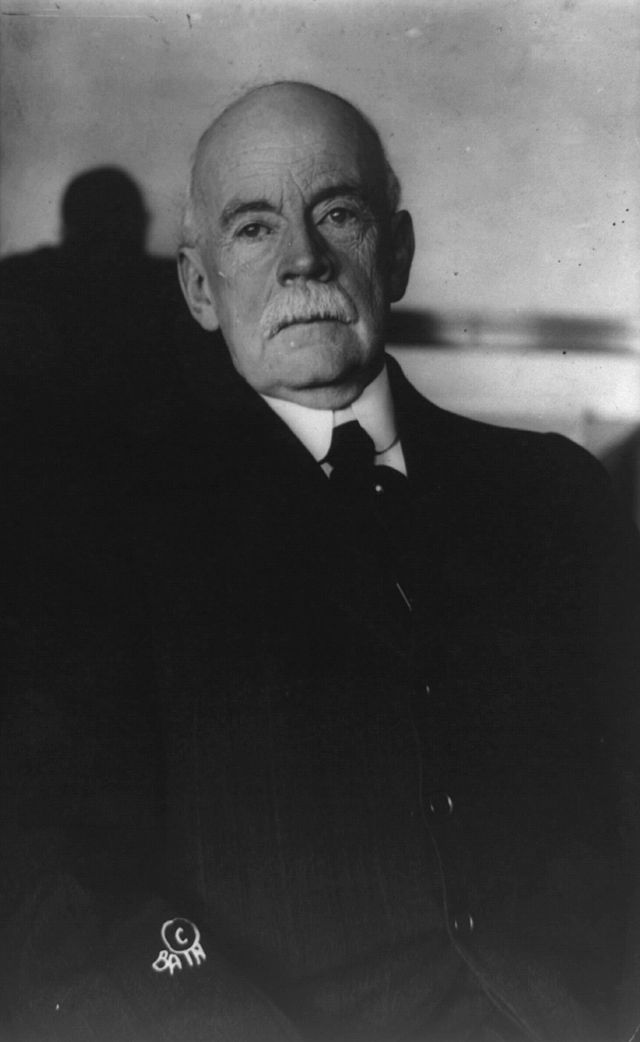
Charles Holland Duell (shown above), Commissioner of the U.S. Patent and Trademark Office from 1898 to 1901, supposedly once said, “Everything that can be invented has been invented.” This has been debunked but what he did say was, “In my opinion, all previous advances in the various lines of invention will appear totally insignificant when compared with those which the present century will witness. I almost wish that I might live my life over again to see the wonders which are at the threshold.” (Thank you, Wikipedia.)

That was in 1902. He died in 1920. What do you think he would say about what’s out there today?

Case in point, my mother was born in 1906, the time when the Wright brothers were developing their flying machine into the first fixed-wing aircraft. She lived long enough to not only see men walk on the Moon but her daughter (yours truly) eventually work for NASA. She marveled at the internet and I shudder to think what her final years in a rest home would have been like without cable television. And that was just the 20th century. What can we expect in the 21st? What will top 3D printers?

1685453_s

You’ve probably heard of Moore’s Law which hypothesizes that technology doubles every two years. This statement originated back in 1965 with Gordon E. Moore, co-founder of Intel and Fairchild Semiconductor, whose original statement related to the complexity of integrated circuits but has applied remarkably well to technology in general which, of course, is largely driven by just that. The miniaturization of devices fits in there as well. This “law” has proven to be accurate enough that tech companies have used it for planning purposes.

Science fiction writers, including myself, would do well to bear that in mind. Technology doubles every two years! It can easily take longer than that to write a book! That’s an exponential rate that’s hard to grasp. We’re all quite aware of the present but have often forgotten much of the past. Can you remember what it was like before cell phones or the internet? How about computers? Were you even born yet???

Trying to imagine what will come next taxes your imagination, yet as sci-fi writers that’s our job, to not only keep up but surpass it! That, my friend, is easier said than done. And I certainly don’t mean to throw stones at my fellow writers, but when I read science fiction I thoroughly enjoy noting how different authors extrapolate technology to the future, especially the near-future, such as another fifty years. Gasoline fueled cars? Paper? Really? Ya think? When technology doubles every two years? I particularly enjoy reading about paper documents on planets equipped with interstellar vehicles. Uh huh. Right. I’m as guilty as anyone, hard as I may try. In my novels I had security devices I called “palm locks” to gain entry to a room. Science fiction is now science fact.

10253627_s

But there’s one area that science fiction writers can always pursue and that’s where technology will take us. Will it eventually all come crashing down? Then what? Are we really better off with our smart phones than we were without them? Or on a path to humanity’s demise? After all, there are those who use smart phones to trigger bombs and incendiary devices. Furthermore, a massive solar flare could destroy the power grid and all those cell towers. Then what? What if our addiction to electronics was forced into cold-turkey withdrawal?

4574511_s

No wonder dystopian stories are so popular these days. Such scenarios are easier to imagine. Which is scary as hell.

[Illustrations credit 123RF Stock Photos]