Robert Kimbrell Blog Hop!

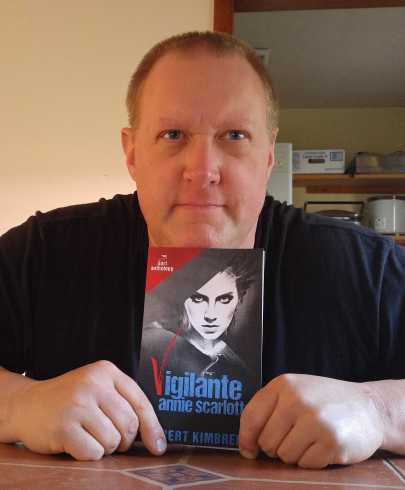
author-pic

Robert Kimbrell recently sat down for a brief interview and was asked four questions.

1. Tell me a bit about your childhood in Ohio.

If one knew me growing up, I was a boring only child. But I’d like to say it was very interesting to be inside my head.

My father was abusive to my mom and me, so as you can imagine the atmosphere was always tense. I had to learn to use my imagination so I had a place to escape to. I was nervous and anxious all the time, even into young adulthood. I mean, to grow up always afraid of making your father angry or seeing him become violent towards your mother really does something to your psyche. Those who have grown up in an abusive atmosphere know what I’m talking about. I’ve never used what happened then as an excuse, but looking back I recognize how far I’ve come, and how far I still have to go.

2. I’m sure what happened to you framed, so to speak, your writing and creative process. Your book is called Vigilante Annie Scarlotte, and it is about a woman who becomes a vampire. Tell me about Annie.

You’re right. Now, when I hear of kids being abused or neglected- I cringe. Or when I catch a news story about a woman whose cowardly husband abused her, I boil, as I’m sure others do. I want to take action. That spark is what is behind Vigilante Annie. She has been blessed by a unique ability, so she decides to use it to take action. For reasons that will be explained in the next book, Annie must have fresh human blood every so often, or she’ll become ill again and die. So the premise of the story is simple: to justify killing others for their blood, Annie chooses the truly evil among us as her victims. As you can imagine, Annie battles with the morality of doing what she has chosen to do.

She questions her fate, her purpose, and begins to be taken over by this vampire within her. She has a sexy Italian boyfriend who is hiding things, an old friend Elisa who has been silent for some time, and a father-figure named Larry whom she decides to tell her secret to. Like I said, the premise is simple, but the plot and chaotic start to Annie’s bloodsucking life isn’t simple at all.

3. Do you have anything new you’re currently in the midst of writing?

Actually, I have several in the works. The next Vigilante Annie book is the biggest, it will be available in ebook and print, just like the anthology. There is not yet a release date set. I actually have a couple erotica titles and a couple shorts that will actually give some backstory or sidestory in the world of Vigilante Annie.

4. So what is the next Vigilante Annie book going to be about?

The next Annie story is going full fantasy. In the middle of recovering from her injuries, Annie is being taken to the underworld. There she will meet others like herself and other diverse types of beings. The plot I cannot reveal just yet, but Annie is being brought there for a specific reason. For anyone who has read up to now, you’ll know Annie will meet her brother and have to face her mother for abandoning her as a child. Anyone wanting more info can visit the website www.VigilanteAnnie.com.

Thank you.

Thank you!

Pageflex Persona [document: PRS0000026_00043]

Book Blurb:

Because Annie has no recollection of her birth parents, her life is full of unknowns. Still, she seems relatively content with her simple existence in Washington, DC. Marcus, her new Italian boyfriend, adds much desired spice to her life despite secrecy about his position at SecureVest. But when Annie becomes mysteriously ill, it is the catalyst for a life far from simple.

Seemingly by luck, Annie discovers that she is maturing into a dhampir (a vampire/human hybrid), and to survive she must feed on fresh human blood. With Marcus fully aware of Annie’s predicament, they concoct a scheme: find the evil living among us and act where justice does not.

Vigilante Annie is born.

Pick up your copy on Amazon here: http://amzn.to/2dGCki4

Author Bio:

An only child, (in the seventies, mind you), little Robert could be seen running in the backyard playing superhero, with a bed sheet serving as his cape. He also spent many hours drawing or writing in his mid-sized Ohio town. Having also battled depression earlier in life, Robert now sees how his low points have brought him to a more creative, stronger sense of being. Now he is where he wants to be, and is telling the stories he is meant to tell. His other interests include reading, motorcycle touring, fitness and classic movies.

Connect with Robert Kimbrell:

Twitter:  @VAAuthor

Website:  www.VigilanteAnnie.com

BLOG HOP: “MIRROR OF OUR LIVES: Voices of Four Igbo Women”

Book Cover

In Mirror of Our Lives, four Nigerian women share the compelling tales of their troubled lives and failed marriages, revealing how each managed to not only survive, but triumph under difficult and repressive circumstances.

Njide, Nneka, Miss Nelly, and Oby relive their stories of passion, deceit, heartaches, and strength as they push through life—each on a unique journey to attain happiness, self-respect, and inner peace. But none of the women’s journeys is without misjudgments and missteps.

Njide falls in love at first sight, marries Tunji too quickly, and is dismayed when Tunji shows his true colors. Nneka once thought that she and Oji were the perfect couple—until Oji traveled to the United States. Miss Nelly is a kind and good natured woman who allows everyone to take advantage of her—even her husband, whom she married only for his name. But everyone wonders why Oby and Mat even married at all, for their marriage was a battle from the very beginning.

The tales in Mirror of Our Lives: Voices of Four Igbo Women will inspire women around the world to never give up, to discover a sense of worth, and most of all, to learn to love themselves above everything else.

Background To The Story:

It is important to give a brief background information on the history of this book. In my culture, it is a great luxury for a woman to be educated. This situation is still prevalent in certain parts of Nigeria, especially in the North, where the people are Muslims. In the South, women education has made a very deep inroad. It was a battle that the women themselves fought and won. Today, in our Universities, the population of the women is more than those of men. But there was a time, when, even in the South, the choice to educate the kids in a family, fell on the male children. The male child was always chosen over the female child, and the female child was bundled off into an early marriage. Mirror of Our Lives: Voices of Four Igbo Women, is the story of the victory that education has given to four Igbo women. It is also the story of what education can do for women, especially , women in the Muslim areas of Nigeria where education is still tabu for the women to attain happiness, self-respect and inner peace. But none of the women’s journeys is without misjudgments and missteps. You can also read the reviews on the book on Amazon.om and on Barnes & Noble.

An Interview with Adebowale On Mirror of Our Lives

(1) Your debut novel, Mirror of Our Lives, focuses on four Nigerian women who went through hardship but triumphed under such difficult and repressive circumstances. Is it right, therefore, to say that you are a female rights campaigner, or a feminist?

JLB: Thank you Adewale for your interest in my book, Mirror of Our Lives. Right now, I am writing you from California, where I am performing the “Omugwo” for my daughter who recently had a baby. When I sent you a complimentary copy of my book last April, 2012, I sent copies also to as many Nigerian newspapers and magazines, as I could find. Since then you are the second newspaper to show interest. Thank you very much for this. To answer your question, I do not like to be hedged into any type of category. I am for justice for all, for each person to be treated humanely, and for the disadvantaged to be given the opportunity to excel.

(2) One of the characters in the book is Njide. How much of your real self is reflected in Njide’s life?

JLB: One thing I learnt in my writing class is that no writer writes from a vacuum. You write from what you know, from personal experience, and then go from there to create a world, or in this case a situation that does not only reflect your personal experience, but all other experiences similar to yours. I am not totally Njide, but Njide lived a lot of my personal experiences, as well as the experiences of other women I have come to know.

(3) If Njide’s life is part of your story, then the other three characters — Nneka, Miss Nelly and Oby — must also have a link with you; can you share this with us?

JLB: Just as I said in my answer to your second question, after writing about Njide, I found it easy to fictionalize the experiences of other women I know. The names I used are not the names of the women whose stories I told, and the stories I told did not reflect the experiences of any particular woman. I wanted any woman who read the story to relate to it, and many women whom I know who read the story have called to tell me that the story of one of the women or the other is the story of their lives. This is what I wanted, to tell a universal story.

(4) In your opinion, do you think the average woman is getting her credit in her contribution to societal good?

JLB: In my opinion, women are doing better today than they did in the past, but that is not to say that they are getting the credit they deserve. I would like to see very hard working women given recognition based on their work. We see a lot of women today, especially in our society getting on based on who they know, and not on their contribution in their areas of specialization. God fatherism in whatever shade or colour, to whom ever uses it, male or female, should not be condoned in public service. We see a lot of this happening in our country.

(5) Mirror of Our Lives is an interesting read. When next is the public reading another story from you?

JLB: I am working on it.

(6) The book is actually published by a foreign publisher; was there a reason why you didn’t approach our local publishers?

JLB: There were two main reasons why the book was not published by a local publisher; first, I wrote the book while I was still living and working in the United States, so I was more familiar with the publishing scene of the US. Secondly, if you notice, the book is a self-published book. I did not want to suffer any rejection on this book as I did in my other attempts to publish. I believed so much in this book that I wanted it out by all means, and iUniverse provided me the opportunity  to self-publish.

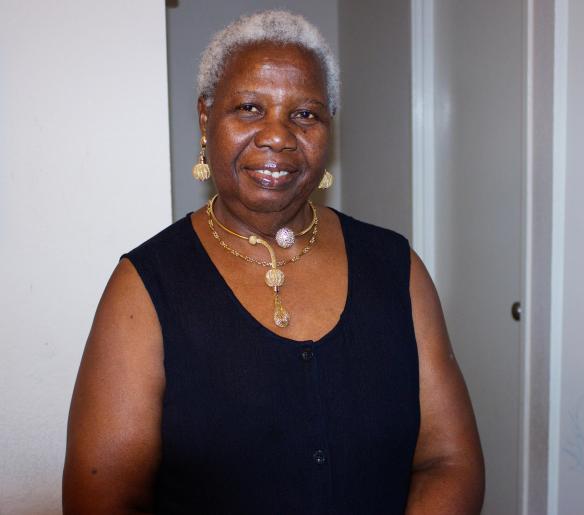
Author Pic

Joy Nwosu Lo-Bamijoko

Joy’s Bio

Joy Nwosu was born in Enugu, Anambra State of south-eastern Nigeria. Her parents were Charles Belonwu and Deborah Nwosu. She is the fifth in rank of the seven children of her parents. Joy was born into a music family.

Joy, now retired, was a music teacher, trained in Santa Cecilia, Rome, and obtained her Ph.D. in Music Education from the University of Michigan, USA.

She has written and published extensively on national and international scholarly journals, magazines, and newspapers.

Her short story I Come from Utopia was published in African Voices, Spring/Summer, 2007, pg. 18, and her first English novel; Mirror of Our Lives: Voices of Four Igbo Women was published in 2011, and was shortlisted for the Commonwealth Book Contest in 2012. She has also two books published in the Italian language.

Joy is a trained musician, and taught music for 35 years.  She writes, performs, and record folk songs.

Her new book: The Legend of the Walking Dead: Igbo Mythologies, which has just been released, is a journey into the mysteries of life and death of the Igbos of Nigeria.  She loves reading romances and mystery stories.

Websites:      http://sbpra.com/joylobamijoko/  Mirror of Our Lives …..

                         http://sbprabooks.com/JoyNwosuLoBamijoko/ Legend of the Walking…

Buy Mirror of Our Lives…Amazon Link:

http://www.amazon.com/Mirror-Our-Lives-Women/dp/1450278965

Barnes & Noble Link

http://www.barnesandnoble.com/w/mirror-of-our-lives-joy-nwosu-lo-bamijoko/1102630079?ean=9781450278966

Link to my Blog:       jinlobify.Com

Face BookLink: https://www.facebook.com/joy.lobamijoko

Link to my LinkedIn Book Add

http://goo.gl/fT1P2O

Trailer: Mirror of Our Lives: Voices of Four Igbo Women

https://youtu.be/UhSyMaUz0Uk

Twitter Handle:         @Jinlobify

Mothers’ Day Blues

henparty2004

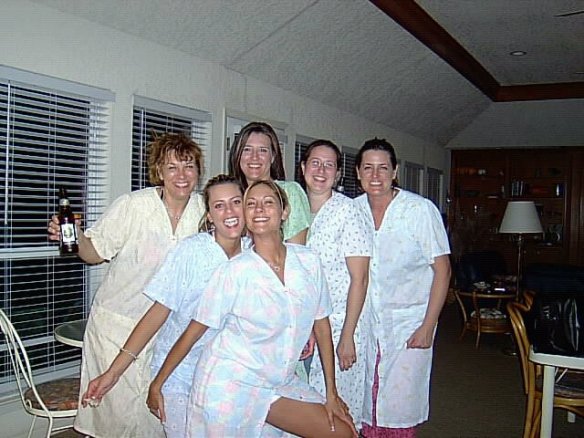
This picture of me, my daughters, and daughter-in-law was taken at a “Hen Party” I hosted over a decade ago. In fact, I referred to our jaunts as “Foxes in the Hen House.”  Its premise was a break for me and “the girls” with no kids, no men. We’d spend a lazy weekend in a beach house working on our tan while subsisting on chili con queso, brownies and beer. My intent was to promote family bonding and build fond memories.

We all love this picture because we all look happy, almost as if we like each other.  It captures an ideal that we somehow never reached, other than for a few photo ops. It’s a good thing our hen parties were confined to a weekend because by the time we went home we were usually not nearly that cheerful. All my kids are very different, except for having strong personalities. Of course I have no idea where that came from.

Mothers Day 2008-2

Relationships are complicated, especially in families. You can’t choose your family (at least not in this life) so you’re stuck with what you’ve got. Which means you need to work with it the best you can.  As an only child raised with TV shows like “The Brady Bunch” I always wanted a big family, thinking they’d always have each other and thus never feel as alone as I had. That isn’t exactly how it turned out. Some don’t like each other, some don’t even like me.

This picture from 2008 was the last time all my kids were together. It was Mothers’ Day, probably the best one ever, when all of us were together. It hasn’t happened since for numerous reasons, some geographic others not.

Hen Party memories bring a wash of nostalgia for other reasons as well.  That beach house was in Galveston, Texas and destroyed by Hurricane Ike in 2008. We could never go back there for old times sake, even if we wanted to. But the memories live on. Sometimes that’s all you have.

beachhouse

When storms strike relationships they, too, can be destroyed. But that doesn’t mean they can’t be rebuilt. The trick is to base them on something more substantial than sand. Like love, compassion and understanding.

I never got along with my mother and now that she’s gone I finally understand her. Hopefully someday it will be the same for my kids.

Fathers’ Day Musings

fatheranyI always approach Fathers’ Day with mixed feelings. There are great fathers and there are those who were present at the moment of conception but that was about it. My father fit somewhere in-between. He was there, at least physically, but not much of a father. No, he wasn’t physically abusive but he didn’t have a clue how to be a parent, or even a husband, for that matter. In his defense, his father died when he was two years old and his mother, my grandmother, never remarried so he really didn’t have any sort of example to follow.

When I was little he found me amusing but as I got older he nicknamed me “Nuisance” and by the time I was a teenager he ignored me completely. Ironically, he and my mother stayed married because of me. The three little words I remember him saying to her on a regular basis were “You’re never satisfied.” As a result I grew up with little respect for either of them whose relationship was somewhere between the Bundys and Bunkers or maybe Ralph and Alice Cramden, a.k.a. “The Honeymooners” of sitcom fame. This, of course, fueled his resentment toward the “stupid kid.” In retrospect, I can see that the sour marriage ruined us all. If my parents had been happily divorced we all would have been better off, especially me, since I felt I was to blame for the sorry situation.

father1

A book I read years ago entitled “Getting the Love You Want” by Harville Hendrix did an excellent job of explaining why men and women marry the people they do. It’s quite simple. Each is attempting to complete a role that was lacking in some way regarding the parent of the opposite gender. I grew up feeling useless at best and a burden at worst, so when I got married I was out to prove that I could support myself and everyone else. That’s what happens when your nickname is “Nuisance.”

I probably sound bitter, but I’m not, just retrospective as once again Fathers’ Day approaches. It was a few weeks before Fathers’ Day when my father died. He was in his 70s and had suffered a major stroke with little to no hope of recovery. He was a Navy veteran so was going to be transported from the local hospital to the Veterans’ Hospital roughly a hundred miles away, so I knew I probably would never see him again. Thus, I went to the hospital that morning to say goodbye. He was unconscious as I took a chair at the foot of his bed, but shortly after I arrived he started to stir, opened his eyes, sat up far enough to make eye contact, then convulsed and was gone. As he left this life I had a strong impression that he’d apologized in passing for being such a lousy father. It didn’t change anything but for some strange reason made me feel at peace, recognize he did the best that he could and forgive him entirely for his deficiencies. The sense of loss I felt then and still is never so much that he’d passed on, but rather for the relationship we never had.

fathergift

As time went by, my own children grew up, had children of their own, and their children likewise grew up. During that time I witnessed a wide variety of fathering or lack thereof. The older I got, the more I realized how many voids I had in my life because of my father’s inability to function in that role. I never felt as if I mattered one way or the other and that I had to prove my worth, to myself as well as everyone else. I never had anyone I felt comfortable going to for advice, mostly because of being told “you’re only a stupid kid” on a regular basis. Ironically, he had a 10th grade education and couldn’t answer some of the simplest questions I asked when I was a youngster. I don’t doubt now, as I look back, that he was simply echoing what he’d been told as a child himself.

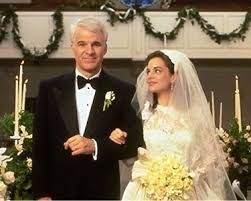
When I got married and he “gave me away” it was an empty part of the ceremony since we’d never bonded. I’ve seen some beautiful interactions between brides and their fathers and sometimes grandfathers, both at the altar and then later when they danced together. Seeing them always brought tears to my eyes because it was an experience I’d never have. I never knew either of my grandfathers, either, but having a loving grandpa can definitely help fill this void.

fatherbride

Fortunately, in my life I’ve known some wonderful older men whom I adopted emotionally as a surrogate father. These were kind, educated and successful men who treated me like an intelligent and perhaps even interesting human being. I wept profusely when these worthy father substitutes passed away while never shedding a tear for my own.

The more children raised without a father’s positive influence, the more dysfunctional families will result. Boys need a loving and responsible male role model and girls need a positive relationship with their father to assure better self-esteem and higher expectations of the men in their future. If that sounds sexist, I don’t care. I wonder if my relationship with my father would have been better if I had been a boy, which he wanted as many men do. Maybe I got a physics degree and went into a career field predominated by men to try to make up for being a girl. My father was a mechanic and I remember when he’d work on our family car that I was curious and wanted to watch but was shooed away since that’s not what girls were supposed to be interested in. And sadly, now that I’m retired and single, I have this huge mental block about fixing things or performing even minor maintenance like changing the air filter on my lawnmower, probably because I was told as a child that girls don’t do such things.

father2

If any fathers out there have stuck with me this long, please recognize how important you are to your children. If a child feels unloved by his or her father it’s highly likely a feeling of not being good enough will have a pervasive detrimental effect on his or her life. Every rejection will reinforce this negative self-perception and deter love, success and joy from every fact of their life. They may turn out to be a workaholic people-pleaser, forever trying to find the praise and acceptance they never got. A more negative spin includes gang membership or promiscuity. Note that well-intentioned but over-critical parents can have the same effect if a child feels unloved or unaccepted.

fathervader

Fathers, your children possess half of your genetic material and have a natural affection for you, whether you deserve it or not. Why do you think adopted children will go to so much trouble to find their birth parents? Any failure on your part to fulfill your role will leave an empty place in their heart. And you adopted fathers are incredibly important. You don’t have the benefit of a genetic link yet have every bit as much influence and responsibility to fill that role. In some cases you’ll do far better than the natural parent ever could, especially if the natural father was in the “sperm donor” category. Unfortunately, my “surrogate” fathers entered my life too late to fill that void.

father3

While numerous male parents in the animal kingdom are remiss in taking part in raising their offspring, humans are supposed to be better than that. Fathers, be the best person you possibly can and man up to your responsibilities. Be there for your sons and daughters. By doing so you can make an important contribution one child at a time to a better world. A world that needs all the help it can get.

Gender Equality: The Ultimate Oxymoron

Men and women will never be equal. They were never intended to be. It’s physically impossible. Furthermore, their brains function differently in ways that support their most basic biological function as intended by Mother Nature. While men have the ability to focus with sufficient concentration such that they become oblivious to anything else up to including a nuclear blast, women can multiplex. If they couldn’t, no child would ever live long enough to make it to maturity. One theory explaining this difference relates to physiological differences in the brains of the two genders. Supposedly, the corpus callosum serves as a barrier between the right and left brain in males but in females allows processing information across both sides simultaneously. This has led some women’s groups to claim rather rudely that all men have brain damage.

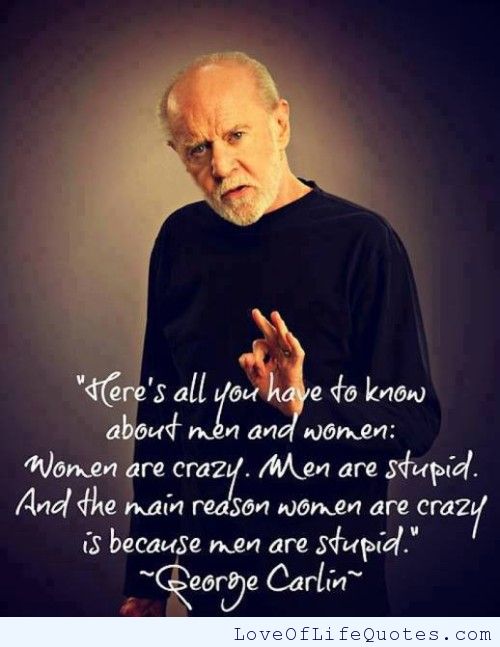
George Carlin summed it up nicely:

George-Carlin-quote-on-men-and-women-500x647

I’m glad that statement originated with a man because I don’t want to offend any of my male readers. Of course that’s an over-simplification. I don’t think men are stupid, just different. And I know some women whom I would agree are definitely crazy, two I can think of offhand.

I consider the ideal relationship to comprise a partnership where each supports the other while carrying equal responsibility within their unique roles. By collaborating, synergism can be achieved. No, I’m not going to say that women should be home, barefoot and pregnant, and men should be the sole provider for their family. In today’s society that no longer works and it’s not the point I want to make. Rather, it’s that each gender sees things differently which is a good thing. Neither is right or wrong, stronger or weaker, good or bad. Pitting one against the other is the ultimate failed comparison between apples and oranges.

An true partnership is about carrying an equal load, not who does what. Some women are happy being the breadwinner while some men are content to stay home with the kids. It only gets complicated when both want to play the same role or, worse yet, one wants to do neither and thus sits around the house all day as exemplified so well by Peg Bundy or Jefferson D’Arcy in the old sitcom, “Married with Children.” These roles are best customized to the mutual satisfaction of the people involved, not by culture-dictated stereotypes. Preferences are also likely to change with time and age. For example, at one time I preferred mowing the lawn to doing dishes. Not anymore. Now that I’m retired I have a deal with my neighbors where I cook them dinner in exchange for keeping my 1/2 acre lot looking civilized.

One fundamental difference that I’ve observed is that, generally speaking, men tend to be naturally suspicious of other members of their gender, whom they perceive as competitors. The only way they get past this is to wear the same color uniform, literally or figuratively, which promotes male-bonding. Conversely, as a rule women tend to be less autonomous and have more friends, even though this brings its own share of complications. There have probably been more women betrayed by a false friend than men, who are more likely to duke it out in the parking lot and then go off together to enjoy a beer.

Of course thousands of books have been written about the battle of the sexes. I always thought that John Grey’s “Men Are from Mars, Women are from Venus” did a pretty good job of spelling it out for relationships. Summing it up in a single sentence, women want to talk about a problem and men want to fix it. For women trying to survive in the workplace, which was originally designed and occupied nearly exclusively by men, “Games Mother Never Taught You” by Betty Harragan is an outstanding tutorial for navigating the corporate jungle. I can’t describe its content any better than its subtitle which declares, “Corporate gamesmanship for women.” But I digress, something I’m prone to do, perhaps because I’m a female whose brain operates like an old-fashioned pinball machine.

Nonetheless, the members of the supposed “weaker sex” seem more inclined to be helpful and nurturing toward others as opposed to competitive. One place where I’ve seen this come about is in Indie author support groups. I can name two right off the top of my head which were founded by women to provide direct help to other authors. There are definitely excellent groups out there founded by men as well, but it’s interesting to see how their functions differ. The groups set up by women tend to be more personal. All members are encouraged to be active participants, get to know each other, and provide help and answers for new writers as well as reviews and moral support for established ones. On the other hand, groups founded by men tend to be more focused on technology and services, operating more like a team, if you will. Both are effective and helpful but in different ways.

If you wonder where this blog is going, at this point I’ll tip my hand. It’s part of a blog blast and competition (probably a man’s idea) to promote the Rave Reviews Book Club. This outstanding group which comprises over 600 members of both genders was formed by author, Nonnie Jules, and is the ultimate in author support. New authors are often starved for reviews which this group helps provide. They maintain high standards via a Code of Conduct that assures the books they promote are not offensive. (In fact, this is a trait of both author groups to which I referred earlier which were formed by women. Some of us are still old-fashioned enough to want to avoid certain genres.) Activity is rewarded, particularly to those who recruit other members, since this is one group where “the more the merrier” is implicit to their mission to provide reviews.

If you enjoyed this blog I’d greatly appreciate it if you’d go to the following link and give it a vote! And if you’re an author who writes material considered “clean” consider joining this awesome group. You won’t be sorry. And be sure to mention my name when you do.

http://wp.me/P49Fi9-GG