Confessions of a Reviewer from Hell – Part Four

As a person who worked in a technical environment for two decades, I have to admit one of my pet peeves is when details relevant to a novel are ignored or inaccurate, particularly when they relate to the protagonist’s or key characters’ livelihoods. If you’re going to place him or her in a particular career or situation such as a police investigation or military setting, then you should know something about their SOPs (Standard Operating Procedures). Otherwise, especially if one of your readers is familiar with such an environment, they’re going to be put off by inaccuracies or glaring errors regarding how that particular field operates. Do you really want someone from one of those professions to pick up your book and laugh themselves silly? Probably not. Not only will you lose a potential fan but may garner a scathing review which will discourage other readers.

Understand that people in most professions including big business, the military, aerospace, law enforcement and most other fields, even including those who labor in fast food establishments, tend to speak their own unique language, often replete with various acronyms. If you want your story to sound authentic then you need to reflect those details in your story. In other words, if you’re going to write a medical thriller then you’d do well to learn some physiology so those gory scenes are accurate and be familiar with emergency room procedures and jargon. In case you haven’t noticed, novels that make it to “Best Seller” status tend to meet these standards of accuracy.

If you’ve followed this blog from the beginning you’re probably getting tired of hearing this, but if you’re going to do something, freakin’ do it right! If nothing else, realize that failing to reflect appropriate details to bring a character, profession or even location to life is a classic example of why authors are continually advised to “Write what you know!” The good news, particularly as far as authenticating a location is concerned, is that as a writer you can vacation in such places of interest and then write off at least part of it as an expense on your income tax. It doesn’t get any better than that. Just be sure to take notes, keep your receipts and not expect immediate book sales to pay off your credit cards from such a jaunt.

If you don’t already know the necessary details through life experience, then you need to do some research. This doesn’t have to be onerous or boring. You can always talk to someone who does that for a living and pick their brain. Most people enjoy talking about what they do and are even flattered that you asked. Use them later as a beta reader to make sure you captured it correctly. You’d be surprised how much more interesting your story becomes when you’ve done your homework. Often new plot twists surface as a result and your finished product will be more convincing and deserving of praise, including by those within or without that particular occupation. If they like it they’ll tell their coworkers and bring more readers and fans your way. You may even inspire someone to go into that line of work as they get a bird’s eye view of what it involves.

The world these days is filled with too much mediocrity. Please don’t contribute to it with your writing. Standards have plunged now that literally anyone who possesses a little computer and internet knowledge (or perhaps sufficient money) can get their novel published in ebook or even printcopy format. No writer today is forced to deal with rejects and a plethora of revisions to get their work published so the incentive to edit and in some cases even run the spellchecker have been lost. Doesn’t anyone own a good dictionary anymore? Okay, okay, I’m one of those weird people who would actually read the dictionary from time to time. I’m not a perfect speller but I can usually tell when a word “looks” wrong and know where to look to find out. My grammar isn’t always correct and one thing I’ve never mastered was punctuation, especially the use of commas. I admit it, I’m far from perfect. But I’m closer than I was 30 years ago.

Please. If you must produce sloppy work, keep it far away from me. If sufficiently provoked by bad writing I can become “The Reviewer from Hell.” Of course that depends on your attitude. Regardless of which stage you’re in as a writer from stark beginner to already published, if you’re a true professional and want to know the truth, then I may be able to either help you move in that direction or validate your efforts as on-track.

That said, before I close what has turned out to be a rather lengthy blog/rant I have one more thing to say: All I’m really trying to do is make this a slightly better world for readers of Indie authors, one sentence at a time.

Namaste.

Confessions of a Reviewer from Hell – Part Three

Needless to say, as I learned these lessons in humility, many of which were difficult and ego-deflating, I became quite adept at editing, if I do say so myself. I’ve been an avid bibliophile my entire life, right back to those Little Golden Books my mother read to me, so I have developed a strong concept of character and plot development as it pertains to fiction writing as well.

I didn’t get it all through osmosis, however; I also read books on writing, attended classes which included obtaining an English minor in college, and went to various workshops dealing with writing technique. I point this out not to brag but to show how serious I was about learning how to do things correctly. It’s only when you can admit how little you know that you open yourself up to really learning something. Long before my own books were in print I helped several friends edit their books, two of which eventually got published and earned me a place in their “Acknowledgements” section up front. Seeing my name in print in their work gave me hope that maybe someday I could do the same.

I evolved into “The Reviewer from Hell” thanks to some God-given talent and experience. I was raised with the mantra “If you’re going to do something, then do it right,” as well as its complement, “If you want something done correctly, then do it yourself.” I’m still extremely self-critical but every now and then I’ll read something I wrote, usually far enough in the past that I’d forgotten about it, and realize it’s actually pretty good. At that point I have one of those Han Solo moments when “Sometimes I amaze even myself.”

So, when I read someone else’s work all of this experience comes to bear. If there are spelling errors they jump off the page and hit me between the eyes. Grammatical errors make my ears ring. Plot or character inconsistencies evoke a spoken comment toward the author, often not complimentary and along the lines of “WTF are you thinking?”

I do try to review in context. If something is intended to be an afternoon read at the beach I will not judge it based on standards that would make Hemingway sweat. I realize that all authors don’t obsess on research and accuracy like I do. (You should have picked that up from the fact I got a physics degree to write sci fi.) However, when I encounter something in a novel that just doesn’t ring true it makes me cringe. Kind of like my rant elsewhere in the blog world about the movie “Armageddon” which is entitled “A Roughneck and a Rocket Scientist Went to a Movie.” Do it right or not at all.

But do you know what this is really all about? It’s simpler than you may think. If you only remember one thing from this blog, remember this: A novel should take you to another place, immerse you in another world which may or may not include this planet, and involve you deeply in the lives of its characters. Agree? Good. Now listen up, writers! Bad writing, which includes anything that distracts the reader, breaks that magical spell! Whether it’s misspelled words, typos, incorrect grammar, choppy writing or plot inconsistencies, the reader loses connection with the story.

Thus, if a story makes me both laugh and cry it has an extremely good chance of earning a 5-star review (provided my reaction was motivated by the story and not the author’s lack of technique). Why? Easy. Because I got emotionally involved with the story which meant there were no distractions which meant it was well-written. If I didn’t laugh or cry but enjoyed the story without stumbling over a figurative garbage-strewn path of author carelessness, it may still get 5-stars, especially if it was a thriller or murder mystery which is usually not intended to elicit that kind of response. After that, my ranking goes downhill steadily, depending on how many whiplashes I suffered as I was jerked back into editor mode.

All reviews are subjective and authors can learn something from them all, even if it’s the simple fact that not everyone will love their work. It’s difficult to edit your own writing and another set of eyes can find all sorts of things which can do you a huge favor. In most cases when I find quite a few things that distract me from the story I simply pass on my observations to the author without putting some horrific review out on Amazon or Goodreads. I really don’t want to upset anyone, I want to help make their work better, just as those red pen wielding engineers helped me. I want to raise the bar, especially for Indie writers, so that no reader ever has to suffer through another novel that simply wasn’t ready to be made public.

Capiche?

(To be continued)

Confessions of a Reviewer from Hell – Part Two

When I finally got around to writing novels it was in the “old days” when you not only had to write it on a typewriter but also hoped to find a publisher. Self-publishing was available through various places known as “Vanity Presses” but they cost a lot of money I didn’t have. So I went the query-submission-reject route multiple times. This, of course, didn’t exactly help my confidence since I was certain it was because my work was not perfect enough. Thus, I’d go back to the manuscript with a critical eye, rewrite and retype.

Revising meant retyping with the most fun when the pagination changed. Then you had to retype everything up to that point or perhaps do some more editing so it fit correctly. I became a master at fitting it in the available space, a skill that came in handy later when I designed pamphlets and other promotional material to say nothing of Twitter. Today’s young authors have no idea what it was like prior to work processors! OMG, it gives me an anxiety attack just thinking about it!

Of course I didn’t realize, naïve as I was, that in most cases getting published was largely political and a matter of who you knew and schmoozed as opposed to genuine talent. My lack of confidence made self-promotion like that impossible as I hoped to be “discovered” and thereby validated. Thus, getting published was often more a matter of confidence as opposed to ability which of course explained why so many books that I considered inferior, or at least no better than mine, made it into print.

I was a late bloomer, which was also a confidence issue. I felt like I wasn’t good enough, mostly based on the number of rejects I’d collected, and was afraid that everyone else would figure that out.

But I wanted to be a science fiction writer and a good one so I figured that I needed to get the education required to do so. So at 35 I went back to college to get a bachelor’s degree in physics. No one was more surprised than I was when I actually graduated and eventually went to work at NASA where my writing skills were often the tie breaker between me and another candidate competing for the same job.

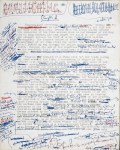
One particular job I held at the space agency was that of a technical writer. My duties were to take minutes at safety review panel meetings which entailed recording the proceedings and capturing action items, writing them up, then submitting them to the engineer for editing and eventual approval. And again I found out how very imperfect I was! It was really hard on my pride when the engineer would bleed all over my hard work with red ink. (Years later, when I was the editing engineer I would use green ink, which somehow seemed far less hostile.)

After limping through hundreds of pages splattered with red ink, however, something I could actually classify as transformational occurred. Eventually I became jaded to criticism and thus got past the shame of producing an inferior product. After overcoming that emotional milestone I could see more clearly and recognize that my writing was greatly improved by the joint effort. I learned to collaborate and eventually let go of my pride. My attitude changed. When people edited or criticized my work I saw it as helpful because it improved the product. I finally realized that I was actually a pretty good writer even though my work still came back with numerous edits sprawled all over the paper like blood-thirsty worms. Writing was subjective and there was probably no such thing as perfection once you got beyond “See Jack run.”

Little by little I had become a “professional” writer.

(To be continued)