Today’s Writing Tip

computer- copy

Give your book a professional appearance by formatting it properly, whether it’s an ebook or print version. It doesn’t have to be fancy, just professional looking. If you don’t want to bother doing this, hire someone to do it for you. Proper formatting contributes significantly to your story’s readability as well as whether you’re perceived as a professional or another indie author who doesn’t think it matters. Trust me, it does.

There are certain conventions that make a book easier on the eyes and thus more readable. This includes everything from the font, font size, line spacing, paragraph size, margins, pagination, headers/footers, and so forth. In graphic design, serif fonts are recommended for text and sans serif fonts for headings, titles, etc. Of course the latter can be some fancy font if you like, since they’re not something that requires more than a quick glance. If it’s so weird it requires more than that, then think again, especially for your cover.

Other conventions include indented paragraphs for most fiction and blocked paragraphs for nonfiction. One way to get a feel for it is to browse through various books in a library or bookstore. I’d bet dollars to donuts until you started writing yourself you didn’t even notice, assuming it was done properly.

Then, one day, you’re an indie author and have to confront this reality and realize how little you knew. Did you ever notice that the first paragraph in a chapter or section is typically not indented?  Yeah. Things like that.

If you have an artistic side, formatting your book can be kind of fun as you figure out how to present it exactly the way you want. However, if you think it’s a major pain, hire someone to do it for you. You want your hard work dressed properly for maximum impact.
Today’s Writing Tip

design-space-copy

I remember when I first went to work at NASA I felt as if everyone around me was speaking in a foreign language. This was because just about everything from space shuttle to space station components and launch operations were referred to by an acronym. This would be particularly annoying to non-NASA spouses at company parties, who had no clue what those around them were talking about if they started talking shop.

Your reader might have the same problem if you use too much terminology that is unfamiliar. While you want your story environment to sound authentic, this is an area where you may want to consider including a glossary, though these are awkward to access in ebooks, as are footnotes.

When I was a technical writer, the rule (at least at NASA) was to write it out the first usage in that particular document, then include the acronym in parenthesis. From that point on the acronym would be used. In a book this might work, depending on how often it will be used as well as how soon after you define it. If it’s something that isn’t obvious from the context of the sentence or conversation, you might need to ditch the acronyms and go with something the average reader immediate understands.

Today’s Writing Tip

desk- copy

If you’re an author and get a good review, it makes your day. Suddenly all your effort transforming your creativity into a story is worth it. However, they do little to improve your work. I have learned more from poor reviews than good ones. Some have improved my writing and others have simply helped me understand who likes my work and who doesn’t, which helps with marketing strategies. No matter how good your story may be, trust me when I say that not everyone will like it.

Reviews are subjective. In most cases they’re only one person’s opinion. Okay, if the average of all your reviews is three stars or less, then there may be more of a problem. However, bear in mind that publishers supposedly don’t take your collection of reviews seriously unless there are a few really bad ones in there. Why? Because they figure they’re all from friends and relatives, even if this isn’t the case.

All this considered, if you leave a bad review, do the author and explain why. Few stories please everyone once they get past Winnie the Pooh. If it’s simply not your kind of story, say so as well as why. I recently didn’t finish a book yet left it a four-star review. Why? Because it was well-written, just simply wasn’t my kind of story or what I expected. To me it was too much action and too little plot, but for someone who thrives on taskforce action it would probably be one of their favorites.

So if you leave a bad review, explain why. If it’s technical, e.g. too many typos, say so, giving the author a chance to fix it. You may not like it when you get a bad review, but pay attention. Unless it’s a troll, there is something to be learned. And even if it’s a troll, consider your work is good enough to be considered a threat to someone.

Today’s Writing Tip

desktop- copy

Yesterday I talked about punctuating dialog. One place that gets tricky is with exclamation points. If you use too many, it gets grating. Even though your character is still excited, angry, or agitated and probably yelling, using too many in succession tends to acquire the look and feel of a comic book.

Therefore, don’t over-use exclamation points! Save them for where they’re really needed for emphasis! Too many gets annoying and reduces their impact!

Capiche?

Today’s Writing Tip

e-mail- copy

I’m always amazed when I encounter an indie published book where the author doesn’t know how to punctuate dialog. Seriously? I remember learning that back in elementary school. However, I’m old as dirt, so maybe that was another one of those things eliminated from school curricula. However, if you’re going to represent yourself as an author, then it’s your job to learn such things.

I have seen some really weird, albeit creative ways to convey characters conversing. However, as far as enhancing the story, forget it. It’s another one of those dreaded distractions that throws a savvy reader out of the story.

Here are the basics:

If it’s a simple statement, you use a comma, NOT a period. “I’m going to the store,” he said.

If it’s a question, then use a question mark. How obvious can it be? For example, “Do you need anything at the store?” The trick here is if it’s part of the narrative, then sometimes it’s ambiguous.  I get that and have run into it myself a few times, especially when a character is wondering about something. Wondering, by it’s very nature, is a question. However, sometimes it’s not that obvious. In dialog, however, it should be pretty clear that something like “I wonder if he’s going to the store this afternoon?” is a question.

If someone is excited, angry, or speaking/thinking in an agitated state, then use an explanation point! “What do you mean you’re not going to the store? You said you were and I need some butter!”

It’s really not that hard, is it? Yet I’ve seen it done incorrectly numerous times. C’mon, indie authors! You can do better!

Today’s Writing Tip

laptop-4 copy

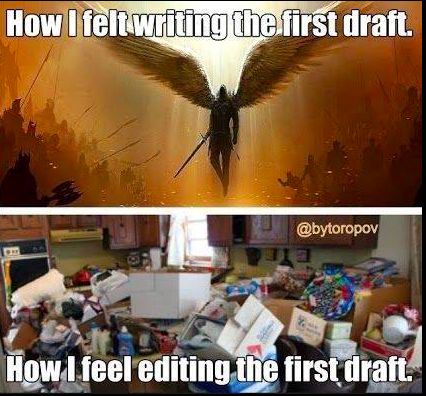
Producing your first draft is a major milestone. Many authors,  myself included, compare it to having a baby, especially if you ever actually HAVE had a baby. At some point in your story, you may feel as if you’re 9 1/2 months pregnant and really want to be done with it.

firstdraftWhen you do, by all means celebrate! You deserve it! But don’t think for more than one glorious day that you’re finished. No matter how great your work seemed as you put it down on paper initially, chances are it can be improved. Probably a lot, depending on whether this is your first book or tenth or more.
If the first draft is comparable to a pregnancy, the second draft is comparable to potty training. If you’re a parent, I probably don’t need to say any more to complete the analogy.

When you get to what you think is your final draft, (probably comparable to raising teenagers) start tightening your story by trimming adverbs, adjectives, and prepositional phrases. Many adverbs go away when you select the correct verb.

Today’s Writing Tip

home-office copy

Here’s another booby trap for authors:  When rewording a sentence, make sure you take out any words that are no longer needed. Many of the editing faux pas examples I find involve extraneous words that weren’t deleted when a change was made.

Always reread a sentence after you revise it. This is one of the easiest mistakes to make when you’re editing. If you don’t catch it and clean it up, your reader will trip over it like an overly friendly cat rubbing against your legs.

Creating flawless copy isn’t easy or simple. There are all sorts of alligators hiding in the water, just waiting to jump out and startle your reader and make you look like an amateur. This is why you need a good editor.

Today’s Writing Tip

home-office-3 copy

One of the most difficult things to find when you’re editing your own work is missing words. Sometimes even editors fail to catch them, but not an alert reader. Once in a while a grammar checker might, but not always. These are usually not quite as bad as typos which stand out like the proverbial sore thumb, but close. They tend to jolt the reader out of the story, even for a nanosecond, or sometimes longer if it makes the sentence difficult to understand.

When reading over your manuscript during your final draft, do so slowly enough to note each word is indeed written as opposed to assumed. Reading it aloud can help. If you’re fast on the keyboard, you may be even more likely to leave words out because regardless of how fast your fingers are, you brain is moving faster.

If you’re ever beta reading for someone and find missing words, be sure to tell them. The author will be very appreciative!

Today’s Writing Tip

laptop-2 copy

Using astrology for character development is helpful and fun. If you’re not familiar with the characteristics of the various zodiac signs, my book “Whobeda’s Guide to Basic Astrology” can help. You can pick up your copy on Amazon here.

For those of you who may be new to the planet, astrology comprises twelve personality profiles with distinct characteristics. More than likely when you start your story, you have a general idea what the characters will be like. However, if they’re too basic, they can remain at the “cardboard” stage and never come to life.

For example, so you know how your character handles money? Is s/he quiet and shy? Emotion or logic driven? Slow, fast, or deep thinker? Courageous or cautious? Bossy or retiring? Providing your character with a Sun Sign and learning a little about its traits will provide these answers.

Another thing astrology comes in handy for is character conflict. As you undoubtedly know, some people get along better than others. Learning how Sun Signs interact can help develop their relationship. Find out how the different signs interact at the most basic level on my astrology website here.

Today’s Writing Tip

laptop-3 copy

If you’re a new author, you may not realize what a back story is. The best way to describe it is to think of the very first Star Wars movie. A few years later, what did it become? EPISODE 4!!! In other words, Episode 1, 2, and 3 were back stories, or how the characters became who they were and what transpired earlier.

Fully developing your backstories always pays off. Not only do they contribute to the quality of your characters and plot–they also make writing easier when you have a well-developed foundation.

You don’t have to define all this background before writing your story. Much of it may evolve along the way as you get to know your character better. Some of it will manifest as flashbacks. Some of it may constitute a short story in and of itself, yet wind up as no more than a sentence or two in your novel.

The main thing is that they constitute the detail that makes your characters and story come alive. They’re never wasted effort. They might even become full-length prequels that you eventually publish. If not, you can always offer them as freebies to potential readers.