Today’s Writing Tip

laptop-3265726_1280 copy

Another way to cover an event that occurred before the story action starts, yet relates to the plot, is to use flashbacks. If its a somewhat long explanation, then a prologue works best. If it can be broken up into several short scenes, then flashbacks can work. Make sure you know how to introduce and then close them out, coming back to the present, by  using past perfect tense.

In other words, to transition to the past, say something like “he’d gone to the movie” (past perfect) as opposed to “he went to the movie” (simple past). After that first sentence, switch to simple past until the flashback is over, then use past perfect again to alert the reader that the story is back in the present. If flashbacks are not introduced and closed properly, it can be very confusing to the reader and cause one of those “WTF moments” you want to avoid. In other words, it will throw them out of the story as they go back to try and figure out when something happened and whether they missed something.

Careful handling of such writing protocols is what labels you a professional versus an amateur.

Today’s Writing Tip

laptop-3253347_1280 copy

If your story needs some background information essential to the plot, but it doesn’t involve the main character, you can introduce it by using a prologue. That way you can start Chapter 1 with your protagonist, which you should always do, because it immediately tells your reader who the story is about. Otherwise, they’re going to wonder what happened to the character they “met” first and whose story your book is really about.

Today’s Writing Tip

e-mail-3239670_1280 copy

Know the different types of editing, especially if you hire an editor. Otherwise, you may be disappointed or not get your money’s worth. I’m always amazed when I find a multitude of goofs in a book that has supposedly been edited. Just because a person can read, doesn’t mean s/he can edit! Furthermore, if they’re a specific type of editor, they may do a great job in that category, yet leave others flapping in the breeze, waiting for some discriminating reader of jump on them like a duck on a June bug.

Rather than reiterate what has already been said very well by another blogger regarding the different types of editors and what their duties are, check out this outstanding blog.

Today’s Writing Tip

desktop-3271745_1280 copy

Whenever you’re reading and encounter something annoying that bumps you out of the story, take a moment to consider whether you do the same thing, but have been blind to it. You can increase your skill as an author by noting when something stands out in another person’s work, whether it’s positive and negative.

Today’s Writing Tip

design-space-3031262_1280 copy

Try to maintain consistent and comfortable chapter lengths. If you find a chapter has multiple section breaks, maybe you should start a new one instead.

Most readers expect a certain rhythm regarding how long a chapter lasts. Many also prefer to stop reading at a chapter’s end; if it drags on and on, it can be frustrating.

However, on the other hand, it’s usually not a good thing for a reader to put down your book, even if it’s to go to sleep or back to work. You can remedy that by ending each chapter with a cliffhanger, so they either keep reading or can’t wait to get back to find out what happens next.

The #RRBC “TREAT” Reads Blog Hop

outshinecvr

Greetings!  Welcome to the first ever “TREAT” Reads Blog Hop!  These members of RRBC (Rave Reviews Book Club) have penned and published some really great reads and we’d like to honor and showcase their talent.  Although there were maybe 3-4 winners who were previously on this list who are no longer with the club, now all of the listed Winners are RWISA members!  Way to go RWISA!

We ask that you pick up a copy of the title listed and after reading it, leave a review.  There will be other books on tour for the next few days, so please visit the HOP’S main page to follow along.

Also, for every comment that you leave along this tour, including on the HOP’S main page, your name will be entered into a drawing for an amazing gift card to be awarded at the end of the tour!

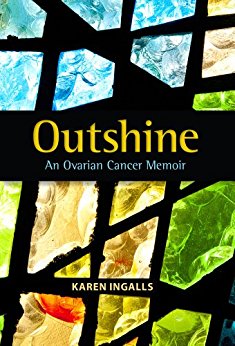
Today’s Featured Book:  OUTSHINE  by Karen Ingalls

Blurb:  When Karen Ingalls was diagnosed with Stage IIC ovarian cancer, she realized how little she knew about what is called “the silent killer.” As Ingalls began to educate herself, she felt overwhelmed by the prevalent negativity of cancer. Lost in the information about drugs, side effects, and statistics, she redirected her energy to focus on the equally overwhelming blessings of life, learning to rejoice in each day and find peace in spirituality. In this memoir, Karen is a calming presence and positive companion, offering a refreshing perspective of hope with the knowledge that “the beauty of the soul, the real me and the real you, outshines the effects of cancer, chemotherapy, and radiation. It is a story of survival and reminds readers that disease is not an absolute, but a challenge to recover.

Follow Karen on Twitter

[NOTE–Read my recent review of another one of Karen’s books here.]


This blog hop sponsored by:  4WillsPublishing


Today’s Writing Tip

blank-3164721_1280 copy

Omniscient viewpoint can confuse the reader; make sure it’s really necessary & the most effective option before using it. If you really want to get inside the head of other characters in addition to your protagonist, separate chapters and/or sections might work better. Readers will relate more strongly to your character(s) if you present their thoughts one at a time, rather than bouncing back and forth. If you really want your reader to relate to your main protagonist, you should stick to his or her viewpoint as much as possible.

Review of “Davida: Model & Mistress of Augustus Saint-Gaudens” by Karen Ingalls

davidacvr

Anyone who knows that the heart has a mind of its own will love this story; those who aren’t privy to that fact need to read it as well. As the saying goes, “true love never runs smooth”, and this beautiful, yet inherently sad, story based on the author’s great-grandmother demonstrates just such a case, that of meeting the right person at the wrong time.

I recently read an article about relationships that noted finding one’s soul mate often followed a karmic relationship which was less that pleasant, i.e., some sort of cosmic payback that needed to be done. Unfortunately, not everyone can walk away from that first encounter, which was the case for Augustus Saint-Gaudens. It’s ironic that the one who accepts the responsibilities of the marriage and stays, even while maintaining a love relationship as well, is often judged more harshly than those who get a divorce.

While this is a fictionalized account from the viewpoint of Saint-Gaudens’s mistress, Davida Johnson Clark, it nonetheless told a touching story backed up by a tremendous amount of research that made it come alive. The author is entirely honest in the back of the book regarding what was fictionalized. As someone who has done genealogy research, I can say that it is very possible to feel as if you know someone from your past, whether it’s through genetic memory or perhaps spiritually channeling the individual. While there is a fair amount of speculation given that documentation as well as various records could not be found, nonetheless the story has the feasibility required to establish its credibility.

Songs and poetry galore have been written expressing the irony of forbidden love. It has always been part of the human condition and probably always will be.  Sundry times and cultures have been more tolerant than others, and I found it ironic that Augustus Saint-Gaudens was half French; had this relationship occurred there, perhaps it would have been less of a scandal than it was in America. Nonetheless, he and Davida were as discreet as possible, though the situation was undoubtedly excruciating for them both, their son growing up with a stigma that affected his entire life.

I knew I’d heard of Augustus Saint-Gaudens, but I’d forgotten where, until I came to the part in the book that talked about him designing coins in addition to statues and plaques. Truly he was a great artist of his time, a perfectionist whose work remains today.

Shortly after finishing this book, I was listening to 80s hits via my satellite TV provider and they played “Saving All My Love For You” by Whitney Houston. If this story were made into a movie, that would certainly be part of the soundtrack. While it’s easy for the world at large to be judgmental about such things as unfaithfulness, it’s important to recognize the difference between continuous, random illicit affairs versus those that last with one specific individual for decades. In a different place and time, those caught in such a situation would have better options.

Those who have experienced such a situation as well as those who need to understand so as not to judge them so harshly, might also want to read, “If Only There Was Music: The Poetry of Forbidden Love”.

This is not a particularly unique situation as many have discovered personally. Finding your soul mate is seldom a painless experience.

Pick up your copy of Davida on Amazon here.
Today’s Writing Tip

desk-2158142_1280 copy

Consider your story’s point of view carefully. If you really want the reader to relate to your protagonist, the story should be told through his or her eyes only, even if you’re using third person narrative. Avoid slipping into an omniscient viewpoint by including something your character couldn’t possibly know, such as what the other person is thinking, unless, of course, he’s telepathic. Instead, describe what your protagonist is seeing in the other’s expression and body language. Another way around this you can use occasionally is to preface it with, “He didn’t know it at the time, but….” Break point of view carefully, deliberately, and sparingly.

Today’s Writing Tip

coffee-3047385_1280 copy

As part of the admonition to “show, don’t tell”, learn to render emotions as opposed to using a simple modifier. Compare the impact of “He fumed with anger” to “His eyes flashed daggers, fists tightening at his sides” or “His heart raced, fury surging through him like a fire storm.” Concentrate on the physical sensations of the emotion you’re trying to express to capture what it actually feels like. One of the marks of good writing is conveying emotions to your reader in an effective manner. If your reader feels something, then your story is upgraded to an experience and becomes much more memorable.