Today’s Writing Tip

home-office copy

Nonfiction is usually easier to sell than fiction. Many busy people don’t have time or inclination to indulge in fiction, yet will read for information. There is also less competition, at least in some disciplines.

If you have a unique niche, such as a craft or hobby, or some area in which you’d be considered an expert, don’t hide your talent under the proverbial bushel. Having a blog, YouTube channel, podcast, or maybe even some books or ebooks out on that subject can help the cash flow as well as draw in new fiction fans.

For me, as you’ve probably already figured out if you’re a regular reader, it’s astrology. Technically, I’m retired, but my “day job” comprises being a professional astrologer, something about as antithetical from being an engineer at NASA as I could think of. Not only does it supplement my income, but I have found in some places and situations people are more interested in astrology than science fiction, giving me something to fall back on if sci-fi isn’t in their wheelhouse. How many people do you know who don’t know their zodiac sign?

Today’s Writing Tip

e-mail- copy

Have you ever felt more inspired in certain locations than others? Perhaps it was when you were on vacation, on travel for work, or visiting a friend or relative. Believe it or not, this is another area where astrology can help by identifying these places.

Even if you don’t want to move there, targeting one for a visit may give your imagination a major boost! If you can’t go there at all, it may even work to set your next story in that locale, the implication that researching it and visiting it via pictures, websites, and Google Earth will be more stimulating and inspiring than you might think.

Today’s Writing Tip

desktop- copy

Even if you’re not really “into” astrology, there are few things you should know. One is to never start writing a new story when Mercury is retrograde. It will either be delayed, never be published, or need to be entirely rewritten. So I’m sure you’re wondering where to find out when Mercury is retrograde; Googling it is one way, though the monthly horoscopes on my astrology website always provide a list of misbehaving planets so you can mark your calendar accordingly.

At the least, know that one of these scenarios is going to be the situation. About three years ago my muse gave me a blast of inspiration for a side-story to one of my books. I knew Mercury was retrograde, but I had such a strong impression regarding what one of the characters was up to, I couldn’t ignore it. It took me almost no time at all to write four or five chapters. Then I realized that there was yet another story I really needed to write first. So, it got set aside while I wrote the next one, “The Terra Debacle: Prisoners at Area 51.”

The good news is that various characters and situations appeared in that story which related to the one that had been cosmically purloined. By the time I got back to it, Mars was retrograde, a time to go back, un-do, re-do, or simply wait. Since I was “going back” I wasn’t too concerned, except a few weeks later, Mercury was going retrograde again. On the positive side, Mercury retrograde is great for editing and revising. However, progress is unbelievably slow and I have to wonder if this book will ever see the light of day?

Great Fodder for my Inner Geek

mysteryofhiggsboson

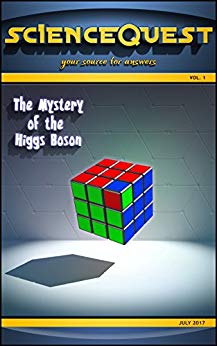
4.5* for The Mystery of the Higgs Boson by Bettina Roselt  & Axel Ewers

This is the first volume in the Science Quest series. As a physicist and science fiction writer, I need some brain candy from time to time to clear out the dust bunnies collecting in my brain and this book was my snack for the summer. It refreshed my knowledge, albeit somewhat limited, of particle physics, but my favorite part of that field has always been Einstein’s infamous E=mc^2.

This book did an excellent job of getting into that quite nicely by explaining particle collisions and the various “decay channels” observed through research at the Large Hadron Collider (LHC) and how they eventually found the Higgs boson. It provided details and information I really enjoyed on the process for looking for such things. There was also a sprinkling of humor here and there, which is always appreciated in an otherwise dry read.

There is still so much we don’t know, which it seems is often forgotten, especially for people who are not scientists. While some scientists can be rather arrogant regarding the lay public, in reality it seems that those who know the least out there seem to think that all the mysteries of the universe have been explained. Yet, it took around a half-century from when the theory for its existence was put forth in the 1960s until  scientific evidence for the Higgs boson was found. It’s situations like this which make me roll my eyes as a physicist and professional astrologer when skeptics dismiss astrology.

For instance, take gravity. We all know it’s there, can calculate its effect, but still don’t understand its mechanism on a detailed, scientific level. Quantum mechanics and the possible link between consciousness and matter is a fascinating field about which we still know relatively little. No telling what’s lurking in that domain along with psi phenomena.  I loved it when they stated, “The discovery of the Higgs boson is a striking example of how much we have to stretch our imagination to reveal nature’s secrets just a little bit more.” Another jewel is, “In fact, the current physical models and theories aren’t sufficient enough to explain all the phenomena we observe in the universe.”

The one thing about this book that bothered me slightly was the fact that in a few places it was obvious that its author is not a native English speaker.  Far be it from me to criticize people who are bilingual; I have tremendous admiration and respect for those who speak more than one language. And chances are the version of English the author knows is UK, not USA, so that also throws some differences in there. However, there were a few places where the syntax, and in some cases, word choice, made it a bit more difficult to understand. Fortunately, there were only a few places where this was the case.

Face it, this is pretty heavy stuff that only geeks like myself would read in the first place. Furthermore, expressing something in words which is usually expressed mathematically or perhaps via Feynman diagrams is difficult enough in your own language. Nonetheless, when you’re occasionally tripping over word choices and general sentence construction, it makes it more difficult to follow. As a physicist and writer myself, I could probably do a pretty good job editing it. But the author certainly did far better in English than I would with German where what little I know, thanks to my German neighbor, comprises spinnst-du, bitte, kartoffel, auf weidersehen, sauerbraten, and a few others, some of which aren’t appropriate for polite company.

If you have a rudimentary knowledge of particle physics and want to get into the sordid details of how they figure this stuff out at the LHC, you’ll probably enjoy this book. It definitely satisfied my scientific appetite for the summer and the insights will come in handy in writing my current science fiction novel. I do look forward to more books in this series.

If you’re a geek or nerd looking for a pretty good science fix presented with a slight German accent, you can pick up your copy here.
Today’s Writing Tip

desk- copy

When I get inspired to write a certain scene, I go for it, even if it’s out of sequence. Like so many things, it’s use it or lose it, and ignoring inspiration is a sure way for it to evaporate forever. Writing a story in the same order it will be presented to the reader isn’t required. When your muse speaks, listen!

Admittedly, it’s not always easy to keep everything straight, especially when you have multiple characters in different situations. When I was writing “Refractions of Frozen Time” it was like putting together a three-dimensional zig-saw puzzle. I had characters and plot twists popping up like mushrooms after a spring rain, some not only in different time zones, but on different planets, or in a space ship traveling at warp speed. Getting these put in the proper order was often a challenge, but it all eventually tied together, some of those spontaneous scenes that came out of the blue the best in the story.

#RRBC SPOTLIGHT AUTHOR! @AuthorJoyceS

Quote

Check out RRBC’s latest Spotlight Author!

via #RRBC SPOTLIGHT AUTHOR! @AuthorJoyceS

Today’s Writing Tip

design-space-copy

Never make it too easy or obvious for your character to get what s/he wants. The more obstacles you place in their way, the more interesting and suspenseful the story. When you don’t know what will happen, chances are your reader won’t either.

Sometimes when things seem to be going too well, it can actually add suspense, at least for a while, because the readers will anticipate things are going to crash. A classic example I can think of for this is the TV show, Scorpion. What always starts out as what they expect will be a simple job inevitably turns into the worst-case scenario. This is what builds suspense and makes the story more interesting. It’s also the way that life seems to work.

Today’s Writing Tip

computer- copy

A chapter outline can be a useful tool, but don’t feel as if it’s engraved in stone. When you start forcing your characters to do your bidding instead of what they want to do, the reader will sense this disparity. Giving your character free rein often brings great plot twists.

When you find that your character wants to do something different than you’d planned, this is an excellent sign that you’ve created a credible one. Cardboard characters are like puppets and will do exactly what you tell them to do, but they also won’t be convincing individuals. No real person is 100% predictable and your characters shouldn’t be, either. If he or she gets himself into more trouble, it contributes to your story, especially when you also allow him or her to find a way out.

I think it’s a lot of fun when a character is in a self-imposed bind that I have no clue how to solve. That’s when I just let him or her figure it out. If I don’t know how it’s going to turn out, it should add to the suspense, assuming the reader won’t know, either.

Today’s Writing Tip

coffee- copy

Make it a habit to spellcheck your work every day when you shut down for the night. This should be part of your routine as a writer. Believe it or not, you might actually forget if you wait until you finish your current story or book. Somehow the final editing and formatting process can eclipse this very essential step.

This is obvious to me based on the many books I’ve read the past few years that are riddled with typos. I’m embarrassed to admit that I’ve been guilty as well, requiring a lot of time after a book was published to upload a corrected version of something that should have been correct in the first place.

By making it part of your routine, it becomes a task you don’t even have to think about, but do automatically. Done daily, it takes less time and you can be sure the final product won’t be riddled with typos, which drive readers crazy and label your work that of an amateur.

Today’s Writing Tip

blogging-copy

If your characters have a specific ethnicity, be sure to name them accordingly. For example, if your heroine is from Sweden, naming her Inge contributes more to her persona than naming her Yolanda. This reinforces the reader’s image of the character as well, providing a subtle, subconscious contribution to imagery.

Along similar lines, if your character is unique, an unusual name can likewise reinforce that; conversely, naming a character you want to be seen as “normal” and one your reader can relate to calls for a more common name.

All that “What’s in a name? A rose by any other name would smell as sweet” business doesn’t necessarily apply to fiction writing.