Today’s Writing Tip

laptop-copy

Editing can be painful. As authors, our words are our children and can be hard to delete, even when we know a scene needs to go. One way to soften the blow is to cut and paste it into an “edits” file arranged by chapter. If you decide to put it back, it’s there.

If you eventually decide it really wasn’t needed, it’s a lot easier to zap that file when the final version goes to press. On the other hand, if you have a real blockbuster on your hands, at some point you may want to work them back in for an “expanded” version or literary “director’s cut” you release later.

Today’s Writing Tip

nobody-copy

We’re all familiar with spin-offs from major works, many of which start a trend in popular genres. Examples are Harry Potter and the Twilight series, which have inspired volumes and volumes of stories with a similar premise. Riding the wave of another author’s success must be done with finesse, however. It may have a similar theme, but needs to stand on its own merits. If it doesn’t have some originality and its own value, you just look lazy and incapable of coming up with an original idea.

I’ve seen some really cheesy imitations where I didn’t get past the first chapter. Some were poorly written, others simply unoriginal. We may read our favorite books more than once, but you don’t necessarily want to deal with a remake, kind of like when Hollywood does a remake of one of your favorite movies, that doesn’t quite cut it.

When you come up with an idea that’s similar to an existing work, put some serious creative effort into making it your own with a different twist. Originality and strong writing go a long way toward retaining and gaining fans.

A Sad Commentary on American History

greatspeeches

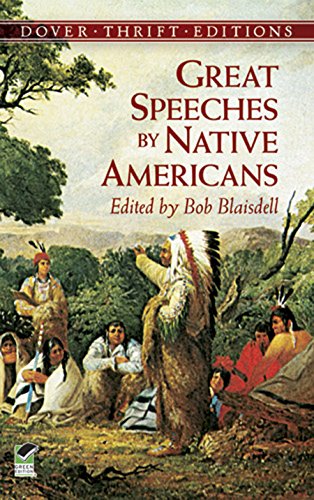
Anyone who thinks they know American history needs to read this book. Those who don’t understand why the white men are hated also need to read it. In a nutshell, it’s a testimonial of exploitation, lies, and aggression, which has been the norm on the part of supposed “civilized” nations for millennia. Seeing indigenous people as inferior, savages, and uncivilized based on their lifestyle and thus treating them no better than animals has a sordid and long history.

This book chronicles the treatment of the Indigenous Americans from the first contact by the Pilgrims in the 1600s through the 20th century. The lies and aggression are nothing short of shameful and an embarrassment to any honest person. Those of us who grew up playing “cowboys and Indians” and watching similar TV shows were not seeing things as they really are.

In most cases, the Indigenous Americans only wanted peace. Some had the foresight to see the problems that were coming. They saw the land as sacred, given to them by The Great Spirit, and they treated Mother Earth with respect and gratitude. They may not have had the white man’s technology, but their societal norms were often far more advanced than “civilized” nations. The wholesale slaughter and exploitation of these people in the name of Christianity is a national disgrace.

Besides the actual slaughters, their children were often taken away, essentially kidnapped, and sent to boarding schools where their native culture was derided while they were indoctrinated with supposedly white civilization’s values. Their women were often sterilized without their knowledge. There is no doubt the intent was genocide.

If you think things have changed today, think again. Power and control by those with selfish and evil intent still prevails. Corporate power subdues the rights of individuals. Nothing has changed.

I cried more reading this book than any novel. It’s a very sad commentary on the foundation of the United States. These Native Americans were highly intelligent, moral individuals. In the vast majority of cases, they were only aggressive when they’d had enough of being lied to and could see the government’s intent was their annihilation.

Read it. More people need their eyes opened to the truth that is our history and how it relates to what’s going on today.


Today’s Writing Tip

notes-copy

There’s another very useful function for backups, even if your computer doesn’t crash. Whenever you’re about to make a major revision, keep the previous version under a different file name, just in case your changes don’t work out. Keeping backups for each date can be a lifesaver if changes don’t work.

I recently had a situation where I wound up reverting to a version saved nearly a week before when what I was trying to work in simply wasn’t going to work. It would have been a nightmare to try and undo all the changes. Having daily backups, I was able to basically do a quick “rewind” which saved a lot of stress and head-banging.

Today’s Writing Tip

paper-2 copy

Timelines are sometimes a real challenge, especially with parallel plot action. I’ve heard authors complain about time zones while I’ve had some situations in my science fiction with characters on entirely different planets or even traveling at relativistic or warp speeds in different timeframes!

Some stories require more precision than others with regard to what day or time it might be. If it doesn’t matter, then all you have to watch for, if you don’t write scenes in chronological order, is that they’re in the proper sequence. If you require more accuracy, one thing you can do is put the supposed date (or perhaps even the time) at the beginning of each scene, even if you erase it when you’re ready to go to press. Then you can tell at a glance if it’s in the proper place.

Today’s Writing Tip

technology-3 copy

The general rule is to start your story with your main character. However, if this person’s importance fades later, you might want to make it a prologue if that scene is essential to the story.

This is something that relates to yesterday’s blog about when a minor character takes over the story. If he or she steps into the star role, you may need to introduce them in chapter one. If both your intended main and the minor character are both in the first chapter, this isn’t a problem. You just need to open with the main character’s POV. However, if the one taking over doesn’t come on the scene until later, it’s more of a challenge.

If anyone out there has encountered a similar issue I’d love to hear how you solved it.


Today’s Writing Tip

technology-copy

Have you ever had a minor character suddenly take over your story? It’s great to have one that’s so strong, but this often presents a challenge. I’ve had this happen to me in my Star Trails Series and find it happening again in my WIP.

In Star Trails, I had to make sure one of those troublesome characters wound up in jail or prison from time to time so the other characters could run the story. In my current WIP, I’m still trying to figure out exactly how to handle it but here are three things I’m considering.

1) Let him or her take over. This is likely to require a major rewrite, but might be worth it.

2) Strengthen intended main character. Make sure there are enough story problems and issues for him or her to deal with to make it interesting. If things are cruising along too easily, throw some stumbling blocks out there.

3) Figure out who’s most important to the story line. Maybe the story is being told through the wrong character’s eyes. Who is most affected by the plot?

Right now I have two characters who score equally in importance. They work together, but their lives are influenced in two different ways by the plot. To be honest, I’m still trying to figure this out. LOL!

Today’s Writing Tip

typewriter-2 copy

Do you back-up your work daily? I learned the hard way about doing that a long time ago. While computers are more reliable than they were years ago, it could still happen and be catastrophic if all your work were lost, especially those very productive days.

I find the easiest way to do this is with a thumb drive. You may even want to keep a few versions, in case you might want to go back and see a previous version you’d since edited out, then change your mind. But the biggest nightmare of all is losing your entire story to a hard drive crash. Computers and word processors have been the author’s best friend, but unless you had a house fire, in the old days with typewriters, you never lost your entire story to hitting the wrong command key.

Today’s Writing Tip

typewriter-copy

Another way to maintain continuity for various viewpoints is to cut and paste relevant scenes into a separate document so you can read them in sequence. That way you don’t have to dig through anything in between to make sure there’s a logical flow to what they’re doing.

I don’t always write scenes in sequence, but skip around. Since it’s important to keep the flow of the story going in the proper order, I find this is helpful to maintain character development within the story. Characters should change and evolve, and by having all their action in a single document makes it easier to see the story through their eyes and how their motivation or attitude might change.

Today’s Writing Tips

woman- copy

I have a difficult time writing from only one point of view. In fact, in my current WIP, I started writing in first person and quickly found myself stuck. When I opened it up to other POVs it started to move. I think knowing characters’ motivation is important and that is harder to cover without getting into their head.

However, multiple viewpoints can be a challenge. I’ve found that when I’m on a roll with one particular character it’s easier to stick to that one until I hit a wall, even if I’m skipping over chapters to do so. That way you at least have continuity for that person.