Today’s Writing Tip

blogging-336375_1280 copy

It’s best to mark your section breaks with a few asterisks rather than simply rely on an extra space, which might not be noticeable on an electronic reading device. This is particularly important if you change the point of view with the next section, a significant amount of time has passed, or the scene location has changed. Every time you leave a reader confused enough that they have to go back and reread a previous section to figure out what’s going on you run the risk of losing them entirely.

Delicious Personal Glimpses

ravesoup4writerssoulcvr

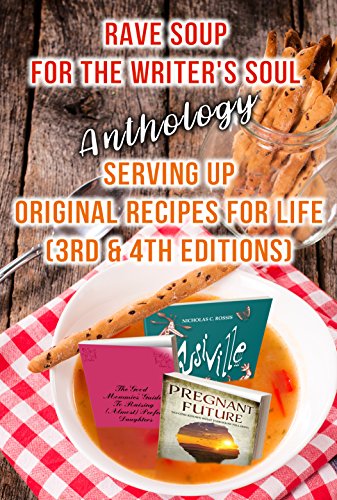
I really enjoyed this collection of stories from members of Rave Reviews Book Club, a.k.a. RRBC. As a member myself, it’s always heartwarming to learn something about your fellow members and what they’ve been through in their life. Hearing what others have endured always places your own issues into a different perspective.

If you’re not a member of this group, the stories are still of considerable value, they just won’t have the same impact as they do when you are familiar with the individuals on a different level. However, it will also show the caliber of people as well as their writing skills which can be found in this group. If you consider yourself a “born writer” or perhaps a “born reader” then you’ll want to check out both this anthology and the Rave Reviews Book Club, which has plenty of room for both.

You can pick up a copy of this enjoyable read on Amazon here.

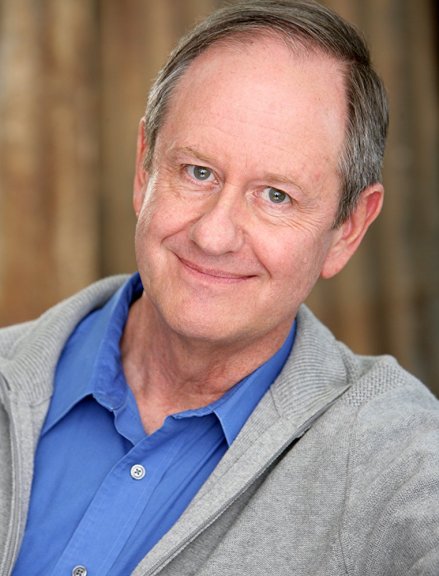
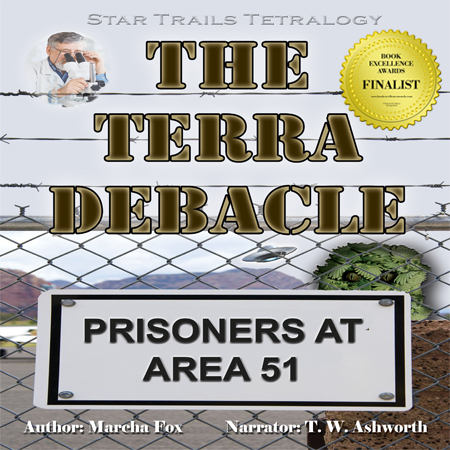
Meet Actor T.W. Ashworth, Narrator Extraordinaire of “The Terra Debacle: Prisoners at Area 51” Audiobook.

TWAshworth

Getting my first audio book produced was a thoroughly enjoyable experience, thanks to the talents of my narrator, Hollywood actor, T.W. Ashworth. You can learn more about him and his credentials on  IMDB. Meanwhile, he was willing to participate in a short interview so I could show you the face behind the many voices you get to enjoy in the audio version of “The Terra Debacle: Prisoner’s at Area 51.”

MF: How long have you been acting? How did you get your start?

TW: I’ve been performing since 1970 in a pretty varied career. Ballet dancer, Classical regional Theatre as an actor and director, national tours in musicals, movie musicals, commercials, music videos, and television. I got my start when a friend in high school dared me to audition for Eugene Ionesco’s RHINOCEROS…I got cast and fell in love with the stage.

MF: What’s your favorite part about narrating a book?

TW: Like Bottom in Shakespeare’s Midsummer Night’s Dream, I get to play all the roles. I enjoy finding different voices in my story telling.

MF: What was your favorite role so far as an actor?

TW: Let me give you an answer as varied as my career: Classical Stage – Face in Ben Jonson’s THE ALCHEMIST, Musical Theatre – Harold Hill in THE MUSIC MAN, Stage – Pastor Brian in Christine Ashworth’s two person play CASSANDRA CRIES, TV – Mr. Fisher in HOW TO GET AWAY WITH MURDER, sketch comedy – Pat Bristow’s HOW TO SURVIVE A ZOMBIE APOCALYPSE.

MF: What are you working on now (either acting role or narrating, or both)?

In narration I’m working on A Fairy Night’s Dream: or The Horn of the Oberon by Katharine Elise Chapman, Samantha V. Hutton and Symbols: Book Two of The Allegoricon Parables by Jason P Doherty. It’s the off season for TV and a slow time for film, so I’m primarily working on narration.

MF: Who was your favorite character in “The Terra Debacle”?

TW: Gabe, a gentle telepathic  intellectual botanist, who is more than a bit bothered by his psychic  gift.

MF: Did any part of “The Terra Debacle” surprise you?

TW: The bittersweet ending.

MF: Who do you think would enjoy this story the most?

TW: A person with an intelligent heart.

So now you know what the man behind the voices you’ll hear in “The Terra Debacle: Prisoners at Area 51” looks like and a little bit about him. You can get your copy of the audiobook on Amazon (where you can listen to an excerpt), Audible, and iTunes. If you’re not already a member, you can get it for free if you sign up for a 30-day trial. If you’re already a member and would be willing to give the story a review, contact me at marcha@kallioperisingpress.com and I’ll make arrangements for you to get a complimentary copy.

TheTerraDebacleAudioRGBflatsmall+ copy

Perfect for Vacation Time!

fantasywritingprompts

With vacation time coming, it’s always great to have activities for your kids that are fun, yet have an educational spin.  Wendy Scott’s “Writing Prompts” series is perfect for just that! She provides an action-packed scene/scenario to fire up your imagination, then challenges you to provide “the rest of the story.” Even as an adult, these are stimulating and fun. If your child, grandchild, or you happens to be a “Harry Potter” or fantasy fan, this book is perfect for hours of creative entertainment with the 31 different prompts. It’s available in both a Kindle or print version. I wish I’d had this when my kids were younger!

Today’s Writing Tip

desktop-3271745_1280 copy

I’m amazed how often authors don’t know the proper way to punctuate dialog. Even if you weren’t taught how to do this in school, you should have figured it out by reading novels that were properly edited.

Okay, here’s the scoop. Dialog is punctuated differently than a normal sentence. Rather than a period, use a comma, followed by “he said”, “she said”, etc. A question uses a question mark (?) and if the speaker is noted, it should say “he asked” or “she asked” or questioned or queried or even wondered, not “said”.  A sentence that is an exclamation is punctuated with an exclamation mark (!).

In all cases, the “he” preceding “said” or “asked” doesn’t need to be capitalized. For example, “I’m going to the library,” he said. Or “Are you going to the library?” he asked.

I hope that I have insulted the intelligence of most of you with this 4th grade grammar lesson who already know this. But I am amazed by how often I see it done incorrectly by otherwise very talented authors. Being creative is really not in your favor in this area.

Today’s Writing Tip

computer-3076956_1280 copy

Using astrology for character development is helpful and fun. If you’re not familiar with the characteristics of the various zodiac signs, a book like my “Whobeda’s Guide to Basic Astrology” can help. Get your copy here. 

If you already have an idea what your character is like, it’s usually not too difficult to fit him or her with a Sun sign. You can find some basics here. This will be their core being and provide considerable help regarding how they’ll react to certain situations. If you define a birth date for him, it’s fun to get a natal chart reading from an astrology site like mine, ValkyrieAstrology.com, which will give you even more in-depth information about your character, perhaps even hinting at events in your story.

Actually, it was writing a novel that first introduced me to astrology. One of my characters was into it, forcing me to do some research. I discovered it worked as well as how handy it was for defining characters. It’s quite eerie how well it works, which you can read above in a previous blog.

A Raw, Heart-rending Account of a Mother’s Love

whenangelsfly

I’m heartbroken as well as outraged that someone had to have such a horrendous experience as the one chronicled in this story. The strength and maturity the author displayed while going through the heart-rending experience of being there for her five year old son while he battled cancer is truly a testimonial to a mother’s love, especially someone who had been abused herself, but had the fortitude to break that cycle.

It’s not like this mom had the support of her family during this trying time. To the contrary, she had an abusive, sociopathic husband and a mother who was to say the least, a psycho bitch from hell, both of whom did everything in their power to make Sarah’s life as miserable as possible. Neither cared about the poor child, but simply wanted to cause as much misery as possible. It’s amazing to me that the courts failed to stop these horrible individuals from harassing this poor woman as well as a child who was gravely ill. It really calls into question both the parental rights of sperm donors as well as grandparents who don’t deserve the time of day, much less inclusion in their grandchildren’s lives. With all the documented abuse, it’s outrageous the courts didn’t protect them. Her abusive husband, whom she was trying to divorce, had over 20 DUIs, yet he was allowed to have access to her and the children! Why wasn’t this worthless SOB in jail????

And then there is the medical side of this nightmare. First of all, incompetent doctors failed to diagnose the illness in the early stages, when perhaps it could have been treated successfully. Then when the poor little guy was hospitalized, it was amazing how many mistakes were made, or could have been, had his mother not been there, keeping an eye on everything.

What follows is technically a spoiler, but all you have to do is ponder the title or look at the cover to know that this story does not end well. In fact, the final mistake that ultimately cost the child’s life was due to a bad decision by a therapist that was carried out in spite of the mother’s protests. The autopsy showed no cancer remained in his little body, his death ultimately caused by the treatments he’d received. What’s the matter with these people who can inflict poisonous therapies on innocent children to the point of death and call it healthcare? Most of it is little more than experimentation, and certainly no better than some of the things the Nazis did during WWII. Okay, this story took place in the 90s and some things have improved, but not much.

While many people in the healthcare industry are caring and competent, and they do save lives, too often patients are seen as no more than another piece of meat or a cash cow. To be fair, I’ll admit that I’d probably be dead today except for having had cancer surgery twice in 1993 and 2008, and a stiff round of antibiotics for bacterial pneumonia in November 2017. Nonetheless,  I’ve had enough negative experiences myself with the medical profession that I am for the most part skeptical and wary when that prescription pad comes out or chemo is mentioned. It’s no secret that healthcare in the USA is not about making people well, but making money, particularly for Big Pharma, who virtually runs the FDA. Other cures exist for cancer–not just one, but many–which are suppressed by the powers that be because they are natural and can’t be patented. Seriously. What’s wrong with this picture?

When I think of that poor, innocent child  going through medical procedures that amounted to legalized torture, to say nothing of his mother having to witness it, I don’t know whether to cry or scream. The casual attitude toward x-rays and CT scans with no regard to the harm caused by exposing a child to repeated radiation is appalling. I’ve been through a round of chemo and it was pure hell. When I think of a child being subjected to that, plus the radiation treatments, my heart aches, especially when it’s possible that other, gentler treatments exist, yet are illegal because they could threaten the income of the pharmaceutical industry. In what universe is that morally okay?

And then there’s the matter that so many children from the surrounding area had come down with cancer. What was going on in the environment for that to happen? Why are so many children coming down with cancer everywhere these days? This reminds me of the fight Erin Brockovich took on against Pacific Gas and Electric, who were polluting the water supply hexavalent chromium and caused a similar outbreak of cancer in a small California town decades ago.  And then there’s the matter of our insecticide and herbicide tainted food supply to say nothing of matters such as Monsanto, GMOs, and so forth, all jeopardizing our health, while the government tells us it’s okay.

There is something fundamentally wrong with a society that allows such things to happen. The fact that this mother was able to get through this heartbreaking experience without being bitter toward those who failed her so miserably shows what a good and caring person she is.  I am furious that so many let her down, from the court system to the medical profession, and even the government, and that her story, decades later, is not that unique. While her love and dedication to her child is definitely inspiring, a system that exacerbates the pain of such a situation rather than relieve it is nothing short of criminal.

Pick up your copy on Amazon here.
Today’s Writing Tip

alphabets-2306479_1280 copy

A fundamental rule of good writing is to show, not tell. Saying “He was angry” is telling. Saying “His eyes bore into his opponent like steel rods, fists clenched at his side” is showing.

Showing is especially important in rendering emotions, which are essential for sucking your reader into the story. Some emotions are anger, love, hate, betrayal, disappointment, grief, heartbreak, and so forth. These words are okay to use in your first draft, but when you start to edit, stop and consider how you can describe what the character is feeling instead of taking the easy way out. Aim to avoid using that word entirely, but to render it in such a way that the reader knows exactly how your character is feeling at that point in your story.

Today’s Writing Tip

writing-pad-3229690_1280 copy

Economy of words makes your message stronger. Using too many that are extraneous distract and dilute it. This is why adverbs, adjectives, and prepositional phrases often add extra bulk that should be trimmed, just like the fat on a brisket.

Flowery writing or over-writing simply doesn’t work. Do you want your reader to get your message or get lost in a tangle of words? [Please note this is not to be confused with saying something so beautifully that your reader (most likely another writer) pauses to admire how well you expressed a thought or rendered a description.]

Being redundant is ever worse, and a special case of over-writing. As a reader, I feel somewhat insulted, like the author thought I wasn’t smart enough to catch it the first time. Doing so within the same sentence or paragraph is even worse. If this is part of your natural style, don’t let it hamper your creativity; worry about it when you start to edit.