Unknown's avatar

About Marcha's Two-Cents Worth

I'm a science fiction author of the Star Trails Tetralogy, retired after two decades working at NASA, defected from my physics training to become a professional astrologer, and various other acts of rebellion. More recently, I've teamed with Pete Risingsun in writing "The Curse of Dead Horse Canyon: Cheyenne Spirits" which was released in July 2020 with more to come.

Today’s Writing Tip

paper-3242863_1280 copy

A good grammar checker should pick up various mistakes including subject-verb agreement and using the wrong homonym. The finer points of grammar can get lost in a creative frenzy, plus many talented writers were bored in English class and didn’t learn as much as they should have about proper use of the language. One mistake I hear a lot is “we was”.

Another mistake waiting to happen is when a sentence has something like a preposition phrase between the subject and verb, it’s easy to mess up. For example, “He looked over his list of grocery items, which was written on the back of his hand” (correct where “list” is what “was written”) versus “He looked over his list of grocery items, which were written on the back of his hand” (incorrect, i.e. “items” isn’t what’s written on his hand).

One homonym frequently used incorrectly, which drives me nuts every time, is using shutter (a window covering or decoration) instead of shudder (to shake or shiver with fear or cold.)  Look it up!
Today’s Writing Tip

nobody-2798850_1280 copy

Always spellcheck your work, especially after completing each draft iteration or editing pass. I don’t know about you, but my fingers have a mind of their own and don’t always type the words my brain had in mind. I’m notorious for typing “you” when I mean “your” or “the” when I mean “that” and a host of others. I’m sure you have your own set, unless you’re more thoughtful with your keyboarding skills. I’m a fast typist, with such goofs the price I pay for speed. These types of errors are extremely difficult to find in your own work because you’ll tend to see it as the expected word as opposed to what’s there, kind of like a rerun of that disconnect between your fingers and your brain that caused it in the first place. A good grammar checker should find any misused words. Test it out by deliberately using the wrong word, then seeing if it shows up.

Our line of sight to bright planets today

This is a fantastic illustration and article showing where the planets are currently with respect to the Sun. Check it out!

Source: Our line of sight to bright planets today

Today’s Writing Tip

laptop-3303835_1280 copy

Epilogues work well to cover “the rest of the story”, i.e, that which relates to proper closure of the plot, yet occurs after the story officially ends. Similar to prologues, epilogues can involve minor characters, or in some cases, someone who wasn’t in the main story at all. For example, it could be someone discovering years later what the effects were of your character’s actions. Sometimes they can even include hints of other stories to come, as opposed to closure.

Today’s Writing Tip

laptop-3265726_1280 copy

Another way to cover an event that occurred before the story action starts, yet relates to the plot, is to use flashbacks. If its a somewhat long explanation, then a prologue works best. If it can be broken up into several short scenes, then flashbacks can work. Make sure you know how to introduce and then close them out, coming back to the present, by  using past perfect tense.

In other words, to transition to the past, say something like “he’d gone to the movie” (past perfect) as opposed to “he went to the movie” (simple past). After that first sentence, switch to simple past until the flashback is over, then use past perfect again to alert the reader that the story is back in the present. If flashbacks are not introduced and closed properly, it can be very confusing to the reader and cause one of those “WTF moments” you want to avoid. In other words, it will throw them out of the story as they go back to try and figure out when something happened and whether they missed something.

Careful handling of such writing protocols is what labels you a professional versus an amateur.

Today’s Writing Tip

laptop-3253347_1280 copy

If your story needs some background information essential to the plot, but it doesn’t involve the main character, you can introduce it by using a prologue. That way you can start Chapter 1 with your protagonist, which you should always do, because it immediately tells your reader who the story is about. Otherwise, they’re going to wonder what happened to the character they “met” first and whose story your book is really about.

Today’s Writing Tip

e-mail-3239670_1280 copy

Know the different types of editing, especially if you hire an editor. Otherwise, you may be disappointed or not get your money’s worth. I’m always amazed when I find a multitude of goofs in a book that has supposedly been edited. Just because a person can read, doesn’t mean s/he can edit! Furthermore, if they’re a specific type of editor, they may do a great job in that category, yet leave others flapping in the breeze, waiting for some discriminating reader of jump on them like a duck on a June bug.

Rather than reiterate what has already been said very well by another blogger regarding the different types of editors and what their duties are, check out this outstanding blog.

Today’s Writing Tip

desktop-3271745_1280 copy

Whenever you’re reading and encounter something annoying that bumps you out of the story, take a moment to consider whether you do the same thing, but have been blind to it. You can increase your skill as an author by noting when something stands out in another person’s work, whether it’s positive and negative.

Today’s Writing Tip

design-space-3031262_1280 copy

Try to maintain consistent and comfortable chapter lengths. If you find a chapter has multiple section breaks, maybe you should start a new one instead.

Most readers expect a certain rhythm regarding how long a chapter lasts. Many also prefer to stop reading at a chapter’s end; if it drags on and on, it can be frustrating.

However, on the other hand, it’s usually not a good thing for a reader to put down your book, even if it’s to go to sleep or back to work. You can remedy that by ending each chapter with a cliffhanger, so they either keep reading or can’t wait to get back to find out what happens next.

The #RRBC “TREAT” Reads Blog Hop

outshinecvr

Greetings!  Welcome to the first ever “TREAT” Reads Blog Hop!  These members of RRBC (Rave Reviews Book Club) have penned and published some really great reads and we’d like to honor and showcase their talent.  Although there were maybe 3-4 winners who were previously on this list who are no longer with the club, now all of the listed Winners are RWISA members!  Way to go RWISA!

We ask that you pick up a copy of the title listed and after reading it, leave a review.  There will be other books on tour for the next few days, so please visit the HOP’S main page to follow along.

Also, for every comment that you leave along this tour, including on the HOP’S main page, your name will be entered into a drawing for an amazing gift card to be awarded at the end of the tour!

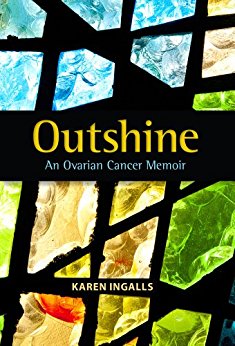
Today’s Featured Book:  OUTSHINE  by Karen Ingalls

Blurb:  When Karen Ingalls was diagnosed with Stage IIC ovarian cancer, she realized how little she knew about what is called “the silent killer.” As Ingalls began to educate herself, she felt overwhelmed by the prevalent negativity of cancer. Lost in the information about drugs, side effects, and statistics, she redirected her energy to focus on the equally overwhelming blessings of life, learning to rejoice in each day and find peace in spirituality. In this memoir, Karen is a calming presence and positive companion, offering a refreshing perspective of hope with the knowledge that “the beauty of the soul, the real me and the real you, outshines the effects of cancer, chemotherapy, and radiation. It is a story of survival and reminds readers that disease is not an absolute, but a challenge to recover.

Follow Karen on Twitter

[NOTE–Read my recent review of another one of Karen’s books here.]


This blog hop sponsored by:  4WillsPublishing