Unknown's avatar

About Marcha's Two-Cents Worth

I'm a science fiction author of the Star Trails Tetralogy, retired after two decades working at NASA, defected from my physics training to become a professional astrologer, and various other acts of rebellion. More recently, I've teamed with Pete Risingsun in writing "The Curse of Dead Horse Canyon: Cheyenne Spirits" which was released in July 2020 with more to come.

Earth passes between Jupiter and sun | EarthSky.org

This is extremely cool on both an astronomical and astrological level.  Jupiter is easy to see these days so be sure to go out there and take a look, weather permitting, of course!

This is Jupiter’s yearly opposition. In 2016, the giant planet is closer than it will be again until the year 2018. It’s brightest and best in the sky for this year!

Source: Earth passes between Jupiter and sun | EarthSky.org

Closest comet in 246 years approaches | EarthSky.org

A pair of comets showing very similar orbits are approaching Earth. While both will pass at a safe distance, one of them will have a record-breakingly close flyby.

Source: Closest comet in 246 years approaches | EarthSky.org

Lenticular clouds look like UFOs | EarthSky.org

These lens-shaped clouds are often mistaken for UFOs. Here’s how they form, plus gorgeous photos.

Source: Lenticular clouds look like UFOs | EarthSky.org

Review of Elle Klass’ “The Vampires Next Door”

VampiresNDCover

This fast-moving tale is populated with engaging characters whom you feel you know personally as this intriguing story unfolds. Freshly transplanted to St. Augustine, Florida, Alison is a shy teenager with the usual insecurities inherent to her age who lives with her recently divorced mother. The two of them reside in an apartment where Alison engages in some people-watching, particularly Rodham, whom she has the hots for, as well as a bunch of young women who occupy the apartment next door. These particular neighbors are given to loud, boisterous partying into the wee hours of the night while her mother, a shift nurse at a local hospital, is typically gone. Of course the title of this story serves as a spoiler as to who and what those nuisance neighbors actually are.

Much to Alison’s horrified delight, Rodham introduces himself and the pair begin a warm friendship moving toward a cozy romance as they investigate exactly what’s going on with these weird neighbors. A variety of surprises and plot twists quickly ensue, presented in Elle Klass’ outstanding, character-driven style with which she’s developed a unique vampire culture known as Bloodseekers with whom an eternal war wages with their mortal enemy, the Slayers. Skillfully woven into the history of the USA’s oldest European-established, continuously occupied settlement, you’ll find a liberal dose of paranormal phenomena intermingled with magic that will satisfy Harry Potter as well as other fantasy fans. You’ll have to read this exciting tale to find out where the young hero and heroine fit into this fascinating tale, but rest assured you won’t be disappointed.

Even better, since you’re bound to fall in love with Alison and Rodham, this is the first volume of a trilogy which promises further exciting adventures. While this story contains plenty of action and intrigue, it’s well within the PG range and thus suitable for adolescents and teenagers. It gets creepy and a little scary, but not terrifying, just exciting. The author’s former life as a junior high school teacher comes through beautifully in her understanding of teen motivation, behavior and emotions. Nonetheless, the book contains enough substance, character development and plot twists to satisfy readers of all ages. I’m not a big vampire fan myself, yet thoroughly enjoyed this suspense-laden tale by this up and coming multi-genre author.

You can pick up your copy on Amazon here.

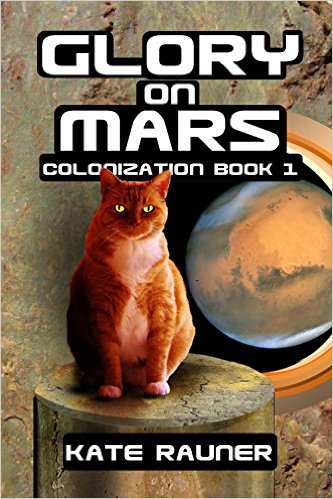
Review of Glory on Mars by Kate Rauner

gloryonmarscover

If you’re a fan of hard science fiction, and I mean really HARD, then you will love this book. In fact, I’m inclined to say that it’s only on the borderline of sci-fi, that it’s more what I would call science faction, i.e. so close to being reality that it’s not even that futuristic. Indeed, many people reading this book are likely to live to see a Mars colony in their lifetime. If you loved the movie “The Martian” then this story is a great follow-up to keep your imagination well-grounded on the Red Planet.

The Mars base the author designed is brilliant. She has thought of just about everything imaginable and described it at a technical level detailed enough to make you feel as if you’re there. She has hab modules, jumpships, walkabouts, surface suits and any number of other goodies. At the least, you know she’s not just making this up because her engineering background truly shows. Since I worked as a NASA contractor for over 20 years, I found many familiar things in this story, from the space technological presence in Noordwick, The Netherlands, since I’d been there more than once, and other terminology such as “frangible nuts” used with explosives to release their hold in various spacecraft applications.

By the time you finish this story, you feel as if you’ve completed a tour of duty on Mars. Anyone who may aspire to go there someday can get a very sound idea of what it would be like, from eating worms to the various hazards that abound on a planet that is not fit for human habitation without serious, high-tech intervention. There are radiation issues, maintaining an appropriate pressurized volume with the correct oxygen mixture, psychological challenges, vehicles for getting around on the surface, sometimes at a great distance, and so forth. In this respect it is exceptionally well-done. The author’s knowledge and undoubtedly a whole lot of research is evident and available for readers to enjoy. The side stories were excellent as well, adding additional detail and background which I highly recommend readers take the time to enjoy. They’re not required, but add to its richness. Thus, as an outstanding science fiction novel, I give this book a strong five stars.

However, if you want a bit more than engineering and science in a story, there are a few things I would have recommended be included, had I been a beta reader for this book. I realize that all reviews have a high degree of subjectivity, and the comments that follow are strictly my opinion and may not be shared in the slightest by other readers, especially if all you want is hard sci-fi. Nonetheless, that’s part of the point of a review, to share one’s opinion, and why over all I give this story four stars, so here we go.

While the numerous characters clearly had different personalities, to me they were faceless. Their physical descriptions were lean at best and missing at worst. She did a great job giving them very diverse and memorable names, many of which implied the individuals’ international heritage, but I never was able to “see” them in my mind, other than perhaps Yin and Yang, which were handled in a very clever manner that worked. I like to be able to picture the characters in a story and didn’t feel I had enough description of the others to do so.

The point of view (POV) was limited to one member in particular named Emma, with whom I connected somewhat. One thing to be said about the single POV is that it does lend the feeling that you were Emma and experiencing what she did. Nonetheless, with so many characters, it would have been interesting to get into their heads and viewpoint as well. The first half of the book contained a lot of description about the base and getting things set up along with the challenges involved, which could have been handled through other crew member’s POV so the reader got to know them as well. This would have rounded out the other characters a bit more and provided an opportunity to describe their appearance.

A little more conflict among the crew members would have added a bit more realism as well. This was touched on a little, but it’s highly likely that roughly a dozen people confined as they were under stressful and sometimes life-threatening conditions would have had a few clashes along the way. There was some tension, but people simply aren’t that mature and logical all the time, even if they’re engineers. This I know, given I’ve managed them in my previous life.

Another thing that bothered me was the cat. As a cat owner and lover, I expected the cat to have a more significant role, perhaps along the lines of Pete in Heinlein’s “The Door Into Summer.” I couldn’t believe it that when this kitten was taken onboard as they began their journey that he was not immediately given a name! Maybe I’m just a crazy animal lover, but I can’t imagine that someone in that group wouldn’t have done so. At the least, when they arrived on Mars, someone already there would have done the honors, since it was that group who’d requested the cat in the first place.

The cat could have been worked into the plot more as well. The base’s AI even recognized the cat as a team member! Cats are curious, (Curiosity would have been a great name, in honor of a previous Mars mission) they get bored just like people, and he would have undoubtedly had some interesting experiences in the zero-gravity environment during the journey as well as once they arrived on the base. Mine get into trouble all the time in a regular earthbound house. Owning a pet isn’t simple and it certainly wouldn’t be on Mars. He could have caused any number of problems and conversely, even provided ways to solve others.

Why did the previous crew request a cat in the first place? Pets add warmth, affection, and a new dimension of “home” to say nothing of comic relief. He could have contributed an additional touch of reality to an unreal situation. I probably wouldn’t harp on the cat issue so much other than the fact the cat is so prominently displayed on the cover. I found this very misleading, since the cat played essentially no role in the story, whatsoever, other than a few cameo appearances, where he could have easily become an endearing and potentially major character.

That precious piece of visual real estate known as a book cover would have been much better used to fill other gaps in the story. It would have been very helpful to have a drawing of the base, for example, with all its modules and such, which was well-described in the text, but not always easy to picture. Any artist would have had a blast with that. It also would have benefited by some people as well, which could have compensated for the lack of description in the text. A newly designed book cover would be a great investment for this story and thus represent its content more accurately. Potential readers for this book include hard sci-fi fans, preppers into self-sufficiency, and cat lovers, based on the cover. The cat on the cover could actually turn off some readers who would enjoy it the most.

Speaking of preppers, a bit more of the self-sufficiency side of growing food, raising fish and so forth would have been great as well. The use of heritage seeds, saving some of the potato harvest to plant for the next generation, or even the use of aquaponics could have further enhanced the story and also fit nicely with switching viewpoints.

In spite of all my grumbling above, I truly did enjoy and appreciate this book and what it took to write it. As a physicist and former “rocket scientist” myself, I found very few things I wondered about on the technical side. There were a few places where I thought about making a few calculations, then reminded myself it was only a novel and to lighten up! It provides a realistic view and excellent vicarious experience of what it would be like to be a space pioneer. For that, I highly recommend it. Just don’t expect much from the cat.

You can pickup your copy on Amazon here.

Why do we need leap years? | EarthSky.org

It’s actually kind of pathetic that the Mayans had a better calendar that we do.  The ego of various Roman emperors certainly didn’t help.

We need leap years to help synchronize our calendar with Earth’s orbit around the sun and the actual passing of the seasons.

Source: Why do we need leap years? | EarthSky.org

Zodiacal light glowing pyramid after dark | EarthSky.org

The Austin Astronomical Society held a star party last night, not far from my home, and this zodiacal light was very visible.  It was a great night for stargazing, but the zodiacal light washed out any stars in that region.

Moonless February and March evenings are the best time to see zodiacal light, that glowing pyramid of light in the west after dusk.

Source: Zodiacal light glowing pyramid after dark | EarthSky.org

Moons might hold key to finding E.T. life | EarthSky.org

Moons aren’t always just a chunk of rock!

As the list of known planets beyond our solar system grows, the search for their moons is intensifying. Why exomoons might be key to E.T. life.

Source: Moons might hold key to finding E.T. life | EarthSky.org

Full moon plus Jupiter on February 22 | EarthSky.org

The skies have been beautiful lately here in Central Texas.  If they’re clear where you live be sure to check out this amazing lunation with Jupiter as an escort!

The full moon and the dazzling planet Jupiter – now nearly at its best for this year – will be together all night. Think photo opportunity!

Source: Full moon plus Jupiter on February 22 | EarthSky.org

Teleportation: Science fiction or science fact?

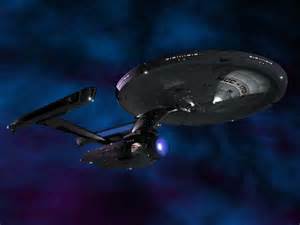
startrekenterprise2

The first time I read Lawrence M. Krauss’ masterpiece, “The Physics of Star Trek”, was in January 1996, which is hard to believe. Time, among other things, definitely does fly, but doesn’t diminish my memory of how much I enjoyed that book. Being a physicist and a life-long science fiction fan, I absolutely devoured it, even though some of his conclusions were disappointing. For example, he virtually discounted the possibility of teleportation. He recounted the basic steps as defined in the Star Trek Next Generation Technical Manual as follows:startrekbeam1
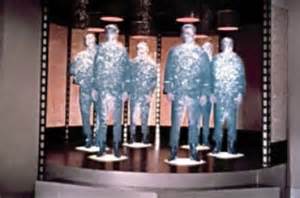
  1. Transporter locks on the target.
  2. Scans the image to be transported.
  3. Dematerializes the item (or person).
  4. Retains the information in a “pattern buffer”
  5. Transmits the “matter stream” in an “annular confinement beam”.
  6. Reassembles it based on data retained in the “pattern buffer.”

Krauss then proceeded to explain in meticulous, often amusing detail, what the requirements would be to create both a matter stream of the atoms comprising the teleportee’s body coupled with an information stream of how to put it back together.
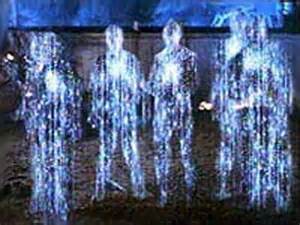
startrekbeam2To wit, considering that a person consists of approximately 10^28 atoms (ten followed by 28 zeros, for those of you who don’t recognize that notation), turning a 50 kilogram person into pure energy according to Einstein’s E=mc^2 would release more energy than that of a thousand 1-megaton hydrogen bombs. To do so would require heating him/her to a temperature a million times the temperature at the center of the Sun. Accelerating the resulting plasma soup to near the speed of light is another feat, to say nothing of also transferring around 10^28 kilobytes of data to the “pattern buffer” to reassemble it. On top of that, there’s Heisenberg’s Uncertainty Principle and various other quantum mechanical difficulties.
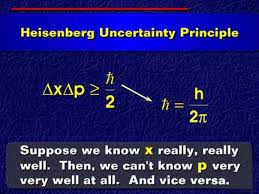
heisenbergprincRemember, however, that this was written back in the 90s and science has made vast advances since then as has our computational capacity. Personally, I would bet it could be done using the principles of quantum entanglement, but Krauss’ points are nonetheless well-taken. After all, he’s a professor of physics in his own right, at Case Western University when he wrote that particular book.

However, in Stephen Hawking’s foreword to said book, this phenomenally brilliant physicist stated, “Today’s science fiction is often tomorrow’s science fact. The physics that underlies Star Trek is surely worth investigating. To confine our attention to terrestrial matters would be to limit the human spirit.”

And apparently someone has done exactly that. At government expense. And much to my delight, quantum entanglement was indeed mentioned.  See?  I’m not as dumb as I look.

I never know what I’ll turn up when I go on a cleaning frenzy, more often than not, a desperate search for something in that proverbial “safe place” which I suspect lies in some other dimension. This last quest didn’t produce what I was hoping for, but instead I stumbled upon something even better, a paper from the Air Force Research Laboratory, Document AFRL-PR-ED-TR-2003-0034 entitled “Teleportation Physics Study.” This report is 88 pages long and is in front of me as I write.
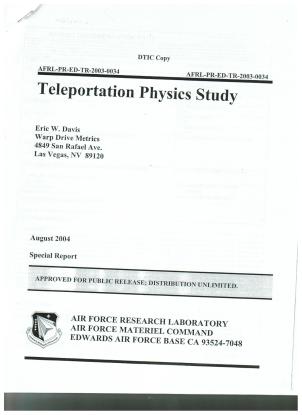
USAFTeleportSeriously. I swear I’m not making this up.

When I worked at NASA, I came across all sorts of similar goodies and usually kept a copy, either electronic or hardcopy, provided it wasn’t classified, of course. In truth, I never saw anything of that nature, but plenty of stuff that was borderline and certainly not publicized.

This study was conducted by an organization known as Warp Drive Metrics located in Las Vegas for the Air Force Research Laboratory at Edwards Air Force Base. I don’t know about you, but I can’t help but notice that they’re both conveniently located not far from the infamous Area 51.

In the Introduction to this study the author states: “Beginning in the 1980s developments in quantum theory and general relativity physics have succeeded in pushing the envelope in exploring the reality of teleportation. . . . It has been recognized that extending the present research in quantum teleportation and developing alternative forms of teleportation physics would have a high payoff impact on communications and transportation technologies in the civilian and military sectors.”

He names five types of teleportation of which the science fiction version is one, but discounted as not included in the study, or so he says. Sad but true, you never know what jewel one of us sci-fi authors might come up with via our respective muses.

Of the five mentioned, my personal favorite is, as you would expect, the method using quantum entanglement, dubbed q-Teleportation, which he defines as the “disembodied transport of the quantum state of a system and its correlations across space to another system.”

I was particularly amused by Section 3.0, which addresses this particular category. The steps he summarized were as follows:

  1. Object placed inside the teleporter and scanned by a computer-generated and controlled beam.
  2. Scan beam encodes entire quantum information contained within the object into organized bits of information, forming a digital pattern of the object.
  3. The information is stored in a pattern buffer.
  4. The scan beam dematerializes the object into a matter stream.
  5. Teleporter transmits matter/energy stream and quantum information signal in the form of an annular confinement beam to its destination.
  6. The receiving teleporter reconstitutes the matter based on quantum information stored in the pattern buffer.

Hmmmmm. Am I the only one who thinks that sounds an awful lot like what Krauss described from the Star Trek Next Generation Technical Manual?

Section 3.0 goes on to describe many of the same calculations Krauss did.

Bah! Sci-fi discounted, indeed!

In Section 3.2.3 entitled “Recent Developments in Entanglement and q-Teleportation Physics”, he states, “Technical applications of entanglement and q-Teleportation are just becoming conceptualized for the first time, while a small number of basic physics breakthroughs and their related applications are in experimental progress at present.” (Emphasis added.)

You can’t make this stuff up.

Note that this study was conducted between January 2001 and July 2003. No telling what advancements have been made in the past 15 years.

My second favorite, p-Teleportation, is the “conveyance of persons or inanimate objects by psychic means” which he describes in Section 5.0. He goes on to mention psychics Uri Geller and Ray Stanford, who “claimed to have been teleported on several occasions. Most (emphasis added) claimed instances of human teleportation of the body from one place to another have been unwitnessed.”

Really? Ya think?
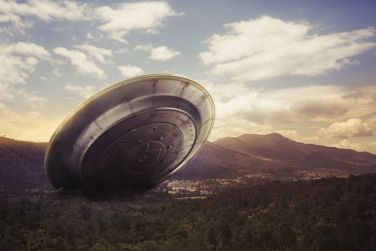
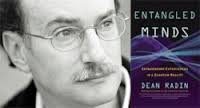
15385125_mlHe goes on to say, “There are also a small number of credible reports of individuals who reported being teleported to/from UFOs during a UFO close encounter, which were scientifically investigated….”   Plus: “There is a wealth of factual scientific research data from around the world attesting to the physical reality of p-Teleportation and related anomalous psi phenomena. The skeptical reader should not be so quick to dismiss the subject matter in this chapter, because one must remain open-minded about this subject and consider p-Teleportation as worthy of further scientific exploration.” He even mentions my favorite psi researcher, Dean Radin, PhD, of whom I’m a tremendous fan.
deanw-book

Dean Radin PhD has done highly respected research on psi phenomena such as telepathy.

e-Teleportation, defined as “exotic”, comprises “the conveyance of persons or inanimate objects by transport through extra space dimensions or parallel universes”. This involves superstring theories, electromagnetic – gravity unification theories, and brane theory.  Don’t mind me, but just because they can do the math doesn’t mean it’s possible, if you know what I mean.

Last but not least, vm-Teleportation involves wormholes and “engineering the spacetime metric” which was supported by numerous pages of mind-bending math including linear algebra, trigonometry and multi-variable calculus equations loaded with enough Greek letters to be its own fraternity.

I don’t know how much money the author received for this study, which took two and a half years, but it could probably be found in the public record using the contract number. I must say that it would be just about any physicist’s dream job. In no way do I mean to dismiss the knowledge and expertise required to put this together. This is a comprehensive, thoroughly investigated study which includes 253 references, most of which were to prestigious journals such as Physics Review Letters, Physics Today, Military Intelligence, Nature, Science, numerous books published by Cambridge and Oxford University presses and various others by esteemed physicist authors. The original document’s distribution list included 54 individuals, 36 of whom were PhDs.

Personally, I don’t have a problem with my tax dollars going for such research, even though it’s undoubtedly hidden in all those “black projects” such as those conducted at Area 51, Dulce Base, Wright-Patterson AFB and probably Dugway Proving Grounds. Better spent there than numerous others I can think of but won’t name so as to remain politically correct in today’s volatile environment.

Nonetheless, the truth is out there.  Possibly more than we could begin to imagine.  Including me, as a science fiction writer.

You can pick up a copy of Krauss’ book on Amazon here. For a copy of the “Teleportation Physics Study” contact the Air Force Research Laboratory, Air Force Materiel Command, Edwards Air Force Base, CA 93524-7048 and ask for Report AFRL-PR-ED-TR-2003-0034. By now it might even be available online since it was released for “unlimited distribution.”