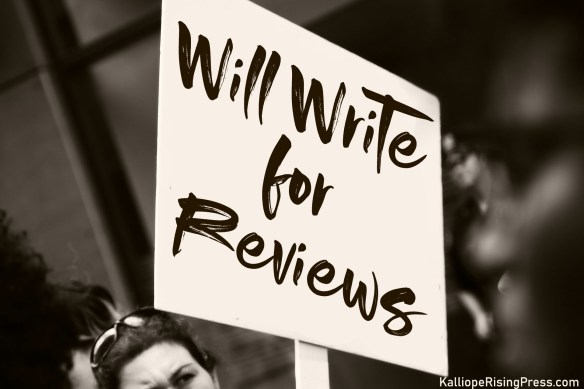
No doubt you’ve seen those unfortunate individuals on the side of the road with a sign that says “Will Work for Food.” Somehow I can relate, though I admit I’m not quite as destitute as those poor souls. Nonetheless, if you’re an author, unless you have a patient spouse who pays the bills or an alternate source of income such as a day job, retirement, or you have the good fortune to be a trust fund baby, chances are your income could be in a similar range, or possibly even less. Way less, like in negative numbers.
It seems no one these days wants to pay for anything, especially if it’s creative. The starving artist has been a familiar entity for eons. People want their music for free, their reading material for free, their games for free, and their artwork for free. This is what the electronic age has brought us. Now that books, music, pictures, and even movies are no longer on tangible media, they’re expected to be free. And of course, now that they’re teaching AI to create, in no time artists of all varieties could be out of business entirely. Muses today get no respect.
So tell me–who out there in any other profession, whether it’s accounting, engineering, administrating, or heaven forbid, even politics, is willing to work for free? To coin an apropos phrase from “Ferris Buehler’s Day Off,” Anyone? Anyone? When’s the last time you went into the grocery store and got your food for free?
Now that I’m retired, I can indulge in pursuing my work as an author. Unfortunately, lately that’s been directed more at marketing and promoting than creating. And the frustration some days is downright scream-inducing. The cash going out for services far outweighs what little comes in. If I were a logical person, I’d quit. If it were only about money, I’d quit. But do I? No. Because writing is in my blood (at least my astrological imprint, which features Kalliope, the muse of epic poetry on my ascendant). While I can make ends meet (barely) through other means, I’d love nothing more than to make a generous (or even adequate…okay, even meager) income from my writing. Tax write-offs are nice, but after a while it gets old. Just once I’d like to finish in the black.
The one thing authors appreciate (most the time, anyway) is a review, especially when we give away our books. And trust me, selling it for 99c is virtually the same as giving it away. Thinking about how long it took to write, edit, and publish it is verboten, because that’s downright depressing. I couldn’t even begin to calculate what I make per hour when selling a book for 99c, most likely less than a Mexican peso per hour, maybe even per day, if that. Yet people who are qualified to do no more than repeat the mantra, “Do you want fries with that?” want $15/hour. Right. And people in hell want ice water.
Reviews are important. Once you get a certain amount, vendors such as Amazon give your book a little more attention and help. If you want to look for an agent, be accepted by certain promoters (for a generous fee, mind you), or even expand into the audio book world, reviews are one measure of your popularity.
Thus, to me, it’s no more than common courtesy to leave a review, especially when you get a few hours entertainment and enjoyment out of a book that took someone a considerable amount of time and effort to produce. If you don’t like it or don’t finish it, fine. No review is better in most cases than a really bad one. Yet, some don’t take your book seriously until you have a few bad ones to show it wasn’t just your family and friends posting them (which isn’t as easy to achieve as you may think, unless you have some serious blackmail material). Granted, reviews are subjective and one man’s trash is another man’s treasure. I get that.
More than likely, unless you’re a fellow author you haven’t even made it this far in my rant du jour. But even fellow authors aren’t always diligent in leaving a review. It doesn’t have to be an essay worthy of a Pulitzer Prize; a few sentences will do.
We authors ask so little. Is it really that difficult to log into Amazon? You know it’s not. If you bought it there, they’ll even remind you and send a link. And the next time you get a book for free or less than you pay for a good cup of coffee, feel it’s your obligation.
I, for one, would rather work for royalties, but reviews, especially a good one, can make it seem at least marginally worthwhile.
So get off your lazy ass and leave one today for a starving author who, in return, will not only love you forever, but might even keep writing. Capisce?


 Marcha's Two-Cents Worth