Do You Want to Work for NASA?

EVA-SA

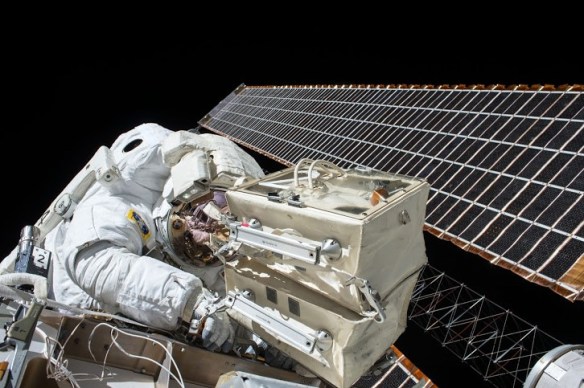
A while back National Geographic featured a blog declaring that NASA was recruiting astronaut candidates. The astronaut corps is obviously an exclusive bunch with strict requirements and grueling competition. Even if you want to join their ranks it’s not going to be easy. At the least, military experience and graduate degrees are usually minimum requirements.

But just because you can’t make muster for the astronaut corps doesn’t mean all is lost. There are literally thousands and thousands of people who work for or support NASA without such demanding qualifications. You can find a list of them here. Having worked at NASA’s Johnson Space Center for over twenty years I can tell you that there is every job imaginable represented in addition to the obvious ones in a technical field. Whether you’re an accountant or public affairs wizard NASA will need people with those skills somewhere in their organization.

If you’re really interested in a NASA career and haven’t checked out their website, then you need to do so. Yesterday. If you haven’t, here are a few highlights.

One thing you need to realize is that NASA is only located in some very specific locations. They have centers in California, Texas, Mississippi, Ohio, Florida and various other places including their headquarters in Washington, DC. Unless you live near one or are willing to relocate, it will be more difficult. There is one caveat I’ll get to later, but if you want to be an actual NASA employee, living in close proximity to one of their centers is required. You can see where these centers are by going here.

If you want to work more directly with the technical side, which comprises 60% of their employees, then you need to have at least a bachelor’s degree in one of the fields noted on their website. Obtaining a position as an intern as part of your education will give you a considerable advantage later for becoming a permanent employee. More information about the various programs available can be found here.

Okay, now I’m going to talk about some things you won’t find on their website.

Getting a job with NASA is not easy. First of all, there are only so many positions available for which there will probably be hundreds if not thousands of applicants. There are three factors that can help you have a slight advantage. One you either have or you don’t with nothing you can do to change it, another may be related to your birth but not necessarily, and the last one you may be able to achieve if you plan early enough as mentioned above.

The first way to get your foot in the door is to be a minority. As a government agency, NASA takes pride in maintaining a high percentage of those in the affirmative action category as an example to industry in general. This is not to say that these folks don’t need to meet the technical requirements of the job at hand. They still need to possess a technical degree and the better their grade point average and/or experience, the better, but these individuals will usually make it to the top of the heap more easily than others. Minority women with a technical degree have an even bigger advantage.

The next potential advantage is to be disabled. Again, this doesn’t mean you don’t need to have the needed qualifications. If you do and you get hired NASA will actually help accommodate your disability. For example, I knew a NASA engineer who was a quadriplegic due to an unfortunate accident when he was a youth. His mind was not affected and he obtained an engineering degree after which he was hired by NASA. He was confined to a wheelchair and clearly had major physical limitations. To compensate, NASA hired an assistant who helped him by entering what he told her on the computer, taking him to meetings, and so forth. In other words, Stephen Hawking could get a job based on his abilities, not refused for his disabilities.

If none of these fit your situation, then it’s going to be a lot more difficult to get onboard, but not impossible. At least not as far as working with NASA’s space program. There are literally thousands of jobs in the aerospace industry, some of which are directly associated with NASA and others that are not. These are mostly available through numerous companies, big and small, that are known as NASA Contractors. In fact, the 21 years I spent at Johnson Space Center were as a contractor employee. There are pros and cons to being a contractor I’ll get into another time, but if you really want to work for NASA it’s a step in the right direction.

After you decide which NASA center you want to work for your next step is to identify which contractors are in that area and start applying. If you don’t want to or can’t move near one, all is not lost. And here’s the caveat I alluded to earlier: There are other options. In order to get their budget passed by Congress each year, NASA requires support throughout the United States. What this boils down to is that there are NASA contractors in just about every state. That way, to protect job interests in their home state, Congressmen will be more inclined to vote favorably for NASA interests. It might be a challenge to find a NASA contractor in your area, but that’s what the Internet is for. If you’re hired by one, depending on the position you hold, you’ll probably get to travel to NASA centers from time to time. You’ll not only get to see some very cool stuff but feel as if you’re part of the program. Perhaps all without moving, at least out of your state.

Like NASA, contractors often have intern programs, especially during the summer. They aren’t always easy to get into, either, but it’s worth a shot. Again, you’ll be competing against a lot of other applicants. And there’s only one way to get around that.

You’ve probably heard the saying “It’s not what you know but who you know.” In other words, if you know someone “on the inside” who can vouch for you, it will give you a much better chance of being considered for a position. In fact, that is why those intern positions are often difficult to obtain, because they’re usually given to the kids whose parents work there first. That may seem unfair depending on your point of view, but it’s the way the world works.

But all is not yet lost.

The next best thing you can do is make personal contact with someone inside your organization of choice. Better yet, lots of them. Trade shows related to aerospace and job fairs at universities are one place you may be able to make such a contact. Always treat such encounters as the equivalent of an interview. It’s critical that the impression you make be favorable as well as memorable. And no, looking like a cast member of “The Big Bang Theory” is not what I mean. Maintain contact with the person afterwards as well, but not to the point of being annoying. Touching base with him or her every few months will be sufficient.

It’s not easy but it can be done. Working with NASA had been my dream since I first watched the Apollo 11 Moon Landing back in 1969, before most of you were born. I didn’t graduate from college until 1987, at the age of 39, yet through determination and the right connections I was able to land a job supporting NASA’s Johnson Space Center in Houston within a year of graduating. I worked my way up through the ranks, eventually managing a cadre of engineers, and finally retired with the satisfaction of knowing I’d gone after something, no matter how elusive, and attained it. There’s no reason you can’t, too.

[Originally published 11/7/2015 at https://medium.com/@marchafox/do-you-want-to-work-for-nasa-f1a64db05292%5D
 

See all five bright planets simultaneously! | EarthSky.org

Don’t miss this since it doesn’t happen very often. 

—-

All five bright planets will appear together in the morning sky from about January 20 to February 20, 2016. That hasn’t happened since 2005.

Source: See all five bright planets simultaneously! | EarthSky.org

Underwater Robots Help Scientists Understand Great White Sharks

Here’s one for you shark fans.  Pretty cool way to observe these less than friendly creatures.

The “REMUS SharkCam,” an autonomous underwater vehicle (AUV), navigated the waters off Mexico’s Guadalupe Island in November 2013. Outfitted with six high-definition video cameras, the AUV provided Woods Hole Oceanographic Institution engineers and scientists a panoramic view of the clear waters, which are a hotspot for great white shark activity.

Source: Underwater Robots Help Scientists Understand Great White Sharks

Four stunning close-ups of Ceres | EarthSky.org

Check out these cool pictures of Ceres.

—-

Dawn spacecraft now in its lowest planned orbit above dwarf planet Ceres. These late December images are from just 240 miles (385 km) above Ceres’ surface.

Source: Four stunning close-ups of Ceres | EarthSky.org

Achernar, at the end of the River | EarthSky.org

If you’re in a very southern latitude now’s your chance to see this interesting constellation!

—-

Many make a game of seeing this bright star from the extreme southern U.S. or similar latitudes. From the Southern Hemisphere, it sweeps high in the sky.

Source: Achernar, at the end of the River | EarthSky.org

Why stars seem brighter this time of year | EarthSky.org

Ever wonder why stars are brighter in the winter?

—–

No matter where you are on Earth on December, January and February evenings, you’re looking toward bright stars in our local spiral arm.

Source: Why stars seem brighter this time of year | EarthSky.org

Comet Catalina’s closest point to Earth | Human World | EarthSky

Here’s some information on Comet Catalina.

—-

It’ll sweep closest – but not too close – on January 17. Its trajectory suggests it’ll be ejected from our solar system, and we’ll never see this comet again.

Source: Comet Catalina’s closest point to Earth | Human World | EarthSky

It’s that Time Again: The Cosmic Season for Editing and Revising

strasclock

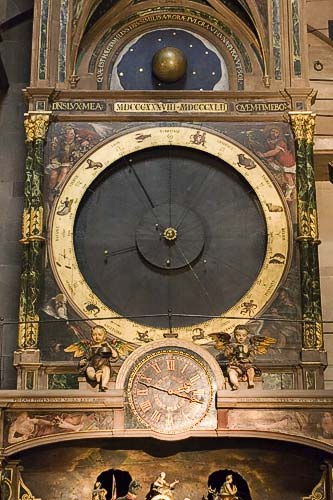
If you’re a writer it would be to your advantage to know a little astrology. Not only can it help you develop your characters as noted in a previous blog but there are actually three times a year when the cosmic climate is particularly conducive to editing and revising. If you don’t believe in astrology, that’s fine, I didn’t used to either. But you might want to give it a try because most writers, myself included, can use all the help we can get. So what exactly is this spell and why is it helpful? Stay tuned, I’m about to tell you.

It starts with the planet Mercury. In mythology Mercury a.k.a. Hermes was the messenger and the only one who could come and go to the Underworld. In astrology he rules communications or all varieties including your thoughts, ideas, writing and paperwork in general. In this day and age he also rules electronic communication devices such as cells phones, computers, television and the internet to name a few, plus anything mechanical, i.e. with moving parts, such as your lawnmower, small appliances, automobile and so forth.

If you’re already familiar with some astrology you’ve probably heard of Mercury Retrograde. While it’s intuitively obvious (or should be) that the planet Mercury does not reverse the direction of its orbit, as a rule three times a years he appears to move backwards in the sky compared to his usual direction. The reason for this is easily explained as similar to when you pass a car on the highway. You’re going faster so it appears the other is moving backwards, even though it’s not. Thus, when the Earth passes Mercury in its orbit you get the same effect.

So what? Hang on, I’m getting to that.

As I write, Mercury is currently in this state which started on 5 January 2016 and will last until 25 January. Astrologically when a planet is retrograde (yes, they all do the backstroke from time to time) it internalizes its energy. During this spell you may notice more computer problems than usual, things may break down more often, traffic is often worse and so forth. Anything ruled by Mercury bogs down during this time. If you buy something ruled by Mercury during a retrograde period it’s likely to be a lemon. Furthermore, anything initiated during Mercury retrograde seldom comes to pass. For example if you interview for a job you’re less likely to get it with one possible caveat, that being if it’s a second interview with the same person. It’s also not a favorable time to sign a contract or lease.

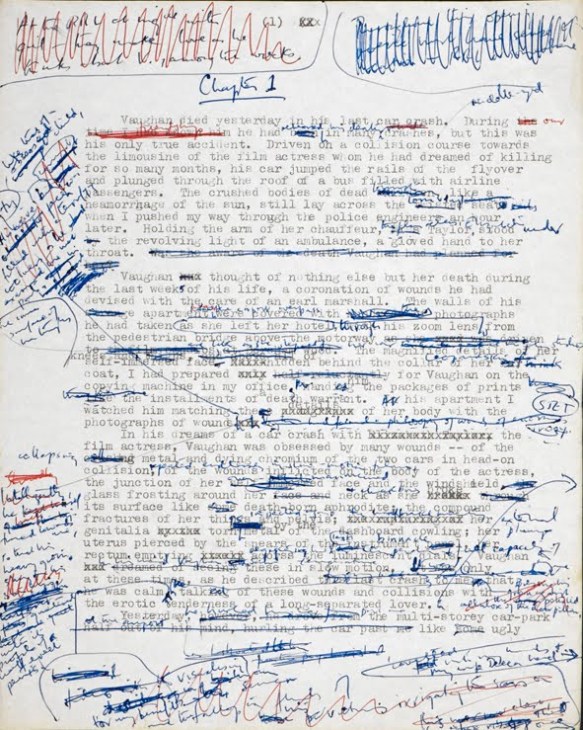
Why? Because during Mercury retrograde it’s a time to rethink, redo, reconsider, revise, refine, repair and so forth. This is a time to slow down, stop, and look over past work, thoughts and decisions. For a writer this is an awesome time for editing and revising. This is when you go back and see your work through different eyes, giving you the ability to make positive changes. It’s not uncommon for writers to dislike this phase because you may feel stuck, your brain may not work as efficiently and your computer may be on strike. Any new endeavors started at this time are likely to bomb out and relate to yet another “re” word, i.e. regret. This is because you’re resisting the cosmic flow. Reviewing, revising and editing your work from time to time is essential if you want to produce professional quality work.

redlines

If you’re suffering from writer’s block, this is the ideal time to look over what you have and see if it’s on the right track. You’ll be surprised at how much you’ll be able to improve it, perhaps even make some critical changes you didn’t think of before. Don’t expect to make much progress with new endeavors which are likely to be an exercise in futility. Submitting work at this time is not likely to bring results or, if it does, they’ll be delayed. Rather, use this time to rework and refine.

Will you be out of the woods for new projects come 25 January? Possibly not. Until Mercury gets back to the zodiacal position where he stationed retrograde he’s in his “shadow period” when things are still stalled. This lasts until February 15, at which time once again it will be “all systems go.”

Even if you think that astrology is a bunch of myth and superstition, give this some thought. Observing the world around you and how people behave is part of your job as a writer. See how many events and situations you can find which reflect this internalized energy, the cosmic climate designed to rethink, reconsider and revise. Few of us get it exactly right the first time and the Universe is well aware of our human frailties. Use these spells as they’re intended by the Universe and you’ll find they can become some of your favorite times when you can polish your work to perfection. Use this one to your advantage.

As previously noted, Mercury does this approximately three times each year. Here are the other times he’ll be doing the backstroke. Mark your calendar now!

28 April – 22 May 2016 (Shadow until 8 June 2016)

30 August – 22 September 2016 (Shadow until 8 October 2016)

19 December 2016 – 8 January 2017 (Shadow until 28 January 2017)

If you’d like to learn more about such things you’d probably enjoy my astrology website www.valkyrieastrology.com.  Which reminds me I have some updating to do on the retrograde planets page, perfect for Mercury RX.  Timing is everything.

Orion the Hunter easy to spot in January | Tonight | EarthSky

Sky watching in cold weather tends to make for better “seeing” but somewhat less comfortable for observers!  Nonetheless, it’s worth it.  Today is a New Moon which makes for great dark skies.

—-

It’s identifiable by Orion’s Belt, three medium-bright stars in a short, straight row at the mid-section of the Hunter.

Source: Orion the Hunter easy to spot in January | Tonight | EarthSky

Comma, give me a break!

booksinbox

I think we all realize that whether or not a person likes a book is highly subjective. I’ve read (or tried to read) books with numerous five-star reviews that I didn’t like and couldn’t get through. Some were well-written, just boring or populated with unappealing characters, while others were poorly written and/or edited. I’m a bit of a grammar/typo Nazi myself so I hide my head in shame that someone put one of my books in that category.

I’ve heard that no literary agent or publisher takes an indie book seriously until it has a few three-star reviews. Thus, when I got my first one as an untimely present for my Christmas birthday, I had mixed feelings. I now had the obligatory mediocre review and, to be perfectly honest, the reason had been noted by a previous reviewer, i.e. the lack of commas. I acknowledge this as a valid complaint and have it on my to-do list to rectify. Sadly, at one point I’d actually taken several of them out because they seemed to slow the story down! How ironic is that?

Okay, you may have already guessed that I have a couple confessions to make. First of all, I edited my own books, which I realize is a major no-no, but let me explain. First of all, there were various times when this particular book, which was admittedly my first novel, was set aside for years. When I would get back to it, I could read it like it wasn’t my own and, for the most part, edit effectively. Like I said, I’ve been accused of being a grammar Nazi with other people’s work, and I definitely fixed a lot over time.

Another factor was finding an editor I could trust to do the job. I mean, really do the job. I’ve seen too many acknowledgements in various novels where authors extol and thank their editor while I, nonetheless, find a plethora of things they missed when I read the work in question. Call it pride, if you must, but it was hard not to feel I could do as good or better of a job than some of the supposed pros out there.

And the coup de grace was that I was on a budget. While I don’t mind paying for services that are done correctly, cost combined with not being sure I could find a competent editor resulted in doing it myself. Oh, well, my bad.

The second one is that, even though I have a minor in English, I am not that well-versed in grammar. Seriously. Most of what I know has been learned through my mother correcting me as a child, reading, and, heaven forbid, intuition. I’ve been an avid reader all my life and been writing since I could hold a pencil, yet never liked English classes or understood some of the rules. Diagramming sentences to me was worse than algebra, which made more sense. I really don’t like to point fingers, but in this case I’m going to point one at a prof I had in college who taught the obligatory grammar class for those majoring or minoring in English. That class was, like we say here in Texas, as useless as teats on a boar hog.

The prof, who is probably now dead and gone, couldn’t find a textbook that he liked so we had none. He would lecture, but with no logical order or continuity that I could recognize. All we did the entire term was–you guessed it–diagram sentences. Punctuation was rarely mentioned. One thing I remember him (or perhaps someone else) saying was that English, unlike Latin, was a living language that evolved, that such things as punctuation styles changed over time, and things like comma usage was becoming somewhat optional. You can bet I jumped on that like a duck on a June bug!

judgeongrammar

But for purists who were more astute at learning the rules than I was, it was a major faux pas. And apparently the person who left this three-star lambasting was one of them.  I must say that the reviewer was generous in giving it three-stars since s/he didn’t even finish reading it.

Back to the subjectivity of what we like, science fiction is certainly one of those genres that everyone doesn’t care for. (Oops, ended that sentence with a preposition! OMG! Let’s correct that to “one of those genres for which everyone does not care.” Right? Right.) Even with proper punctuation it’s likely s/he wouldn’t have liked it. That I understand. And I do admit s/he has a point and I will fix the problem because, believe it or not, I really am a bit of a perfectionist, but that doesn’t mean that I know everything by a long shot. I’m teachable but, as noted earlier, I never had a decent English teacher or at least one I could follow. Math is much simpler to me with its concrete, easy to follow rules and black and white answers. Equations make a lot more sense.

pageheart

So what have I learned that I can pass on to other writers? If I had this to do over, it would be to do a beta reader exchange with someone who has equal editing skills to my own. Fortunately, for subsequent books I was able to find such individuals. And that is what saddens me the most, the other books in the series are in much better shape. I’ve actually received compliments on the editing of at least one of the others. This was my first book and I’ve heard it said that everyone’s first novel should go in the trash bin labeled “tuition.” My problem was that it was the start of a series with so much more to tell! The characters evolved and so did the plot to the point that it took four full-length novels to complete the story. I’m a much better writer now, as all of us become, the more we write.

So, bottom line, I’ll go back eventually and correct the comma situation. I don’t know all the rules, but at this point I’m reasonably confident that I’ll be able to do so in a competent manner. The worst part, as most indie authors know, is that there are so many different formats to deal with, i.e., both print and electronic versions, which complicates the process considerably. Nonetheless, I’ll have the satisfaction of debunking that uncomplimentary review when it’s corrected, unless, of course, those who would appreciate a properly copy edited work are turned off by that seething diatribe, which is actually so excessive that it’s downright amusing. Fortunately, most geeks and nerds, who are my primary audience, anyway, aren’t quite so concerned, though there are exceptions, of course, many of whom I met at NASA.

<Sigh.>

Rant over.

Thanks for listening.

P.S. If you’d like an ecopy of the book in question, “Beyond the Hidden Sky,” for free, join my mailing list, which qualifies you for a free download. You can do so here.